
Timeline of Pakistan: from Mehrgarh to today
Filter by era or theme, search for a person or place, and open any moment to read the full story and its sources.
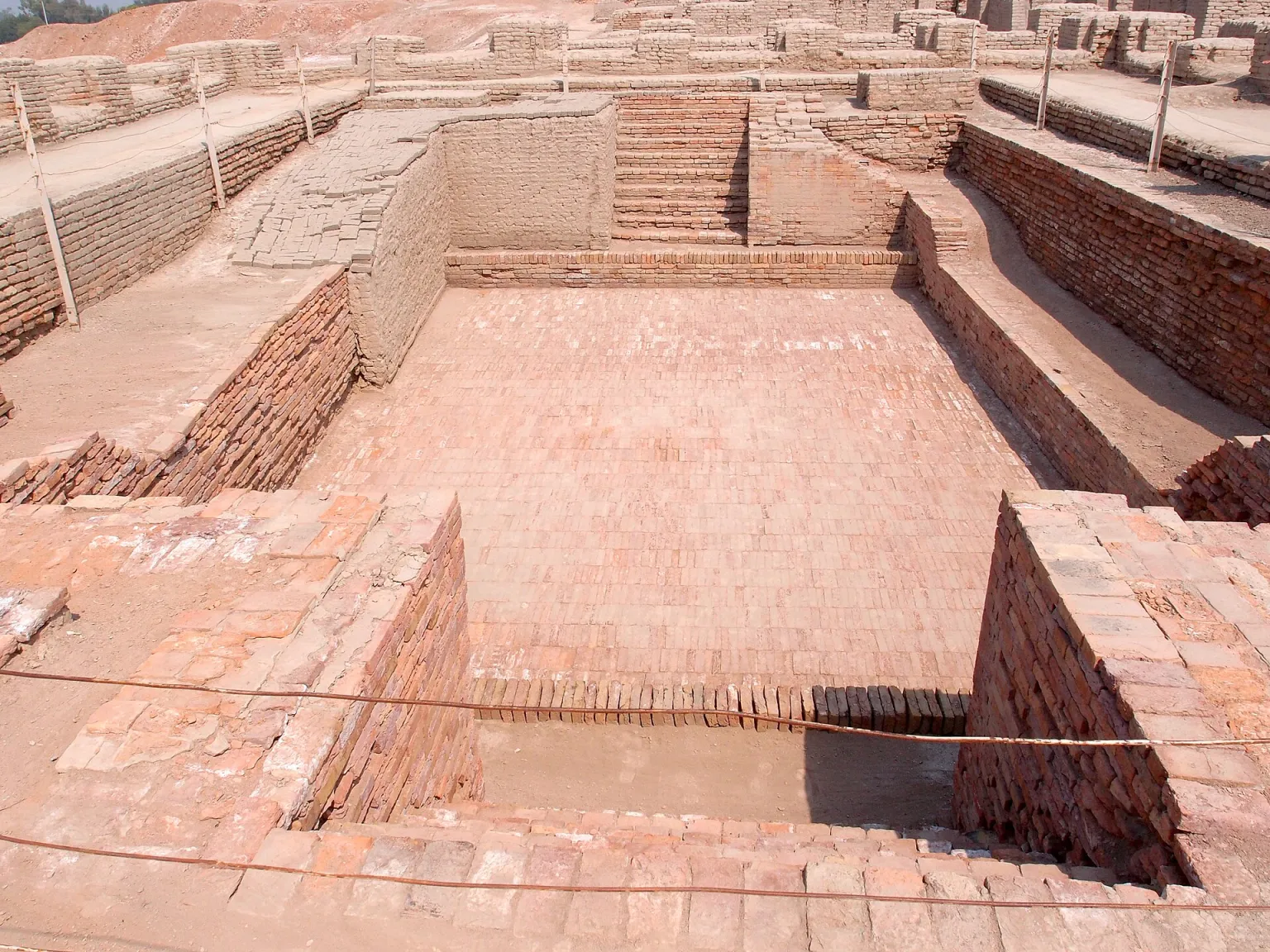
Mohenjo-daro, Sindh
This timeline gathers every dated moment recorded across DailyLife.pk, the Indus cities, Gandhara, the sultanates, the Mughals, British rule, the Pakistan Movement and the country since 1947. Pick an era, filter by theme or search for a name. Each entry links back to the page it comes from, where you can read the full account and check its sources.
1009 moments
Early settlements
Before c. 3300 BCE · 6 moments
- c. 500,000 years ago
First toolmakers
Early humans leave Acheulean-type hand-axes in the Soan valley near present-day Rawalpindi.
- c. 7000–5500 BCE
Farming begins at Mehrgarh
Aceramic Neolithic villages on the Kachhi plain show the domestication of barley and cattle and mudbrick houses with storage units.
- 7th millennium BCE
Farming begins at Mehrgarh
On the Kachhi plain near the Bolan Pass in Balochistan, mudbrick villages grow barley and keep cattle, among the earliest farming settlements in South Asia.
- 7th millennium BCE
Mehrgarh
At the foot of the Bolan Pass in Balochistan, villagers domesticate barley and cattle, among the earliest farming communities in South Asia.
- c. 5000–2600 BCE
Early Indus cultures
Farming communities spread across the Indus plains and the Balochistan uplands; towns, crafts and trade networks grow.
- c. 5000–2600 BCE
Early Harappan (Early Indus) period
Regional farming cultures spread across the Indus plains and Balochistan; towns grow, crafts specialise and trade networks widen.
Indus Civilization
c. 3300–1300 BCE · 9 moments
- c. 2600–1900 BCE
The Indus cities
Mohenjo-daro in Sindh and Harappa in Punjab flourish as planned cities with drains, standard bricks and weights, and a still-undeciphered script.
- c. 2600–1900 BCE
Indus cities
Mohenjo-daro and Harappa reach their peak: grid-like streets, brick houses, covered drains and the Great Bath.
- c. 2600 BCE
Rise of the cities
A complex urban civilization centred on Mohenjo-daro and Harappa emerges, with planned streets, drains, standard bricks and weights.
- c. 2500 BCE
City founded
A planned city of baked brick rises beside the Indus; it is one of the great centres of the Indus Civilization.
- 3rd millennium BCE
Indus Valley Civilization
Planned cities such as Mohenjo-daro and Harappa flourished along the Indus; Mohenjo-daro became a UNESCO World Heritage Site in 1980.
- c. 2350–1794 BCE
Meluhha in Mesopotamian texts
Akkadian and later Mesopotamian records mention trade with ‘Meluhha’, widely identified with the Indus region.
- c. 2000–1750 BCE
Urban decline
The great cities shrink and are gradually abandoned; writing, seals and standard weights fall out of use.
- c. 1900 BCE onwards
Decline of the cities
The great cities shrink and are abandoned; writing and standard weights fall out of use, while village life continues.
- c. 1700 BCE
Abandonment
Mohenjo-daro, like other large Indus cities, is gradually abandoned. Archaeologists still debate the causes, including river shifts and floods.
Ancient kingdoms & Gandhara
c. 1300 BCE–700 CE · 30 moments
- 6th century BCE
Persian province
Gandhara is incorporated into the Achaemenid Persian empire as a satrapy. The Bhir Mound city at Taxila is probably founded around this time.
- 1st millennium BCE – 1st millennium CE
Gandhara
Taxila and the Peshawar valley became centres of Buddhist learning and Gandharan art, now recognised by UNESCO at Taxila and Takht-i-Bahi.
- 6th–5th century BCE
Achaemenid Persia
Gandhara and the Indus lands become part of the Achaemenid Persian empire.
- 4th century BCE
Alexander the Great
Alexander crosses Gandhara and is received at Taxila (c. 327–326 BCE) before pushing east towards the Beas River, where his army turns back.
- c. 6th–4th century BCE
Persians, Alexander and the Mauryas
Gandhara becomes an Achaemenid province; Alexander the Great arrives in 327–326 BCE; the Mauryan empire follows, and Buddhism spreads under Ashoka.
- 327 BCE
West of the Indus
After campaigns in Central Asia, Alexander campaigns in the hills west of the Indus; ancient sources describe the siege of Aornos.
- 327–326 BCE
Alexander the Great
Alexander enters Gandhara and is received at Taxila before pushing east towards the Beas River.
- 326–325 BCE (Battle of the Hydaspes, May 326 BCE)
Alexander in the Punjab
In 326 BCE Alexander of Macedon crossed the Indus, was welcomed at Taxila and defeated King Porus at the Hydaspes (Jhelum) River. His army refused to go beyond the Beas, and he returned down the rivers of Punjab and Sindh to the sea.
- 326 BCE
Welcome at Taxila
The army crosses the Indus; the ruler of Taxila becomes Alexander's ally and supplies troops and provisions.
- Summer 326 BCE
Mutiny at the Hyphasis
After crossing the Chenab and Ravi, the army reaches the Beas and refuses to march further east.
- Winter 326–325 BCE
Wounded among the Malli
Storming a town of the Malli, Alexander is struck in the chest by an arrow and nearly dies.
- May 326 BCE
Battle of the Hydaspes
Alexander crosses the Jhelum by night in a storm and defeats Porus; Porus is reinstated as a vassal king.
- November 326 BCE
Down the rivers
A fleet built on the Jhelum carries part of the army south while columns march along the banks.
- February 325 BCE
Reaching the Indus
The flotilla reaches the meeting of the Punjab rivers with the Indus and continues into Sindh.
- July 325 BCE
Patala and the sea
Alexander reaches Patala at the head of the Indus delta, then sets off west through Gedrosia (Makran) while his admiral Nearchus sails along the coast.
- June 323 BCE
Death in Babylon
Alexander dies in Babylon; within a few years his eastern conquests fall away.
- c. 322 BCE onwards
The Mauryans and Ashoka
The region is ruled by India's Mauryan dynasty; under Ashoka Buddhism spreads through Gandhara.
- c. 322 BCE onwards
Mauryan rule and Ashoka
Chandragupta Maurya takes the Punjab; under Ashoka in the 3rd century BCE Buddhism becomes dominant and missionaries spread it northwards.
- 2nd century BCE–1st century CE
Indo-Greeks, Shakas and Parthians
Greek kings from Bactria build Sirkap at Taxila on a grid plan, followed by Scythian and Parthian rulers.
- 2nd–1st century BCE
Indo-Greeks, Shakas and Parthians
Greek rulers from Bactria found Sirkap at Taxila on a Hellenistic grid plan; Scythian (Shaka) and Parthian dynasties follow.
- 2nd century CE
Buddhist stupa
A Buddhist stupa and monastery are built on the highest mound, the citadel area, the ruin that later attracts archaeologists.
- 1st–3rd century CE
The Kushans
Kushan emperors, notably Kanishka, rule from Purushapura (Peshawar); Gandharan Buddhist art reaches its peak at sites such as Takht-i-Bahi.
- 1st–3rd century CE
The Kushan golden age
Kushan emperors, notably Kanishka, rule from Purushapura (Peshawar). Monasteries multiply and Gandharan sculpture reaches its peak.
- From the 3rd century CE
Stucco takes over
Sculptors increasingly work in modelled stucco and clay alongside or instead of carved schist.
- 5th century CE
Hephthalite invasions
Taxila is sacked by the Hephthalites (the ‘White Huns’), and the urban and monastic network begins to decline.
- 1st–5th century CE
Kushan Gandhara
Ruling from Peshawar, the Kushans preside over a golden age of Buddhist monasteries and Greco-Buddhist art, until Hephthalite invasions in the 5th century.
- 5th–7th century CE
Huns and the end of Gandhara
Hephthalite invasions damage Taxila; the monasteries decline and Gandhara's distinctive art fades by about the 7th century.
- 1st–7th century CE
Gandhara
Buddhist monasteries, stupas and cities flourish around Peshawar, Swat and Taxila; Takht-i-Bahi is the best-preserved monastery complex.
- 7th century CE
Last monastic phase
Takht-i-Bahi remains in use until about the 7th century; Gandhara's distinctive art fades out.
- 630s–660s
Early raids
Arab expeditions reach the Sindh coast and the north-west during the early caliphates but do not establish lasting rule.
Sultanates & regional powers
700–1526 · 28 moments
- c. 708–710
Failed expeditions
Expeditions sent by al-Hajjaj against Sindh are defeated; their commanders are killed.
- 711–712 CE
Arab Conquest of Sindh
In 711–712 an Umayyad army under the young commander Muhammad ibn al-Qasim took the port of Debal, defeated Raja Dahir and brought Sindh and Multan under Arab rule. It marked the beginning of Muslim rule in the Indus region, an event remembered and interpreted in…
- 711
Siege of Debal
Muhammad ibn al-Qasim's army, with siege engines brought by sea, takes the port of Debal.
- 711–712
Muhammad bin Qasim in Sindh
An Umayyad army defeats Raja Dahir; Sindh and Multan become part of the caliphate, beginning Islamic rule in South Asia.
- 711–712
The Arab conquest of Sindh
Muhammad bin Qasim defeats Raja Dahir, the last Hindu king of Sindh, and Sindh and Multan pass under the Umayyad caliphate, with Arabic as the language of administration.
- 711–712 CE
Islam reaches Sindh
Muhammad ibn al-Qasim conquers Sindh and Multan for the Umayyad caliphate, establishing the first lasting Muslim rule in South Asia.
- 712
Defeat of Raja Dahir
Dahir is defeated and killed in battle near Aror; his capital and Brahmanabad fall.
- 713
Multan
The Arab army takes Multan in southern Punjab, the northern limit of the conquest. (Some accounts date this to late 712.)
- 715
Recall and death
After the death of al-Walid I and of al-Hajjaj, the new caliph recalls Muhammad ibn al-Qasim, who dies in custody.
- 727 CE
Mosque at Banbhore
An inscription found at the Banbhore mosque carries this date, which may record its construction.
- 10th century
Multan, outpost of Islam
For about three centuries Multan remains the main Muslim centre in the subcontinent, and in the 10th century it becomes a stronghold of the Qarmatians, an Ismaili-related movement.
- 1001–1027
Mahmud of Ghazni
Mahmud leads more than 20 campaigns into the subcontinent and makes Punjab the eastern province of his empire; Persian becomes the language of culture.
- 11th century
Data Ganj Bakhsh
The Sufi scholar Ali Hujwiri settles in Lahore and writes the Persian classic Kashf al-Mahjub; his shrine, Data Darbar, remains a centre of devotion in Lahore.
- 11th century
Ali Hujwiri in Lahore
The Sufi scholar Ali Hujwiri, remembered as Data Ganj Bakhsh, comes to Lahore from Ghazni and writes the Persian classic Kashf al-Mahjub.
- 11th century CE
Ghaznavid conquest
Mahmud of Ghazni takes the region, which then passes to a succession of Muslim dynasties.
- 1163–1186
Lahore, a royal capital
Driven from Afghanistan, the last Ghaznavid sultans rule from Lahore until the Ghurids take the city in 1186.
- 1163–1186
Lahore, Ghaznavid capital
Pushed out of Afghanistan by the Ghurids, the last Ghaznavids rule from Lahore.
- 1175–1186
The Ghurid advance
Muhammad of Ghor captures Multan and Uch in 1175 and annexes the Ghaznavid principality of Lahore in 1186.
- 1192–1206
Taraori and the road to Delhi
Defeated at Taraori in 1191, Muhammad returns to win there in 1192; by 1193 his forces hold Delhi. He is assassinated at Damyak on 15 March 1206.
- 13th century
The Chach Nama
A Persian account of the conquest, the Chach Nama, is written; it becomes the main narrative source.
- 1206
The Delhi Sultanate begins
Qutb al-Din Aibak proclaims himself king at Lahore; he dies there in 1210 and is buried in the city.
- 1206–1210
Aibak, first sultan
Qutb al-Din Aibak proclaims himself king at Lahore in June 1206, founding the Delhi Sultanate. He dies at Lahore in 1210 after a polo accident and is buried there.
- 1241–1398
Mongols and Timur
Mongol armies sack Lahore in 1241 and raid repeatedly; Timur takes the city in 1398. Multan and Uch flourish as centres of Sufi learning, with great tombs such as Shah Rukn-e-Alam's.
- 12th–14th centuries
A new shared speech
A common language grows in north India from local Indo-Aryan speech in contact with Persian, the language of the court. The poet Amir Khusrau (1253–1325), writing in what was then called Hindvi, is often counted as its first major poet.
- 14th century
Sultanate tombs of Multan and Uch
Massive brick tombs faced with blue-and-white glazed tile, such as the Tomb of Shah Rukn-e-Alam, define a southern Punjabi style.
- 11th–16th century
Ghaznavids and the Delhi Sultanate
Mahmud of Ghazni makes Punjab the eastern province of his empire (Persian becomes the language of government); the Delhi Sultanate follows from the 1190s.
- 8th–16th centuries
Arrival and spread of Islam
Arab, Turkic and Afghan dynasties brought Islam and Persianate culture; Sufi shrines became focal points of devotion.
- 1524–1526
Babur arrives
Babur's troops take Lahore in 1524; his victory over Ibrahim Lodi at Panipat in 1526 ends the Delhi Sultanate and founds the Mughal dynasty.
Mughals, Durranis & Sikhs
1526–1857 · 63 moments
- 1526
Babur founds the Mughal dynasty
After taking Lahore in 1524, Babur defeats Ibrahim Lodi at Panipat and founds the Mughal dynasty.
- 1526
Babur's victory at Panipat
Babur defeats Ibrahim Lodi, ending the Delhi Sultanate and founding the Mughal dynasty.
- 1526–1857
Mughal era
The Mughals left monuments such as Lahore Fort and the Shalamar Gardens, a World Heritage property since 1981.
- 1540s
The Suri interlude
Sher Shah Suri drives Humayun into exile and in 1541 begins Rohtas Fort near Jhelum to control the road to the north-west. Humayun regains his throne in 1555.
- 1541
Rohtas Fort
Sher Shah Suri, who has driven Humayun into exile, begins the massive Rohtas Fort near Jhelum.
- 1556–1658
Mughal Lahore at its height
Akbar rebuilds Lahore Fort; Jahangir and Shah Jahan add palaces, the Wazir Khan Mosque (1634–41) and the Shalamar Gardens (1641–42).
- 1556–1605
Akbar
The empire is consolidated and organised. At Lahore, Akbar rebuilds the fort and introduces early Mughal forms such as the Masjidi Gate.
- 16th–17th centuries
Dakhni in the Deccan
Under the sultanates of the Deccan, the language, called Dakhni, becomes a literary language, with poetry written for royal courts.
- 16th–17th century
Mughal Lahore
Lahore Fort, the Shalamar Gardens (1641–42), Wazir Khan Mosque (1634–41) and the Badshahi Mosque (1671–73).
- 1605–1627
Jahangir
Jahangir completes the great northern court of Lahore Fort (1617–18) and decorates its walls with tile and painted panels (1624–25). He is buried at Shahdara.
- 1627–1658
Shah Jahan
The age of marble and gardens: the Sheesh Mahal (1631–32), Wazir Khan Mosque (1634–41) and Shalamar Gardens (1641–42) in Lahore.
- 1658–1707
Aurangzeb
The empire reaches its greatest extent. In Lahore he builds the Badshahi Mosque (1671–73) and the Alamgiri Gate of the fort.
- 1671
Construction begins
Work starts under Fidai Khan Koka, governor of Lahore, on Aurangzeb's orders.
- 1671–1707
Aurangzeb
Aurangzeb builds the Badshahi Mosque (1671–73). After his death in 1707 Mughal power fragments.
- 1671–1673 (gateway inscription: AH 1084, 1673–74)
Completion of the Badshahi Mosque
Built for the Mughal emperor Aurangzeb under the supervision of Lahore's governor Fidai Khan Koka, the Badshahi Mosque was completed in 1673 opposite the Lahore Fort. It was the last great imperial mosque of the Mughals and remains a symbol of Lahore.
- 1673
Completion
The mosque is finished; the gateway inscription is dated AH 1084 (1673–74).
- 18th century
Rekhta and the Delhi poets
Poets in Delhi turn from Persian to the vernacular, then called Rekhta ('mixed'). Mir Taqi Mir becomes one of its great masters. The name Urdu, from a word meaning 'camp' (as in the Turkic ordu), comes into use for the language of the royal camp…
- 14th–18th century
Makli and Thatta
Samma, Arghun, Tarkhan and Mughal rulers and nobles build stone and brick tombs on Makli Hill, a UNESCO World Heritage Site since 1981.
- 18th century
Fragmentation
After 1707 central power weakens. Provincial governors act independently, and invasions from Iran and Afghanistan and the rise of the Marathas and Sikhs erode Mughal authority.
- 1526–18th century
The Mughals
Babur's victory at Panipat founds the Mughal dynasty; Akbar, Jahangir, Shah Jahan and Aurangzeb endow Lahore with its greatest monuments.
- 1747–1772
Ahmad Shah Durrani
Crowned near Kandahar in 1747, Ahmad Shah invades the subcontinent nine times and holds Punjab, Sindh and Kashmir in his empire for a time; he crushes the Marathas at Panipat in 1761.
- 1760s–1790s
The age of the misls
With Mughal power gone, Sikh confederacies (misls) dominate much of Punjab between Afghan invasions. A Sikh triumvirate holds Lahore from the 1760s.
- 1799
Under Sikh rule
After Ranjit Singh's forces take Lahore, the courtyard is used as a stable and the cells as soldiers' quarters and stores.
- 1799–1801
Ranjit Singh takes Lahore
Ranjit Singh captures Lahore in 1799 and is crowned Maharaja of Punjab there in 1801.
- 1799
Lahore taken
Ranjit Singh, leader of the Sukerchakia misl, captures Lahore. The Afghan ruler Zaman Shah confirms him in possession of the city.
- 1799–1849
Sikh Lahore
Marble pavilions, havelis, gurdwaras and the Samadhi of Ranjit Singh are added around the Mughal core of Lahore.
- 1799–1947
Sikh rule and the British
Ranjit Singh takes Lahore in 1799; the British conquer Sindh in 1843 and annex Punjab in 1849. The Muslim League is founded in 1906 and adopts the Lahore Resolution in 1940.
- 19th century
Ghalib and the language debate
Mirza Ghalib (1797–1869) writes his famous ghazals and letters. In the later 19th century, the Urdu–Hindi controversy over script and official use becomes bound up with Muslim political identity.
- Early 19th century
Tea planting in British India
Tea cultivation began in Assam under British rule. At first it was grown mainly as a commercial crop for export.
- 1801
Maharaja of Punjab
Ranjit Singh is formally crowned in Lahore on 12 April 1801. Lahore becomes the seat of government.
- 1809
Treaty of Amritsar
An agreement with the East India Company fixes the Sutlej as the eastern limit of Ranjit Singh's expansion, turning his ambitions north and west.
- 1811
Print and prose
Fort William College in Calcutta publishes the collected poems of Mir, part of a wider effort to print Urdu texts and develop modern prose.
- 1817-10-17
Birth of Sir Syed Ahmad Khan
Sir Syed Ahmad Khan (1817–1898): life, 1857, the Scientific Society, the Aligarh college, his views on Muslims as a nation, and his critics.
- 17 October 1817
Born in Delhi
Born in Delhi, then still the seat of the Mughal emperor.
- 1818–1839
The Sikh Empire expands
Multan falls in 1818, Kashmir in 1819 and Peshawar comes under direct Sikh rule in 1834. Ranjit Singh dies in Lahore in 1839.
- 1818–1819
Multan and Kashmir
Multan falls after a siege in 1818, ending Afghan influence east of the Indus; Kashmir is taken from the Durranis in 1819.
- 1823–1834
Towards the Khyber
Sikh armies defeat Afghan and Pashtun forces at Nowshera (1823); Peshawar is brought under direct Sikh rule in 1834.
- 1837
Battle of Jamrud
Afghan forces attack the Sikh fort at Jamrud at the mouth of the Khyber Pass; the Sikh commander Hari Singh Nalwa is killed, but the frontier holds.
- 1838
Enters Company service
Joins the East India Company's judicial service, working first as a clerk in Delhi and then as a munsif (sub-judge) at Fatehpur Sikri from 1841.
- 1839
Death of Ranjit Singh
The Maharaja dies in Lahore on 27 June 1839. A rapid succession of rulers and court murders follows.
- 1840s–1947
British rule
Sindh and then Punjab, after the fall of the Sikh Empire, came under British rule; railways, canals and new cities reshaped the region.
- 1843
Conquest of Sindh
Charles Napier defeats the Talpur Mirs at Miani and Hyderabad; Sindh is annexed to British India.
- 1845–1846
First Anglo-Sikh War
War with the East India Company ends in Sikh defeat. Treaties in 1846 cede territory and Kashmir passes to Gulab Singh of Jammu.
- 1848–1849
Second Anglo-Sikh War and annexation
A revolt that began at Multan widens into a second war. After defeat at Gujrat, the kingdom is annexed in March 1849 and the boy-king Duleep Singh is deposed.
- 1849
Punjab annexed
After two Anglo-Sikh wars the British annex Punjab; Lahore becomes a provincial capital.
- 1849
Annexation of Punjab
After the Second Anglo-Sikh War the Sikh kingdom is annexed; Lahore becomes the capital of the new British province, which includes the Peshawar region.
- 1849–1947
Colonial era
Indo-Saracenic and Gothic Revival courts, museums, colleges and stations in Lahore, Karachi and Peshawar.
- 1850s
British garrison and return
The British use the mosque as a garrison; a Badshahi Mosque Authority is set up in 1852 and the building is returned to Muslims in 1856. Cells around the courtyard are later demolished.
- 1856
Survey names K2
Colonel T. G. Montgomerie of the Survey of India sights the peak from afar and labels it K2, the second Karakoram peak measured (Britannica).
- 1857
The uprising at Bijnor
Serving as a judicial officer at Bijnor, he shelters British officers and their families during the revolt and stays loyal to the government.
- 1857–1858
Uprising and Crown rule
After the great uprising, the last Mughal emperor is exiled and the British Crown takes over from the East India Company.
- 1857–1858
The War of 1857 and Crown rule
The great uprising against the East India Company, remembered in Pakistan as the War of Independence, is crushed. The last Mughal emperor is exiled and the British Crown takes over direct rule. Many Muslims emerge from the aftermath politically and economically weakened.
- 1857
End of the dynasty
After the uprising of 1857 the British exile the last Mughal emperor, formally ending the dynasty.
- 1857–1875
After the uprising
Following the failed uprising of 1857, Sir Syed Ahmad Khan campaigns for modern education for Muslims and founds the college at Aligarh in 1875.
- 10 May 1857
Rising at Meerut
Sepoys of the Meerut garrison mutiny and march on Delhi, where the Mughal emperor Bahadur Shah Zafar becomes the symbolic head of the revolt.
- 18–19 May 1857
Unrest at Nowshera and Mardan
Officers report discontent in the 55th Bengal Native Infantry at Nowshera and Mardan; British troops are ordered to garrison Attock (Becher's report, 1858).
- 22 May 1857
Disarming at Peshawar
Two British infantry regiments with artillery disarm the four Bengal regiments considered most disaffected. Many local chiefs then side with the Company.
- 7 July 1857
Mutiny at Jhelum
Sepoys at Jhelum resist disarming; 35 soldiers of the British 24th Regiment of Foot are killed in the fighting.
- 9–12 July 1857
Sialkot and Trimmu Ghat
Most of the Sialkot brigade rises and heads for Delhi; three days later John Nicholson's column destroys roughly 1,100 of them at Trimmu Ghat on the Ravi.
- September 1857
Delhi retaken
Company forces, reinforced from the Punjab, recapture Delhi.
- 2 September 1857
Attack on Murree
Around 300 men of the hill clans attack the Murree station; the rising is crushed and its leaders executed (Army Institute of Military History).
- 13–17 September 1857
Karachi plot crushed
A planned rising in the Karachi cantonment is reported to officers; after a curfew and arrests, sepoys are publicly executed on 17 September on the parade ground that is now Empress Market.
- 16–21 September 1857
Rising on the Ravi
Clans around Gogera rise under Rai Ahmad Khan Kharal, cutting communications between Lahore and Multan. Kharal is killed in battle on 21 September.
British rule & the Pakistan Movement
1858–1947 · 207 moments
- May 1857 – 1858
The War of 1857 in Punjab, Sindh and the Frontier
The uprising of 1857 against the East India Company reached the lands that are now Pakistan through mutinies and disarmings in Peshawar, Mardan, Jhelum, Sialkot and Karachi, and through rural risings in the Ravi country around Gogera and in the hills near Murree. The Company…
- 1858
Crown rule
The Company is dissolved and Britain governs India directly; an amnesty for rebels not involved in murder follows on 1 November 1858.
- 1859
Causes of the Indian Revolt
Publishes Asbab-e-Baghawat-e-Hind, arguing that the rebellion grew out of Company policy and the exclusion of Indians from government, not a Muslim conspiracy.
- 1861
The first railway
The Karachi–Kotri line opens on 13 May 1861, the first railway in what is now Pakistan.
- 1861
First railway
The Scinde Railway opens the Karachi–Kotri line on 13 May 1861, the first railway in today's Pakistan.
- 1864
The Scientific Society
Founds a society to translate Western scientific and historical works into Urdu; it moves to Aligarh as the Scientific Society of Aligarh.
- 1864
Government College Lahore opens
Affiliated at first to Calcutta University; Forman Christian College also traces its history to 1864.
- 1864–1882
Colleges and a university
Government College opens in Lahore (1864), followed by the Lahore Museum (1864) and the University of the Punjab (1882).
- 1869–1870
Journey to England
Spends over a year in Britain with his sons and studies its universities, which become his model for Aligarh. He begins the journal Tahzib-ul-Akhlaq on 24 December 1870.
- 1875
Aligarh college
Sir Syed Ahmad Khan founds the Muhammadan Anglo-Oriental College, the cradle of the Aligarh movement.
- 1875
Aligarh: Sir Syed's college
Sir Syed Ahmad Khan founds the Muhammadan Anglo-Oriental College at Aligarh to give Muslims modern, English-language education. The 'Aligarh Movement' produces many of the lawyers, officials and politicians who later lead Muslim politics.
- 24 May 1875
The Aligarh school opens
Establishes the Madrasatul Uloom at Aligarh; it becomes the Muhammadan Anglo-Oriental College in 1877.
- 25 December 1876
Birth in Karachi
Born in Wazir Mansion in Kharadar, the old merchant quarter of Karachi. He goes to school at the Sind Madrassa and the Mission School.
- 9 November 1877
Birth in Sialkot
Born in the family house now known as Iqbal Manzil, in the old city of Sialkot.
- 1881
A trade body for tea
The Indian Tea Association was formed to expand the tea business in British-ruled India, according to Dawn's account of tea's history in the region.
- 1883–1891
Bridges and frontier lines
The Attock Bridge spans the Indus (1883), the railway reaches Quetta (1887), the Lansdowne Bridge opens at Sukkur (1889) and the Khojak Tunnel is completed (1891).
- 1885
Indian National Congress
The Indian National Congress holds its first session in Bombay. It becomes the main all-India nationalist body and the League's chief rival and partner over the next six decades.
- 1886
Muhammadan Educational Conference
Launches an annual all-India conference to spread modern education among Muslims; its first session meets at Aligarh.
- 1886
Canal colonies begin
The first canal colonies are settled at Sidhnai and Sohag Para; the great Chenab Colony around Lyallpur follows from 1892.
- 1887
D.J. College, Karachi
Sindh's leading college of its era, later the cradle of engineering education in Karachi.
- 1888
Knighthood
Appointed Knight Commander of the Order of the Star of India in the New Year Honours.
- 1886–1890s
Canal colonies
New canals turn the Punjab's dry interfluves into farmland; settlers found towns such as Lyallpur (Faisalabad).
- 1890s–1905
Lahore
Studies at Government College, Lahore, and begins to make his name as a poet; early Urdu poems such as Naya Shawala express a hopeful Indian nationalism.
- 1892
Conway reaches Concordia
Martin Conway's British expedition travels up the Baltoro and reaches Concordia (Wikipedia). Conway is credited with the English names Broad Peak and Hidden Peak.
- 1892–1896
London and Lincoln's Inn
Leaves for England at 16; admitted to Lincoln's Inn on 5 June 1893 and called to the Bar in 1896, the year he formally changes his name from Jinnahbhai to Jinnah.
- 1893–1901
Frontier lines
The Durand Line agreement with Afghanistan (1893) is followed by the creation of the North-West Frontier Province in 1901.
- 1893
Gordon College's beginnings
A mission school in Rawalpindi's Raja Bazaar; college status and its Liaquat Road building followed in 1902.
- 1893
Durand Line
An agreement with the Amir of Afghanistan defines the boundary between British India and Afghanistan.
- 1893-07-31
Birth of Fatima Jinnah
Fatima Jinnah (1893–1967), Madar-e-Millat: dentist, Jinnah's companion, organiser of Muslim women, and opposition candidate against Ayub Khan in 1965.
- 31 July 1893
Birth
Born into the Jinnah family. Pakistani official accounts give Karachi as her birthplace; some biographies give Kathiawar.
- 1895
Mummery on Nanga Parbat
Albert Mummery reaches almost 6,100 m on the Diamir face. He and two Gurkha companions die later while reconnoitring the Rakhiot face (Wikipedia; Britannica notes the 1895 attempt).
- 1895-10-01
Birth of Liaquat Ali Khan
Liaquat Ali Khan (1895–1951): Muslim League general secretary, first prime minister, the Objectives Resolution, and his unsolved assassination in Rawalpindi.
- 1 October 1895
Born in Karnal
Born into a landowning family in Karnal, Punjab, British India.
- 1897-11-16
Birth of Choudhry Rahmat Ali
Choudhry Rahmat Ali (1897–1951): the Cambridge student who coined 'Pakistan' in his 1933 pamphlet Now or Never, his break with the League, and his lonely end.
- 16 November 1897
Born in Punjab
Born at Balachaur in Garhshankar tehsil, Hoshiarpur district, into a Gujjar Muslim family.
- 1898-03-27
Death of Sir Syed Ahmad Khan
- 27 March 1898
Death at Aligarh
Dies aged 80 and is buried in the grounds of the college, beside the university mosque.
- 1901–1913
Schooling in Bombay
After her father's death in 1901 her brother becomes her guardian; she studies at the Bandra Convent from 1902 and passes her Senior Cambridge in 1913.
- Early 20th century
Selling the habit
Tea companies ran marketing campaigns and set up tea stalls at railway stations, factories and mines, where workers were given tea breaks. The milky, sweet cup took root on platforms and in markets.
- 1901
North-West Frontier Province
The frontier districts are separated from Punjab to form the North-West Frontier Province, today's Khyber Pakhtunkhwa.
- 1902–1909
First serious K2 attempts
In 1902 Oscar Eckenstein, Aleister Crowley and others reach about 6,525 m on the north-east ridge. In 1909 the Duke of the Abruzzi's expedition reaches about 6,250 m on the south-east spur, later named the Abruzzi Spur, and judges the mountain unclimbable (Wikipedia).
- 1903
Anjuman Taraqqi-e-Urdu
The association for the promotion of Urdu is founded under the All-India Muslim Educational Conference. Urdu becomes a major symbol of the Pakistan Movement.
- 1905–1908
Europe
Takes a philosophy degree at Cambridge, qualifies as a barrister in London and earns a doctorate in Munich with a thesis on The Development of Metaphysics in Persia.
- 16 October 1905
Partition of Bengal
A new Muslim-majority province with its capital at Dhaka is created.
- 1906–1940
The Pakistan Movement
From the founding of the Muslim League in Dhaka (1906) to Iqbal's Allahabad Address (1930) and the Lahore Resolution of 23 March 1940, see the Making of Pakistan timeline.
- 1906
Into politics
Attends the Calcutta session of the Indian National Congress as private secretary to its president, and builds a leading legal practice in Bombay.
- 1906
Muslim League founded
After the Simla Deputation to the Viceroy in October, the All-India Muslim League is founded in Dhaka in December to represent Muslim political interests.
- 1 October 1906
Simla Deputation
Muslim notables led by Aga Khan III ask Viceroy Lord Minto for separate representation.
- 1 October 1906
The Simla Deputation
A deputation of Muslim notables led by Aga Khan III meets Viceroy Lord Minto at Simla to ask for separate electorates and representation reflecting Muslims' political importance.
- 30 December 1906
Founding of the All-India Muslim League
On 30 December 1906, at a session of the Muhammadan Educational Conference in Dhaka, Muslim leaders founded the All-India Muslim League to represent Muslim political interests in British India. Four decades later, under Jinnah, it led the movement that created Pakistan.
- 30 December 1906
League founded in Dhaka
On Nawab Salimullah's proposal, the Educational Conference session chaired by Nawab Viqar-ul-Mulk resolves to form the All-India Muslim League.
- 30 December 1906
All-India Muslim League founded
Meeting in Dhaka, Muslim leaders found the All-India Muslim League to represent Muslim political interests. At first it is loyal to British rule; in 1913 it adopts self-government for India as its aim.
- 1907-05-14
Birth of Ayub Khan
Ayub Khan (1907–1974): army chief, 1958 takeover, Basic Democracies, the 1962 constitution, economic growth, the 1965 war and election, and his fall in 1969.
- 14 May 1907
Born at Rehana
Born in Rehana village, then in the North-West Frontier Province of British India.
- 1909
Separate electorates
The Morley–Minto reforms give Muslims separate electorates in the legislative councils.
- 25 May 1909
Morley–Minto Reforms
The Indian Councils Act enlarges the legislative councils and, for the first time, gives Muslims separate electorates, Muslim seats chosen only by Muslim voters. Congress sees this as divide-and-rule; the League sees it as a vital safeguard.
- 1911-02-13
Birth of Faiz Ahmed Faiz
Faiz Ahmed Faiz (1911–1984): Sialkot-born Urdu poet, Progressive Writers, Pakistan Times editor, the Rawalpindi Conspiracy prison years, Lenin Prize and exile.
- 13 February 1911
Born near Sialkot
Born at Kala Qader in Sialkot district; schooled in Sialkot at the Scotch Mission High School.
- 1912-05-11
Birth of Saadat Hasan Manto
Saadat Hasan Manto (1912–1955): Amritsar and Bombay years, move to Lahore, six obscenity trials, Partition stories like Toba Tek Singh, and his legacy.
- 11 May 1912
Born in Punjab
Born at Paprodi, Samrala, Ludhiana district; his father is a judge.
- 1913
Self-government
The League adopts self-government for India as its goal; Jinnah joins it the same year while remaining in Congress.
- 1913
Islamia College Peshawar
Admissions open on 1 October.
- 1913
Joins the Muslim League
Joins the All-India Muslim League in March while remaining in Congress, working for joint Hindu–Muslim constitutional demands such as the Lucknow Pact.
- 1915
Asrar-e-Khudi
Publishes The Secrets of the Self in Persian, the first statement of his philosophy of selfhood. Rumuz-e-Bekhudi follows in 1918.
- 1916
Lucknow Pact
The League and Congress agree a joint scheme of reforms.
- 1918–1922
Aligarh, Oxford and the Bar
Graduates from the Muhammadan Anglo-Oriental College at Aligarh, studies law at Exeter College, Oxford, and is called to the Bar at the Inner Temple in 1922.
- 1918
Graduates in Lahore
Takes his BA from Islamia College, Lahore, then teaches at Aitchison College and studies law at Punjab University.
- 1919–1923
Dental training
Studies at the Dr R. Ahmed Dental College of the University of Calcutta and opens a clinic in Bombay in 1923.
- 1919–1920
Banerji's visit
R. D. Banerji of the Archaeological Survey of India visits and finds a flint scraper that convinces him of the site's antiquity.
- 1919–1924
The Khilafat Movement
Led by the Ali brothers, Indian Muslims campaign to protect the Ottoman caliphate, allied with Gandhi's non-cooperation movement. In 1920 around 18,000 peasants migrate to Afghanistan in the Hijrat. The movement collapses when the caliphate is abolished in 1924.
- 1921–1922
Rediscovery
Excavations at Harappa (1921) and Mohenjo-daro (1922) reveal that both belong to the same forgotten civilization.
- 1922–1931 (announced 20 September 1924)
Discovery of Mohenjo-daro
Excavations that began at Mohenjo-daro in Sindh in 1922 revealed a planned Bronze Age city of the Indus Civilization. Announced to the world in 1924, the finds pushed the known history of the region back by thousands of years.
- 1922
Excavations begin
Digging starts around the stupa mound; Bronze Age levels with Indus-type seals are found beneath it.
- 1922
Knighthood
Knighted by the British Crown, hence ‘Sir Muhammad Iqbal’ in documents of the period.
- 1924–1931
Large-scale excavation
Seasons led by Marshall, Dikshit and Mackay uncover the Great Bath, the lower town and thousands of objects; Marshall publishes the official report in 1931 and Mackay a further report in 1937.
- 1924
Bang-e-Dara
His first Urdu collection, including the celebrated paired poems Shikwa and Jawab-e-Shikwa.
- 1924-08-12
Birth of Zia-ul-Haq
General Zia-ul-Haq (1924–1988): the 1977 coup, Bhutto's execution, Islamisation, the Afghan war, the 1985 elections and the unexplained 1988 air crash.
- 12 August 1924
Born in Jullundur
Born in Jullundur, Punjab, British India.
- 20 September 1924
Announcement
John Marshall announces the discovery of a new civilization at Harappa and Mohenjo-daro in the Illustrated London News.
- 1926–1940
Provincial legislator
Sits in the United Provinces Legislative Council, becoming its deputy president in 1932; moves to the Central Legislative Assembly in 1940.
- 1926
Born in Jhang
Abdus Salam is born in Jhang, Punjab.
- 1926-01-29
Birth of Abdus Salam
Abdus Salam (1926–1996): Jhang to Cambridge, Imperial College, the 1979 Nobel Prize in Physics, ICTP Trieste, his role in Pakistan's science, and his legacy.
- 1926-09-21
Birth of Noor Jehan
Noor Jehan (1926–2000), Malika-e-Tarannum: from Kasur to film stardom, Pakistan's first woman director, thousands of songs, the 1965 war songs and her legacy.
- 21 September 1926
Born in Kasur
Born Allah Wasai at Kasur, Punjab, into a family of musicians.
- 1927-07-18
Birth of Mehdi Hassan
Mehdi Hassan (1927–2012), Shahenshah-e-Ghazal: from mechanic to Radio Pakistan, film songs, famous ghazals by Faiz and Faraz, awards, illness and legacy.
- 18 July 1927
Born in Luna
Born in Luna village, then in Jaipur State, British India, into a hereditary family of musicians.
- 1928
Commissioned
Commissioned into the Indian Army after training at Sandhurst.
- 1928
Birth of Abdul Sattar Edhi
Abdul Sattar Edhi (1928–2016): from a Mithadar dispensary to the Edhi Foundation's ambulances, cradles and shelters; awards, state funeral and legacy.
- 1928
Born in Bantva
Born in Bantva, Gujarat, British India; as a boy he helps a neighbourhood dispensary deliver medicines.
- 1928
Nehru Report
Proposes dominion status with joint electorates; most League leaders reject it.
- 1928–1929
Nehru Report and the Fourteen Points
The Nehru Report (1928) proposes dominion status with joint electorates and a strong centre, dropping the safeguards of 1916. League leaders reject it; in 1929 Jinnah answers with his Fourteen Points, restating the safeguards Muslims wanted, including separate electorates and residuary powers for the provinces.
- 1928–1929
The Fourteen Points
After the National Convention of December 1928 he parts ways with Congress, and in 1929 sets out his Fourteen Points for safeguarding Muslim rights.
- 1928-01-05
Birth of Zulfikar Ali Bhutto
Zulfikar Ali Bhutto (1928–1979): foreign minister, PPP founder, president and PM, the 1973 Constitution, nationalisation, the 1977 coup, trial and execution.
- 5 January 1928
Born near Larkana
Born at Ratodero near Larkana, Sindh, into the Bhutto landowning family.
- 1929
Joins her brother
Closes her practice after the death of Jinnah's wife Rattanbai and moves into his home.
- 1929
Jinnah's Fourteen Points
Jinnah restates the safeguards Muslims want, including separate electorates and provincial autonomy.
- 1929
Lahore's first film
Husn Ka Daku, a silent film from Abdur Rashid Kardar's studio, is recorded as the first film produced in Lahore.
- 1929-09-09
Birth of Ruth Pfau
Dr Ruth Pfau (1929–2017): German-born doctor and nun, founder of the Marie Adelaide Leprosy Centre, leprosy control in Pakistan, awards and state funeral.
- 9 September 1929
Born in Leipzig
Born in Leipzig, Germany; lives through the Second World War as a girl.
- 1930–1931
To Cambridge
Travels to England and joins Emmanuel College, Cambridge.
- 1930–1932
Round Table Conferences
Three conferences in London (November 1930–January 1931, autumn 1931 and November–December 1932) discuss India's future constitution. Muslim delegates take part; the second session ends without agreement on communal representation.
- 1930
The Allahabad address
On 29 December, presiding over the 25th session of the All-India Muslim League, he calls for the Muslim-majority provinces of the north-west to be united in a single state.
- 1930
Iqbal's Allahabad address
As League president, Iqbal argues that the north-western provinces should one day be joined into a self-governing Muslim state.
- November 1930
First Round Table Conference
Talks on India's constitution open in London.
- 1932
Lahore degrees
Takes a BA in Arabic and an MA in English at Government College, Lahore, followed by an MA in Arabic from Oriental College.
- 1932–1937
Late masterpieces
Javid Nama (1932), Bal-e-Jibril (1935) and Zarb-e-Kalim (1936). The Iqbal Academy’s introduction to the collected works dates Zarb-e-Kalim to 1936.
- 1932–1936
Barrage and a new province
The Lloyd (Sukkur) Barrage opens in 1932. On 1 April 1936 Sindh becomes a separate province with its own legislative assembly.
- 1933–1934
Amritsar beginnings
Encouraged by the editor Abdul Bari Alig, translates Victor Hugo into Urdu; joins Aligarh Muslim University in 1934 but leaves within a year after being diagnosed with tuberculosis.
- 1933–1946
A stream of pamphlets
Writes on 'Pakistan', 'Bangistan' for Bengal, 'Osmanistan' for Hyderabad and a continent he called 'Dinia'. Takes his Cambridge MA in 1940 and is called to the Bar at Middle Temple in 1943.
- 1933
The name ‘Pakistan’
Choudhary Rahmat Ali and three Cambridge colleagues coin the name in the pamphlet Now or Never.
- January 1933
'Pakistan' named
Choudhry Rahmat Ali's Cambridge pamphlet Now or Never coins the name Pakistan.
- January 1933
'Now or Never' names Pakistan
At Cambridge, Choudhry Rahmat Ali and three fellow students publish the pamphlet Now or Never, coining 'Pakistan' for a Muslim homeland in the north-west, a name built from the regions it would join, and meaning 'land of the pure' in Persian and Urdu.
- 28 January 1933
'Now or Never'
Publishes the pamphlet that first uses the name 'Pakstan' for the Muslim-majority north-west of British India.
- 1934 and 1937
German expeditions to Nanga Parbat
The 1934 expedition led by Willy Merkl ends in a storm-driven retreat in which Merkl, Willo Welzenbach, Ulrich Wieland and six Sherpas die. On or about 14 June 1937 an avalanche buries Camp IV and kills sixteen men, seven Germans and nine Sherpas (Wikipedia).
- 1934
Jinnah returns to lead the League
After several years in London, Jinnah comes back to India and is elected the League's permanent president, beginning the task of turning a loose body of notables into a disciplined party.
- 1934
Leader of the League
Returns from a long stay in England, reorganises the Muslim League and is elected its permanent president.
- 1935–1941
Bombay
Works on film weeklies such as Musawwir and writes for film companies; his first collection of original stories, Atish Pare, appears in 1936.
- c. 1935
Child star
Begins her career in Calcutta at about nine years old.
- 1935–1936
Teacher and progressive
Begins teaching English at M.A.O. College, Amritsar, and joins the Progressive Writers' Movement launched in 1936.
- 1935
Government of India Act
The Round Table process produces the 1935 Act, which grants provincial autonomy, widens the vote to about 14% of the population and plans an all-India federation that is never implemented. It later serves as Pakistan's interim constitution after 1947.
- 1936
League general secretary
Elected honorary general secretary of the All-India Muslim League, a post he holds until 1947.
- 1936-04-01
Birth of Abdul Qadeer Khan
Dr A. Q. Khan (1936–2021): education in Europe, Khan Research Laboratories, the 1998 tests, the proliferation network, his 2004 confession and later life.
- 1 April 1936
Born in Bhopal
Born in Bhopal, then a princely state in British India.
- 1937
Election setback
The League fares poorly in the provincial elections; Jinnah begins reorganising it.
- 1937
Provincial elections
Congress sweeps the general seats and forms governments in most provinces. The League fares poorly, even in Muslim-majority Punjab and Bengal. Jinnah responds by reorganising the League as a mass movement, and grievances about Congress ministries (1937–39) harden Muslim opinion.
- 1937
The League goes to the masses
After disappointing provincial elections, Jinnah reorganises the League as a mass movement.
- 28 May 1937
Letter to Jinnah
Iqbal writes to Jinnah urging a free Muslim state or states.
- 1938, 1939, 1953
American expeditions to K2
Charles Houston's 1938 reconnaissance judges the Abruzzi Spur the best route. In 1939 Fritz Wiessner's team comes within about 200 m of the top; Dudley Wolfe and three Sherpas disappear. In 1953 Houston leads a second attempt; Art Gilkey dies during the retreat and Pete…
- 1938–1947
Women's wing of the League
Leads the Muslim League's women's sub-committee; attends the Lahore session of March 1940 and helps organise the All India Muslim Women Students Federation in Delhi in February 1941.
- 21 April 1938
Iqbal dies
Iqbal dies in Lahore and is buried beside the Badshahi Mosque.
- 21 April 1938
Death in Lahore
Dies in Lahore aged 60 and is buried beside the steps of the Badshahi Mosque. Armaghan-e-Hijaz is published after his death.
- 1939–1946
Film star
Appears in films including Gul Bakawli (1939), Khandaan (1942), Zeenat (1945) and Anmol Ghadi (1946).
- 1939–1960
Major restoration
Repairs begin under Sir Sikandar Hayat Khan, Premier of Punjab, and are completed in 1960.
- 1939 and 1965
Third-party cover in motor vehicle law
The Motor Vehicles Act, 1939 and the Provincial (formerly West Pakistan) Motor Vehicles Ordinance, 1965 provide the framework for compulsory third-party insurance; registering authorities can act against uninsured vehicles.
- 1940s
Commissioned
Commissioned into the British Indian Army and serves in South-East Asia at the end of the Second World War.
- 1940
Lahore Resolution
The League demands independent Muslim-majority states in the north-west and east.
- March 1940
The Lahore Resolution
At the League's annual session in Lahore, the demand for independent Muslim-majority states, soon called Pakistan, is formally adopted.
- 9 March 1940
'Two Nations in India'
Jinnah's article in Time and Tide sets out the two-nation argument for a British audience.
- 22 March 1940
Session opens
Jinnah gives his presidential address at Minto Park, Lahore.
- 23 March 1940
Resolution adopted
Fazlul Huq moves the resolution; it is seconded by leaders from across India including Chaudhry Khaliquzzaman, Zafar Ali Khan, Sardar Aurangzeb Khan and Sir Abdullah Haroon.
- 24 March 1940
Session closes
The League session ends; the press soon calls the text the 'Pakistan Resolution'.
- 1941–1942
All India Radio
Writes radio plays for the Urdu service of All India Radio in Delhi, then returns to Bombay's film studios.
- 1942–1947
Army years
Joins the British Indian Army in the Second World War, rising to lieutenant-colonel; resigns in 1947.
- 1942–1946
Failed compromises
The Cripps Mission (1942) and the Cabinet Mission (1946) fail to produce a constitutional settlement acceptable to both Congress and the League.
- March–April 1942
The Cripps Mission
Sir Stafford Cripps offers dominion status after the war, with the right of any province to stay out of a future Indian union. Congress rejects it for offering too little now; the League rejects it for not clearly accepting Pakistan.
- 1944–1951
Hashim Khan emerges
Hashim Khan won the first All-India Championship in 1944 and the Pakistan Professional Championship in 1949. In 1951, at 37, he travelled to London and won the British Open.
- September 1944
Gandhi–Jinnah talks
Gandhi and Jinnah meet repeatedly at Jinnah's house on Malabar Hill, Bombay, from 9 September, and exchange letters. They cannot agree on whether, and how, Muslim-majority areas would separate.
- 1945–46
Electoral mandate
The League wins about 87% of Muslim seats in the provincial elections on the Pakistan platform.
- 25 June – 14 July 1945
Simla Conference fails
Talks on a new executive council collapse over the League's claim to nominate all Muslim members.
- 25 June–14 July 1945
Simla Conference
Viceroy Wavell proposes an all-Indian executive council with equal numbers of caste Hindus and Muslims. Talks collapse when the League insists on nominating all the Muslim members, claiming to be Muslims' sole representative.
- 19 September 1945
Elections announced
Viceroy Lord Wavell announces central and provincial elections for December 1945 to January 1946.
- Dec 1945 – early 1946
The vote
The League sweeps the Muslim seats in the central assembly and most Muslim seats in the provinces.
- Dec 1945–Jan 1946
Elections settle the question of support
In the central and provincial elections the League wins all the Muslim seats in the central assembly and about 429 of 492 Muslim seats in the provinces, a mandate for Pakistan among Muslim voters. Congress dominates the general seats.
- 1946
MA in Lahore
Completes an MA in mathematics at Government College, Lahore, and wins a scholarship to St John's College, Cambridge.
- 1946
Lahore to Cambridge
Completes his MA at Government College, Lahore, and wins a scholarship to Cambridge.
- 1946
Negotiations fail
The British Cabinet Mission fails to win agreement between Congress and the Muslim League on a united India. Communal violence escalates, beginning with the killings in Calcutta in August and spreading to Bihar, Noakhali and elsewhere.
- 24 March 1946
Cabinet Mission arrives
Three British ministers arrive to negotiate a settlement.
- 6 June 1946
League accepts the plan
The League accepts the Cabinet Mission's grouping scheme.
- March–July 1946
The Cabinet Mission
Three British ministers arrive on 24 March. Their plan of mid-May proposes a loose union with provinces grouped into three sections. The League accepts on 6 June, but withdraws its acceptance on 29 July after Congress statements on the grouping scheme.
- 29 July 1946
Acceptance withdrawn
The League rescinds its acceptance and calls for Direct Action Day.
- December 1945 – August 1946
The 1945–46 Elections and Direct Action Day
In the central and provincial elections of winter 1945–46 the Muslim League won about 87% of the seats reserved for Muslims, a mandate for Pakistan. After the Cabinet Mission plan broke down, the League called a 'Direct Action Day' on 16 August 1946; in Calcutta…
- 16 August 1946
Direct Action Day
The League calls a day of protest for Pakistan. In Calcutta it turns into communal killing: more than 4,000 people die within three days, by the official report's count, with some estimates far higher. Violence spreads to Noakhali, Bihar and later Punjab.
- 16–19 August 1946
Calcutta killings
Rioting after a League rally in Calcutta leaves thousands dead.
- 29 October 1946
Finance member
Joins the interim government of British India as finance member.
- October–November 1946
Noakhali, Bihar, Garhmukteshwar
Attacks on Hindus in Noakhali and Tippera are followed by massacres of Muslims in Bihar and at Garhmukteshwar.
- 1947
To Pakistan
Moves to Pakistan with his family after Partition, aged 20, and works in a bicycle shop and as a mechanic.
- 1947–1948
Refugee relief
Helps found the women's association that later became APWA and works with women refugees; nurses Jinnah through his final illness.
- 1947
'The Greatest Betrayal'
Condemns the partition plan accepted by the Muslim League as a betrayal of his larger vision.
- 1947
The Pakistan Times
Becomes editor of The Pakistan Times in Lahore and later of the Urdu daily Imroz; active in the trade union movement.
- 1947
To Karachi
Settles in Karachi around the time of Partition, according to Britannica.
- 1947–1949
Partition and the first war
Independence on 14–15 August 1947 is followed by war over Jammu and Kashmir, ending in a UN-brokered ceasefire on 1 January 1949.
- 1947
Interim order
The Indian Independence Act 1947 and an amended Government of India Act 1935 serve as Pakistan's working constitution, and a Constituent Assembly begins drafting.
- 1947
Independence
Pakistan begins as a dominion, governed under an adapted Government of India Act 1935, with a Constituent Assembly tasked with writing a constitution.
- 1947–1948
A federation is born
The Pakistan Football Federation was created on 5 December 1947, with Muhammad Ali Jinnah as patron-in-chief, and joined FIFA in 1948. The first national championship was held in Karachi in 1948.
- After 1947
A nation of importers
Today's Pakistan had no tea gardens of its own and relied on imported tea, a pattern that continues to this day.
- 1947
Independence and Partition
British rule ends in August 1947. Punjab is partitioned, and Sindh, NWFP, Balochistan and West Punjab become part of Pakistan.
- 1947–1951
Founding years
Jinnah serves as Governor-General until his death on 11 September 1948. The Objectives Resolution (March 1949) sets principles for a future constitution. Prime Minister Liaquat Ali Khan is assassinated in Rawalpindi on 16 October 1951.
- 1947–today
Pakistan
Independence on 14 August 1947 amid Partition; constitutions in 1956, 1962 and 1973; the separation of Bangladesh in 1971; and a long, ongoing journey of nation-building.
- February 1947
Deadline set
Britain announces it will leave India by June 1948 and sends Lord Mountbatten as the last Viceroy.
- February 1947
A deadline for withdrawal
Britain announces it will leave India by June 1948 and sends Lord Mountbatten as the last Viceroy to oversee the transfer of power.
- March 1947
Violence in Punjab
Riots and massacres break out in Rawalpindi district and elsewhere in Punjab.
- March 1947
Punjab
Violence breaks out in Rawalpindi district and other parts of Punjab.
- February–March 1947
A deadline to leave
Britain announces it will quit India by June 1948 and sends Lord Mountbatten as the last Viceroy. Violence breaks out in Rawalpindi district and elsewhere in Punjab in March.
- Late June 1947
Provinces vote to divide
The Punjab and Bengal assemblies, meeting in two parts, vote for partition.
- Late June 1947
Provincial decisions
Bengal's and Punjab's assemblies, meeting in two parts, vote for partition; Sindh's assembly and Balochistan's representatives opt for Pakistan.
- 3 June 1947
Plan announced
Partition of Punjab and Bengal by boundary commissions is agreed in principle.
- 2–3 June 1947
Leaders accept
Indian leaders accept the plan; it is announced in Delhi and London on 3 June and broadcast that evening.
- 3 June 1947
Partition plan
Britain announces the transfer of power to two dominions.
- 3 June 1947
The Partition Plan
Viceroy Lord Mountbatten announces, with Nehru and Jinnah, that power will be transferred to two dominions, India and Pakistan.
- July 1947
Hearings
The parties present their claims; the Punjab commission sits in Lahore.
- July 1947
Referendums and the Independence Act
Referendums take the North-West Frontier Province and Sylhet district into Pakistan. The Indian Independence Act receives Royal Assent on 18 July, creating the two dominions from 15 August.
- July 1947
Referendums and legislation
Referendums in the North-West Frontier Province and Sylhet district decide those areas join Pakistan. The Indian Independence Act receives Royal Assent on 18 July.
- 6 July 1947
Referendums begin
Polling opens in the North-West Frontier Province; Sylhet district also holds its referendum in July.
- 8 July 1947
Radcliffe arrives
Radcliffe reaches India and begins work with the commissions.
- 18 July 1947
Independence Act
The Indian Independence Act receives Royal Assent, setting 15 August as the appointed day for two dominions.
- 18 July 1947
Royal Assent
The Indian Independence Act becomes law.
- 20 July 1947
Frontier result
The NWFP referendum result is published: 289,244 votes for Pakistan and 2,874 for India.
- 10–11 August 1947
Assembly meets
The Constituent Assembly holds its first session; Jinnah gives his 11 August address.
- 10–11 August 1947
Constituent Assembly meets
The Assembly holds its first session in Karachi and elects Jinnah President; he delivers his 11 August address.
- 9 and 12 August 1947
Awards completed
Radcliffe completes the awards.
- 14 August 1947
Pakistan created
Pakistan becomes independent.
- 14 August 1947
Transfer of power in Karachi
Mountbatten addresses the Constituent Assembly and power passes to the new dominion.
- 14 August 1947
Pakistan is born
Pakistan becomes independent, with two wings a thousand miles apart. Jinnah is its first Governor-General and Liaquat Ali Khan its first Prime Minister; Karachi is the capital. Three days earlier, Jinnah told the Constituent Assembly that citizens of every faith would be equal.
- 15 August 1947
Prime Minister
Becomes the first Prime Minister of Pakistan.
- 15 August 1947
Appointed day
The legal date of independence under the Act; Jinnah's first broadcast as Governor-General calls it Pakistan's birthday.
- 17 August 1947
Awards published
The boundaries are announced; migration and violence intensify along the new line.
- 17 August 1947
Boundaries published
The Radcliffe Award fixes the borders in Punjab and Bengal.
Founding & early statehood
1947–1971 · 239 moments
- 3 June 1947
The 3 June Plan
On 3 June 1947 the British government announced that power would be transferred to one or two successor states on a dominion basis well before June 1948, with Punjab and Bengal divided if their legislators chose, and Sindh, Balochistan, the Frontier and Sylhet given their…
- 14 August 1947
Independence of Pakistan
Pakistan became an independent dominion in August 1947 under the Indian Independence Act, with power transferred in Karachi on 14 August. Muhammad Ali Jinnah became its first Governor-General and Liaquat Ali Khan its first Prime Minister, and the Constituent Assembly began its work in Karachi.
- 17 August 1947
The Radcliffe Award
The boundaries dividing Punjab and Bengal between Pakistan and India were drawn by two commissions chaired by the British lawyer Sir Cyril Radcliffe and published on 17 August 1947, two days after independence. Several allocations, above all in Gurdaspur and Ferozepur districts, remain disputed.
- August–September 1947
Unrest in Poonch
Protests and then armed rebellion grow against the Maharaja's administration in the Poonch area; accounts of the violence differ sharply.
- 18 September 1947
Karachi Stock Exchange founded
Established within weeks of independence. According to Business Recorder it began with five listed companies with a combined paid-up capital of Rs 37 million.
- October 1947–March 1948
Princely states accede
Bahawalpur and Khairpur accede in October 1947, followed by Chitral, Swat, Dir, Hunza, Nagar and Amb; Kalat, Las Bela, Kharan and Makran join in March 1948. Junagadh's accession to Pakistan is overtaken by Indian control and a 1948 plebiscite.
- October 1947–January 1949
War over Kashmir
The Muslim-majority princely state of Jammu and Kashmir, with a Hindu ruler, accedes to India amid conflict in October 1947. The first India–Pakistan war ends with a UN-brokered ceasefire on 1 January 1949, and Kashmir remains a disputed territory.
- August–October 1947
A state between two dominions
At independence the Maharaja does not join either country. Unrest in Poonch and the entry of armed tribesmen from the Pakistan side in October are followed by his appeal to India. The {{link:azad-jammu-and-kashmir|AJK}} government is proclaimed on 24 October 1947.
- October 1947 – 1 January 1949
The First Kashmir War, 1947–48
The first war between Pakistan and India was fought over the princely state of Jammu and Kashmir from October 1947 until a UN-arranged ceasefire on 1 January 1949. It left the state divided along a ceasefire line, with Azad Jammu and Kashmir and Gilgit-Baltistan administered…
- 22 October 1947
Lashkars cross into the state
Armed tribesmen from the Frontier advance along the Jhelum valley through Muzaffarabad towards Srinagar.
- 24 October 1947
Azad Kashmir government
The Azad Jammu and Kashmir government is established in the areas held by the insurgents.
- 26–27 October 1947
Accession and Indian airlift
The Maharaja signs the Instrument of Accession to India; Indian troops are flown to Srinagar.
- 26–27 October 1947
Instrument of Accession
India dates the Maharaja's Instrument of Accession to 26 October; Governor-General Mountbatten accepts it on 27 October as Indian troops land in Srinagar. Pakistan rejects the accession. War follows.
- August–November 1947
First embassies
Pakistan establishes relations with the United States, Iran and Türkiye in its first months, and joins the UN on 30 September 1947.
- August–November 1947
Migration and massacre
Muslims move into Pakistan and Hindus and Sikhs into India. Estimates of those displaced run from over 10 million to over 15 million; estimates of the dead range from a few hundred thousand to one or two million. All communities suffered and all committed violence.
- August–November 1947
Mass migration and massacres
Millions cross the new border on foot, by bullock cart and on overcrowded trains. Refugee columns and trains are attacked on both sides.
- 1 November 1947
Gilgit
The Gilgit Scouts overthrow Dogra rule in Gilgit; the region later comes under Pakistan's administration.
- 1 November 1947
Gilgit uprising
Local forces including the Gilgit Scouts end Dogra rule in Gilgit; the day is marked as Gilgit-Baltistan's Independence Day.
- 1948
To Lahore
Leaves Bombay by sea after Partition, stays briefly in Karachi and settles in Lahore.
- 1948–1955
The Lahore stories
Writes 'Thanda Gosht', 'Khol Do' and 'Toba Tek Singh' and faces three more obscenity cases in Pakistan.
- From 1948
14 August observed
Pakistan settles on 14 August as Independence Day.
- 1948–1949
Loss of the founder; Kashmir
Jinnah dies on 11 September 1948. The first war over Kashmir ends in a UN-brokered ceasefire on 1 January 1949, leaving the territory disputed. The Objectives Resolution is adopted in March 1949.
- 1948
The UN steps in
India takes the matter to the Security Council. Resolution 39 (January 1948) creates the UN Commission for India and Pakistan; Resolution 47 (21 April 1948) addresses restoring peace and a plebiscite.
- 1948–1956
National language, contested
In March 1948 Muhammad Ali Jinnah declares in Dhaka that the state language should be Urdu alone. The Bengali language movement, met with deadly force in February 1952, leads to the 1956 constitution recognising both Urdu and Bengali.
- 1948
First Games
A Pakistan team competes at the London Olympics, the year the Pakistan Olympic Association is founded. The hockey team reaches the semi-finals.
- 1948
State Bank of Pakistan opens
Pakistan's central bank begins operations in Karachi, taking over central banking from the Reserve Bank of India.
- 1948
A federation and a first match
The Pakistan Hockey Federation (PHF) was formed and affiliated to the FIH. Pakistan's first international match was a 2–1 win over Belgium at the London Olympics on 2 August 1948.
- 1948
Teri Yaad
Released on 7 August 1948, Teri Yaad is regarded as the first Pakistani feature film.
- 1 January 1948
India goes to the UN
India refers the dispute to the Security Council.
- 21 April 1948
Resolution 47
The Security Council sets out steps towards a plebiscite.
- June 1948
To Balochistan
Jinnah and Fatima Jinnah travel to Quetta and Ziarat.
- July 1948
First stamps
Pakistan's first commemorative stamps carry the date 15 August 1947.
- July 1948
Ziarat
On doctors' advice he moves to the higher altitude of Ziarat; tests show tuberculosis and lung cancer.
- 13 August 1948
UNCIP resolution
The UN Commission for India and Pakistan proposes ceasefire and truce terms, completed by its resolution of 5 January 1949.
- 13 August 1948
Back to Quetta
He is moved to the lower altitude of Quetta.
- Early September 1948
Pneumonia
His condition worsens; he agrees to return to Karachi.
- July–September 1948
Ziarat and the final weeks
Ill with tuberculosis and advanced lung cancer, he spends the summer at the Residency in Ziarat, moves to Quetta on 13 August and is flown to Karachi on 11 September, where he dies that night.
- 11 September 1948
Jinnah dies
The founder's death leaves Liaquat Ali Khan as the leading figure.
- 11 September 1948
Death of the Quaid-i-Azam
Muhammad Ali Jinnah, founder and first Governor-General of Pakistan, died in Karachi on 11 September 1948, aged 71, thirteen months after independence. He had spent his last summer at Ziarat and Quetta, battling tuberculosis and lung cancer kept secret from the public, and was buried…
- 11 September 1948
Flight to Karachi and death
Flown from Quetta, he is delayed by an ambulance breakdown and dies in Karachi at 10:20 pm.
- 11 September 1948
Death of the Quaid
Seriously ill, Jinnah spends his last summer at the Residency in Ziarat, moves to Quetta and is flown to Karachi, where he dies aged 71. He is buried in the city of his birth.
- 12 September 1948
State funeral
Shabbir Ahmad Usmani leads the prayers; he is buried in Karachi.
- April–October 1948
Return to Pakistan
Arrives in Lahore in April 1948 intending to stay; in October he leaves for England after being ordered out under Liaquat Ali Khan's government, with his belongings confiscated.
- 1948-10-13
Birth of Nusrat Fateh Ali Khan
Nusrat Fateh Ali Khan (1948–1997): Faisalabad qawwali master, family tradition, WOMAD and Real World collaborations, awards, death in London and legacy.
- 13 October 1948
Born in Lyallpur
Born in Lyallpur, now Faisalabad, into a hereditary family of qawwals.
- 1949–1951
Cambridge
Graduates with a double first in mathematics and physics, receives the Smith's Prize (1950) and completes a PhD in theoretical physics.
- 1 January 1949
Ceasefire
A UN-arranged ceasefire takes effect one minute before midnight.
- March 1949
Objectives Resolution
The First Constituent Assembly adopts the Objectives Resolution, setting out the principles for the future constitution.
- 7 March 1949
Resolution moved
Liaquat Ali Khan presents the Objectives Resolution.
- 10 March 1949
Incorporation
The exchange was incorporated as Karachi Stock Exchange (Guarantee) Limited.
- 7–12 March 1949
The Objectives Resolution
On 12 March 1949 Pakistan's Constituent Assembly adopted the Objectives Resolution, moved by Prime Minister Liaquat Ali Khan, setting out the principles for the future constitution: sovereignty belonging to God and exercised by the state through the people, democracy and social justice as enunciated by…
- 12 March 1949
Resolution adopted
The Assembly adopts it and forms the Basic Principles Committee.
- July 1949
Karachi Agreement
The armies define a ceasefire line; UN military observers, who first arrived on 24 January 1949, monitor it.
- 1950–1953
Berkeley, Oxford and the Bar
Graduates in political science from Berkeley (1950), studies jurisprudence at Christ Church, Oxford, and is called to the Bar at Lincoln's Inn in 1953.
- 1950s
Medicine and vocation
Studies medicine at Mainz and Marburg; joins the Daughters of the Heart of Mary in 1957.
- 1950s
Radio Pakistan
Begins singing on Radio Pakistan; his elder brother is a staff artist there.
- 1950
Delhi Pact and US visit
Signs the Liaquat–Nehru (Delhi) Pact with India on the protection of minorities, and makes a state visit to the United States in May.
- Early 1950s
Migration
Moves to Pakistan after finishing school in Bhopal; studies physics at the University of Karachi (BSc, 1956).
- 1950
Wheeler's excavations
Sir Mortimer Wheeler excavates on the citadel mound, by then in Pakistan, and identifies the so-called Great Granary.
- 1950s
Early internationals
The national team debuted on a tour of Iran and Iraq in 1950 and played in the Asian Quadrangular tournaments and the Asian Games. Pakistan was a founding member of the Asian Football Confederation in 1954.
- 1950s–1960s
A golden era
Often remembered as Pakistani football's best period, with Lyari players such as Abdul Ghafoor, the 'Pakistani Pelé', prominent in national squads.
- 1950s–1970s
Radio and film
Radio Pakistan and the Lahore film industry made playback singers such as Noor Jehan, Mehdi Hassan and Ahmed Rushdi national stars.
- 21 July 1950
Tirich Mir
A Norwegian expedition (Arne Næss, Per Kvernberg, Henry Berg and Tony Streather per Wikipedia) makes the first ascent of the Hindu Kush's highest peak. Britannica dates it to July 1950.
- 1951
Director
Co-directs and stars in Chan Wey, the first Pakistani film directed by a woman.
- 1951
Commander-in-chief
Appointed commander-in-chief of the Pakistan Army, the first Pakistani to hold the post.
- 1951
First dispensary
Opens a dispensary in a small shop in Mithadar, Karachi, open to all; Arab News dates the founding of the Edhi Foundation itself to 1951.
- 1951–1954
Back in Lahore
Teaches mathematics at Government College, Lahore, and heads the mathematics department of Punjab University from 1952, before returning to a lectureship at Cambridge.
- 1951
Return to Lahore
Publishes his PhD work and returns to teach at Government College, Lahore.
- 1951–1955
Turbulent early years
Prime Minister Liaquat Ali Khan is assassinated in Rawalpindi in 1951. The first Constituent Assembly is dissolved in 1954, and in 1955 the western provinces are merged into One Unit.
- 1951–1952
Test status and a first victory
A win over the touring MCC in Karachi in 1951 under Abdul Hafeez Kardar helped secure Test status. On the 1952 tour of India Pakistan won only their second Test, at Lucknow, by an innings.
- 1951
A woman behind the camera
Chanway, directed by the singer and actress Noor Jehan, became the first Pakistani film directed by a woman.
- 1951–1958
Seven British Opens
Hashim won the British Open in 1951–1956 and 1958. In 1957 the title went to Roshan Khan, who beat him in the final; Roshan later became father of Jahangir Khan.
- 1951-02-03
Death of Choudhry Rahmat Ali
- 3 February 1951
Death in Cambridge
Dies in Cambridge and is buried on 20 February 1951 in the city's Newmarket Road cemetery; Emmanuel College meets the costs, later repaid by Pakistan's High Commission.
- 9 March 1951
Arrest
Arrested under the Safety Act in the Rawalpindi Conspiracy case; held in jails including Hyderabad. His sentence is commuted and he is released in 1955.
- 21 May 1951
China
Diplomatic relations with the People's Republic of China are established; Pakistan was among the first countries to recognise it.
- October 1951
New government
Khawaja Nazimuddin becomes Prime Minister and Ghulam Muhammad Governor-General.
- 1951-10-16
Death of Liaquat Ali Khan
- 16 October 1951
Assassination
Shot at Company Bagh, Rawalpindi; the assassin is killed by police at the scene. He is buried in the grounds of the Mazar-e-Quaid in Karachi.
- 16 October 1951
Assassination of Liaquat Ali Khan
Pakistan's first Prime Minister, Liaquat Ali Khan, was shot dead while addressing a public meeting at Company Bagh in Rawalpindi on 16 October 1951. The gunman, an Afghan national named Sayyid (Said) Akbar, was killed on the spot by police; official inquiries found no wider…
- 16 October 1951, afternoon
Shot in Rawalpindi
He is shot twice while addressing a public meeting at Company Bagh; the assassin is killed at the scene.
- 16 October 1951
Death
He dies at the Military Hospital, Rawalpindi.
- 1952
Commission report
A judicial commission of Justices Muhammad Munir and Akhtar Hussain reports, attributing the killing to the assassin's own act.
- 1952-01-27
Birth of Asma Jahangir
Asma Jahangir (1952–2018): Lahore lawyer, co-founder of HRCP and the first free legal aid centre, UN Special Rapporteur, Supreme Court Bar president, awards.
- 27 January 1952
Born in Lahore
Born in Lahore, Punjab.
- 1953-06-21
Birth of Benazir Bhutto
Benazir Bhutto (1953–2007): PPP leader, two terms as prime minister, dismissals and corruption cases, exile, return in 2007 and assassination in Rawalpindi.
- 21 June 1953
Born in Karachi
Born in Karachi, Sindh, the eldest child of Zulfikar Ali Bhutto and Nusrat Bhutto.
- 3 July 1953
Nanga Parbat
Hermann Buhl reaches the summit alone on the German-Austrian expedition, without supplemental oxygen. It is the first ascent of an eight-thousander in Pakistan.
- 1954
Defence minister
Serves briefly as minister of defence while remaining army chief.
- 1954
Back to Cambridge
Leaves Pakistan for a lectureship at Cambridge; from 1957 he is a professor at Imperial College London.
- 1954–1955
Assembly dissolved
Governor-General Ghulam Muhammad dissolves the First Constituent Assembly in October 1954; in 1955 the provinces of West Pakistan are merged into One Unit.
- 1954
The Oval
Kardar's team won at The Oval to level the series in England, a result still remembered as the moment Pakistan cricket arrived. Fast-medium bowler Fazal Mahmood was the hero.
- 31 July 1954
K2
Achille Compagnoni and Lino Lacedelli of Ardito Desio's Italian expedition reach the summit by the Abruzzi Spur. Amir Mehdi, a Hunza porter, carried oxygen to about 8,100 m and spent a night above 8,000 m in the open, losing his toes to frostbite (Wikipedia).
- 24 October 1954
First Assembly dissolved
Governor-General Ghulam Muhammad dissolves the Constituent Assembly.
- 1955
One Unit
The provinces and states of the west are merged into a single province of West Pakistan.
- 1955
Cold War alliances
Pakistan is a member of the US-backed SEATO and Baghdad Pact (later CENTO) alliances.
- 1955
Karachi's National Stadium opens
The National Stadium hosted its first Test, against India, in February 1955. Pakistan would go unbeaten in Tests there until 2000.
- 1955-01-18
Death of Saadat Hasan Manto
- 18 January 1955
Death in Lahore
Dies at Lakshmi Mansions, Lahore, of liver disease; buried at Miani Sahib graveyard.
- 28 May 1955
Second Assembly
An 80-member Constituent Assembly is created, indirectly elected by the provincial assemblies.
- 1956
First film song
Records his first film song for Shikar.
- 1956–1958
Revolving governments
Four prime ministers hold office in two years.
- 1956
First constitution
Pakistan becomes an Islamic Republic with a parliamentary system; the constitution is abrogated in 1958.
- 1956
First medal
Hockey silver in Melbourne after a 1–0 defeat by India in the final.
- 1956
First Olympic medal
Silver in Melbourne began a run of Olympic podium finishes that lasted until 1992.
- 9 January 1956
Draft introduced
The constitution bill is introduced in the Assembly.
- 29 February 1956
Constitution passed
The Assembly passes the constitution.
- 23 March 1956
Republic Day
The first constitution comes into force on the resolution's anniversary; 23 March becomes Pakistan Day.
- Passed 29 February; in force 23 March 1956
The Constitution of 1956
Pakistan's first constitution, passed by the second Constituent Assembly on 29 February 1956 and in force from 23 March 1956, made the country the Islamic Republic of Pakistan with a parliamentary system and parity between East and West Pakistan. It was abrogated when martial law…
- 23 March 1956
Constitution in force
Pakistan becomes an Islamic Republic with Iskander Mirza as President.
- 23 March 1956
The Islamic Republic
Pakistan's first constitution comes into force and the country becomes a republic.
- 7 July 1956
Gasherbrum II
Austrians Fritz Moravec, Josef Larch and Hans Willenpart reach the summit.
- 1957
Flu epidemic
Sets up treatment camps during the influenza epidemic, gaining his first official recognition; a donation buys his first ambulance, an old van.
- 1957
Imperial College
Becomes Professor of Theoretical Physics at Imperial College London.
- 1957
Nigar Awards
The Nigar Awards, long the industry's best-known film honours, were launched.
- 9 June 1957
Broad Peak
Austrians Fritz Wintersteller, Marcus Schmuck, Kurt Diemberger and Hermann Buhl, led by Schmuck, climb without high-altitude porters, supplemental oxygen or a base camp support team.
- 1958–1966
In Ayub Khan's cabinet
Holds several ministries and serves as foreign minister from June 1963, building close ties with China.
- 1958–1969
Ayub Khan
Martial law in October 1958 brings General Ayub Khan to power. The Indus Waters Treaty (1960), the choice of Islamabad as capital (1959, construction from 1961) and the 1962 constitution follow; he resigns in 1969.
- 1958
Gwadar joins Pakistan
Oman, which had held the town since 1797, gives up Gwadar and its hinterland to Pakistan.
- 1958–1969
Ayub Khan era
In October 1958 the constitution is suspended and martial law declared; General Ayub Khan becomes president, introduces ‘Basic Democracies’ and a new constitution (1962), and presides over rapid industrial growth. War with India in 1965. He resigns on 26 March 1969 amid mass protests.
- 25 June 1958
Rakaposhi
Mike Banks and Tom Patey of a British expedition reach the summit by the south-west spur (Wikipedia).
- 5 July 1958
Gasherbrum I
Pete Schoening and Andy Kauffman of an American expedition led by Nicholas Clinch reach the summit. Pakistani army officers Captains Mohammad Akram and S. T. H. Rizvi were members of the team.
- October 1958
Martial law
President Mirza abrogates the constitution on 7 October and names Ayub chief martial law administrator; Ayub takes the presidency himself later that month.
- 7 October 1958
Abrogation
President Iskander Mirza abrogates the constitution, dissolves the assemblies and declares martial law.
- 7–27 October 1958
The Martial Law of 1958
On 7 October 1958 President Iskander Mirza abrogated Pakistan's 1956 constitution, dismissed the government, dissolved the assemblies, banned political parties and declared martial law, naming army commander-in-chief General Ayub Khan as Chief Martial Law Administrator. On 27 October Ayub removed Mirza and took the presidency…
- 27 October 1958
Ayub takes over
Mirza resigns under pressure; Ayub Khan becomes President.
- 27 November 1958
Mirza exiled
Mirza leaves for exile in London.
- 1959–1960
Basic Democracies
Ayub introduces a system of local councils whose members also form an electoral college.
- 1959–1961
A new capital
A commission chooses the site of Islamabad below the Margalla Hills in 1959; construction begins in 1961, with Rawalpindi as the interim capital.
- 1959–1978
Karakoram Highway
Built jointly by Pakistan and China over almost 20 years, the roughly 800 km highway links the plains with Xinjiang over the Khunjerab Pass.
- 1959 and 1974
Lahore's great ground
Lahore Stadium was built in 1959 and renamed Gaddafi Stadium in 1974 after the Libyan leader Muammar Gaddafi, who had expressed support for Pakistan.
- 1959–1963
Azam and Mohibullah
Azam Khan won four consecutive British Opens (1959–1962), and Mohibullah Khan took the title in 1963.
- 1960
Stops in Karachi
Delayed in Karachi by visa problems, she begins working with leprosy patients; she trains further at Vellore in 1961 and returns to Karachi.
- 1960s
MALC grows
The dispensary moves into a proper hospital building and becomes the Marie Adelaide Leprosy Centre.
- 1960
Basic Democracies and Indus Waters Treaty
Introduces the Basic Democracies system and is confirmed as president by a vote of its members; signs the World Bank-brokered Indus Waters Treaty with India.
- Late 1960s–1978
Construction
The FWO and Chinese teams build the road over about ten years, with heavy loss of life.
- 1960–1967
Indus Waters Treaty and Mangla
The 1960 treaty with India divides the rivers of the Indus basin and launches the Indus Basin Project. Its first great dam, Mangla on the Jhelum, is completed in 1967.
- 1960
First gold: and a wrestling bronze
Pakistan beat India 1–0 in the Rome hockey final. Muhammad Bashir wins freestyle wrestling bronze, Pakistan's first individual medal.
- 1960s–1980s
A new nation's landmarks
Minar-e-Pakistan (completed 1968), Mazar-e-Quaid (inaugurated 1971) and the Faisal Mosque (completed 1986); Islamabad is built as a planned capital from 1961.
- 1960s
Industrial push and the Green Revolution
Rapid growth in manufacturing and the spread of high-yield wheat and rice transform output.
- 1960
Gold in Rome
Pakistan beat India 1–0 in the final, Naseer Bunda scoring, to win the country's first Olympic gold. Abdul Hamid captained the side.
- 1960
Hockey gold in Rome
Pakistan beat India 1–0 in the Olympic final, Naseer Bunda scoring the winner, to end India's long run of Olympic hockey titles and claim the country's first Olympic gold.
- 6 and 8 July 1960
Masherbrum
Willi Unsoeld and George Bell make the first ascent on 6 July. Two days later Nick Clinch and Captain Jawed Akhter Khan follow; Khan is described by ExplorersWeb as the first Pakistani to summit a major Karakoram peak.
- 19 September 1960
Indus Waters Treaty
Signed by Prime Minister Jawaharlal Nehru and President Ayub Khan, with the World Bank, after nine years of negotiations.
- 1961–1962
New laws and constitution
Promulgates the Muslim Family Laws Ordinance (1961) and a presidential constitution (1962).
- 1961
Adviser and SUPARCO
Becomes chief scientific adviser to the President of Pakistan (to 1974) and founding director of the Space and Upper Atmosphere Research Commission (SUPARCO).
- 1961–1972
Studies in Europe
Studies in West Berlin, at Delft (engineer's degree, 1967) and at Leuven (PhD in metallurgical engineering, 1972).
- 1961–1974
Science adviser
Serves as Chief Scientific Adviser to the President of Pakistan.
- 1962
Lenin Peace Prize
Awarded the Lenin Peace Prize by the Soviet Union.
- 1962 and 1973
Later constitutions
It forms the preamble of the 1962 and 1973 Constitutions.
- 1962
China in Ladakh
Britannica notes China has controlled the north-eastern part of Ladakh since 1962.
- 1962
Second constitution
Ayub Khan promulgates a constitution by executive order, creating a presidential system with indirect elections. It ends when he steps down in March 1969.
- 1962–1964
Colour arrives
Colour sequences began appearing in 1962 with Azra, and Sangam (1964) is recorded as the first full-length colour feature.
- 1 March 1962
New constitution
Ayub gives the country a presidential constitution; martial law is lifted.
- March 1963
Border agreement
Pakistan and China sign a boundary agreement.
- 1963-12-10
Birth of Jahangir Khan
Jahangir Khan: Karachi squash champion, 555-match unbeaten run, six World Open and ten British Open titles, World Squash Federation president and honours.
- 10 December 1963
Born in Karachi
Born in Karachi to Roshan Khan, the 1957 British Open champion.
- 1964–1965
Into the family trade
After his father's death in 1964 he becomes a lead singer in the family party.
- 1964
Breakthrough
His rendition of Faiz's ghazal 'Gulon mein rang bhare' in the film Farangi makes him a star; wins the first of nine Nigar Awards for best male playback singer.
- 1964
Karachi
Settles in Karachi as principal of Abdullah Haroon College.
- 1964–1965
Last major excavation
George Dales of the Penn Museum leads the last major dig, studying flood deposits. Large excavations then stop to protect the exposed brickwork.
- 1964
ICTP Trieste
Becomes the first director of the International Centre for Theoretical Physics.
- 1964
Regional Cooperation for Development
Pakistan, Iran and Turkey form the RCD, forerunner of the Economic Cooperation Organization founded by the same three countries in 1985.
- 5 October 1964
ICTP opens
The International Centre for Theoretical Physics, which he proposed in 1960, holds its inaugural meeting in Trieste; he leads it for decades.
- 26 November 1964
PTV goes on air
Pakistan Television began broadcasting in black and white from Lahore; Dhaka (then Dacca) followed on 25 December 1964.
- 1965
The war songs
Her patriotic songs during the war with India bring a special Nigar Award; she receives the Pride of Performance the same year.
- 1965
War relief and marriage
His volunteers rescue the injured and bury the dead in Karachi during the war; marries Bilquis, a nurse at his dispensary, who becomes his partner in the work.
- Spring 1965
Rann of Kutch
Pakistani and Indian forces clash over disputed territory in the Rann of Kutch.
- 1965
War with India
Fighting over Kashmir from August 1965 becomes a wider war; a UN ceasefire takes effect on 22 September and the Tashkent Declaration is signed on 10 January 1966.
- 1965–1966
Second war and Tashkent
Major hostilities from August 1965; a UN ceasefire on 22 September. The Tashkent Declaration, mediated by the Soviet Union, is signed on 10 January 1966.
- 1965
Indian films banned
After the 1965 war, a full ban on Indian films came into force, shaping Pakistani cinema for decades.
- January 1965
Presidential election
Stands against Ayub Khan as candidate of the combined opposition in an indirect election by Basic Democrats, and loses.
- January 1965
Election against Fatima Jinnah
Re-elected by the Basic Democrats, defeating the combined opposition candidate Fatima Jinnah.
- 5 August 1965
Operation Gibraltar
Pakistani infiltrators cross the ceasefire line into Indian-held Kashmir.
- 28 August 1965
Haji Pir
Indian forces capture the Haji Pir pass.
- August–September 1965
Second war
Fighting over Kashmir from August becomes a wider war; a UN ceasefire takes effect on 22 September. The Tashkent Declaration follows on 10 January 1966.
- 1 September 1965
Operation Grand Slam
Pakistan attacks in the Chhamb sector towards Akhnoor.
- August – 23 September 1965 (main fighting 6–23 September)
The Indo-Pakistani War of 1965
The second war between Pakistan and India grew out of fighting in Kashmir in August 1965 and became a full-scale war when Indian forces crossed the international border towards Lahore on 6 September, now marked in Pakistan as Defence Day. After heavy fighting around Lahore…
- 6 September 1965
War on the Punjab border
Indian forces cross the international border towards Lahore; Pakistan declares an emergency.
- 7 September 1965
Dwarka
The Pakistan Navy bombards the Indian radar station at Dwarka.
- 8–10 September 1965
Khem Karan
A Pakistani armoured offensive towards Khem Karan is halted at Asal Uttar.
- 14–19 September 1965
Chawinda
Major tank battles in the Sialkot sector around Chawinda.
- 20–23 September 1965
Ceasefire
UN Resolution 211 is adopted; India accepts on 21 September, Pakistan on 22 September; fighting ends on 23 September.
- 1966
Break with Ayub
Leaves the government after the Tashkent Declaration that ended the 1965 war.
- 1966
Road agreed
Around three years later the two countries agree to build a road via the Khunjerab Pass.
- 1966
Six Points
Sheikh Mujibur Rahman announces the Awami League's programme for provincial autonomy.
- 1966
First Pakistani pop hit
Ahmed Rushdi's Ko Ko Korina is widely regarded as Pakistan's first pop song.
- 10 January 1966
Tashkent Declaration
Ayub Khan and Lal Bahadur Shastri agree to withdraw to pre-August positions by 25 February 1966.
- 1967–1970
Mission in Jordan
Heads a Pakistani army training mission in Jordan, which becomes involved in the 1970 Black September conflict.
- 1967-07-09
Death of Fatima Jinnah
- 9 July 1967
Death in Karachi
Dies in Karachi aged 73 and is buried at the Mazar-e-Quaid.
- 30 November 1967
Founds the PPP
The Pakistan Peoples Party is founded at the Lahore home of Mubashir Hassan.
- 1968
National programme
Invites the government of Pakistan to create a National Leprosy Control Programme in partnership with MALC.
- 1968–1976
Tarbela Dam
Tarbela on the Indus, one of the world's largest earth-and-rock-fill dams, is built between 1968 and 1976.
- 1968
Second hockey gold
Victory over Australia in the Mexico City final.
- 1968
Gold in Mexico City
Under Tariq Aziz, Pakistan beat Australia 2–1 in the final, with Asad Malik scoring the decisive goal.
- 1968–1971
Mexico City gold and the first World Cup
A second Olympic gold came in Mexico City in 1968 with a 2–1 final win over Australia. In 1971 Pakistan won the inaugural Hockey World Cup in Barcelona, beating hosts Spain 1–0.
- 1969–1977
Harvard and Oxford
Graduates from Radcliffe College, Harvard (1973), studies PPE at Lady Margaret Hall, Oxford, and serves as president of the Oxford Union in 1977.
- 1969–1974
The OIC
Pakistan takes part in the OIC from its founding in 1969 and hosts its second summit.
- 1969
Khuda Ki Basti
The adaptation of Shaukat Siddiqui's novel about poverty and exploitation in Karachi became one of PTV's most celebrated serials; it was re-broadcast in 1974 at Prime Minister Zulfikar Ali Bhutto's request.
- March 1969
Resignation
After months of protests, resigns and hands power to the army chief, General Yahya Khan.
- 26 March 1969
Ayub resigns
After mass protests he hands power to General Yahya Khan.
- 1969-06-15
Birth of Jansher Khan
Jansher Khan: Peshawar squash great, record eight World Open titles, six British Opens, 97 months at world No. 1, rivalry with Jahangir and Hall of Fame.
- 15 June 1969
Born in Peshawar
Born in Peshawar, Khyber Pakhtunkhwa.
- Late 1970s–1982
Beirut
Lives in exile in Beirut after the 1977 coup, editing the literary magazine Lotus.
- 1970–1971
Elections and the creation of Bangladesh
The Awami League wins a national majority in December 1970 but power is not transferred. A military crackdown from March 1971, civil war and Indian intervention end with East Pakistan becoming Bangladesh on 16 December 1971. Death tolls remain deeply contested.
- 1970–1972
Elections and an interim constitution
The first general elections on adult franchise are held in December 1970; East Pakistan secedes in December 1971, and an interim constitution governs in 1972.
- 1970
Lahore Stock Exchange
A second exchange opened in Lahore, serving Punjab's investors and companies.
- 1970s
Nationalisation and Gulf migration
Banks and major industries are nationalised, while large-scale migration to the Gulf begins the era of remittances.
- 1970–1971
Elections and the break-up
The Awami League wins a majority in the December 1970 election, but power is not transferred. A military crackdown in East Pakistan from 25 March 1971 leads to civil war, Indian intervention and Bangladesh's independence on 16 December 1971.
- March 1970
Legal Framework Order
Yahya sets the rules for the election and the 120-day deadline for a constitution.
- November 1970
Bhola cyclone
A cyclone devastates coastal East Pakistan weeks before the vote.
- December 1970
General election
The PPP wins the largest share of seats in West Pakistan; the Awami League wins an overall majority with its sweep of East Pakistan.
- December 1970
First general elections
The first nationwide elections on adult franchise produce the assembly that would later frame the 1973 text.
- 7 December 1970
Election
The Awami League wins 160 of 300 general seats; the PPP wins 81 in the West.
- 7 December 1970
The 1970 General Election
On 7 December 1970 Pakistan held its first general election on adult franchise. Sheikh Mujibur Rahman's Awami League won 160 of the 300 general seats, all but two of East Pakistan's 162, and an overall majority, while Zulfikar Ali Bhutto's Pakistan Peoples Party won 81,…
- 7 December 1970
National Assembly election
The Awami League wins 160 seats and the PPP 81.
- 17 December 1970
Provincial elections
Voters elect the provincial assemblies.
- 1971
Head of the party
Takes over leadership of the qawwali party after the death of his uncle Mubarak Ali Khan.
- 1971–1972
War and the Simla Agreement
After the December 1971 war, the Simla Agreement of 2 July 1972 turns the ceasefire line into the Line of Control.
- 1971–1977
Zulfikar Ali Bhutto
Bhutto leads as president, then prime minister. The 1973 Constitution, adopted with cross-party support, establishes a federal parliamentary system. Major industries are nationalised.
- 1971
First World Cup
The inaugural World Cup moved from Pakistan to Barcelona because of political tensions in the region. Pakistan won it, beating Spain 1–0 in the final with a goal from Akhtarul Islam.
- 1971
Bangladesh
After civil war and an India–Pakistan war, East Pakistan became the independent state of Bangladesh.
- March 1971
Deadlock
The National Assembly's first session is postponed; non-cooperation spreads across East Pakistan.
- March 1971
Assembly postponed
The inaugural session of the new National Assembly is postponed, triggering mass non-cooperation in East Pakistan.
- 25 March 1971
Operation Searchlight
The army begins its crackdown in Dhaka and other cities; Mujib is arrested.
- 25 March 1971
Military crackdown
The army launches operations in East Pakistan; the crisis becomes a civil war.
- 26 March 1971
Independence declared
Bengali nationalists proclaim independence; Bangladesh marks this as its Independence Day.
- August 1971
Indo-Soviet treaty
India signs a treaty of friendship and cooperation with the Soviet Union.
- April–November 1971
Civil war
Fighting between the army and the Mukti Bahini; mass killings and displacement; refugees pour into India.
- December 1971
Loss of East Pakistan
East Pakistan secedes after civil war and war with India; Bhutto becomes president.
- December 1971
Third war
War during the crisis in East Pakistan ends with the surrender in Dhaka on 16 December and the independence of Bangladesh.
- 3 December 1971
Full war
After Pakistani air strikes on India, war begins on both the eastern and western fronts.
- 14 December 1971
Killing of intellectuals
Academics, doctors, writers and engineers are abducted and murdered in Dhaka by the army and allied militia.
- 25 March – 16 December 1971
The 1971 War and the Separation of East Pakistan
After power was not transferred following the 1970 election, the Pakistan Army launched a military operation in East Pakistan on 25 March 1971 and Bengali nationalists declared independence. Nine months of civil war, mass killings and displacement followed; India entered the war in December, and…
- 16 December 1971
Surrender
Pakistani forces in the East surrender in Dhaka; over 93,000 become prisoners of war.
- 17 December 1971
Western ceasefire
A ceasefire takes effect on the western front; Yahya Khan hands power to Zulfikar Ali Bhutto days later.
- 20 December 1971
President
After the war and the separation of East Pakistan, takes over from Yahya Khan as president and chief martial law administrator.
- 26 December 1971
Inquiry ordered
Bhutto sets up the Hamoodur Rahman Commission to investigate the defeat.
Constitution & transition
1972–1999 · 197 moments
- 1972
Simla Agreement
Negotiates the Simla Agreement with Indian Prime Minister Indira Gandhi; announces nationalisation of major industries in January.
- 1972–1975
Centrifuge work
Works for FDO in Amsterdam, a subcontractor to Urenco, on centrifuge and uranium metallurgy problems.
- 1972
Interim constitution
An interim constitution governs the country while the permanent constitution is drafted.
- 1972 and 1989
Commonwealth
Pakistan leaves the Commonwealth in 1972 over its recognition of Bangladesh and rejoins in 1989.
- 1972
Nationalisation
Church-run institutions, including Gordon College in Rawalpindi and St Patrick's in Karachi, are taken over by the government.
- 1973
Theory confirmed
Weak neutral currents predicted by the theory are observed at CERN.
- 1973
The current Constitution
A cross-party Constitution creating a federal parliamentary system is passed on 10 April and takes effect on 14 August 1973.
- 1973
Article 251
The constitution names Urdu the national language and calls for arrangements for its official use within fifteen years, allowing English meanwhile and provincial languages alongside.
- 1973
Current Constitution
Passed by the National Assembly in April and in force from 14 August 1973, creating a bicameral federal parliament.
- Passed 10 April 1973; in force 14 August 1973
Constitution of 1973
On 10 April 1973 the National Assembly unanimously passed a new constitution, which came into force on 14 August 1973. It created a federal parliamentary republic with a two-house Parliament and, though suspended and amended many times, remains Pakistan's constitution.
- 10 April 1973
Constitution passed
The National Assembly passes the Constitution unanimously; it is authenticated on 12 April.
- 14 August 1973
Prime Minister
Becomes prime minister as the new constitution comes into force.
- 14 August 1973
In force
The Constitution comes into force; Bhutto becomes Prime Minister under the new system.
- 1974
Alpine Club of Pakistan
The club is founded; Wikipedia notes it is the national governing body for mountaineering and trains climbers, liaison officers and women at its institute in Nilt, Gilgit-Baltistan, a programme running since 1977.
- 1974
Edhi Foundation
Registers the Abdul Sattar Edhi Trust and founds the Edhi Foundation, expanding across Pakistan.
- 1974
Leaves Pakistan in protest
Resigns his government role after Parliament passes the Second Amendment declaring Ahmadis non-Muslim.
- 1974
Protocol on Visits to Religious Shrines
India and Pakistan agree a protocol allowing their nationals to visit listed shrines in each other's country; India's Ministry of External Affairs record of it is dated 14 September 1974.
- 1974
Mehrgarh excavated
The French Archaeological Mission begins work at Mehrgarh (1974–1986, resumed 1996), pushing the region's farming story back thousands of years.
- 22 February 1974
Islamic Summit prayers
Heads of state attending the Second Islamic Summit in Lahore offer Friday prayers at the mosque.
- 1974-04-19
Death of Ayub Khan
- 19 April 1974
Death
Dies at his home near Islamabad aged 66.
- 1975 and 1984
Alpine-style ascents on the Gasherbrums
Reinhold Messner and Peter Habeler climb a north-west route on Gasherbrum I in alpine style in 1975. In 1984 Messner and Hans Kammerlander traverse Gasherbrum II and I without returning to base camp.
- 1975
Qamar Zaman's British Open
Qamar Zaman, a flamboyant shot-maker, won the British Open in 1975 and finished runner-up four times at both the British and World Opens.
- 1976
Kahuta laboratory
Joins Pakistan's nuclear programme and founds the uranium enrichment laboratory later named Khan Research Laboratories.
- 1976
New army chief
Bhutto appoints General Zia-ul-Haq as Chief of Army Staff.
- 1976
Colour television
PTV moved to colour transmission. Parchaiyan, adapted by Haseena Moin from Henry James's The Portrait of a Lady, is remembered as the first colour drama serial.
- 1 March 1976
Army chief
Appointed Chief of Army Staff by Prime Minister Bhutto.
- 23 July 1976
The first five
Kinjhar (Keenjhar) Lake, Haleji Lake, Tanda Dam, Drigh Lake and Thanedar Wala Game Reserve were designated together.
- 1977–1984
Detention
After her father's overthrow and execution she is repeatedly detained and held under house arrest; she leaves for Britain in January 1984.
- 1977–1988
Zia-ul-Haq
General Zia seizes power in July 1977; Zulfikar Ali Bhutto is executed in 1979. Pakistan becomes a frontline state in the Afghan war. Zia dies in an air crash on 17 August 1988.
- 1977–1985
Suspension and revival
General Zia-ul-Haq suspends the Constitution in July 1977. It is revived in amended form in March 1985; the Eighth Amendment (November 1985) validates martial-law acts and gives the President power to dissolve the National Assembly.
- January 1977
Elections called
Bhutto announces general elections; the opposition forms the Pakistan National Alliance.
- 7 March 1977
Polling day
The PPP wins a large majority; the PNA alleges rigging and rejects the results.
- March–May 1977
Protest movement
Nationwide strikes and demonstrations; martial law is declared in Karachi, Lahore and Hyderabad.
- June 1977
Negotiations
Talks between the government and PNA leaders make progress on fresh elections, but the deal is not finalised.
- 5 July 1977
Coup
Seizes power in a bloodless coup and becomes chief martial law administrator while remaining army chief.
- 5 July 1977
Overthrown
After months of protests over the March 1977 election results, he is deposed in a coup led by General Zia-ul-Haq.
- 5 July 1977
First suspension
General Zia-ul-Haq suspends the Constitution after a military takeover.
- 5 July 1977
1977 Military Coup
On 5 July 1977, after months of protest over disputed elections, army chief General Zia-ul-Haq removed Prime Minister Zulfikar Ali Bhutto, suspended the Constitution and imposed martial law. Promised elections within 90 days did not take place, and Bhutto was later tried and executed in…
- 5 July 1977
Military takeover
General Zia imposes martial law, suspends the Constitution and detains political leaders.
- 5 July 1977
Military rule
General Zia-ul-Haq takes power and makes Islamisation a stated priority.
- 24 October 1977
Bhutto's case in the courts
Proceedings over the murder charge against Bhutto move through the courts; elections are postponed.
- 1978
Law degree
Graduates in law from Punjab University Law College after a BA from Kinnaird College.
- 1978
Zia becomes President
Zia assumes the presidency after President Fazal Elahi Chaudhry steps down.
- 1978–1982
The golden age
With Air Marshal Nur Khan back as PHF president, Pakistan won the World Cup in Buenos Aires (1978) and Bombay (1982), the Champions Trophy in 1978 and 1980, and Asian Games gold in 1978 and 1982.
- 1978–1982
Hockey's golden age
Pakistan won the World Cup again in Buenos Aires (1978) and Bombay (1982), and the Champions Trophy in 1978 and 1980, during Air Marshal Nur Khan's presidency of the hockey federation.
- 18 June 1978 (completion ceremony)
Completion of the Karakoram Highway
After about a decade of construction by Pakistani and Chinese engineers and workers, the Karakoram Highway linking northern Pakistan to Xinjiang over the Khunjerab Pass was completed in 1978; a Chinese delegation attended the completion ceremony on 18 June 1978. Hundreds of workers died building…
- 18 June 1978
Completion ceremony
A Chinese delegation led by Vice Premier Geng Biao attends the ceremony marking the highway's completion.
- 16 September 1978
President
Assumes the presidency after Fazal Elahi Chaudhry resigns.
- 1979
Bhutto hanged; Hudood laws
Bhutto is executed on 4 April; the Hudood Ordinances are promulgated; the Soviet Union invades Afghanistan in December.
- 1979
Federal adviser
Appointed Federal Advisor on Leprosy to the Ministry of Health; awarded the Hilal-e-Imtiaz.
- 1979
World amateur champion
Wins the World Amateur Individual Championship in Melbourne at 15, its youngest-ever winner.
- 1979
Nobel Prize
Shares the Nobel Prize in Physics; Pakistan awards him the Nishan-e-Imtiaz.
- 1979
Maula Jatt
The Punjabi action film Maula Jatt was released in a year when Pakistani output peaked at 98 films; production fell to 58 the next year.
- 1979–1981
A teenage prodigy
Jahangir Khan became the youngest World Amateur champion at 15 in 1979 and, at 17, the youngest-ever World Open champion in 1981.
- 10 February 1979
The Hudood Ordinances and Islamisation (1979)
On 10 February 1979 General Zia-ul-Haq's government promulgated the Hudood Ordinances, introducing Islamic punishments for theft, adultery and fornication, false accusation and intoxicants. They were central to his Islamisation programme and remained the subject of intense debate until major reforms in 2006.
- 10 February 1979
Hudood Ordinances
Five Hudood laws are promulgated.
- 1979-04-04
Death of Zulfikar Ali Bhutto
- 4 April 1979
Executed
Hanged at Rawalpindi District Jail after the Supreme Court upholds his conviction; buried at the family mausoleum at Garhi Khuda Bakhsh, Larkana district.
- 4 April 1979
Bhutto executed
Bhutto is hanged in Rawalpindi after his appeal is rejected.
- 15 October 1979 (announcement)
Abdus Salam Wins the Nobel Prize
On 15 October 1979 the Royal Swedish Academy of Sciences awarded the Nobel Prize in Physics to Abdus Salam, Sheldon Glashow and Steven Weinberg for the theory unifying the weak and electromagnetic forces. Salam, born in Jhang, was the first Pakistani Nobel laureate.
- 1980
Three sites inscribed
Moenjodaro, Taxila, and the Buddhist ruins of Takht-i-Bahi with Sahr-i-Bahlol join the World Heritage List.
- 1980
Women's law firm
With Hina Jilani founds Pakistan's first law firm established by women, and helps form the Women's Action Forum.
- 1980
World Heritage
UNESCO inscribes the Archaeological Ruins at Moenjodaro on the World Heritage List.
- Early 1980s
Federal Shariat Court
A Federal Shariat Court is established to examine laws against Islamic injunctions and to hear hudood appeals.
- 1980
Moscow boycott
Pakistan joins the boycott of the Moscow Games over the Soviet invasion of Afghanistan.
- 1980
World Heritage listing
The Archaeological Ruins at Moenjodaro are inscribed on UNESCO's World Heritage List.
- 1980s–1990s
Bands and Sufi rock
Vital Signs (with Junaid Jamshed and Rohail Hyatt) defined Pakistani pop; Junoon pioneered Sufi rock, setting the poetry of Bulleh Shah and others to electric guitars.
- c. 1980
Waris
Amjad Islam Amjad's saga of a declining feudal family ran for only 13 episodes, yet streets were reportedly deserted when it aired.
- 1981
Lahore and Makli
The Fort and Shalamar Gardens in Lahore and the Historical Monuments at Makli, Thatta, are inscribed.
- 1981
World champion at 17
Wins the World Open, defeating Geoff Hunt in the final; the unbeaten run begins in November.
- 1981
Disco Deewane
Nazia and Zoheb Hassan's album became a best-seller in Pakistan and across South Asia.
- 1981–1986
555 matches unbeaten
From April 1981 Jahangir went a reputed 555 matches without defeat, a run ended by New Zealand's Ross Norman in the 1986 World Open final.
- 1981–1986
Jahangir Khan's unbeaten run
Jahangir Khan won the World Open at 17 in 1981, still its youngest champion, and then went a reputed 555 matches unbeaten until Ross Norman beat him in the 1986 World Open final.
- 1982
First British Open
Wins the first of ten consecutive British Open titles; receives the Pride of Performance.
- 1982–1987
Haseena Moin's classics
Ankahi (1982), Tanhaiyan (1985) and Dhoop Kinare (1987), the last co-created with director Sahira Kazmi, defined a sophisticated, witty urban style.
- 1982–1991
Ten British Opens
Jahangir won the British Open ten years in a row, a men's record, and spent 94 months as world No. 1 between 1982 and 1992.
- 1983
Imprisoned
Jailed for taking part in the Movement for the Restoration of Democracy against General Zia-ul-Haq.
- 1983
Dutch case
A Dutch court sentences him in absentia for espionage; the conviction is later overturned on a legal technicality.
- 1984
Third hockey gold
Pakistan beat West Germany 2–1 in the Los Angeles final.
- 1984
Gold in Los Angeles
Pakistan beat West Germany 2–1 in extra time. Hassan Sardar, the tournament's top scorer, equalised and Kaleemullah scored the winner.
- 1984-11-20
Death of Faiz Ahmed Faiz
- 20 November 1984
Death in Lahore
Dies in Lahore, aged 73; buried in the Model Town graveyard.
- 19 December 1984
Referendum
A referendum endorsing his Islamisation programme extends his presidency.
- 1985
Four districts
Muzaffarabad, Poonch, Mirpur and Kotli were the four districts.
- 1985
Non-party elections
Holds non-party elections in February; the Eighth Amendment preserves strong presidential powers, and martial law is lifted later that year.
- 1985
WOMAD
Performs at the WOMAD festival in England, the start of his international career.
- 1985
Pride of Performance
Receives the Pride of Performance.
- 1985
Article 2A
Under General Zia-ul-Haq, the resolution is made a substantive part of the Constitution as Article 2A.
- 1985
Party-less elections
Non-party general elections are held; martial law is lifted at the end of the year.
- 1985
Eighth Amendment
Constitutional changes on restoring civilian government give protection to martial-law-era laws, including the ordinances.
- 1986
World junior champion
Wins the world junior title in Australia at 16.
- 1986–1987
Legal aid and HRCP
Sets up the AGHS Legal Aid Cell (1986) and co-founds the Human Rights Commission of Pakistan (1987).
- 1986
Magsaysay Award
Receives the Ramon Magsaysay Award for Public Service.
- 1986
Border opens
The Khunjerab crossing opens for travel and trade.
- 1986
Research at Shinkiari
A national tea research station was established at Shinkiari in Mansehra district, Khyber Pakhtunkhwa, to test whether tea could be grown commercially in Pakistan.
- April 1986
Return to Lahore
Returns to Pakistan through Lahore and leads the opposition to Zia.
- 11 November 1986
The run ends
Loses the World Open final to Ross Norman, ending 555 matches unbeaten.
- 1987
Bagh separated
Bagh became a district separate from Poonch.
- 1987
Pride of Performance
Receives Pakistan's Pride of Performance award.
- 1987
First World Open
Beats Jahangir Khan in the Hong Kong Open final and wins his first World Open.
- 1987–1996
The Jansher era
Jansher Khan beat Jahangir three times in 1987, won his first World Open that year and went on to a record eight, plus six British Opens.
- 1987–1996
Jansher Khan's eight World Opens
Peshawar's Jansher Khan won his first World Open in 1987 and went on to a record eight, adding six British Open titles.
- 1988–1990
Real World
Works with Peter Gabriel on music for The Last Temptation of Christ; records Mustt Mustt with Michael Brook for Real World.
- 1988–1989
Pakistani citizen
Granted Pakistani citizenship in 1988 and the Hilal-e-Pakistan in 1989.
- 1988
Sixth World Open
Wins his sixth World Open title.
- 1988–1999
Elected governments alternate
Benazir Bhutto, the first woman elected to lead a Muslim-majority country in modern times, and Nawaz Sharif each serve twice as prime minister.
- 1988
Boxing bronze
Syed Hussain Shah, a middleweight from Karachi, wins bronze in Seoul.
- January 1988
World No. 1
Reaches the top of the world rankings for the first time; receives the Pride of Performance.
- 29 May 1988
Assembly dissolved
Zia dissolves the National Assembly and dismisses the Junejo government.
- 1988-08-17
Death of Zia-ul-Haq
- 17 August 1988
Death in air crash
Killed when the aircraft Pak-1 crashes near Bahawalpur shortly after take-off.
- 17 August 1988
Zia killed
Zia dies in an air crash near Bahawalpur; Ghulam Ishaq Khan becomes acting president.
- 2 October 1988
Supreme Court ruling
The Supreme Court allows political parties to contest the elections.
- 16 November 1988 (election); government formed early December 1988
1988 Return to Elected Government
After General Zia-ul-Haq died in an air crash on 17 August 1988, Pakistan held party-based general elections on 16 November 1988. The Pakistan Peoples Party won the most seats and Benazir Bhutto formed a government in December, the first woman to lead a modern Muslim-majority…
- 16 November 1988
General election
The PPP emerges as the largest party; the IJI comes second.
- 2 December 1988
Prime Minister
Sworn in as prime minister after the PPP wins the November 1988 election.
- 4 December 1988
New government
Benazir Bhutto's cabinet is announced after the PPP is invited to form a government.
- 1989
Islamabad Stock Exchange
The capital gained its own exchange, making three in all.
- 1989 and 1991
South Asian gold
Pakistan won the football gold at the South Asian Games in 1989 and 1991; under-23 teams added further golds in 2004 and 2006.
- Late 1990s
Retirement
Leaves the tour citing injuries and burnout; SquashInfo dates his retirement to January 1999, while Britannica records an announced retirement in 2001 followed by a brief return.
- 1990
First term ends
Benazir Bhutto's first government ends; she serves a second term from 1993 to 1996.
- 1990s
Liberalisation
Privatisation, financial-sector reform and the opening of telecoms and power generation to private investment.
- 1990s
New favourites
The children's fantasy Ainak Wala Jin (1993) and Shoaib Mansoor's army drama Alpha Bravo Charlie (1998), which set ratings records, showed PTV's range.
- 6 August 1990
First dismissal
Dismissed by President Ghulam Ishaq Khan on charges including corruption and nepotism.
- 1991
Tenth British Open
Completes ten straight British Open wins.
- 1 November 1991
KSE-100 index created
The KSE-100, which succeeded the earlier KSE-50, was launched with a base value of 1,000 points.
- 1992–1997
Era of dominance
Wins five consecutive World Opens (1992–1996) and six consecutive British Opens (1992–1997); awarded the Sitara-e-Imtiaz (1993) and Hilal-e-Imtiaz (1997).
- 1992
Central Asia
Relations are opened with the newly independent Central Asian republics and Azerbaijan after the Soviet Union dissolves.
- 1992
Last hockey medal
Bronze in Barcelona, the start of a 32-year medal drought.
- 1992
World champions
Imran Khan's side, after a poor start to the tournament, beat England by 22 runs in the final at the Melbourne Cricket Ground on 25 March 1992.
- February 1992
A losing start
Pakistan open with a defeat by the West Indies and win only one of their first five matches, against Zimbabwe.
- February–March 1992
Saved by rain at Adelaide
Bowled out for 74 by England, Pakistan are rescued when rain ends the match; each team gets a point.
- March 1992
Must-win games
Victories over Australia in Perth, Sri Lanka and New Zealand in Christchurch take Pakistan into the semi-finals.
- March 1992
Semi-final, Auckland
Chasing 263, Pakistan beat New Zealand by four wickets; Inzamam-ul-Haq makes 60 off 37 balls.
- 25 March 1992
1992 Cricket World Cup Win
On 25 March 1992 at the Melbourne Cricket Ground, Pakistan beat England by 22 runs to win the Cricket World Cup for the first time. Led by Imran Khan, the team recovered from a poor start to the tournament in one of the great comebacks…
- 25 March 1992
Final, Melbourne
Pakistan beat England by 22 runs at the MCG to win their first World Cup.
- 25 March 1992
Cricket World Cup champions
Imran Khan's side beat England by 22 runs at the Melbourne Cricket Ground. Imran top-scored with 72 and Wasim Akram took 3 for 49 in the final.
- 1993
First Tentative List entries
Seven properties are added, among them the Badshahi Mosque, Wazir Khan's Mosque, the Tomb of Jahangir complex and the Chaukhandi Tombs.
- 1993
Retirement
Retires as a player, aged 29, after helping Pakistan win the World Team Championship.
- 18 October 1993
Second term
Returns as prime minister after the 1993 election.
- 14 December 1993
UNESCO Tentative List
Pakistan submits the Badshahi Mosque to UNESCO's Tentative List of World Heritage Sites.
- 1994
A record fourth World Cup
Victory in Sydney made Pakistan four-time world champions, and the team also won the Champions Trophy in Lahore.
- 1994
Fourth Hockey World Cup
Victory in Sydney gave Pakistan a fourth men's World Cup, still the most by any nation, and the team also won the Champions Trophy in Lahore that year.
- 1995
Hollywood and UNESCO
Sings with Eddie Vedder on the Dead Man Walking soundtrack and receives the UNESCO Music Prize.
- 1995-02-02
Birth of Arfa Karim
Arfa Karim (1995–2012): from a village near Faisalabad to youngest Microsoft Certified Professional at nine, national awards, early death, and Arfa Tech Park.
- 2 February 1995
Born
Born into a family from Chak 4 JB Ram Diwali, near Faisalabad. Sources differ on whether she was born in the village or in Faisalabad city.
- 1996 and 2006
Seven, then eight districts
Lists show seven districts in 1996 and eight in 2006, with Bhimber, Neelum and Sudhnoti (then called Pallandri) appearing.
- 1996
Leprosy controlled
The WHO declares leprosy controlled in Pakistan.
- 1996
Sitara-e-Imtiaz
Awarded the Sitara-e-Imtiaz.
- 1996
Whipping restricted
The Abolition of the Punishment of Whipping Act limits whipping except as a hadd punishment.
- 1996
A World Cup final in Lahore
Pakistan co-hosted the World Cup, and the final between Australia and Sri Lanka was played at Gaddafi Stadium.
- 22 March 1996
Three Indus and Salt Range sites
Taunsa Barrage, Chashma Barrage and the Uchhali Complex joined the list.
- 5 November 1996
Second dismissal
Dismissed by President Farooq Leghari, citing corruption and misrule.
- 1996-11-21
Death of Abdus Salam
- 21 November 1996
Death in Oxford
Dies in Oxford aged 70 after a long illness; buried at Rabwah (Chenab Nagar), Punjab.
- 21 November 1996
Death
Salam dies in Oxford and is buried in Pakistan.
- 1997
Rohtas Fort
The most recent inscription so far.
- April 1997
Thirteenth Amendment
An elected parliament removes the dissolution power.
- 1997-07-12
Birth of Malala Yousafzai
Malala Yousafzai: from Mingora, Swat, to the BBC Urdu diary, the 2012 attack, the UN, the 2014 Nobel Peace Prize and the Malala Fund for girls' education.
- 12 July 1997
Born in Mingora
Born in Mingora, Swat, in today's Khyber Pakhtunkhwa.
- 1997-08-16
Death of Nusrat Fateh Ali Khan
- 16 August 1997
Death in London
Dies at the Cromwell Hospital, London, after travelling for treatment of liver and kidney problems; buried in Faisalabad.
- 26 November 1997
The first motorway
Prime Minister Nawaz Sharif inaugurates the M-2 between Lahore and Islamabad, the start of today's motorway network.
- 1998
99th title
Wins the 1998 World Series Finals, his 99th and last PSA title; he loses the No. 1 ranking in January 1998.
- 1998–2004
UN Special Rapporteur
Serves as UN Special Rapporteur on extrajudicial, summary or arbitrary executions.
- 1998–2007
Exile
Lives mainly in Dubai and London while corruption cases continue in Pakistan and abroad.
- Winter 1998–99
Positions occupied
Forces from the Pakistani side occupy heights across the LoC in the Kargil sector.
- 1998
End of an era
Jansher lost the 1998 British Open final. Since then no Pakistani man has reached a British Open or World Open final.
- Mid-May 1998
Diplomatic pressure
The US and others urge Pakistan not to respond; Pakistan's leadership weighs the economic and strategic costs.
- 11 May 1998
India tests
India conducts nuclear tests at Pokhran, followed by further tests on 13 May.
- 28 May 1998
Nuclear tests
Pakistan carries out nuclear tests at Chagai using uranium enriched at KRL.
- 28 and 30 May 1998
Chagai Nuclear Tests
On 28 May 1998, two weeks after India's nuclear tests, Pakistan conducted underground nuclear tests in the Ras Koh Hills of Chagai District, Balochistan, followed by a further test on 30 May. Pakistan became an openly declared nuclear-armed state; the tests drew international sanctions and…
- 28 May 1998
Chagai-I
Underground tests in the Ras Koh Hills; the government announces five devices.
- 28 May 1998
Emergency declared
President Tarar declares a state of emergency.
- 30 May 1998
Chagai-II
A further test is conducted in Chagai District.
- June 1998
UN Resolution 1172
The Security Council unanimously condemns the Indian and Pakistani tests.
- October 1998
New army chief
General Pervez Musharraf becomes Chief of Army Staff.
- October 1998
Musharraf appointed
Sharif appoints Pervez Musharraf Chief of Army Staff.
- 1999–2003
Second suspension
After General Pervez Musharraf's coup in October 1999 the Constitution is again held in abeyance. The Legal Framework Order 2002 restores it with changes, and the 17th Amendment (December 2003) incorporates them.
- 1999
SECP begins operations
The Securities and Exchange Commission of Pakistan, created under the SECP Act 1997, became operational on 1 January 1999 as the capital market regulator.
- 1999–2008
Musharraf era
General Pervez Musharraf takes power on 12 October 1999 and becomes president in 2001. After 9/11 Pakistan joins the US-led campaign in Afghanistan. Benazir Bhutto is assassinated in December 2007; Musharraf resigns in August 2008.
- February 1999
Lahore Declaration
Nawaz Sharif and Atal Bihari Vajpayee sign the Lahore Declaration.
- 20–21 February 1999
Lahore Summit
Prime Minister Atal Bihari Vajpayee travels to Lahore on the inaugural Delhi–Lahore bus; the Lahore Declaration is signed with Prime Minister Nawaz Sharif.
- May–July 1999
Kargil Conflict
In spring 1999 forces from the Pakistani side occupied heights across the Line of Control in the Kargil sector of disputed Kashmir. Weeks of fighting with Indian forces followed until Pakistan agreed to withdraw after Nawaz Sharif met US President Bill Clinton on 4 July.…
- 3 May 1999
Incursion detected
Indian accounts say local shepherds reported the intruders; Indian patrols follow.
- 17 May 1999
Briefing in Rawalpindi
According to Nasim Zehra, Sharif and senior ministers receive a detailed briefing on the operation at the ISI's Ojhri Camp.
- 26 May 1999
Air war
India begins air operations; two Indian jets are lost on 27 May and a helicopter on 28 May.
- June 1999
Heavy fighting
Indian forces retake Tololing (13 June) and other peaks; diplomatic pressure on Pakistan grows.
- May–July 1999
Kargil
The Kargil conflict and Pakistan's withdrawal strain civil–military relations.
- 4 July 1999
Washington meeting
Sharif meets Clinton and agrees to steps to restore the Line of Control.
- 26 July 1999
End of fighting
India announces that the intruders have been cleared.
- 12 October 1999
Political aftermath
Tensions between Sharif and Musharraf over Kargil contribute to the {{link:1999-military-takeover|military takeover}}.
- 12 October 1999 (emergency proclaimed 14 October)
1999 Military Takeover
On 12 October 1999, after Prime Minister Nawaz Sharif tried to replace army chief Pervez Musharraf while Musharraf was flying back from Sri Lanka, the army removed the government. Musharraf proclaimed an emergency, held the Constitution in abeyance and ruled as Chief Executive, later as…
- 12 October 1999
Dismissal and takeover
Sharif names a new army chief while Musharraf is in the air; the army takes control and detains the prime minister.
- 12 October 1999
Musharraf takes power
General Pervez Musharraf ousts the elected government; after 2001 Pakistan joins the US-led campaign in Afghanistan.
- 14 October 1999
Emergency proclaimed
Musharraf proclaims an emergency and issues the Provisional Constitution Order (issued at 1 a.m. on 15 October).
A new century
2000–2019 · 152 moments
- 2000s
Illness
Suffers strokes and a long lung illness and withdraws from singing.
- 2000
Balzan Prize
Awarded the Balzan Prize for Humanity, Peace and Fraternity among Peoples.
- 2000
Sharif convicted
Sharif is convicted in the case over the aircraft incident; he was acquitted in 2009.
- 26 January 2000
Judges' oath
Judges are required to take a new oath under the PCO; the Chief Justice and several other judges decline and leave office.
- 12 May 2000
Supreme Court ruling
The Supreme Court validates the takeover under the doctrine of necessity but requires elections to restore democratic rule.
- August 2000 to 2008
Divisions abolished, then restored
The division tier was abolished in August 2000 under the local government reforms and restored from 2008, with Commissioners reappointed; Sindh's divisions were restored in July 2011.
- December 2000
Exile
Sharif is pardoned and leaves for Saudi Arabia under an agreement to stay abroad.
- 2000-12-23
Death of Noor Jehan
- 23 December 2000
Death
Dies in Karachi after a long illness; buried in the Gizri graveyard, Karachi.
- 2001
President
Musharraf becomes President.
- 10 May 2001
Eight coastal and river sites
Jubho Lagoon, Jiwani Coastal Wetland, the Indus Dolphin Reserve, Miani Hor, Nurri Lagoon, Ormara Turtle Beaches, Astola Island and Hub Dam were designated on a single day.
- 2002
Magsaysay Award
Receives the Ramon Magsaysay Award for Public Service.
- 2002–2008
WSF president
Serves as president of the World Squash Federation, later its emeritus president.
- 2002
General elections
Elections are held and a civilian government formed, with Musharraf remaining president and army chief.
- 2002
GC becomes GC University
The Lahore college is raised to university status.
- 30 April 2002
Referendum
A referendum extends Musharraf's presidency; rights groups allege irregularities.
- 5 November 2002
Delta and desert
The Indus Delta, the Runn of Kutch and the Deh Akro-II Desert Wetland Complex completed the current list of 19.
- 2003
Commission recommends repeal
Pakistan's National Commission on the Status of Women recommends repealing the Hudood laws.
- 1 October 2003
25th anniversary stamp
Pakistan Post issues a stamp marking 25 years of the KKH (1978–2003).
- December 2003
Seventeenth Amendment
Incorporates the Legal Framework Order of 2002, restoring strong presidential powers.
- 2004
Ten more candidates
Entries include Mehrgarh, Harappa, Baltit Fort, Ranigat and the Tomb of Shah Rukn-e-Alam.
- 2004–2010
Freedom of religion
Serves as UN Special Rapporteur on freedom of religion or belief.
- 2004
Youngest MCP
Passes the Microsoft Certified Professional exam at nine; Microsoft invites her to the United States.
- 2004–2008
Composite dialogue resumes
Structured talks resume in 2004 and are paused after the Mumbai attacks of November 2008, according to India's External Affairs Ministry.
- 2004
A national league
The Pakistan Premier League replaced the old National Football Championship, with promotion and relegation, though it has been interrupted in later years.
- January–February 2004
Confession and pardon
Removed from his post and debriefed; confesses on television on 4 February to proliferation and is pardoned by President Pervez Musharraf the next day, but placed under house arrest.
- 2005
National honours
Receives the Salaam Pakistan Youth Award and the President's Pride of Performance, its youngest recipient; also becomes the youngest holder of a first-flight certificate from the Dubai Flying Club.
- Late 2005
LoC crossings
Crossing points on the Line of Control are opened to let relief goods through.
- 2 August 2005
Gold medal
Receives the Fatima Jinnah Gold Medal in Science and Technology from Prime Minister Shaukat Aziz.
- October 2005
Rescue and relief
The army, volunteers, Pakistani charities and international teams, including NATO and UN agencies, begin rescue and relief; helicopters reach cut-off valleys.
- 8 October 2005, 8:50 a.m.
2005 Kashmir Earthquake
On the morning of 8 October 2005 a magnitude 7.6 earthquake struck near Muzaffarabad, devastating Azad Jammu and Kashmir and northern Khyber Pakhtunkhwa. More than 73,000 people were killed in Pakistan by official count (other estimates exceed 86,000) and about 3 million were left homeless,…
- 8 October 2005
The earthquake
A magnitude 7.6 quake strikes at 8:50 a.m. near Muzaffarabad; aftershocks and landslides follow.
- 8 October 2005
The Kashmir earthquake
A magnitude 7.6 earthquake near Muzaffarabad kills an estimated 79,000 people or more in Azad Kashmir and the then NWFP and leaves about four million homeless.
- 24 October 2005
ERRA founded
The Earthquake Reconstruction and Rehabilitation Authority is created to lead rebuilding in nine affected districts.
- 2006–2010
Owner-driven rebuilding
Households receive cash grants in instalments to rebuild their own homes to seismic standards under ERRA inspection.
- November 2006
Barcelona
Attends Microsoft's Tech-Ed Developers conference in Barcelona, the only Pakistani among more than 5,000 developers.
- 15 November 2006
Reform bill passes
The National Assembly passes the Protection of Women (Criminal Laws Amendment) Bill; the Senate approves it on 23 November.
- 1 December 2006
Act signed
President Pervez Musharraf signs the Act; religious parties hold protests against it.
- 2007–2008
Return to civilian rule
Benazir Bhutto is assassinated in December 2007. Elections in 2008 bring a civilian government, and Musharraf resigns in August 2008.
- 2007–2016
Gwadar Port
The deep-sea port, under construction since March 2002, is inaugurated on 20 March 2007 and becomes functional for commercial traffic in November 2016.
- 2007
The revival begins
Shoaib Mansoor's Khuda Kay Liye was a box-office success and, in 2008, became the first Pakistani film released in India in four decades.
- October 2007
Return
Returns to Pakistan to contest the 2008 election; her homecoming procession is attacked.
- November 2007
House arrest
Placed under house arrest for her role in the Lawyers' Movement against President Pervez Musharraf.
- 2007-12-27
Death of Benazir Bhutto
- 27 December 2007
Assassination
Killed leaving a rally at Liaquat Bagh, Rawalpindi; buried at the family mausoleum at Garhi Khuda Bakhsh.
- 2008–2018
Democratic transitions
The 18th Amendment (2010) restores parliamentary powers and devolves authority to the provinces. In 2013 one elected government hands over to another after completing a full term for the first time.
- 2008
Coke Studio Pakistan begins
Rohail Hyatt launched the series, pairing folk, Sufi and classical musicians with a studio band. Strings produced seasons 7–10, Ali Hamza and Zohaib Kazi season 11, and Hyatt returned for seasons 12 and 13.
- February 2008
Crackdown on bogus certificates
An inter-ministerial meeting approved an SECP plan so that excise departments accept only certificates issued by registered insurers or takaful operators, after the SECP estimated that about 10% of vehicles had genuine cover.
- August 2008
Musharraf resigns
The President resigns facing impeachment, clearing the way for constitutional reform.
- 18 August 2008
Resignation
Facing impeachment, Musharraf resigns as President.
- 2009
The present ten
Hattian Bala and Haveli joined the list, completing the ten-district set-up. Sources opened for this page report no new AJK districts since.
- 2009
National coach
Serves for a year as chief coach of the Pakistan Squash Federation; later coaches young players in Peshawar.
- 2009
Tragedy and triumph
In March the attack on the Sri Lankan team bus in Lahore halted international cricket in Pakistan. In June, Younis Khan's side won the World Twenty20 at Lord's, beating Sri Lanka by eight wickets.
- 2009 and 2017
Two more ICC trophies
Pakistan won the World Twenty20 at Lord's on 21 June 2009, beating Sri Lanka by eight wickets, and the 2017 Champions Trophy at The Oval, beating India by 180 runs.
- 6 February 2009
Released
The Islamabad High Court ends his house arrest.
- January–March 2009
The Gul Makai diary
Writes an anonymous diary for BBC Urdu about girls' education under Taliban rule in Swat.
- 2010
Bar president
Elected the first woman president of the Supreme Court Bar Association; receives the Hilal-i-Imtiaz.
- 2010
Brand ambassador
Becomes brand ambassador for a national telecom company's 3G broadband service.
- 2010
18th Amendment and the great flood
The 18th Amendment (April) restores parliamentary powers and devolves authority to the provinces. Monsoon floods in July–August affect about 20 million people, with 1,200–2,200 deaths estimated.
- 2010
18th Amendment
Restores the parliamentary character of the system, renames NWFP as Khyber Pakhtunkhwa, abolishes the concurrent legislative list and devolves many subjects to the provinces.
- 2010
Winter debut
Alpine skier Muhammad Abbas becomes Pakistan's first Winter Olympian at Vancouver.
- 2010
Asian Games gold
Pakistan beat Malaysia in the final in Guangzhou to win an eighth Asian Games title.
- 4 January 2010
Attabad landslide
A landslide in Hunza blocks the river and creates Attabad Lake, submerging part of the highway.
- April 2010
Housing nearly complete
ERRA reports more than 400,000 rural homes rebuilt, with most schools and health projects completed or under way.
- 1 April 2010
Draft agreed
Reports say the Parliamentary Committee on Constitutional Reforms has signed the draft amendment.
- 8 April 2010
National Assembly vote
The bill passes the National Assembly with 292 votes in favour.
- 15 April 2010
Senate vote
The Senate passes the bill.
- Passed 8 and 15 April; signed 19 April 2010
Eighteenth Amendment
Passed by the National Assembly on 8 April and the Senate on 15 April 2010, and signed into law on 19 April, the Eighteenth Amendment rewrote about a third of the Constitution. It restored a parliamentary system, removed the President's power to dissolve the National…
- 19 April 2010
Signed into law
President Asif Ali Zardari signs the amendment.
- Late July 2010
Flash floods
Flash floods hit Khyber Pakhtunkhwa, parts of Punjab and Balochistan; bridges and roads are swept away.
- Late July – autumn 2010
2010 Pakistan Floods
Exceptional monsoon rains from late July 2010 caused flash floods in Khyber Pakhtunkhwa and then a slow flood wave down the Indus through Punjab and Sindh. About one-fifth of Pakistan was affected, around 20 million people were hit and close to 2,000 died, according to…
- 22 July 2010
Rains begin
Record monsoon rains start in the north-west.
- August 2010
Flood wave moves south
The Indus flood wave reaches southern Punjab and Sindh; embankment breaches flood vast areas.
- Mid-August 2010
One-fifth of the country
About a fifth of Pakistan's land area is affected.
- 1 August 2010
Toll mounts
At least 1,000 people are dead and more than a million displaced.
- July–September 2010
The 'super flood'
Monsoon rains from late July caused the worst flooding since 1929, moving from Khyber Pakhtunkhwa down through Punjab and Sindh. At least 20 million people were affected and more than 7 million left homeless; NDMA reported 1,985 deaths as of 24 October 2010 and 78…
- October 2010
Waters recede
Indus levels largely return to normal, though some areas stay flooded into early 2011.
- 2011 to 2016
Winter firsts
Gasherbrum II (2 February 2011), Gasherbrum I (9 March 2012), Broad Peak (5 March 2013) and Nanga Parbat (26 February 2016, with Ali Sadpara) all receive first winter ascents.
- 2011
National Youth Peace Prize
Receives Pakistan's National Youth Peace Prize and is nominated for the International Children's Peace Prize.
- 2011–2015
A new wave
Bol (2011) broke box-office records, Waar (2013) became the highest-grossing Pakistani film of its time, and 3 Bahadur (2015) was the first Pakistani computer-animated feature.
- 2011–2013
Humsafar and Zindagi Gulzar Hai
Hum TV's Humsafar (2011) and Zindagi Gulzar Hai (2012–13), both starring Fawad Khan, became landmark hits of the private-channel era.
- 1 January 2011
Nineteenth Amendment
A follow-up constitutional amendment receives assent.
- 31 January 2011
Relief phase ends
The UN-coordinated relief and early recovery plan reaches its scheduled end; reconstruction continues.
- 2 February 2011
Gasherbrum II
Simone Moro, Denis Urubko and Cory Richards, without supplemental oxygen or porters, according to Wikipedia.
- March 2011
Reconstruction finance
The Asian Development Bank approves a US$650 million flood emergency reconstruction project.
- 22 December 2011
Illness
Suffers an epileptic seizure and cardiac arrest and is admitted to the Combined Military Hospital, Lahore; Bill Gates contacts her family and Microsoft helps with medical advice.
- 2012
Demutualisation
The Stock Exchanges (Corporatisation, Demutualization and Integration) Act converted the member-owned exchanges into companies limited by shares.
- 2012-01-14
Death of Arfa Karim
- 14 January 2012
Death
Dies in Lahore, aged 16; buried at Chak 4 JB Ram Diwali, Faisalabad district.
- 9 March 2012
Gasherbrum I
Adam Bielecki and Janusz Gołąb of Poland, without supplemental oxygen.
- 2012-06-13
Death of Mehdi Hassan
- 9 October 2012
Attack
Shot by a Taliban gunman on her school bus in Swat; flown to the Queen Elizabeth Hospital, Birmingham, on 15 October.
- 2013
Korangi district created
The provincial government created Korangi, reported at the time as a way to make the port city more manageable.
- 2013–2018
Democratic transitions
In 2013 an elected government hands over to another for the first time. In 2018 the tribal areas are merged into Khyber Pakhtunkhwa and Imran Khan becomes prime minister.
- 2013–2016
Dramas go abroad
MBC broadcast Humsafar in Arabic in 2013, and India's Zindagi channel aired Pakistani serials from June 2014 until dropping them in 2016.
- February 2013
Lahore Metrobus
Lahore's Metrobus opens on a 27 km dedicated corridor from Gajjumata to Shahdara with 27 stations.
- 5 March 2013
Broad Peak
Four Polish climbers reached the summit. Two of them, Maciej Berbeka and Tomasz Kowalski, were lost on the descent and declared dead on 8 March 2013.
- 12 July 2013
UN address
Speaks at the United Nations in New York on her sixteenth birthday.
- October 2013
Book and Sakharov Prize
Publishes I Am Malala and receives the European Parliament's Sakharov Prize for Freedom of Thought.
- 2014
EU trade preferences
Pakistan begins benefiting from the EU's GSP+ scheme.
- April 2014
Proposed Banbhore division
A seventh division, sometimes called Banbhore or Thatta, covering Thatta, Sujawal and Badin, was announced in April 2014 but never became an official administrative decision. Those districts remain in Hyderabad Division.
- 26 July 2014
All-Pakistani K2 summit team
Wikipedia records that six Pakistani climbers summited K2 on the 'K2 60 Years Later' expedition, the first all-Pakistani team to do so.
- 28 August 2014
Threat alert
NACTA warns provincial and federal authorities of a possible TTP attack on army-run schools.
- 10 December 2014
Nobel Peace Prize
Receives the Nobel Peace Prize in Oslo, shared with Kailash Satyarthi.
- 16 December 2014
Army Public School Attack, Peshawar
On 16 December 2014 militants of the Tehrik-i-Taliban Pakistan attacked the Army Public School in Peshawar, killing about 147 people, most of them children. The attack united the country in grief and led to the 20-point National Action Plan against terrorism.
- 16 December 2014
The attack
Gunmen attack the Army Public School in Peshawar; about 147 people are killed.
- 17 December 2014
Moratorium lifted
Prime Minister Nawaz Sharif lifts the moratorium on the death penalty in terrorism cases.
- 24 December 2014
National Action Plan
The 20-point National Action Plan is approved and announced by the Prime Minister in a televised address.
- 2015
Supreme Court judgment
On 8 September 2015 a three-member bench headed by Chief Justice Jawwad S. Khawaja orders federal and provincial governments to implement Article 251 without further delay and to translate laws into Urdu.
- 2015–2016
Cricket starts to come home
Zimbabwe's limited-overs tour in 2015 was the first by a Test nation since 2009. In February 2016 the Pakistan Super League began, initially staged in the UAE.
- 2015
CPEC launched
The China–Pakistan Economic Corridor brings large investment in power plants, roads and Gwadar port.
- 6 January 2015
21st Amendment
Parliament passes the 21st Amendment and Army Act changes allowing military courts to try terrorism cases for two years.
- June 2015
Karachi heatwave
A week-long heatwave during Ramadan, with temperatures peaking around 45 °C, killed 1,233 people in Karachi according to Sindh's Provincial Disaster Management Authority, as power cuts left many without fans or water.
- September 2015
Attabad tunnels
A realignment with tunnels around Attabad Lake is opened, restoring through traffic.
- 2016
Landscapes and forts
Eight entries, including Derawar and the desert forts of Cholistan, Deosai National Park and the Salt Range and Khewra Salt Mine.
- 2016–2018
Iran mandate
Serves as UN Special Rapporteur on the situation of human rights in Iran.
- 2016
Recognition
The physics centre at Quaid-i-Azam University, Islamabad, is named after him.
- 2016–2017
Strategic investors and self-listing
A 40% stake was sold to a Chinese consortium, shares were offered to the public, and PSX listed on its own board in June 2017.
- 2016
Missing the Olympics
For the first time, Pakistan failed to qualify for the Olympic hockey tournament. The team also missed Tokyo 2020 and Paris 2024.
- 11 January 2016
Pakistan Stock Exchange launched
The three exchanges were integrated into PSX, inaugurated in Karachi by the federal finance minister.
- February 2016
Launch in the UAE
Five franchises, Islamabad United, Karachi Kings, Lahore Qalandars, Peshawar Zalmi and Quetta Gladiators, played the first season, which opened at the Dubai International Cricket Stadium. Islamabad United beat Quetta Gladiators by six wickets in the final on 23 February.
- 26 February 2016
Nanga Parbat
Simone Moro, Alex Txikon and Muhammad Ali Sadpara. Wikipedia notes that the article text gives 26 February and the infobox gives 16 February; the later date is the one in the narrative.
- 2016-07-08
Death of Abdul Sattar Edhi
- 8 July 2016
Death
Dies in Karachi of kidney failure; state funeral prayers at the National Stadium and burial at Edhi Village.
- 7 October 2016
Further reforms
Parliament unanimously passes anti-rape and anti-honour-killing bills.
- 2017–2018
First suspension
FIFA suspended Pakistan in October 2017 over third-party interference after courts appointed an administrator to run the PFF. The ban was lifted in 2018.
- 2017
Champions Trophy
Sarfaraz Ahmed's side beat India by 180 runs in the final at The Oval, powered by Fakhar Zaman's maiden ODI hundred and Mohammad Amir's new-ball spell.
- March 2017
A final in Lahore
The second season's final was staged at Gaddafi Stadium, Lahore, under heavy security. Peshawar Zalmi, captained by Darren Sammy, beat Quetta Gladiators by 58 runs.
- 9 June 2017
SCO
Pakistan becomes a full member of the Shanghai Cooperation Organisation at Astana.
- 2017-08-10
Death of Ruth Pfau
- 10 August 2017
Death
Dies at the Aga Khan University Hospital, Karachi, aged 87; state funeral at St Patrick's Cathedral on 19 August and burial at Gora Qabristan.
- 2018
CNN Travel feature
CNN Travel reported that bookings with the UK operator Wild Frontiers had doubled that year, drawn by mountain landscapes, good food and better-than-expected hotels.
- 2018
25th Amendment
Merges the Federally Administered Tribal Areas into Khyber Pakhtunkhwa.
- 2018
Multan joins, Karachi hosts
Multan Sultans entered as the sixth team. Eliminators were played in Lahore and the final in Karachi, where Islamabad United won their second title against Peshawar Zalmi.
- 2018–2025
Recent years
Imran Khan becomes prime minister in 2018 and is removed by a parliamentary no-confidence vote in April 2022. Elections on 8 February 2024 lead to a coalition under Shehbaz Sharif. Severe tensions with India in spring 2025 include the suspension of bilateral agreements.
- 2018-02-11
Death of Asma Jahangir
- 11 February 2018
Death
Dies in Lahore after a cardiac arrest, aged 66.
- March 2018
British Backpacker Society: number one
The society named Pakistan the clear winner of its list of the top 20 adventure travel destinations for 2018, calling it one of the friendliest countries on Earth.
- 29 March 2018
First return to Pakistan
Returns to Pakistan for the first time since the attack, meeting the prime minister and visiting Mingora.
- 1–3 May 2018
New Islamabad airport
The new Islamabad International Airport is inaugurated on 1 May and takes over from the old Benazir Bhutto airport in Rawalpindi, with capacity for about 15 million passengers a year.
- 31 May 2018
Tribal districts merged
The 25th Amendment ended FATA's separate status and merged its seven agencies into Khyber Pakhtunkhwa as districts.
- 31 May 2018
FATA merged into Khyber Pakhtunkhwa
The 25th Amendment ended the separate status of the tribal areas, whose agencies became districts of Khyber Pakhtunkhwa.
- 12 October 2018
Judicial commission
On the Supreme Court's order, the Peshawar High Court forms a one-member commission under Justice Mohammad Ibrahim to inquire into the attack.
- December 2018
Forbes: coolest places to go in 2019
Forbes included Pakistan's north, Hunza, Shigar and Khaplu, in its list of ten coolest places to visit in 2019, praising the scenery and warm people.
- 2019
Quetta's turn
Most matches were still in the UAE, but the final stages moved to Karachi, where Quetta Gladiators beat Peshawar Zalmi by eight wickets.
- 2019
Normalisation committee
On 13 September 2019 FIFA appointed a normalisation committee, initially chaired by Humza Khan, to run the PFF and hold fresh elections. Haroon Malik took over as chair in December 2020.
- 2019–2025
Tests and ICC events return
Sri Lanka played Tests in Rawalpindi and Karachi in December 2019, the first Tests in Pakistan since 2009. In 2025 Pakistan hosted the ICC Champions Trophy, with renovated grounds in Lahore, Karachi and Rawalpindi.
- February–August 2019
Pulwama, Balakot and Article 370
An attack in Pulwama is followed by Indian air strikes at Balakot (26 February) and an aerial clash (27 February). In August Pakistan downgrades ties after India's changes to Article 370.
- 5 August 2019
Article 370
India ends the special constitutional status of Jammu and Kashmir and reorganises it into two union territories. Pakistan downgrades diplomatic ties and suspends trade.
- 24 October 2019
Kartarpur agreement signed
The two governments sign an agreement for visa-free visits by Indian pilgrims to Gurdwara Darbar Sahib Kartarpur in Narowal, initially for five years.
- 9 November 2019
Kartarpur Corridor opens
The corridor opens ahead of Guru Nanak's 550th birth anniversary.
- December 2019
Condé Nast Traveller: best holiday destinations for 2020
Pakistan appeared on the magazine's list for 2020. Pakistani media reported it at the top; Dawn noted that its position on the list had changed, from fifth in early November.
Pakistan today
2020 onwards · 78 moments
- 2020
Oxford graduate
Graduates in Philosophy, Politics and Economics from the University of Oxford.
- 2020–2021
Metro rail and BRT
Peshawar's BRT opens on 13 August 2020 and Lahore's Orange Line metro train on 25 October 2020; Karachi's Green Line BRT begins commercial service on 25 December 2021.
- 2020
Associate degrees introduced
HEC's ADP replaces the two-year BA/BSc.
- 2020
A full season at home: and a pandemic
The fifth season was the first scheduled entirely in Pakistan. COVID-19 halted it before the play-offs; they were completed in Karachi in November, when Karachi Kings beat Lahore Qalandars by five wickets.
- 2020s
The import bill debate
Rising costs made tea imports a regular economic talking point, and renewed calls to expand local plantations in Hazara and Malakand.
- 2020
Ertugrul on PTV
From Ramadan 2020, PTV aired an Urdu-dubbed version of the Turkish series Diriliş: Ertuğrul, which became a nationwide phenomenon.
- 9 July 2020
Inquiry report
The commission's report, based on statements from 132 witnesses including officials, injured students and parents, is submitted to the Chief Justice.
- 20 August 2020
Keamari approved
The Sindh cabinet approved Keamari as a new district by splitting Karachi West, bringing the city to seven districts.
- 20 August 2020
Karachi reaches seven districts
The Sindh cabinet approved Keamari, split from Karachi West.
- 2021
Split season
Virus cases interrupted the sixth season in Karachi; it resumed in Abu Dhabi, where Multan Sultans beat Peshawar Zalmi by 47 runs to take their first title.
- 2021–2022
Second suspension
In March 2021 a group led by Ashfaq Hussain Shah took over the PFF headquarters in Lahore. FIFA suspended Pakistan in April 2021 and lifted the ban on 1 July 2022 after the committee regained control.
- 16 January 2021
K2 in winter
Ten Nepali climbers reach the summit. Sergi Mingote died on the descent the same day, and four more climbers died in the season, including the Pakistani climber Muhammad Ali Sadpara, John Snorri Sigurjónsson and Juan Pablo Mohr Prieto (Wikipedia).
- 16 January 2021
K2
Ten Nepali climbers led by Nirmal Purja and Mingma Gyalje Sherpa. The season also saw deaths, covered in the K2 page.
- February 2021
Ali Sadpara, John Snorri and Juan Pablo Mohr
The three were last seen near K2's Bottleneck and declared missing on 5 February 2021. Pakistani authorities officially presumed them dead on 18 February. Bodies believed to be theirs were found above Camp 4 on 26 July 2021, per Wikipedia.
- 2021-10-10
Death of Abdul Qadeer Khan
- 10 October 2021
Death
Dies in Islamabad aged 85; state funeral at the Faisal Mosque and burial in the H-8 graveyard.
- 2022
No-confidence vote and floods
Imran Khan is removed by a no-confidence vote in April. Floods from June to October submerge roughly a third of the country and kill more than 1,700 people.
- 2022–2023
Lahore's back-to-back titles
Lahore Qalandars beat Multan Sultans in both finals, by 42 runs in Lahore in 2022, and by a single run in 2023.
- 2022
Pasoori
Produced by Xulfi for season 14, Ali Sethi and Shae Gill's Pasoori became a global hit and the first Coke Studio song to pass one billion streams on YouTube Music.
- 2022
A record and a red carpet
The Legend of Maula Jatt opened in October and became Pakistan's highest-grossing film; Joyland premiered at Cannes in May and was shortlisted for the Oscars in December.
- Mid-June 2022
Monsoon begins
Heavy pre-monsoon and monsoon rains start, earlier and stronger than usual.
- Mid-June – October 2022
2022 Pakistan Floods
Record monsoon rains from mid-June to the end of August 2022 caused floods that submerged roughly a third of Pakistan. About 33 million people were affected and more than 1,700 died; a government-led assessment put damages at over US$14.9 billion and losses at about US$15.2…
- July 2022
Floods spread
Repeated spells of heavy rain cause deadly floods in several provinces.
- August 2022
Wettest August since 1961
Extreme rainfall over Sindh and Balochistan; flash floods hit Khyber Pakhtunkhwa, including Swat.
- June–September 2022
The worst floods on record
Pakistan received more than three times its usual August rainfall. The government's Post-Disaster Needs Assessment found 33 million people affected and more than 1,730 deaths, with damages over US$14.9 billion and losses of about US$15.2 billion.
- 14 September 2022
Attribution study
World Weather Attribution publishes its analysis of climate change's role in the rainfall.
- 14 October 2022
Gujrat made a division
Gujrat became Punjab's tenth division, taking in Gujrat, Hafizabad, Mandi Bahauddin and, later, Wazirabad.
- 15 October 2022
Four new districts approved
The Chief Minister signed a summary approving Murree (from Rawalpindi), Kot Addu (from Muzaffargarh), Wazirabad (from Gujranwala) and Talagang. Taunsa was held back at the time over boundary questions with Dera Ghazi Khan.
- 15 October 2022
Punjab approves new districts
Murree, Kot Addu, Wazirabad and Talagang were approved; some were suspended in February 2023 and Murree and Wazirabad were later restored by the Lahore High Court. The map of 1 January 2026 lists them all, with Taunsa.
- 28 October 2022
PDNA released
The Post-Disaster Needs Assessment estimates over US$30 billion in damages and losses.
- 2023–2024
Highest honours
Receives the Nishan-e-Imtiaz (2023) and becomes one of the first two inductees of the PSA Hall of Fame (2024).
- 2023–2024
Honours
Awarded the Nishan-e-Imtiaz (2023) and inducted into the PSA Hall of Fame in Hong Kong on 1 December 2024.
- 2023–2025
Census, elections and amendments
The first digital census counts 241.49 million people (2023). Elections on 8 February 2024 produce a coalition under Shehbaz Sharif; the 26th (2024) and 27th (2025) Amendments reshape the higher judiciary.
- 2023
New trading system
PSX adopted its New Trading & Surveillance System (NTS).
- 15 February 2023
Caretaker government suspends the changes
The caretaker provincial government suspended the notifications for the Gujrat division and the districts of Murree, Wazirabad, Talagang and Kot Addu until the general elections.
- 24 February 2023
Lahore High Court restores Murree
The court suspended the caretaker notification for Murree and restored it as a district; it had earlier restored Gujrat as a division and Wazirabad as a district.
- October 2023
A historic win
Pakistan beat Cambodia 1–0 in Islamabad, Harun Hamid scoring, to win a World Cup qualifier for the first time and reach the second round.
- 2024
Gold in Paris
Arshad Nadeem wins the javelin with an Olympic record of 92.97 m. Pakistan's seven-strong team competes in athletics, shooting and swimming.
- 2024
Islamabad's record third
Islamabad United beat Multan Sultans by two wickets in Karachi on 18 March. Imad Wasim took five wickets, the first five-wicket haul in a PSL final.
- 2024
Extended Fund Facility
Pakistan requests a new IMF Extended Fund Facility, tying financing to reforms in tax, energy and state-owned enterprises.
- 2024
Hall of Fame
Jansher Khan was inducted into the PSA Hall of Fame in December 2024, joining Jahangir among the sport's honoured greats.
- March 2024
Renaming of four Karachi districts reported
Press reports said the provincial government planned to rename Karachi West as Orangi, Karachi Central as Nazimabad, Karachi East as Gulshan and Karachi South as Karachi, with Malir, Korangi and Keamari unchanged. Reports described this as a plan; confirm the names in current notifications before…
- 6 March 2024
Supreme Court opinion
Answering a 2011 presidential reference, a nine-member Supreme Court bench unanimously says Bhutto's trial did not meet fair-trial and due-process standards, while noting it cannot set aside the verdict.
- 8 August 2024
Arshad Nadeem's Olympic gold
Arshad Nadeem threw 92.97 metres in Paris, an Olympic record, to win Pakistan's first individual Olympic gold and its first Olympic gold of any kind since 1984.
- October 2024
26th Amendment
Changes how the Chief Justice of Pakistan is chosen, fixes the post at a three-year term and limits the Supreme Court's own-motion (suo motu) powers.
- 22 October 2024
Kartarpur agreement renewed
Pakistan's Foreign Office announces the agreement has been renewed for a further five years.
- 2025
Lahore draw level
Lahore Qalandars chased 202 to beat Quetta Gladiators by six wickets at Gaddafi Stadium on 25 May, their third title.
- 2025
Third suspension, then elections
FIFA suspended Pakistan on 6 February 2025 after the PFF congress rejected required constitutional amendments, lifting it on 2 March once they were adopted. PFF elections followed on 27 May 2025.
- April–May 2025
Restrictions and border closure
Pakistan revokes SAARC visa exemptions for Indian nationals except Sikh pilgrims and closes the Wagah border post to cross-border transit until further notice (Fragomen). India suspends the guard commanders' handshake at the retreat ceremony and keeps the gates closed (BSF, via The Tribune). The Kartarpur…
- April–May 2025
A new crisis
After an attack on tourists near Pahalgam on 22 April, both governments take reciprocal measures and exchange strikes in early May; a ceasefire is announced on 10 May.
- April–May 2025
Crisis and ceasefire
Reciprocal measures after the Pahalgam attack of 22 April, strikes from 7 May, and a ceasefire announced on 10 May 2025.
- 18 May 2025
Sirbaz Khan completes all fourteen
Gulf News reports that Sirbaz Khan of Aliabad, Hunza, summited Kangchenjunga on 18 May 2025 and became the first Pakistani to climb all 14 eight-thousanders, without supplemental oxygen according to the Alpine Club of Pakistan's secretary, as quoted.
- July 2025
Location-based SMS warnings
NDMA and Jazz launched geo-fenced SMS flood alerts for people in high-risk areas, as the season's death toll passed 80 within weeks of the monsoon's start.
- 17 September 2025
Saudi defence pact
Pakistan and Saudi Arabia sign a Strategic Mutual Defence Agreement in Riyadh.
- 2 October 2025
Paharpur approved
The provincial cabinet approved Paharpur as a district split from Dera Ismail Khan, made up of Paharpur and Paniyala tehsils; it was reported as formally created in November 2025.
- 2 October 2025
Paharpur district approved
The Khyber Pakhtunkhwa cabinet approved Paharpur, split from Dera Ismail Khan.
- November 2025
Pilgrims cross at Wagah
Pakistan's High Commission in New Delhi issues more than 2,100 visas for the Guru Nanak birth-anniversary festival, and Indian Sikh pilgrims cross at Wagah–Attari, the first major crossing since May, Arab News reported.
- 13 November 2025
27th Amendment
Signed into law: creates a Federal Constitutional Court and a new military post of Chief of Defence Forces, among other changes.
- 8 December 2025
Motor Insurance Repository
The SECP required non-life insurers writing motor business to join a central electronic database of policies and claims run with the Central Depository Company, so that authorities can validate policies.
- 19 December 2025
Swat split approved by cabinet
The cabinet approved dividing Swat at its 43rd meeting.
- 2026
Twelve new entries
Added between March and May 2026, including Kalasha Valley, Kot Diji Fort, Bhamala and Bazira-Barikot.
- Until early 2026
Fortnightly reviews
OGRA worked out prices every two weeks and sent its working through the Petroleum Division to the Finance Division; the prime minister approved the final price, which was then notified.
- 2026
HEC curbs annual-mode ADPs
A 25 September notification stops new admissions to associate degrees run in annual or private mode.
- 2026
Other provinces
The SECP said it was working with Punjab's transport authorities to link route permits to the repository and hoped other provinces would follow. Check your provincial Excise and Taxation department for the current rule.
- 2026
Eight teams and an auction
The league expanded to eight teams, with new franchises in Hyderabad and Sialkot, and replaced its player draft with an auction. Peshawar Zalmi beat debutants Hyderabad Kingsmen by five wickets in the final in Lahore on 3 May.
- 1 January 2026
New administrative map
Punjab published a map listing 10 divisions, 41 districts and 156 tehsils, with Kot Addu shown under Dera Ghazi Khan Division and Taunsa, Murree, Wazirabad and Talagang listed as districts.
- 27 January 2026
Bar Swat notified
The Revenue and Estate Department notified Bar (Upper) Swat, headquartered at Matta, with Matta, Bahrain and Khwazakhela tehsils; the remaining Swat district, with Babuzai, Kabal, Charbagh and Barikot, is based at Gulkada.
- 27 January 2026
Swat divided
Bar (Upper) Swat was notified as a separate district.
- March 2026
Weekly reviews
With Middle East tensions pushing up oil prices, the federal government announced weekly reviews in place of the fortnightly schedule (Daily Times, 7 March 2026).
- March 2026
Sindh makes cover a condition of registration
Sindh's Motor Vehicles (Amendment) Act 2026 added Section 67-H: vehicles cannot be registered, transferred or pay annual token tax without valid third-party cover, with no-fault compensation of Rs 700,000 for a death and Rs 500,000 for permanent disability.
- July 2026
Daily revisions
The government moved to daily price revisions; the first revision under the new system was notified on 21 July 2026, with OGRA issuing the revised prices (Arab News).
- 8 July 2026
New map notified
The Revenue Department notified 11 divisions and 41 districts, after cabinet approval. The reported prior count was 8 divisions and 36 districts.
- 8 July 2026
Quetta divided
Quetta district was split into Quetta East and Quetta West, with Mastung transferred into Quetta Division from the former Kalat Division.
- 8 July 2026
Kalat Division replaced
Khuzdar Division (Khuzdar, Kalat, Surab and the new Wadh) and Lasbela Division (Lasbela, Hub and Awaran) replaced Kalat Division. Surab was shown as renamed from Shaheed Sikandarabad.
- 8 July 2026
Pishin Division and other changes
A new Pishin Division groups Pishin, Killa Abdullah, Chaman and the new Barshore district. Sibi Division became Sevi, Kachhi moved from Naseerabad, and Ziarat and Harnai moved to Loralai Division. Upper and Lower Dera Bugti became North and South Dera Bugti.
- 8 July 2026
Balochistan redrawn
A notification reported 11 divisions and 41 districts, splitting Quetta and creating three divisions.
- August 2026
The Telegraph: unexplored destinations
Pakistan was reported among the Telegraph's most unusual destinations for 2026, cited for the Karakoram, Hunza, the Karakoram Highway and Lahore's Badshahi Mosque.
- October 2026
OGRA notifications
Price changes continue to be published as OGRA notifications with a stated effective date, as with the revisions reported on 14 and 15 October 2026.
Nothing matches, try another word or theme.
Every entry links to the page it comes from, where the sources are listed. Dates marked “c.” are approximate; eras are broad editorial divisions, not hard boundaries.
How to read the dates
Dates before about 600 BCE come from archaeology and are approximate; they are marked “c.” (circa). Eras are broad divisions chosen to make the story easier to follow, real history does not change overnight. Where historians disagree about what happened or why, the linked page explains the different views.
Frequently Asked Questions
Where does this timeline come from?
Every entry is taken from a researched page on DailyLife.pk, a history guide, a city guide or a record of a single event. Open an entry to see the page and its sources.
Why are some dates approximate?
Ancient dates come from archaeology and radiocarbon dating, so they are given as ranges or with “c.” (circa). Modern events have exact dates.
Can I suggest a missing event?
Yes. Use “Suggest a correction” at the bottom of any page, or share a family story on Pakistan Voices. Editors check every suggestion against sources before adding it.
Keep Exploring
Related places and stories on DailyLife.pk
 The Making of Pakistan: A Timeline, 1857–1947Year-by-year timeline of Pakistan's creation, 1857–1947: Aligarh, the Muslim League, Iqbal's 1930 address, the Lahore Resolution
 Timeline of Pakistan: From Mehrgarh to TodayMaster timeline of Pakistan's history: Mehrgarh, the Indus cities, Gandhara, 712, Mughals, Sikhs, the British, 1947
 This Day in Pakistan’s HistoryPick any date and see what happened in Pakistan's history on that day: founding moments, laws
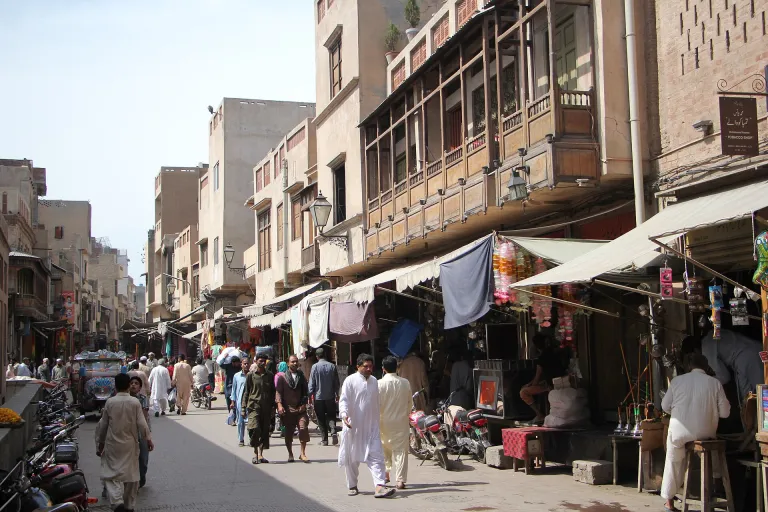 One Place, All of Time: The History of Any Place in PakistanType the name of a city, valley or region in Pakistan and see its history from…
How we know this
- Type Historical & cultural research
- Sources Photo credits only
- Reviewed October 2026
- Disputed points None
Photo credits (1)
- Great bath view Mohenjodaro.JPG, Saqib Qayyum, CC BY-SA 3.0, via Wikimedia Commons
