

Languages
Urdu: Pakistan's National Language
Born in the camps and courts of north India, written in flowing Nastaliq and spoken from Karachi to Gilgit: the story of Urdu, Pakistan's national language and shared tongue.
- National language (Article 251)
- Lingua franca across Pakistan
- Written in Nastaliq script
Tomb of Allama Iqbal, Lahore
About Urdu
Urdu is Pakistan's national language and its great common tongue. Only about one Pakistani in eleven speaks it as a mother tongue, 9.25% in the 2023 Census, yet it is understood across the country, from the bazaars of Karachi to the valleys of Gilgit-Baltistan. It is the language of national television, many leading newspapers, film and drama, political speeches, school textbooks and the lyrics of songs that every Pakistani knows. For a Punjabi-speaker in Lahore, a Pashto-speaker in Peshawar and a Sindhi-speaker in Hyderabad, Urdu is usually the language they share.
Linguistically, Urdu is an Indo-Aryan language. Its grammar and core vocabulary are closely related to Hindi, in everyday speech the two are often mutually intelligible, but Urdu draws much of its higher vocabulary from Persian and Arabic and is written in a Perso-Arabic script, while Hindi uses Devanagari and draws on Sanskrit. Linguists often treat the shared spoken base as Hindustani.
Urdu's literary tradition is one of the richest in South Asia, built around the ghazal, the nazm and a prose tradition that runs from 19th-century letters to modern fiction. Names such as Mir, Ghalib, Iqbal, Faiz and Manto are household words in Pakistan.

A Short History of Urdu
12th–14th centuries
A new shared speech
A common language grows in north India from local Indo-Aryan speech in contact with Persian, the language of the court. The poet Amir Khusrau (1253–1325), writing in what was then called Hindvi, is often counted as its first major poet.
16th–17th centuries
Dakhni in the Deccan
Under the sultanates of the Deccan, the language, called Dakhni, becomes a literary language, with poetry written for royal courts.
18th century
Rekhta and the Delhi poets
Poets in Delhi turn from Persian to the vernacular, then called Rekhta ('mixed'). Mir Taqi Mir becomes one of its great masters. The name Urdu, from a word meaning 'camp' (as in the Turkic <em>ordu</em>), comes into use for the language of the royal camp and city.
1811
Print and prose
Fort William College in Calcutta publishes the collected poems of Mir, part of a wider effort to print Urdu texts and develop modern prose.
19th century
Ghalib and the language debate
Mirza Ghalib (1797–1869) writes his famous ghazals and letters. In the later 19th century, the Urdu–Hindi controversy over script and official use becomes bound up with Muslim political identity.
1903
Anjuman Taraqqi-e-Urdu
The association for the promotion of Urdu is founded under the All-India Muslim Educational Conference. Urdu becomes a major symbol of the Pakistan Movement.
1948–1956
National language, contested
In March 1948 Muhammad Ali Jinnah declares in Dhaka that the state language should be Urdu alone. The Bengali language movement, met with deadly force in February 1952, leads to the 1956 constitution recognising both Urdu and Bengali.
1973
Article 251
The constitution names Urdu the national language and calls for arrangements for its official use within fifteen years, allowing English meanwhile and provincial languages alongside.
2015
Supreme Court judgment
On 8 September 2015 a three-member bench headed by Chief Justice Jawwad S. Khawaja orders federal and provincial governments to implement Article 251 without further delay and to translate laws into Urdu.
The Script: Nastaliq
Urdu is written from right to left in a modified form of the Perso-Arabic alphabet. Its standard style is Nastaliq, a flowing, hanging script developed by Persian calligraphers, in which each word slopes downward from right to left and letters stack diagonally. Nastaliq gives printed Urdu its distinctive look, newspapers were hand-calligraphed by katibs long after other scripts had moved to metal type, until computer Nastaliq fonts became widespread.
The Urdu alphabet adds letters to the Persian set for sounds that Persian and Arabic lack: retroflex consonants written with a small toy above the letter (ٹ ڈ ڑ), aspirated consonants formed with the 'two-eyed' he (ھ), as in بھ (bh) and کھ (kh), and the bari ye (ے) at the end of words. Short vowels are usually not written, so readers learn words by sight.
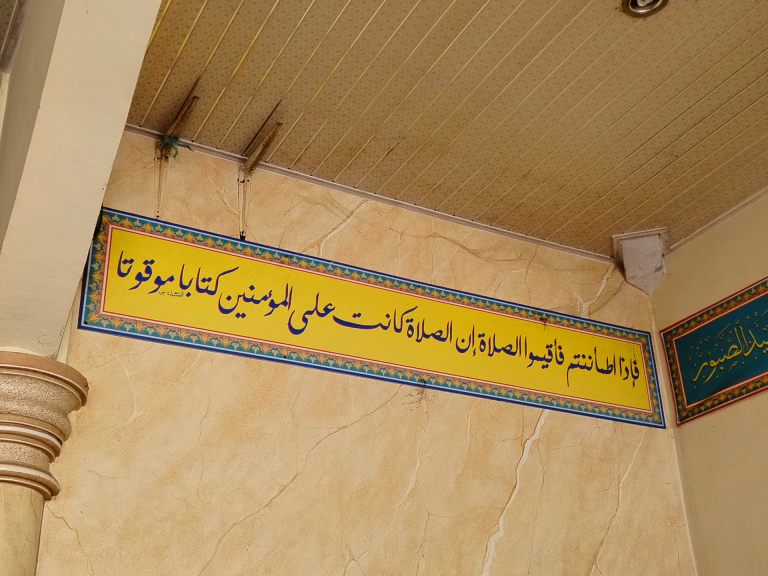
On signboards, especially in the north and west of the country, you will also see the closely related scripts of Sindhi, Pashto and Balochi, each with letters of its own.

Writers Who Shaped Urdu
A few of the names every Urdu reader knows.
 Muhammad IqbalPoet-philosopher whose Urdu and Persian verse inspired the Pakistan Movement; Pakistan's national poet.
 Faiz Ahmed FaizPakistan's best-loved modern poet, who brought politics, protest and tenderness into the ghazal and nazm.
 Contemporary voicesFrom Intizar Husain's fiction to the poetry of Parveen Shakir and Ahmad Faraz, Urdu literature continues to thrive at literature festivals and mushairas across Pakistan.
Learning a Little Urdu
| Urdu | Pronunciation | Meaning |
|---|---|---|
| السلام علیکم | assalam-o-alaikum | Peace be upon you (hello) |
| شکریہ | shukriya | Thank you |
| جی | ji | Yes; also a polite particle |
| کتنے کا ہے؟ | kitne ka hai? | How much is it? |
| خدا حافظ | Khuda hafiz | Goodbye |
For more phrases with pronunciation tips, see our Urdu phrases for travellers guide.

Frequently Asked Questions
Is Urdu the official language of Pakistan?
Article 251 of the Constitution makes Urdu the national language and requires arrangements for its official use, while allowing English to be used for official purposes until it is replaced. In practice, both Urdu and English are used in government, and in 2015 the Supreme Court ordered Article 251 to be implemented without further delay.
How many Pakistanis speak Urdu as their first language?
In the 2023 Census, 9.25% of Pakistanis (excluding AJK and Gilgit-Baltistan) reported Urdu as their mother tongue. Far more speak it as a second language.
Are Urdu and Hindi the same language?
They share the same grammar and everyday vocabulary and are largely mutually intelligible in speech, but they use different scripts and draw their formal vocabulary from different sources, Persian and Arabic for Urdu, Sanskrit for Hindi.
What does the word Urdu mean?
It comes from a word meaning 'camp' or 'army' (Turkic ordu), reflecting the language's association with the royal camp and city of the Mughal era.
What script is Urdu written in?
A modified Perso-Arabic alphabet, written right to left in the Nastaliq style, with extra letters for sounds found in South Asian languages.
Keep Exploring
Related places and stories on DailyLife.pk
 LahoreLahore travel guide: Badshahi Mosque, Lahore Fort, Shalimar Gardens, the Walled City, food streets, neighbourhoods, metro
 KarachiKarachi travel guide: Mazar-e-Quaid, Mohatta Palace, Clifton, Burns Road, bazaars, neighbourhoods, Green Line BRT
 HyderabadHyderabad, Sindh city guide: Pakka Qila, Talpur and Kalhoro tombs, Rani Bagh, Sindh Museum, glass bangles
 Languages of PakistanPakistan's languages explained: 2023 Census mother-tongue shares, Urdu and English under Article 251
 Urdu Phrases for Travellers78 essential Urdu phrases for visitors to Pakistan, with Urdu script and easy pronunciation: greetings, bargainingPoetry and Literature of PakistanPakistan's poetry and literature: Bhittai, Bulleh Shah, Rahman Baba, Khushal Khan Khattak, Ghalib's legacy, Iqbal, Faiz
How we know this
- Type Historical & cultural research
- Sources 6 (2 official/academic)
- Reviewed October 2026
- Disputed points None
6 sources
- Urdu language, Encyclopaedia Britannica
- Article 251: National language, Pakistan Constitution Law
- Constitution of the Islamic Republic of Pakistan, National Assembly of Pakistan
- Directions given for the implementation of Urdu as the official language of Pakistan, SCC Online, 11 September 2015
- Seventy years on, a fraught question still troubles Pakistan: should Urdu be its official language?, Scroll.in
- Census 2023: Punjabi tops as 'most spoken language' in Pakistan, Geo News
Photo credits (7)
- Allama Iqbal Tomb side view, adjacent to the Badshahi Mosque's gateway.jpg, Rohaan Bhatti, CC BY-SA 3.0, via Wikimedia Commons
- Muhammad Iqbal in 1935.png, https://allamaiqbal.com/new/picture_gallery_iqbal.html, Public domain, via Wikimedia Commons
- Faiz Ahmed Faiz (cropped).jpg, BpldxbCrop by Titodutta, CC BY-SA 3.0, via Wikimedia Commons
- Nastaliq Calligraphy.png, Udaradingin, CC BY-SA 4.0, via Wikimedia Commons
- Sindhi Cultural Day 2019 celebrations at Sindh museum Hyderabad, Sindh.jpg, JogiAsad, CC BY-SA 4.0, via Wikimedia Commons
- Alhamra Art Centre.JPG, Khalid Mahmood, CC BY-SA 3.0, via Wikimedia Commons
- Mausoleum of Shah Abdul Latif Bhittai 05.jpg, Umasha79, CC BY-SA 3.0, via Wikimedia Commons
