

Cities · Punjab
Rawalpindi: Old BazaarsGarrison Streets and the Gateway to the North
Pakistan's fourth-largest city, where crowded bazaars and colonial cantonments sit beside Islamabad and the road north to Murree, Taxila and beyond.
- Punjab, Pothohar Plateau
- Twin city of Islamabad
- Best season: October to April
Rawalpindi Railway Station
Rawalpindi at a Glance
About Rawalpindi
Rawalpindi, almost always shortened to Pindi, is the older, louder and more commercial of Pakistan's twin cities. It sits on the Pothohar (Potwar) Plateau in northern Punjab, a short drive south-west of Islamabad, and for generations it has been the place where travellers heading for Murree, the Kashmir road or the Karakoram first stop to change buses, buy supplies and eat well.
The 2023 Census counted 3,357,612 people in the city when the Rawalpindi Metropolitan Corporation (2,284,014) is combined with the Rawalpindi Cantonment (740,483) and Chaklala Cantonment (333,115). Rawalpindi District as a whole recorded 6,118,911 residents. That makes Pindi one of the largest urban centres in the country, though its character still comes from its bazaars and mohallas rather than its suburbs.
The city has two faces. The walled-in tangle of Raja Bazaar and the old mohallas grew up as a trading town on the routes between the Punjab plains and the north-west. South of the Leh (Nullah Lai) stream lies the British-built Cantonment, with its broad roads, churches, messes and, since independence, the General Headquarters of the Pakistan Army. Britannica notes that the Leh separates the old city from the cantonment, a divide you can still feel when you cross from the shouting cloth market to the tree-lined calm of the Mall.
Rawalpindi served as Pakistan's capital from 1959 to 1969 while Islamabad was being built next door. Today the two cities function as one metropolitan area, joined by the Murree Road corridor, the Islamabad Expressway and the Metrobus. Visitors often stay in Islamabad and come to Pindi for its markets, its food and its history; it rewards those who give it a full day or more.
Islamabad gives Pakistan its ministries; Rawalpindi gives it the bazaar, the bus stand and the breakfast table.

Top Attractions in Rawalpindi
Bazaars, museums, colonial landmarks and a Gakhar-era fort on the edge of town.
 Raja BazaarThe commercial heart of old Rawalpindi: a dense web of lanes selling cloth, spices, utensils, dry fruit and wedding goods. Go in the morning, before the traffic peaks, and wander into the side mohallas to see older timber-balconied houses.
 Pakistan Army MuseumClose to General Headquarters, the museum traces the history of soldiering in the region through uniforms, weapons and dioramas, with tanks and artillery pieces displayed in its grounds. Check opening days locally before you go.
 Christ ChurchA 19th-century Anglican church with buttresses, stained glass and memorial plaques to British-era regiments, one of the best-preserved reminders of Rawalpindi's garrison past, and still a working place of worship.
 Ayub National ParkOne of the city's largest green spaces, named by Britannica among Rawalpindi's landmarks. Families come for the lake, play areas and shaded lawns, especially on weekend evenings.
 Liaquat BaghA historic park and rally ground on Murree Road. Pakistan's first prime minister, Liaquat Ali Khan, was assassinated here in 1951, and former prime minister Benazir Bhutto was killed near its gate in 2007.
 SaddarThe cantonment's bustling market district, laid out in the colonial era. Bank Road, Kashmir Road and Haider Road are lined with shops, bakeries and eateries, and the Metrobus line begins here.
 Sujan Singh HaveliA grand but weathered late-19th-century mansion built for the Sikh banker Rai Bahadur Sujan Singh, hidden among the old city's lanes. Its carved woodwork and balconies hint at the wealth of pre-Partition Pindi.
 Rawat FortOn the Grand Trunk Road east of the city, this walled enclosure with domed tombs and a small mosque is linked to the Gakhar chiefs who dominated the Pothohar before the Mughals. Quiet, atmospheric and easy to combine with a drive towards Rohtas.
Neighbourhoods and Areas
From the old walled bazaars to planned suburbs along the expressways.
 Old City and Raja BazaarNarrow lanes, mohallas, wholesale markets and historic temples, gurdwaras and havelis. The best area to explore on foot, and the most crowded.
 Saddar and the MallThe commercial core of the Cantonment, with shops, hotels, banks and the Metrobus terminus. The Mall leads past Christ Church and colonial-era buildings.
 Murree Road and Committee ChowkThe main artery linking the old city with Islamabad, lined with markets, colleges and the elevated Metrobus track. Liaquat Bagh and Committee Chowk are landmarks along it.
Explore Rawalpindi by Category
 About RawalpindiRawalpindi, almost always shortened to Pindi, is the older,…
 Top Attractions in RawalpindiBazaars, museums, colonial landmarks and a Gakhar-era fort on…
 Neighbourhoods and AreasFrom the old walled bazaars to planned suburbs along…
 Food and BazaarsPindi is a breakfast city: chickpeas, halwa puri and…
 Culture and FestivalsPindi is a Pothohari-speaking city at heart. Pothwari (a…
 Plan Your Visit
Food and Bazaars
Pindi is a breakfast city: chickpeas, halwa puri and freshly fried parathas.
 Chana and Halwa Puri BreakfastsSpiced chickpeas (cholay) with puri or kulcha and sweet semolina halwa are a weekend ritual. Look for busy stalls in the old city and Saddar, a queue is the best recommendation.
 Saddar Food StreetSaddar's food lanes come alive after dark with tikka, karahi, seekh kebabs, fried fish in winter and endless cups of doodh-patti chai.
 Raja Bazaar ShoppingFabrics, embroidered shawls, brass and steel utensils, spices and dry fruit at wholesale prices. Bargaining is normal; fixed-price shops will say so.
 Saddar Malls and MarketsAlongside the old bazaars, Saddar has modern shopping plazas for clothes, electronics and mobile phones, useful for a SIM card or travel essentials.
History of Rawalpindi
From a village of ascetics to the headquarters of an army.
Antiquity
Part of Gandhara
The region belonged to the ancient Gandhara world and, for a time, the Achaemenid Persian empire. The ruins of Taxila lie to the north-west and the Buddhist stupa at Mankiala to the south.
14th century
Destruction and revival
Mongol raids devastated the earlier settlement. The Gakhar chief Jhanda Khan later restored it; its name is usually explained as the 'village of the Rawals', a group of yogis.
1765
Sikh settlement
The Sikh chief Milkha Singh occupied the town and invited traders from Jhelum and Shahpur, setting off rapid commercial growth.
1849
British annexation
After the Anglo-Sikh wars the British annexed the Punjab; Rawalpindi became a major cantonment on the road to the North-West Frontier, and a municipality in 1867.
1947
Independence and Partition
Rawalpindi became part of Pakistan. The departure of much of its Hindu and Sikh population and the arrival of refugees reshaped the old city; the Army's General Headquarters was established here.
1959–1969
National capital
Rawalpindi served as Pakistan's capital while Islamabad was planned and built on its doorstep.
2015
Metrobus opens
The Rawalpindi–Islamabad Metrobus began running on 4 June 2015, linking Saddar with Islamabad along a partly elevated corridor.
Culture and Festivals
Pindi is a Pothohari-speaking city at heart. Pothwari (a Punjabi variety) is heard in homes and markets alongside Urdu, while decades of migration have brought Pashto, Hindko and Kashmiri voices into the mix. The result is a practical, outgoing city with a strong sense of hospitality, expect to be offered tea.
The religious calendar sets the rhythm of the year. During Ramadan the bazaars stay open late and food streets fill after iftar; before Eid ul-Fitr Raja Bazaar is at its most crowded as families shop for clothes, bangles and sweets. Muharram processions pass through the old city, when routes may close and security is tightened. Wedding season, which peaks in the cooler months, keeps the cloth and jewellery markets busy.
Cricket matters here: the Rawalpindi Cricket Stadium hosts Test and limited-overs internationals, and match days bring a festive atmosphere to the city. The old city's surviving temples, gurdwaras and havelis, Sujan Singh Haveli among them, are a reminder of the mixed society that existed before 1947.

Getting Around
Rawalpindi shares an airport, a Metrobus and a motorway network with Islamabad.
Airport
Islamabad International Airport
The twin cities are served by Islamabad International Airport, west of the metropolitan area off the Srinagar Highway. Allow generous time for road transfers at peak hours.
Rail
Rawalpindi Railway Station
A key stop on Pakistan Railways' main line, with trains towards Lahore, Karachi and Peshawar. Book through Pakistan Railways and confirm schedules close to travel.
Metrobus
Saddar to Islamabad
The Rawalpindi–Islamabad Metrobus opened on 4 June 2015 with 24 stations; the 8.3 km section from Saddar to IJP Road is elevated above Murree Road. Cards are sold at stations.
Ride-hailing
App-based cars and bikes
App-based car and motorbike services operate across the twin cities and are the easiest way to reach the old city, the airport or Islamabad without haggling.
Road
GT Road and motorways
The Grand Trunk Road runs through the city, and the motorway network connects the twin cities with Lahore and Peshawar. Inter-city coaches leave from terminals around Pir Wadhai and Faizabad.
On foot
Best for the old city
Raja Bazaar and the old mohallas are far easier on foot than by car. Wear comfortable shoes and keep valuables secure in crowds.
Plan Your Visit
Best Time to Visit
October to April
Autumn and spring are pleasant for walking the bazaars. Winters are cool, and summers are hot with a humid monsoon spell in July and August.
Where to Stay
Saddar, Murree Road, Bahria Town, or Islamabad
Saddar and the Murree Road corridor put you near the Metrobus and markets; Bahria Town and DHA are quieter. Many visitors stay in Islamabad and travel in.
Weather
Four distinct seasons
Rawalpindi has hot summers, a monsoon season and cool winters. The Leh stream can flood after very heavy monsoon rain, so watch local advisories during storms.
Etiquette
Modest dress
Dress modestly, especially in the old city and at shrines and mosques. Ask before photographing people, and avoid photographing military installations in the Cantonment.
Practicalities
Check local guidance
Rawalpindi is a busy working city. Keep an eye on local news for road closures during rallies or religious processions, and follow local authority guidance.
Money
Cash still rules in bazaars
ATMs are widespread in Saddar and along Murree Road. Carry small notes for markets, chai stalls and rickshaws.
Read moreDay Trips from Rawalpindi
Pindi's position on the GT Road makes it an ideal base for heritage and the hills.
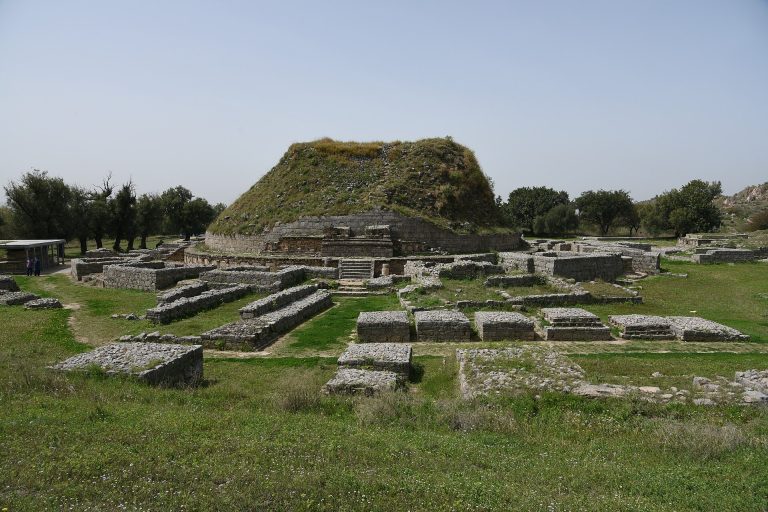 TaxilaStupas, monasteries and three successive city sites of ancient Gandhara, plus a fine museum of Buddhist sculpture.
 IslamabadThe planned capital, with Faisal Mosque, the Margalla Hills trails and the Pakistan Monument, reachable by Metrobus.
 MurreeThe colonial-era hill station on the Murree hills, busy in summer and snowy in winter. Check road and weather advisories before winter trips.
 Rohtas FortSher Shah Suri's massive 16th-century fortress, with monumental gates and long stretches of rampart.
 Katas Raj TemplesA complex of temples around a sacred pool in the Salt Range, revered in Hindu tradition.
 Khewra Salt MineOne of the world's best-known rock-salt mines, with guided tunnels and illuminated salt formations; easy to combine with Katas Raj.

Rawalpindi Through Time
Every dated moment our guides record about Rawalpindi, from its own history and from national events that touched it. Each entry links to its source page.
- c. 500,000 years ago
First toolmakers
Early humans leave Acheulean-type hand-axes in the Soan valley near present-day Rawalpindi.
- 1506
Pindi Bahauddin
The original village is founded, according to local tradition.
- 1893
Gordon College's beginnings
A mission school in Rawalpindi's Raja Bazaar; college status and its Liaquat Road building followed in 1902.
- 1901
Railway arrives
Stations open at Pindi Bahauddin and Malakwal.
- 1947–1951
Founding years
Jinnah serves as Governor-General until his death on 11 September 1948. The Objectives Resolution (March 1949) sets principles for a future constitution. Prime Minister Liaquat Ali Khan is assassinated in Rawalpindi on 16 October 1951.
- Before 1947
Ancient routes and villages
The foothills north of Rawalpindi lay near historic caravan routes, and old settlements such as Saidpur predate the modern city by centuries.
- March 1947
Violence in Punjab
Riots and massacres break out in Rawalpindi district and elsewhere in Punjab.
- March 1947
Punjab
Violence breaks out in Rawalpindi district and other parts of Punjab.
- February–March 1947
A deadline to leave
Britain announces it will quit India by June 1948 and sends Lord Mountbatten as the last Viceroy. Violence breaks out in Rawalpindi district and elsewhere in Punjab in March.
- Late 1950s–1960s
The capital moves north
A new capital site near Rawalpindi is chosen in 1959, and Islamabad is formally established as capital in 1967. Karachi remains the commercial capital.
- 1951–1955
Turbulent early years
Prime Minister Liaquat Ali Khan is assassinated in Rawalpindi in 1951. The first Constituent Assembly is dissolved in 1954, and in 1955 the western provinces are merged into One Unit.
- 9 March 1951
Arrest
Arrested under the Safety Act in the Rawalpindi Conspiracy case; held in jails including Hyderabad. His sentence is commuted and he is released in 1955.
- 1951-10-16
Death of Liaquat Ali Khan
- 16 October 1951
Assassination
Shot at Company Bagh, Rawalpindi; the assassin is killed by police at the scene. He is buried in the grounds of the Mazar-e-Quaid in Karachi.
- 16 October 1951
Assassination of Liaquat Ali Khan
Pakistan's first Prime Minister, Liaquat Ali Khan, was shot dead while addressing a public meeting at Company Bagh in Rawalpindi on 16 October 1951. The gunman, an Afghan national named Sayyid (Said) Akbar, was killed on the spot by police; official inquiries found no wider…
- 16 October 1951, afternoon
Shot in Rawalpindi
He is shot twice while addressing a public meeting at Company Bagh; the assassin is killed at the scene.
- 16 October 1951
Death
He dies at the Military Hospital, Rawalpindi.
- 1958–1959
Choosing a capital
A commission recommends a new capital near Rawalpindi, which serves as the interim capital while the new city is built.
- 1958
Site selected
A commission selected land north-east of Rawalpindi, weighing climate, defence needs, water and scenery.
- 1959–1961
A new capital
A commission chooses the site of Islamabad below the Margalla Hills in 1959; construction begins in 1961, with Rawalpindi as the interim capital.
- 1963
Capital in operation
Islamabad began functioning as the capital, and ordinances separated Rawalpindi and its cantonment from the Islamabad master plan area.
- 1972
Nationalisation
Church-run institutions, including Gordon College in Rawalpindi and St Patrick's in Karachi, are taken over by the government.
- 5 July 1977
1977 Military Coup
On 5 July 1977, after months of protest over disputed elections, army chief General Zia-ul-Haq removed Prime Minister Zulfikar Ali Bhutto, suspended the Constitution and imposed martial law. Promised elections within 90 days did not take place, and Bhutto was later tried and executed in…
- 1979-04-04
Death of Zulfikar Ali Bhutto
- 4 April 1979
Executed
Hanged at Rawalpindi District Jail after the Supreme Court upholds his conviction; buried at the family mausoleum at Garhi Khuda Bakhsh, Larkana district.
- 4 April 1979
Bhutto executed
Bhutto is hanged in Rawalpindi after his appeal is rejected.
- 17 May 1999
Briefing in Rawalpindi
According to Nasim Zehra, Sharif and senior ministers receive a detailed briefing on the operation at the ISI's Ojhri Camp.
- 12 October 1999 (emergency proclaimed 14 October)
1999 Military Takeover
On 12 October 1999, after Prime Minister Nawaz Sharif tried to replace army chief Pervez Musharraf while Musharraf was flying back from Sri Lanka, the army removed the government. Musharraf proclaimed an emergency, held the Constitution in abeyance and ruled as Chief Executive, later as…
- 2007-12-27
Death of Benazir Bhutto
- 27 December 2007
Assassination
Killed leaving a rally at Liaquat Bagh, Rawalpindi; buried at the family mausoleum at Garhi Khuda Bakhsh.
- 2015–2022
Modern transit
The Rawalpindi–Islamabad Metrobus opens in 2015; Islamabad International Airport opens in 2018; Orange, Green and Blue Metrobus lines follow in 2022.
- 1–3 May 2018
New Islamabad airport
The new Islamabad International Airport is inaugurated on 1 May and takes over from the old Benazir Bhutto airport in Rawalpindi, with capacity for about 15 million passengers a year.
- 2019–2025
Tests and ICC events return
Sri Lanka played Tests in Rawalpindi and Karachi in December 2019, the first Tests in Pakistan since 2009. In 2025 Pakistan hosted the ICC Champions Trophy, with renovated grounds in Lahore, Karachi and Rawalpindi.
- 15 October 2022
Four new districts approved
The Chief Minister signed a summary approving Murree (from Rawalpindi), Kot Addu (from Muzaffargarh), Wazirabad (from Gujranwala) and Talagang. Taunsa was held back at the time over boundary questions with Dera Ghazi Khan.
Do you remember Rawalpindi as it used to be? Share a memory or an old photo, our editors review every story before it appears.
Frequently Asked Questions
What is the population of Rawalpindi?
The 2023 Census counted 3,357,612 people in Rawalpindi city (the Metropolitan Corporation plus Rawalpindi and Chaklala cantonments). Rawalpindi District recorded 6,118,911 people.
What is the difference between Rawalpindi and Islamabad?
They are separate cities in different administrative units, Rawalpindi is in Punjab province, Islamabad is the federal capital territory, but they form one metropolitan area. Rawalpindi is the older trading and garrison city; Islamabad was purpose-built as the capital in the 1960s.
Was Rawalpindi ever the capital of Pakistan?
Yes. Rawalpindi served as the national capital from 1959 to 1969 while Islamabad was being built.
How do I get from Rawalpindi to Islamabad?
The Rawalpindi–Islamabad Metrobus runs from Saddar along Murree Road into Islamabad. App-based ride-hailing and taxis are also widely available.
What is Rawalpindi famous for?
Its bazaars (especially Raja Bazaar), hearty breakfasts of chickpeas and halwa puri, the Army's General Headquarters, colonial Cantonment architecture and its role as a gateway to Murree, Taxila and northern Pakistan.
When is the best time to visit Rawalpindi?
October to April is the most comfortable period. Summers are hot, and the July–August monsoon brings heavy downpours.
Keep Exploring
Related places and stories on DailyLife.pk
 TaxilaVisit Taxila: Dharmarajika stupa, Jaulian monastery, Sirkap and Taxila Museum.
 MurreeMurree travel guide: Mall Road, Holy Trinity Church, Patriata, Nathia Gali and Ayubia, with seasons, routes
 Rohtas FortExplore Rohtas Fort near Jhelum: Sohail Gate, ramparts, Haveli Man Singh, Shahi Masjid and stepwellsKatas Raj TemplesVisit the Katas Raj Temples in Chakwal: the sacred pond, Satgarha temples, Hari Singh Nalwa's haveliKhewra Salt MineVisit Khewra Salt Mine, Jhelum District: history, the mine train, salt mosque and brine pools
 IslamabadIslamabad travel guide: Faisal Mosque, Pakistan Monument, Margalla Hills trails, Saidpur, markets, sectors, Metrobus
How we know this
- Type Place guide
- Sources 5 (4 official/academic)
- Reviewed October 2026
- Disputed points None
5 sources
- Population Census 2023 – Table 2: Urban localities by population size, Pakistan Bureau of Statistics
- Pakistan: Administrative Division (districts, 2023 Census), City Population (Thomas Brinkhoff), based on PBS data
- Rawalpindi, Encyclopaedia Britannica
- Pakistan Metrobus System (Rawalpindi–Islamabad), Punjab Masstransit Authority
- UNESCO World Heritage List: Taxila, UNESCO World Heritage Centre
Photo credits (26)
- Rawalpindi railway St.jpg, Ayathere19, CC BY-SA 4.0, via Wikimedia Commons
- Rawalpindi from above.jpg, Omer Wazir from Tucson, AZ, USA, CC BY-SA 2.0, via Wikimedia Commons
- Inside raja bazaar Rawalpindi 1.jpg, Fahads1982, CC BY-SA 4.0, via Wikimedia Commons
- Rawalpindi Bazaar.jpg, Trueblood786 at English Wikipedia, CC BY-SA 3.0, via Wikimedia Commons
- Ariel view of raja bazaar Rawalpindi from rooftop.png, Fahads1982, CC BY-SA 4.0, via Wikimedia Commons
- Army museum Rawalpindi 1.jpg, Fahads1982, CC BY-SA 4.0, via Wikimedia Commons
- Christ Church, Rawalpindi.jpg, Omer Wazir from Tucson, AZ, USA, CC BY-SA 2.0, via Wikimedia Commons
- Ayub Park, Rawalpindi Pakistan.jpg, Maemuna, CC BY-SA 4.0, via Wikimedia Commons
- Liaquat Bagh Chowk Rawalpindi.jpg, Fahads1982, CC BY-SA 4.0, via Wikimedia Commons
- Saddar in Rawalpindi.jpg, Idontknow1213, CC BY-SA 4.0, via Wikimedia Commons
- Rawalpindi Saddar.jpg, Idontknow1213, CC BY-SA 4.0, via Wikimedia Commons
- Mall of Rawalpindi in Saddar bazaar.png, Fahads1982, CC BY-SA 4.0, via Wikimedia Commons
- Haveli sujan Singh Rawalpindi.jpg, Fahads1982, CC BY-SA 4.0, via Wikimedia Commons
- Rawat Fort - Main Gate East.jpg, Mudabbirmaajid, CC BY-SA 3.0, via Wikimedia Commons
- Murree Road Rawalpindi.jpg, King Eliot, CC BY-SA 4.0, via Wikimedia Commons
- Rawalpindi food street.JPG, SyedFarhanTahir1990, CC BY-SA 4.0, via Wikimedia Commons
- Pindi Chole Rawalpindi Style Dry Chickpea Fry (15292723194).jpg, Yummy O Yummy, CC BY 2.0, via Wikimedia Commons
- Rawalpindi Railway Station 2.jpg, Mazahirshah, CC BY-SA 4.0, via Wikimedia Commons
- Dharmarajika stupa & Monastery Taxila.jpg, Mhtoori, CC BY-SA 4.0, via Wikimedia Commons
- National Faisal Mosque Islamabad.jpg, Marsmux, CC BY-SA 4.0, via Wikimedia Commons
- Murree way To Mall Road.jpg, MuhammadYassal, CC BY-SA 4.0, via Wikimedia Commons
- Rohtas Fort (Jhelum, Pakistan) - World Heritage Site.jpeg, Hussain Khalid, CC BY-SA 4.0, via Wikimedia Commons
- Katas Raj Temple 2.jpg, Dowdoo14, CC BY-SA 4.0, via Wikimedia Commons
- Faizabad Bus-stop Rawalpindi.jpg, King Eliot, CC BY-SA 4.0, via Wikimedia Commons
- Old building of State Bank of Pakistan, Now its known as State Bank Museum.jpg, Asim Iftikhar Nagi, CC BY-SA 4.0, via Wikimedia Commons
- Khewra Salt Mines 03.jpg, Shahzaib Damn Cruze, CC BY-SA 4.0, via Wikimedia Commons
