
Business & markets
Pakistan Stock Exchange: Historythe KSE-100 and How Investing Works
From a Karachi trading floor founded weeks after independence to today's unified, demutualised exchange: how PSX works, what the KSE-100 measures and how retail investors get started.
- Stock Exchange Road, Karachi
- Regulated by SECP
- Educational only, not investment advice
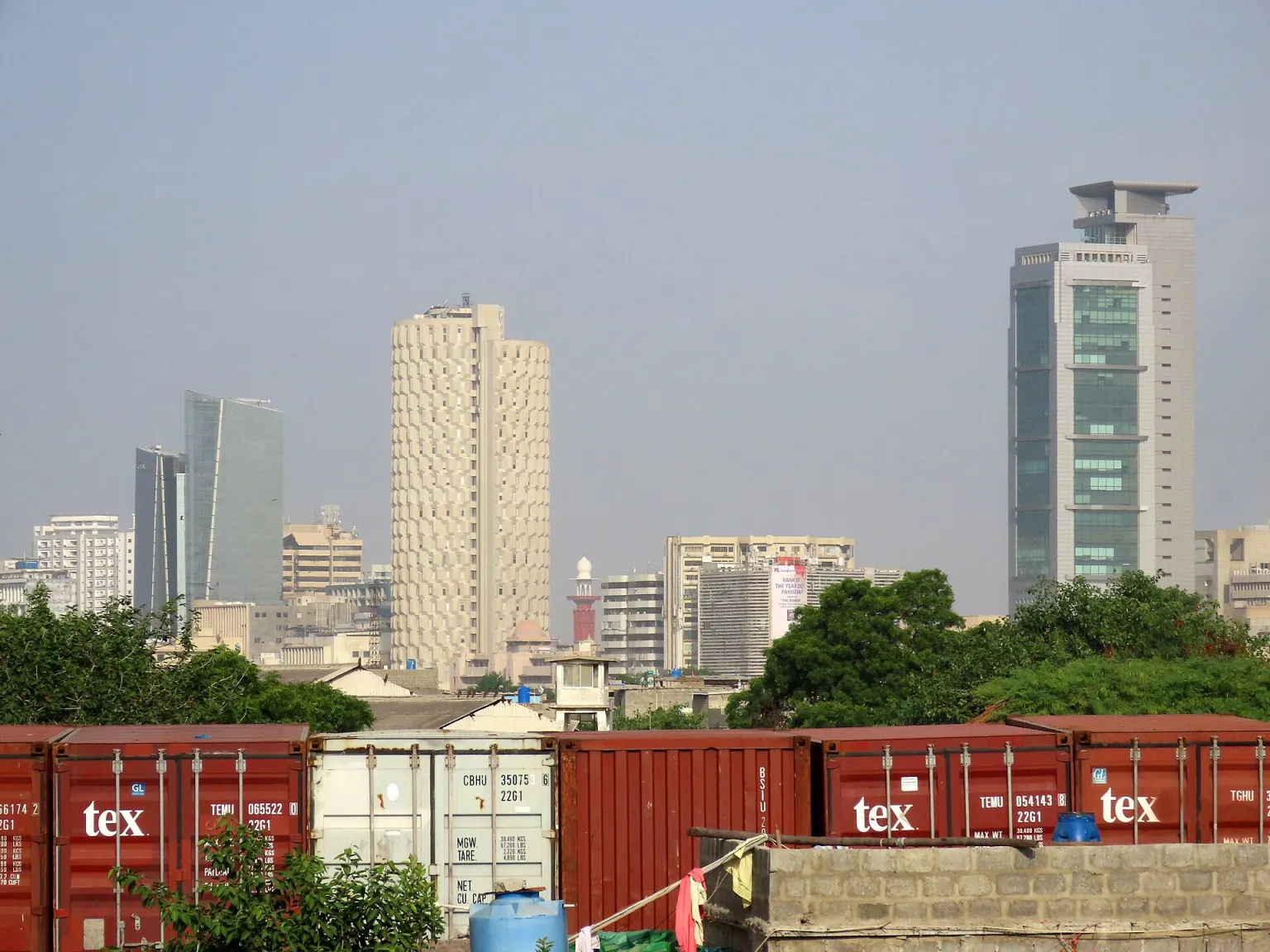
I. I. Chundrigar Road, Karachi
Pakistan's Stock Market in Brief
The Pakistan Stock Exchange (PSX) is the country's only stock exchange, headquartered on Stock Exchange Road in Karachi's financial district, with a presence in Lahore and Islamabad inherited from the exchanges it absorbed. It is where shares of Pakistan's listed companies, banks, cement makers, fertiliser producers, oil and gas firms, power companies, textile mills, technology firms and more, are bought and sold, along with exchange-traded funds and debt instruments.
PSX was formed on 11 January 2016, when the Karachi, Lahore and Islamabad stock exchanges were merged into a single company under the Stock Exchanges (Corporatisation, Demutualization and Integration) Act 2012. As of 30 June 2025, PSX reported 527 listed companies plus 7 on its Growth Enterprise Market (GEM) Board, spread across 38 sectors. A consortium of three Chinese exchanges, Shanghai, Shenzhen and the China Financial Futures Exchange, holds a 40% stake; the remaining shares are held by the public and other investors.
This page explains how the market is organised and how ordinary people take part. It is educational only and not investment advice. Share prices can fall as well as rise, and you can lose money. Before investing, use official investor-education resources and consider speaking to a licensed adviser.
From Karachi Floor to Unified Exchange
18 September 1947
Karachi Stock Exchange founded
Established within weeks of independence. According to Business Recorder it began with five listed companies with a combined paid-up capital of Rs 37 million.
10 March 1949
Incorporation
The exchange was incorporated as Karachi Stock Exchange (Guarantee) Limited.
1970
Lahore Stock Exchange
A second exchange opened in Lahore, serving Punjab's investors and companies.
1989
Islamabad Stock Exchange
The capital gained its own exchange, making three in all.
1 November 1991
KSE-100 index created
The KSE-100, which succeeded the earlier KSE-50, was launched with a base value of 1,000 points.
1999
SECP begins operations
The Securities and Exchange Commission of Pakistan, created under the SECP Act 1997, became operational on 1 January 1999 as the capital market regulator.
2012
Demutualisation
The Stock Exchanges (Corporatisation, Demutualization and Integration) Act converted the member-owned exchanges into companies limited by shares.
11 January 2016
Pakistan Stock Exchange launched
The three exchanges were integrated into PSX, inaugurated in Karachi by the federal finance minister.
2016–2017
Strategic investors and self-listing
A 40% stake was sold to a Chinese consortium, shares were offered to the public, and PSX listed on its own board in June 2017.
2023
New trading system
PSX adopted its New Trading & Surveillance System (NTS).
What the KSE-100 Measures
The KSE-100 is the headline index you hear on the evening news. It tracks the performance of a basket of 100 large listed companies, chosen to represent the market as a whole across its main sectors, so a rise or fall in the index is a quick read on overall market sentiment.
When the index was created in 1991 it started at 1,000 points. Business Recorder, marking its 30th anniversary, calculated average annual returns of around 14% over those three decades, but averages hide sharp swings. The index has repeatedly fallen hard during political crises, balance-of-payments stress and global shocks, and rallied strongly in recoveries. PSX reported a 60.15% return for the KSE-100 in fiscal year 2025 alone; such years are exceptional, not a forecast.
PSX calculates 17 indices in all, including Shariah-compliant and broader all-share measures. Index levels change every trading day, check PSX's website for live figures.
How Retail Investors Open an Account
The general route described by PSX's investor-education material. Requirements vary by broker.
- 1
Learn the basics first
Use PSX's investor-education resources and SECP's Jamapunji to understand risk, costs and how orders work before committing money.
- 2
Choose a licensed broker
Pick a firm from PSX's list of TREC holders. Compare service, research, online trading platforms, brokerage charges, branch locations and how they confirm trades.
- 3
Complete the account-opening form
Brokers use the Standardized Account Opening Form (SAOF). It opens your trading account and a CDC sub-account in which your shares are held. Expect know-your-customer checks with your CNIC, bank account details and source-of-income information; many brokers now offer online account opening.
- 4
Consider a CDC Investor Account
PSX's guidance recommends a CDC Investor Account, which holds your shares directly with the depository rather than under your broker's umbrella, for added safekeeping.
- 5
Fund the account from your own bank account
Deposit money through banking channels in your own name, following your broker's instructions. Never hand cash to an individual agent.
- 6
Trade, then check every confirmation
Place orders through your broker's platform. Request trade confirmations for every buy and sell, review statements regularly, and cross-check your holdings with CDC.
Costs and Taxes to Expect
Investing in shares involves several layers of cost: brokerage commission, plus charges levied by PSX, CDC, NCCPL and SECP, and taxes collected by FBR. On the tax side, dividends and capital gains on listed securities are subject to withholding tax, and FBR's own guidance notes that taxpayers on the Active Taxpayer List pay lower rates on both. Rates change through the annual Finance Act, so ask your broker for a current schedule of charges and check FBR's withholding tax card before you trade.
Mutual funds and exchange-traded funds, offered by SECP-licensed asset management companies, are an alternative for people who prefer diversified, professionally managed exposure rather than picking individual shares.
Protect Yourself
- Deal only with brokers listed by PSX and licensed by SECP; verify before you sign anything.
- Be wary of WhatsApp groups, social media 'signals' or anyone promising guaranteed or fixed returns.
- Keep your CDC and trading credentials private and enable alerts for every transaction.
- Reconcile broker statements with your CDC account statement regularly.
- Invest only money you will not need in the short term, and spread risk across companies and sectors.
- If you have a complaint against a broker, raise it with the broker first, then with PSX or SECP through their official complaint channels.
Important
Educational information only, not investment advice. Nothing on this page is a recommendation to buy or sell any security. Figures are as stated by the cited sources (company counts as of 30 June 2025); procedures were checked in October 2026. Confirm current requirements with PSX, SECP and your broker.
Frequently Asked Questions
When was the Pakistan Stock Exchange formed?
PSX was formed on 11 January 2016 by integrating the Karachi, Lahore and Islamabad stock exchanges. Its oldest predecessor, the Karachi Stock Exchange, was established on 18 September 1947.
What is the KSE-100?
PSX's benchmark index, tracking 100 large listed companies chosen to represent the market. It was created in 1991 with a base value of 1,000 points.
Who regulates the stock market in Pakistan?
The Securities and Exchange Commission of Pakistan (SECP), operational since 1 January 1999, regulates the capital market. PSX acts as frontline regulator of its brokers and listed companies.
How do I start investing in shares?
Choose a PSX-licensed broker, complete the Standardized Account Opening Form with your CNIC and bank details, which also opens a CDC sub-account, fund the account from your own bank account, and place orders through the broker. Learn the basics first through PSX and SECP's Jamapunji resources.
Does PSX tell me which shares to buy?
No. PSX operates the market; it does not give investment advice. This page is educational only, consider speaking to a licensed adviser.
Keep Exploring
Related places and stories on DailyLife.pk
 KarachiKarachi travel guide: Mazar-e-Quaid, Mohatta Palace, Clifton, Burns Road, bazaars, neighbourhoods, Green Line BRT
 LahoreLahore travel guide: Badshahi Mosque, Lahore Fort, Shalimar Gardens, the Walled City, food streets, neighbourhoods, metro
 IslamabadIslamabad travel guide: Faisal Mosque, Pakistan Monument, Margalla Hills trails, Saidpur, markets, sectors, Metrobus
 Economy of PakistanPakistan's economy explained: FY2025-26 GDP, growth, per capita income, exports, textiles, record remittances
 Filing Income Tax in PakistanA practical guide to filing income tax in Pakistan: IRIS registration, CNIC as NTN, deadlines
 Starting a Business in PakistanHow to start a business in Pakistan: sole proprietor vs company, SECP eZfile incorporation
How we know this
- Type Practical guide
- Sources 7 (2 official/academic)
- Reviewed October 2026
- Disputed points None
Rules and fees change, confirm with the official links below before you act.
7 sources
- About Us – Pakistan Stock Exchange, Pakistan Stock Exchange
- How to open a brokerage account, Pakistan Stock Exchange Knowledge Center
- About SECP, Securities and Exchange Commission of Pakistan
- Pakistan Stock Exchange history (opinion, 23 April 2024), Business Recorder
- 30 years of existence: KSE-100 Index posts average annual returns of 14pc, Business Recorder
- Pakistan Stock Exchange inaugurated (January 2016), Dawn
- Active Taxpayer List (ATL) – benefits, Federal Board of Revenue
Photo credits (4)
- Highrises on II Chundrigar.jpg, King Eliot, CC BY-SA 4.0, via Wikimedia Commons
- PK Karachi asv2020-02 img47 container port.jpg, A.Savin, FAL, via Wikimedia Commons
- Parliament House, Islamabad by Usman Ghani.jpg, Usman.pg, CC BY-SA 3.0, via Wikimedia Commons
- Karachi Skyline 1.jpg, Ktownboy103, CC0, via Wikimedia Commons
