
Archaeological site
Mehrgarh: Where South Asian Farming Began
A group of low mounds on the Kachhi plain at the mouth of the Bolan Pass, holding one of the oldest farming and herding settlements in South Asia.
- Near Sibi, Balochistan
- 7th–3rd millennium BCE
- UNESCO Tentative List
Mehrgarh, Kachhi District, Balochistan
About Mehrgarh
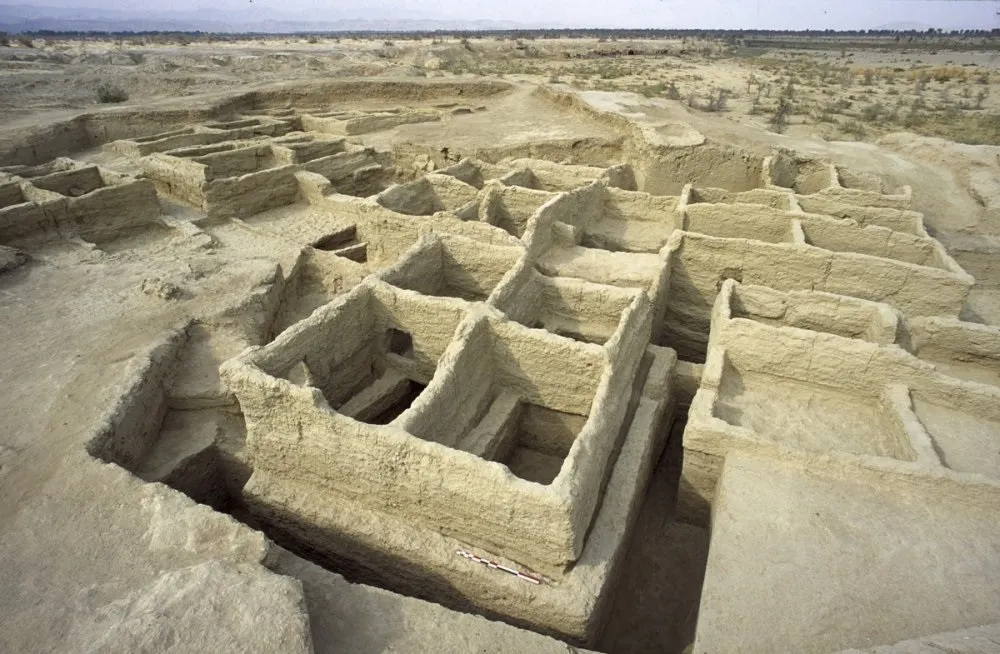
Mehrgarh is a cluster of low mounds on the Kachhi plain of Balochistan, on the west bank of the Bolan River close to where the river leaves the Bolan Pass, about 30 km from Sibi. UNESCO's Tentative List entry describes a classic tell, built up by generation after generation of mud-brick buildings, with an archaeological sequence more than 11 metres deep.
It matters because it shows what happened before the cities. The settlement began as small mud-brick storage units with evidence of barley and cattle, and grew into a substantial village with its own craft zone. By around 2600 BCE activity had moved to the nearby site of Naushero, and Mehrgarh was abandoned before the literate, urban phase of the Indus Civilisation, so it records the roots of that civilisation's farming, craft and trade rather than its cities.
The site was exposed by a flash flood in the 1970s and was then excavated by the French Archaeological Mission to Pakistan from 1974 to 1986, with work resuming in 1996. Most of the deposits still lie under river silt, so a visit is more about understanding a landscape than seeing standing monuments.
What Mehrgarh Tells Us
 Bolan PassThe site sits at the southern mouth of the pass, which has linked the plains and the plateau for millennia.
The Mehrgarh Sequence
c. 6500–6000 BCE
Period IA: aceramic Neolithic
Small mud-brick storage units on Mound MR3, with early cattle and barley (UNESCO chronology).
c. 6000–5500 BCE
Period IB: ceramic Neolithic
Pottery appears; the settlement grows.
c. 5500–4500 BCE
Period II
Occupation continues on Mound MR4.
c. 4500–3500 BCE
Period III: early Chalcolithic
Mound MR2; the potter's wheel and more specialised crafts appear.
c. 3500–2500 BCE
Periods IV–VII: Chalcolithic
Mound MR1; a larger village with a craft zone, before activity shifts to Naushero around 2600 BCE.
1974–1986; from 1996
French excavations
The French Archaeological Mission to Pakistan excavates the site; work resumed in 1996 (UNESCO).
How Old Is It? A Note on Dating
Dates quoted for Mehrgarh differ. UNESCO's Tentative List entry uses an excavators' chronology that starts around 6500 BCE. Later radiocarbon work on human teeth has suggested a somewhat later start for the earliest occupation, and scholars also disagree about whether the site's culture was a local development or influenced by migrants. For a visitor the practical point is simple: Mehrgarh covers several thousand years, mostly in the period before the Indus cities rose.
Plan Your Visit
Best Time to Visit
November to March
Summers on the Kachhi plain are very hot. Winter is the sensible season for any field visit.
How to Reach
From Sibi
The site is about 30 km from Sibi (UNESCO). There is no regular public transport to the mounds; arrange a vehicle and local guidance in Sibi.
What You Will See
Low mounds and eroded brick
Most deposits are buried. Expect to see eroding mud-brick walls and mound profiles, not reconstructed buildings. Check with the Department of Archaeology & Museums for site access and any visitor arrangements.
Where to Stay
Sibi or Quetta
Plan accommodation in Sibi or Quetta rather than near the site.
Etiquette and Photography
Look, do not collect
Do not remove sherds, beads or bones. Ask permission from the site custodians and local landowners before photographing or walking on the mounds.
Advisories and permits
Check before you go
Conditions in Balochistan vary. Foreign visitors may need permission. Check current advisories and local authority guidance.
Security conditions in parts of Balochistan vary and can change at short notice, and some areas require permission (an NOC) for foreign visitors. Foreign governments publish travel advisories for the province. Check current advisories and local authority guidance before you travel, and consider going with local contacts or an experienced operator.
A Day Around Sibi and the Pass
- 1
Start in Sibi
Begin early; check local conditions and arrange a driver and a local contact.
- 2
Drive to the mounds
Visit the site with a local guide or officials from the archaeology department. Spend time reading the mound profiles and the surrounding plain.
- 3
Look towards the Bolan
Note how the site sits at the mouth of the pass, a natural meeting point of farmers, herders and traders.
- 4
Return before afternoon heat
In warm months, finish before midday.
Travel Responsibly
- Stay on existing paths; the exposed mud-brick structures are fragile and erode in rain.
- Never pick up or take away archaeological material.
- Respect farmland and local land use around the mounds.
- Hire local guides and drivers so that the benefit of visits stays in the area.
- Support efforts for proper protection and interpretation of the site.
Nearby and Related
Bolan PassThe gorge route from the plains to Quetta. SibiThe nearest city, a rail junction.
 QuettaCapital of Balochistan.
 Indus Valley CivilisationThe wider story of early farming and urbanism in the Indus basin.Mohenjo-daroThe best-known Indus city, in Sindh.
 HarappaAnother major Indus city, in Punjab.
Mehrgarh Through Time
Every dated moment our guides record about Mehrgarh, from its own history and from national events that touched it. Each entry links to its source page.
- c. 7000–5500 BCE
Farming begins at Mehrgarh
Aceramic Neolithic villages on the Kachhi plain show the domestication of barley and cattle and mudbrick houses with storage units.
- c. 7000 BCE
Mehrgarh
Farming villages appear on the Kachhi plain, among the earliest in South Asia.
- c. 6500–2600 BCE
Neolithic settlement at the mouth
Mehrgarh grows at the southern entrance of the pass, on the Kachhi plain (UNESCO Tentative List description).
- 7th millennium BCE
Farming begins at Mehrgarh
On the Kachhi plain near the Bolan Pass in Balochistan, mudbrick villages grow barley and keep cattle, among the earliest farming settlements in South Asia.
- 7th millennium BCE onward
Mehrgarh
Farming villages appear at Mehrgarh on the Kachhi plain, among the earliest in South Asia.
- 1974
Mehrgarh excavated
The French Archaeological Mission begins work at Mehrgarh (1974–1986, resumed 1996), pushing the region's farming story back thousands of years.
- 2004
Ten more candidates
Entries include Mehrgarh, Harappa, Baltit Fort, Ranigat and the Tomb of Shah Rukn-e-Alam.
Do you remember Mehrgarh as it used to be? Share a memory or an old photo, our editors review every story before it appears.
Frequently Asked Questions
Where is Mehrgarh?
On the Kachhi plain of Balochistan, on the west bank of the Bolan River near the mouth of the Bolan Pass, about 30 km from Sibi (UNESCO Tentative List).
How old is Mehrgarh?
The excavators' chronology cited by UNESCO runs from around 6500 BCE to around 2500 BCE. Some radiocarbon work suggests a later start for the earliest levels, so dates are debated.
Is Mehrgarh a UNESCO World Heritage Site?
Not yet inscribed. Pakistan added it to UNESCO's Tentative List on 30 January 2004; that is a step towards a possible future nomination.
Can I visit Mehrgarh?
The site is open ground with mostly buried remains and no confirmed visitor facilities. Check with the Department of Archaeology & Museums and local authorities, and check current advisories.
Keep Exploring
Related places and stories on DailyLife.pk
Bolan PassBolan Pass guide: the 89 km gorge between Sibi and QuettaMohenjo-daroPlan a visit to Mohenjo-daro, Sindh: the Great Bath, citadel stupa, lower town and museumHarappaVisit Harappa near Sahiwal: the Bronze Age Indus city, its mounds, granary and museumSibiSibi city guide: the Sibi Mela held since 1885, Mir Chakar Rind and Baloch historyQuettaQuetta city guide: Hanna Lake, Urak Valley, bazaars, sajji and dry fruitIndus Valley CivilizationThe Indus or Harappan civilization (c.How we know this
- Type Travel guide
- Sources 4 (2 official/academic)
- Reviewed October 2026
- Disputed points Yes, see the debates
Rules and fees change, confirm with the official links below before you act.
4 sources
- Archaeological Site of Mehrgarh – Tentative List, UNESCO World Heritage Centre
- Mehrgarh (Dawn, 2005), Dawn
- Mehrgarh (used to locate primary sources), Wikipedia
- Bolān Pass, Encyclopaedia Britannica
Photo credits (6)
- Mehrgarh ruins.jpg, Ashish_Premier, CC BY-SA 3.0, via Wikimedia Commons
- Bolan Pass, rail and road, Balochistan, Pakistan.jpg, ShahbanoBaloch, CC BY-SA 4.0, via Wikimedia Commons
- Marghazani-masjid.jpg, Awazsibi, CC BY-SA 4.0, via Wikimedia Commons
- Hanna Lake Quetta.jpg, Aysafaran, CC BY-SA 4.0, via Wikimedia Commons
- Mohenjodaro - view of the stupa mound.JPG, Saqib Qayyum, CC BY-SA 3.0, via Wikimedia Commons
- View of Granary and Great Hall on Mound F - Archaeological site of Harappa.jpg, Muhammad Bin Naveed, CC BY-SA 3.0, via Wikimedia Commons
