
History
Gandhara: Where Buddhism Met the Greek World
In the valleys around Peshawar, Taxila and Swat, an ancient crossroads produced hilltop monasteries, great stupas and some of the earliest images of the Buddha in human form.
- Peshawar Valley, Swat & Taxila
- Gandhara art c. 1st century BCE–7th century CE
- Two UNESCO World Heritage properties
- Greco-Buddhist art
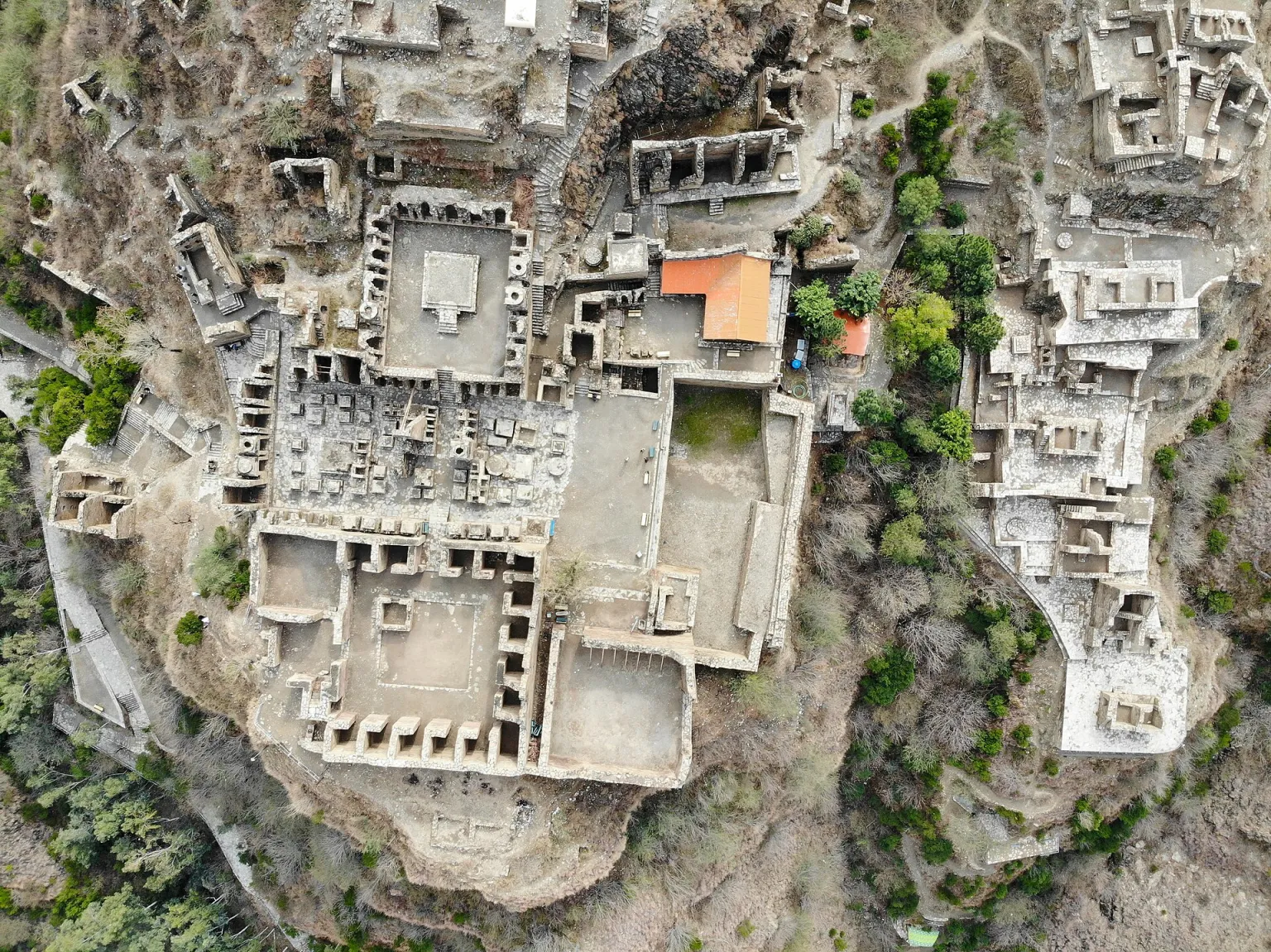
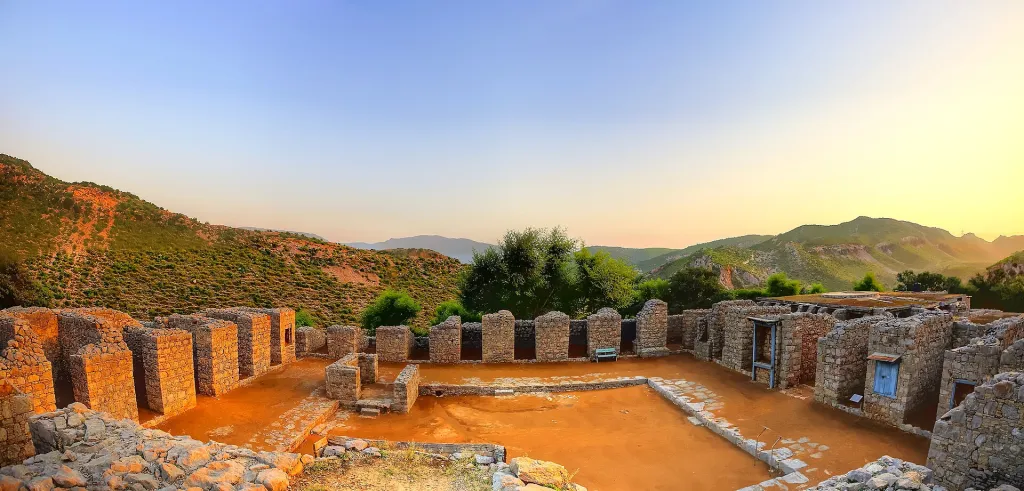
Takht-i-Bahi, Mardan District, Khyber Pakhtunkhwa
About Gandhara
Gandhara is the ancient name of a region in what is now north-western Pakistan, centred on the Vale of Peshawar and reaching into the lower Kabul and Swat river valleys. Its chief cities were Taxila (ancient Takshashila) and Peshawar (ancient Purushapura). Sitting where routes from Persia, Central Asia and the Indian plains met, it was one of the great cultural crossroads of the ancient world.
Over a thousand years Gandhara passed between Persian, Greek, Indian, Central Asian and Iranian rulers. Under the Mauryan emperor Ashoka in the 3rd century BCE it became a stronghold of Buddhism, and under the Kushans in the early centuries CE it flowered into a land of monasteries, stupas and workshops whose sculpture blended Indian Buddhist ideas with Greco-Roman artistic forms.
That sculpture, now treasured in the Peshawar, Lahore and Taxila museums and in collections from London to Tokyo, is what most people mean by ‘Gandhara’ today. On the ground, the hilltop monastery of Takht-i-Bahi and the ruined cities and stupas of Taxila let visitors walk through the same spaces monks and merchants used two thousand years ago.

Key Sites of Gandhara
Cities, monasteries and stupas you can still visit in Punjab and Khyber Pakhtunkhwa.
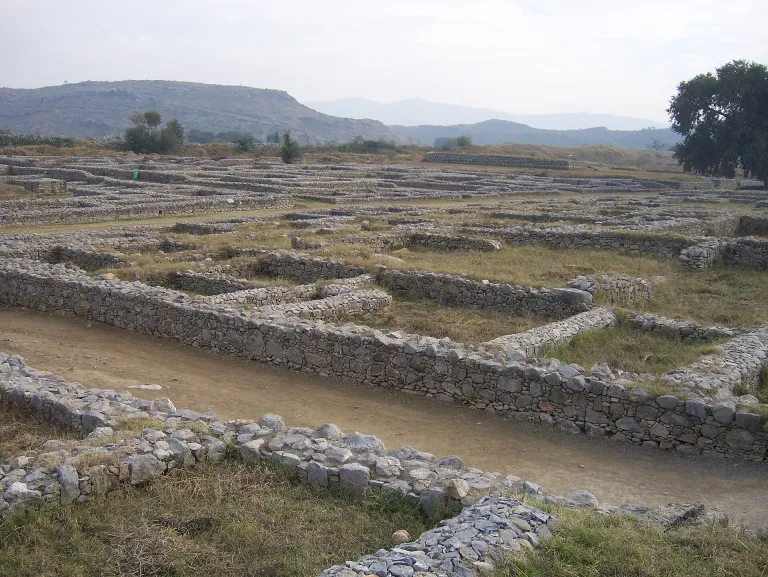 TaxilaA serial UNESCO site with four successive cities, Saraikala, the Bhir Mound, Sirkap and Sirsukh, and a ring of Buddhist monasteries and stupas. It reached its height between the 1st and 5th centuries CE.
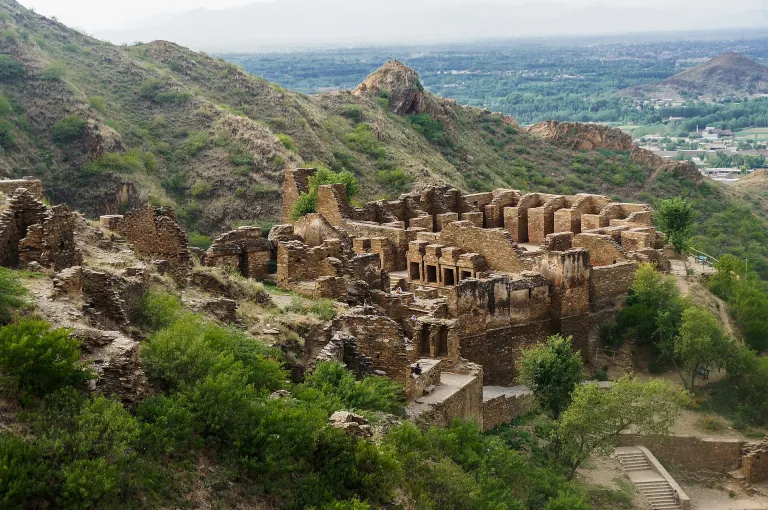 Takht-i-BahiA hilltop monastic complex founded in the early 1st century CE and used until the 7th. Its hill setting spared it from later destruction, making it the most complete Buddhist monastery in Pakistan.
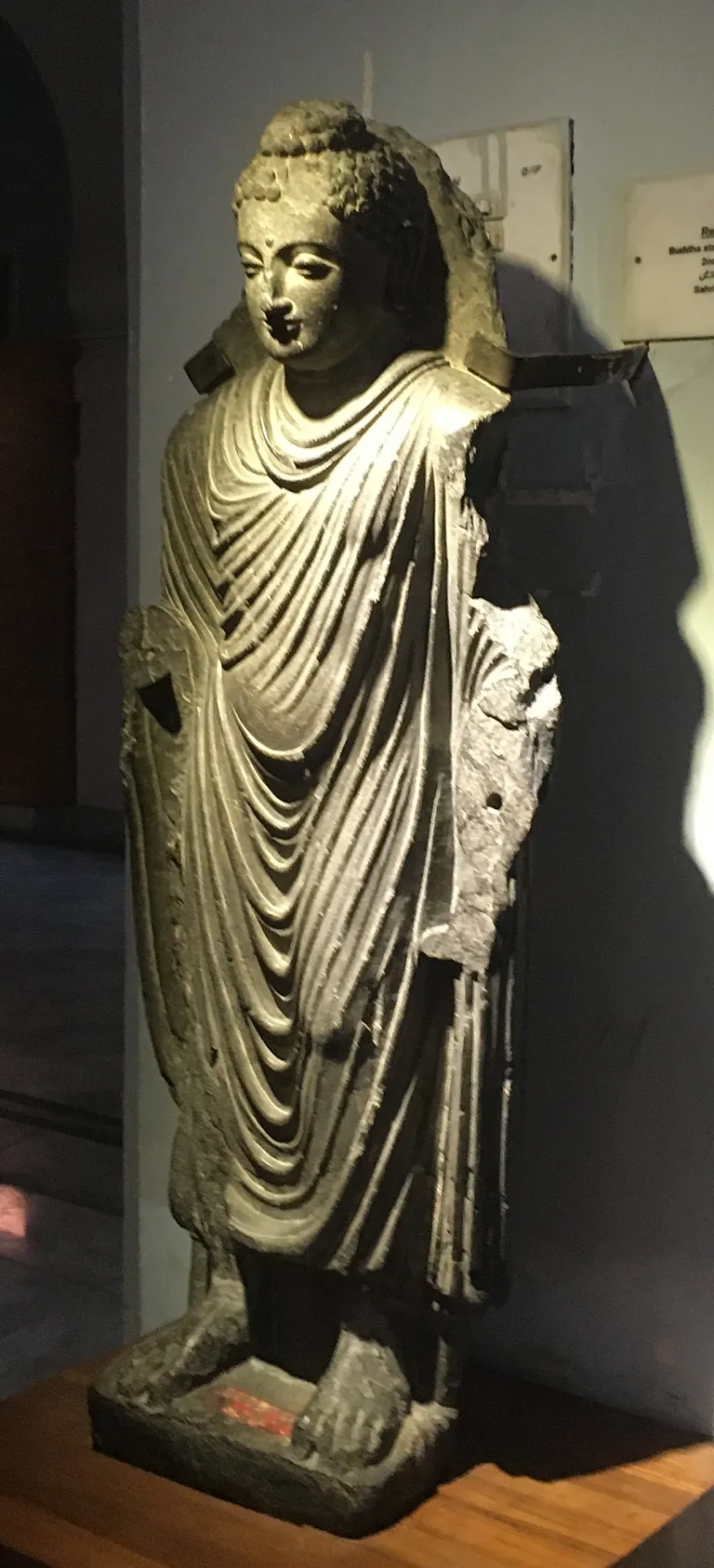 Sahr-i-BahlolThe remains of a small fortified Kushan-period town about 5 km from Takht-i-Bahi, inscribed with it. Excavations here in 1909–1910 yielded major sculptures now in the Peshawar Museum.
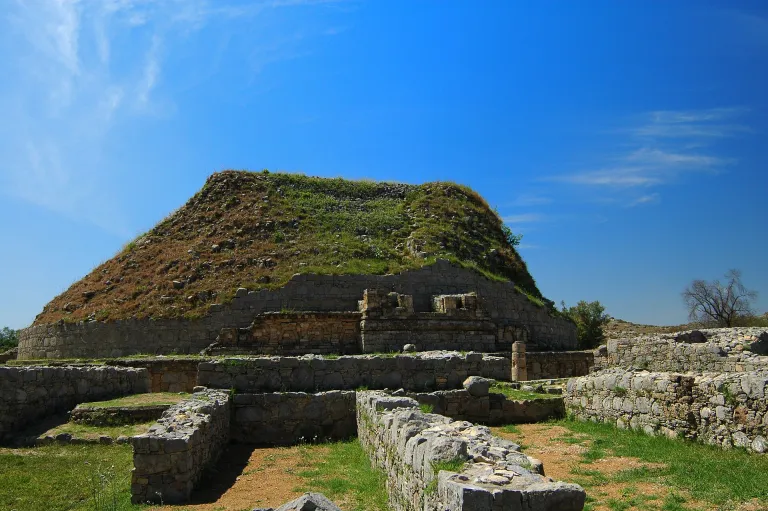 Dharmarajika StupaA large circular stupa at Taxila, ringed by smaller votive stupas and chapels and associated by tradition with the Mauryan period.
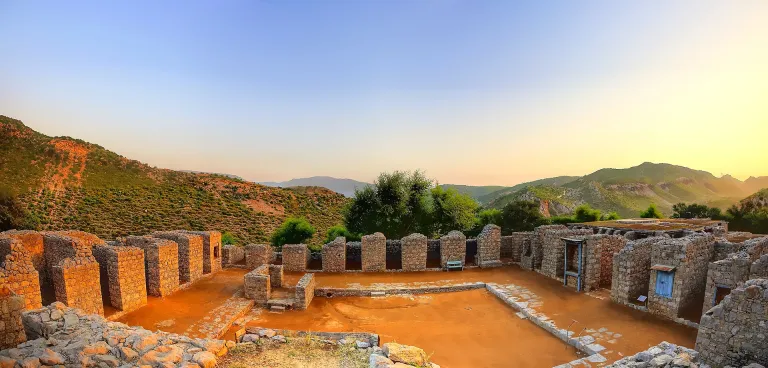 Jaulian MonasteryA hilltop monastery near Taxila with a stupa court, monks' cells and well-preserved stucco figures of the Buddha.
 Swat ValleyAncient Uddiyana, dotted with stupas, monasteries and rock carvings, part of Gandhara's wider Buddhist landscape.
Timeline of Gandhara
6th century BCE
Persian province
Gandhara is incorporated into the Achaemenid Persian empire as a satrapy. The Bhir Mound city at Taxila is probably founded around this time.
327–326 BCE
Alexander the Great
Alexander enters Gandhara and is received at Taxila before pushing east towards the Beas River.
c. 322 BCE onwards
Mauryan rule and Ashoka
Chandragupta Maurya takes the Punjab; under Ashoka in the 3rd century BCE Buddhism becomes dominant and missionaries spread it northwards.
2nd–1st century BCE
Indo-Greeks, Shakas and Parthians
Greek rulers from Bactria found Sirkap at Taxila on a Hellenistic grid plan; Scythian (Shaka) and Parthian dynasties follow.
1st–3rd century CE
The Kushan golden age
Kushan emperors, notably Kanishka, rule from Purushapura (Peshawar). Monasteries multiply and Gandharan sculpture reaches its peak.
From the 3rd century CE
Stucco takes over
Sculptors increasingly work in modelled stucco and clay alongside or instead of carved schist.
5th century CE
Hephthalite invasions
Taxila is sacked by the Hephthalites (the ‘White Huns’), and the urban and monastic network begins to decline.
7th century CE
Last monastic phase
Takht-i-Bahi remains in use until about the 7th century; Gandhara's distinctive art fades out.
11th century CE
Ghaznavid conquest
Mahmud of Ghazni takes the region, which then passes to a succession of Muslim dynasties.
Gandhara Art: East Meets West
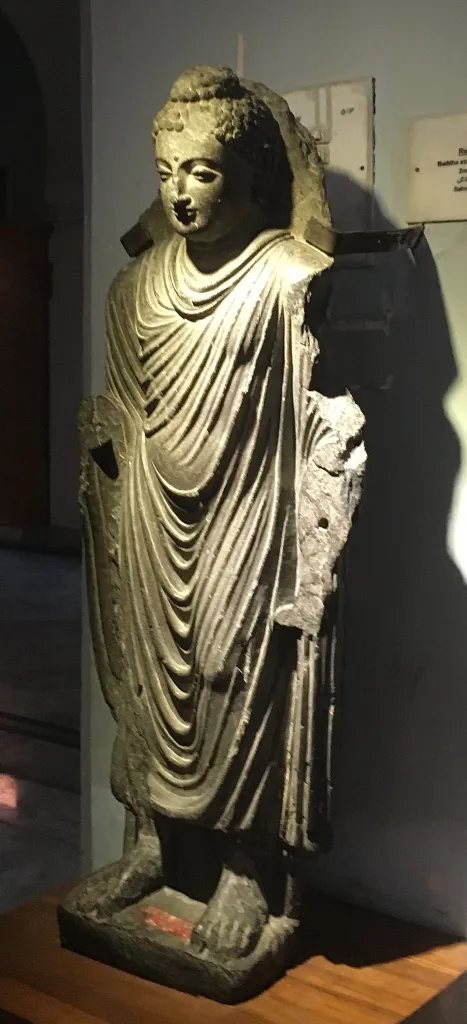
Gandhara's sculptors drew on two worlds at once. The subjects are Indian and Buddhist: the life of the Buddha from his miraculous birth to his death, the bodhisattva Maitreya, jataka tales of his previous lives, donors and worshippers. The style owes much to the Hellenistic and Roman art that reached the region through Greek settlement and Kushan trade with the Roman world: the Buddha often has a youthful, Apollo-like face and wears a heavy, deeply folded robe resembling the drapery of Roman imperial statues, while friezes are framed by vine scrolls, garland-bearing cherubs, tritons and centaurs.
Britannica stresses that the basic iconography nevertheless remained Indian. Gandhara developed alongside a quite different Kushan school at Mathura in present-day India; the two schools created their own images of the Buddha at around the same time, about the 1st century CE, and influenced each other. Which school portrayed the Buddha in human form first is still debated.
Materials
Early works were carved in grey-blue mica schist and green phyllite. From the 3rd century CE, stucco became increasingly common, especially for figures on stupas and in monastery chapels, as at Jaulian. Sculptures were originally painted and gilded; the bare grey stone we see today is only part of how they once looked.
Artefacts and Notable Works
Highlights held in Pakistan's museums and international collections.
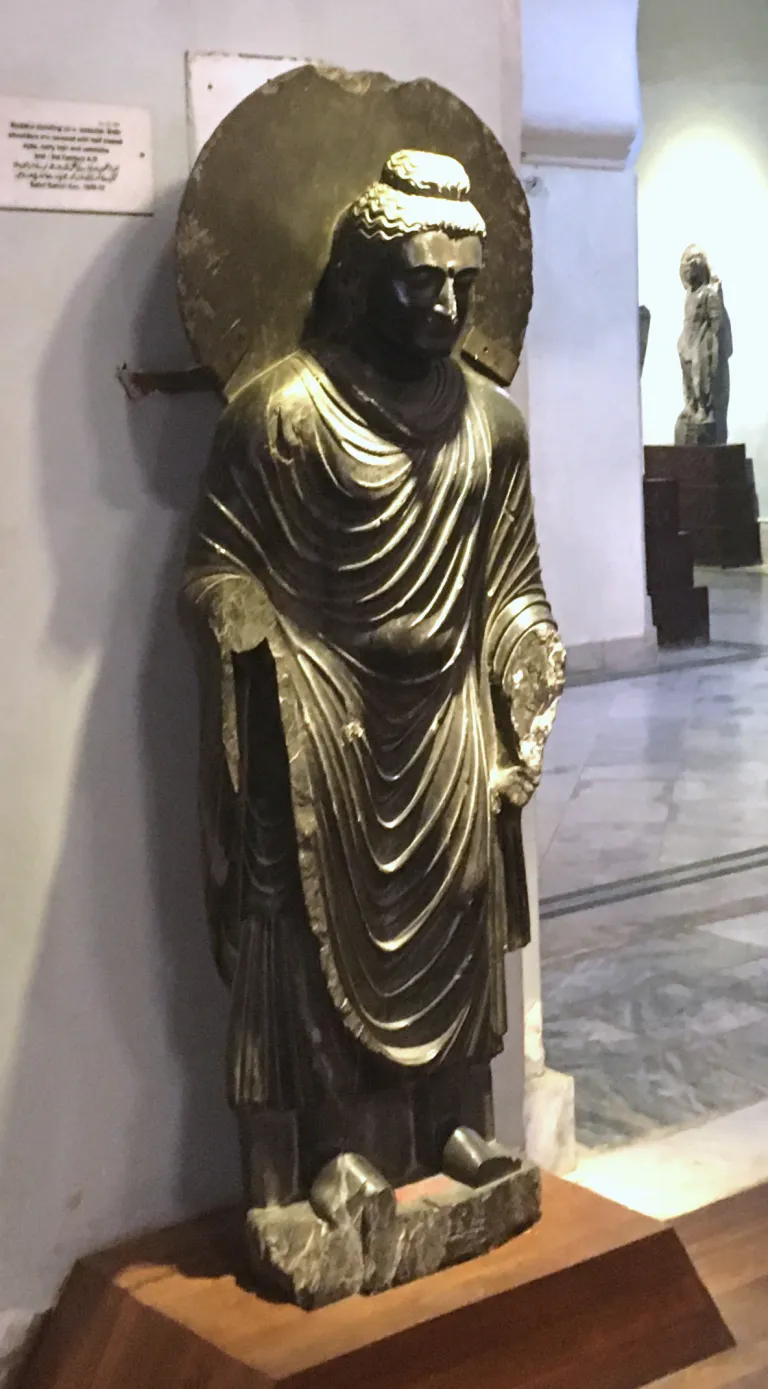
Sahri Bahlol BuddhaA large standing Buddha excavated at Sahri Bahlol in 1909–1910, showing the classic Gandharan halo, wavy hair and heavy pleated robe.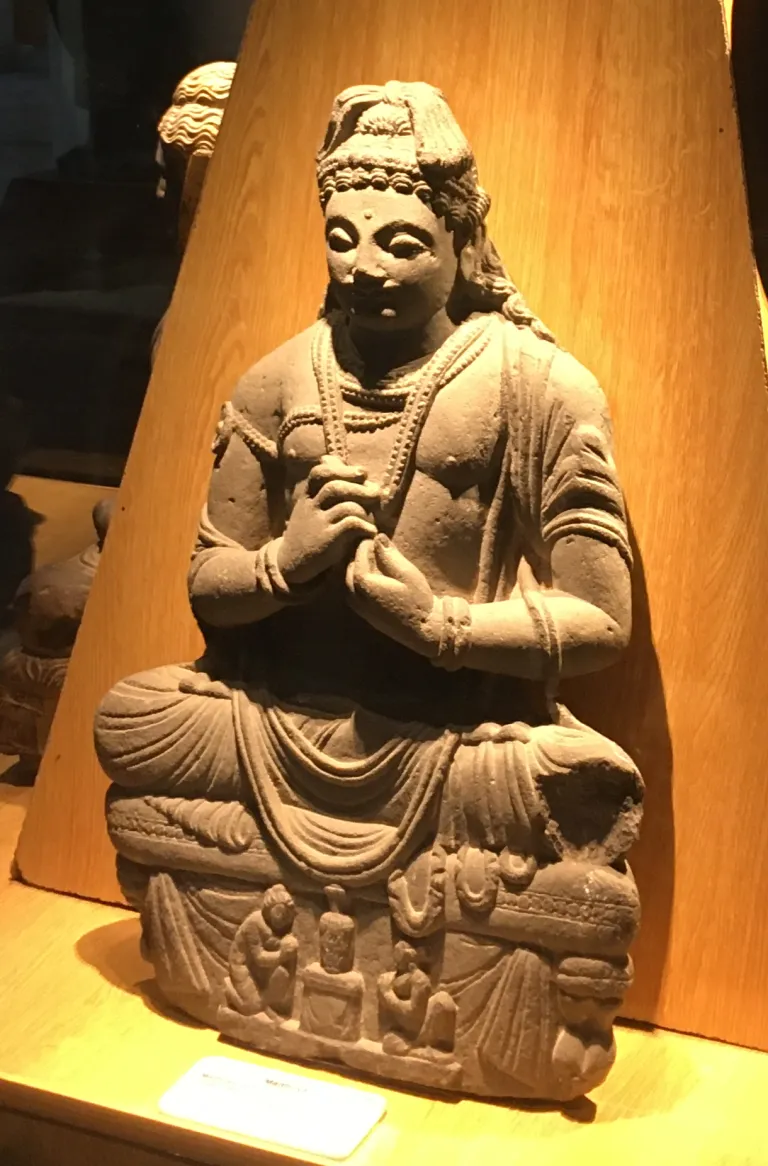 Seated BodhisattvaBodhisattvas were shown as richly dressed princes with jewellery, turbans and moustaches, a striking contrast with the monk-like Buddha.
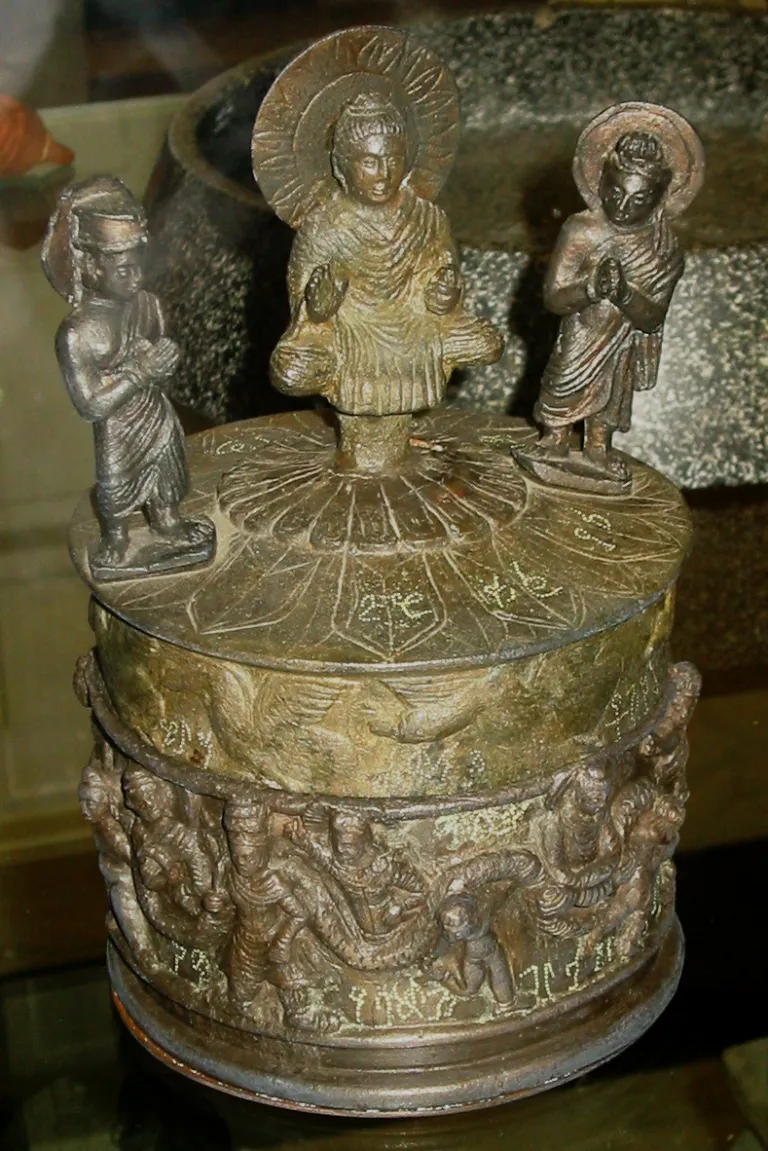 Kanishka casketA gilded copper reliquary inscribed with the name of the Kushan emperor Kanishka and decorated with seated Buddhas. The original is in the Peshawar Museum; its exact date depends on the debated chronology of Kanishka's reign.
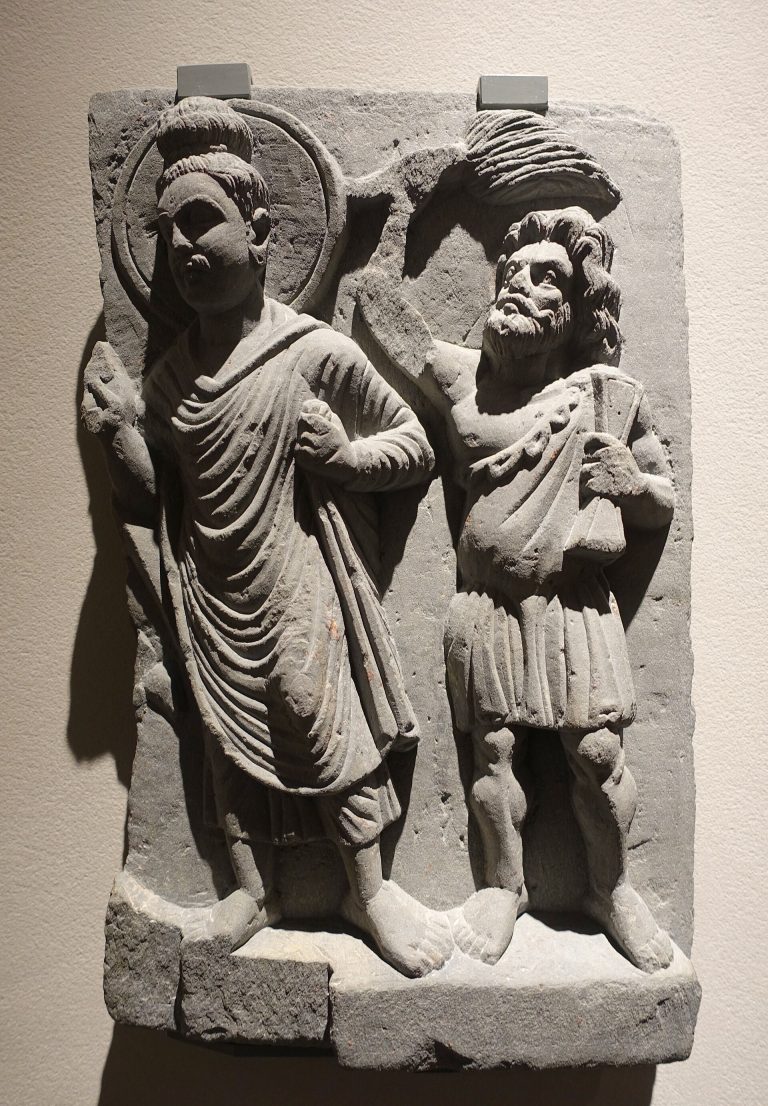 Buddha with VajrapaniA relief in which the Buddha's protector Vajrapani is portrayed like the Greek hero Herakles, a vivid example of borrowed imagery given new meaning.
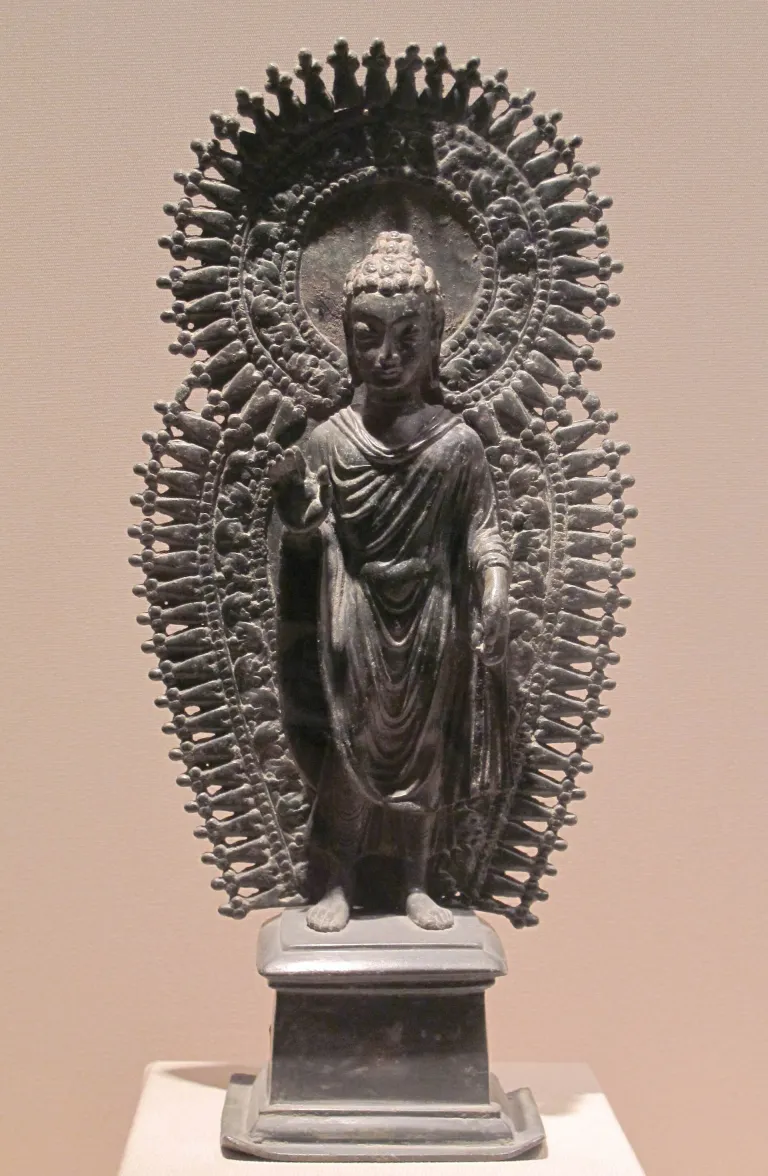 Buddha with radiate haloA standing Buddha framed by a halo and a full-body mandorla, from a later phase of Gandharan art.
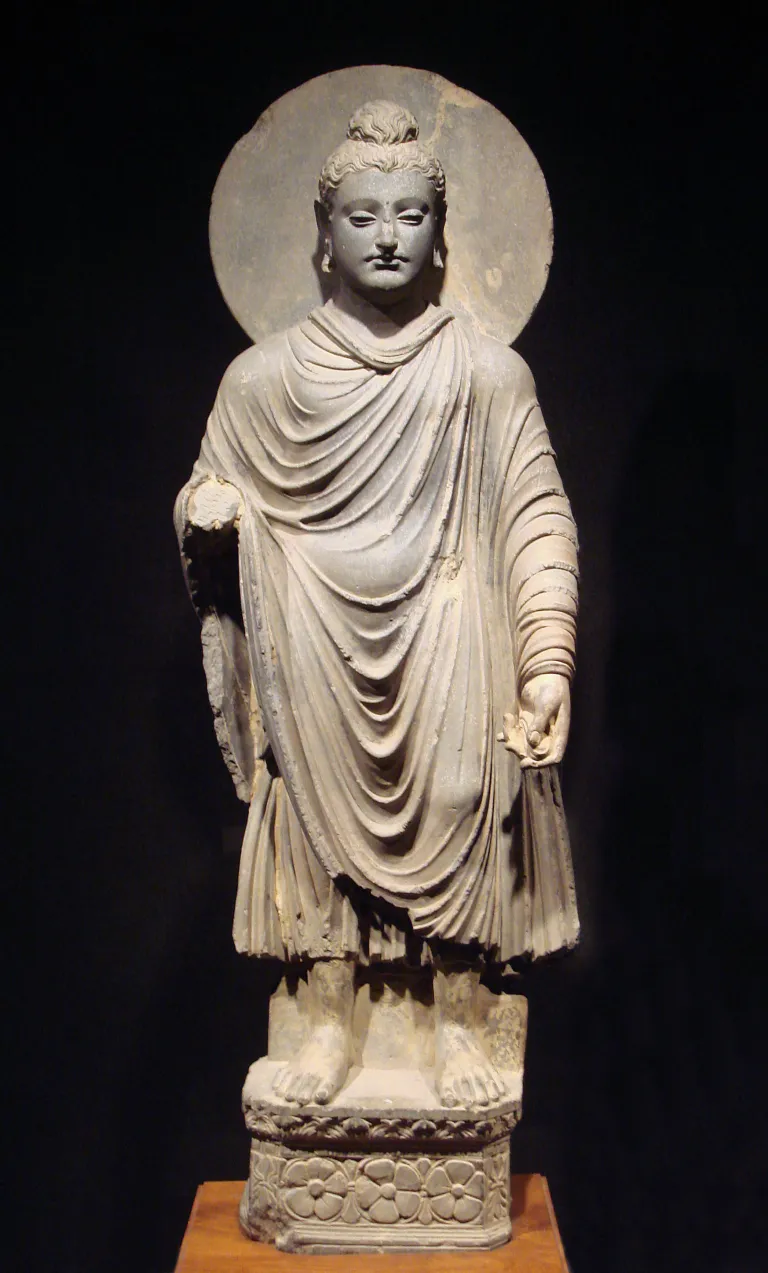 Standing BuddhaOne of many Gandharan Buddhas now abroad, showing the idealised face and classical drapery that made the style famous worldwide.
Monks, Merchants and Pilgrims
Gandhara's monasteries were planned communities. At Takht-i-Bahi a court of votive stupas sits beside a monastic quadrangle of small meditation cells, a hall for gatherings and covered stairways linking the terraces. Monks lived on donations from lay patrons, merchants, officials and families whose gifts are recorded in short inscriptions and often depicted in reliefs.
Wealth came from trade. Taxila stood at the junction of three major routes and on a branch of the Silk Roads, so goods, coins and ideas from Persia, the Mediterranean and Central Asia passed through it. Excavated cities such as Sirkap, with its straight main street, shops, houses and shrines, show a cosmopolitan population: Buddhist, Jain, Greek and Iranian religious traditions all left traces.
Gandhara was also a centre of learning. UNESCO notes that from roughly the 5th century BCE to the 2nd century CE Taxila was an important Buddhist centre of learning, and that its monuments drew pilgrims from as far away as Central Asia and China. Local texts were written in the Gandhari language using the Kharosthi script, which is also used in Ashoka's rock edicts in the region.
Evidence and Interpretation
Well established: the region's succession of rulers, the dating of Takht-i-Bahi and the Taxila cities from excavation, the materials and workshops of Gandharan sculpture, and the Buddhist character of its monasteries.
Still debated: the exact dates of Kanishka's reign (and so of objects tied to it), how much Gandharan art owes to Greek settlers versus later contact with Rome, and whether Gandhara or Mathura produced the first anthropomorphic Buddha. Many museum pieces were removed in the 19th and early 20th centuries with poor records of where they were found, which limits what they can tell us.
Decline and Legacy
Gandhara's decline was gradual. The Hephthalite invasions of the 5th century CE devastated Taxila, patronage weakened, and trade routes shifted. Some monasteries, such as Takht-i-Bahi, carried on until about the 7th century, but by then the region's Buddhist culture was fading. From the 11th century, under the Ghaznavids and later Muslim dynasties, the area's religious and cultural life took a different course.
Gandhara's influence long outlived it. Missionaries and pilgrims carried Buddhist texts and images along the Silk Roads, and the Gandharan Buddha shaped how the Buddha was portrayed in Central Asia, China and beyond. In Pakistan today, Gandhara is a living part of heritage tourism: Buddhist visitors from East and South-East Asia travel to Taxila, Takht-i-Bahi and Swat, and the Taxila and Peshawar museums are among the finest places anywhere to see this art.
Seeing Gandhara Today
Taxila Museum & ruins
Near Islamabad
The museum and the sites of Sirkap, Dharmarajika and Jaulian make an easy day trip from Islamabad or Rawalpindi.
Takht-i-Bahi
Mardan District
A steep but rewarding climb to the monastery terraces; go early in the day for cooler temperatures and soft light.
Peshawar Museum
Peshawar
One of the world's richest collections of Gandharan sculpture, including finds from Sahri Bahlol.
Before you go
Opening times and access can change; check with the museum or provincial archaeology department and follow current local advisories.

Frequently Asked Questions
Where exactly was Gandhara?
In north-western Pakistan: the Vale of Peshawar, extending into the lower Kabul and Swat valleys, with Taxila (near Islamabad) and Peshawar as its chief cities. Its cultural sphere also reached into eastern Afghanistan.
What is Gandhara art?
A school of mainly Buddhist sculpture that flourished from about the 1st century BCE to the 7th century CE, especially under the Kushans. It combines Indian Buddhist subjects with Greco-Roman styles of face, drapery and decoration, carved in schist or modelled in stucco.
Which Gandhara sites are UNESCO World Heritage Sites?
Two properties, both inscribed in 1980: Taxila, and the Buddhist Ruins of Takht-i-Bahi with the neighbouring city remains at Sahr-i-Bahlol.
Who was Kanishka?
The most famous Kushan emperor, who ruled in the late 1st to mid-2nd century CE from Purushapura (Peshawar) and Mathura. He is remembered as a major patron of Buddhism, although the precise dates of his reign are still debated.
Where can I see Gandhara sculpture in Pakistan?
The Peshawar Museum, the Taxila Museum and the Lahore Museum hold the most important collections. Check opening times locally before visiting.
Keep Exploring
Related places and stories on DailyLife.pk
 TaxilaVisit Taxila: Dharmarajika stupa, Jaulian monastery, Sirkap and Taxila Museum.Swat ValleyPlan a trip to Swat Valley: Kalam, Mahodand Lake, Malam Jabba
 PeshawarPeshawar city guide: Qissa Khwani Bazaar, Mahabat Khan Mosque, Sethi House, Peshawar Museum, Pashtun food
 IslamabadIslamabad travel guide: Faisal Mosque, Pakistan Monument, Margalla Hills trails, Saidpur, markets, sectors, Metrobus
 RawalpindiRawalpindi guide: Raja Bazaar, Saddar, the Army Museum, history from the Gakhars to 1959, food
 MingoraMingora city guide: Saidu Sharif, the Swat Museum, Butkara I, Fizagat and the White Palace, bazaars
How we know this
- Type Historical & cultural research
- Sources 8 (6 official/academic)
- Reviewed October 2026
- Disputed points Yes, see the debates
8 sources
- Gandhara, Encyclopaedia Britannica
- Gandhara art, Encyclopaedia Britannica
- Pakistan: History, Encyclopaedia Britannica
- Taxila, Encyclopaedia Britannica
- Taxila, UNESCO World Heritage Centre
- Buddhist Ruins of Takht-i-Bahi and Neighbouring City Remains at Sahr-i-Bahlol, UNESCO World Heritage Centre
- Kushan Empire (ca. 2nd century B.C.–3rd century A.D.), The Metropolitan Museum of Art, Heilbrunn Timeline of Art History
- Kanishka Casket: cross-reference, Wikipedia
Photo credits (15)
- Takht-i-Bahi Buddhist Monastery.jpg, Muzamil Hassain Toori, CC BY-SA 4.0, via Wikimedia Commons
- Takht-e-bahi.jpg, Asif Nawaz, CC BY-SA 3.0, via Wikimedia Commons
- Dharmarajika stupa,Taxila.jpg, Sasha Isachenko, CC BY-SA 3.0, via Wikimedia Commons
- Dharmarajika stupa and monastery c by Usman Ghani.jpg, Usman.pg, CC BY-SA 3.0, via Wikimedia Commons
- SirkapCity.JPG, Dawoodmajoka, Public domain, via Wikimedia Commons
- Jaulian Buddhist Monastery in Taxila.jpg, ClicksByMohammadOmer, CC BY-SA 3.0, via Wikimedia Commons
- Peshawar Museum Sahri Bahlol Buddha, excavated 1909-1910.jpg, Batool Nasir, CC BY-SA 2.0, via Wikimedia Commons
- Peshawar Museum - Standing Buddha (cropped).jpg, Batool Nasir, CC BY-SA 2.0, via Wikimedia Commons
- Peshawar Museum Seated Bodhisattva.jpg, Batool Nasir, CC BY-SA 2.0, via Wikimedia Commons
- KanishkaCasket.JPG, Personal photograph, CC BY-SA 3.0, via Wikimedia Commons
- Buddha and Vajrapani, Gandhara, 1st century AD, schist - Ethnological Museum, Berlin - DSC01644.JPG, Daderot, CC0, via Wikimedia Commons
- Buddha with radiate halo and mandorla.Gandhara.Met.jpg, Ismoon (talk), CC BY-SA 4.0, via Wikimedia Commons
- Gandhara Buddha (tnm).jpeg, World Imaging, Public domain, via Wikimedia Commons
- Mohenjodaro - view of the stupa mound.JPG, Saqib Qayyum, CC BY-SA 3.0, via Wikimedia Commons
- Panoramic shot of SWAT. the place is called KALAM.jpg, Syed ali025, CC BY-SA 4.0, via Wikimedia Commons
