
Historical event
The 1971 War and the Separation of East Pakistan
The year Pakistan lost its eastern wing: a military crackdown, civil war, ten million refugees, war with India and surrender in Dhaka.
- 25 March – 16 December 1971
- About 10 million refugees to India
- Death toll fiercely contested
- Bangladesh independent
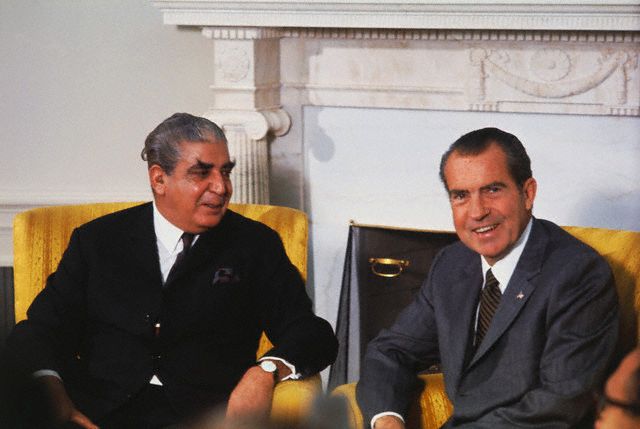
Portrait of General Yahya Khan
- When
- 25 March – 16 December 1971
- Key people
- Yahya Khan, Sheikh Mujibur Rahman, Zulfikar Ali Bhutto
- Certainty
- Historically disputed
What Happened
The Awami League's victory in the December 1970 election was not followed by a transfer of power. As talks among President Yahya Khan, Sheikh Mujibur Rahman and Zulfikar Ali Bhutto failed, East Pakistan was gripped by a mass non-cooperation movement. On the night of 25 March 1971 the army launched a military operation, known as Operation Searchlight, to crush the movement. Mujib was arrested and flown to West Pakistan, and the Awami League was banned; on 26 March Bengali nationalists declared independence.
Nine months of civil war followed. Bengali soldiers, police and civilians formed the Mukti Bahini guerrilla forces, supported by India. Pakistani forces and allied militias carried out widespread killings, including of students, Hindus and, in the final days, intellectuals in Dhaka; sexual violence against women was extensive. There were also killings of Biharis (Urdu-speaking migrants) and West Pakistanis by Bengali nationalists. About ten million refugees fled to India.
After Pakistani air strikes on northern India on 3 December 1971, open war broke out on both fronts. Indian and Mukti Bahini forces advanced on Dhaka, and on 16 December 1971 Lt Gen A. A. K. Niazi signed the instrument of surrender in Dhaka. A ceasefire on the western front followed on 17 December. East Pakistan became the independent state of Bangladesh.
Background
From 1947 the two wings were separated by about 1,600 km of Indian territory and by language, economy and political grievance. East Pakistan had the majority of the population, yet many Bengalis felt excluded from power, through the early dispute over Urdu as the sole national language, the parity formula of 1956, years of military rule and a perceived unfair share of resources. The 1965 war deepened the sense in the East that it had been left undefended. These grievances found expression in the Awami League's Six Points and its landslide in 1970.
Timeline
7 December 1970
Election
The Awami League wins 160 of 300 general seats; the PPP wins 81 in the West.
March 1971
Deadlock
The National Assembly's first session is postponed; non-cooperation spreads across East Pakistan.
25 March 1971
Operation Searchlight
The army begins its crackdown in Dhaka and other cities; Mujib is arrested.
26 March 1971
Independence declared
Bengali nationalists proclaim independence; Bangladesh marks this as its Independence Day.
April–November 1971
Civil war
Fighting between the army and the Mukti Bahini; mass killings and displacement; refugees pour into India.
August 1971
Indo-Soviet treaty
India signs a treaty of friendship and cooperation with the Soviet Union.
3 December 1971
Full war
After Pakistani air strikes on India, war begins on both the eastern and western fronts.
14 December 1971
Killing of intellectuals
Academics, doctors, writers and engineers are abducted and murdered in Dhaka by the army and allied militia.
16 December 1971
Surrender
Pakistani forces in the East surrender in Dhaka; over 93,000 become prisoners of war.
17 December 1971
Western ceasefire
A ceasefire takes effect on the western front; Yahya Khan hands power to Zulfikar Ali Bhutto days later.
26 December 1971
Inquiry ordered
Bhutto sets up the Hamoodur Rahman Commission to investigate the defeat.
2–3 July 1972
Simla Agreement
Bhutto and Indira Gandhi agree to settle differences bilaterally and respect the Line of Control.
How Many Died? Attributed Estimates
| Estimate | Figure | Source |
|---|---|---|
| Bangladesh official figure | 3 million | Government of Bangladesh |
| Pakistan's Hamoodur Rahman Commission | About 26,000 | Commission report (1974; declassified 2000) |
| BMJ survey-based study (2008) | About 269,000 (range 125,000–505,000) | Obermeyer, Murray & Gakidou, BMJ |
| Range in Bangladeshi media and reference works | 300,000 – 3 million | As summarised in the Wikipedia cross-reference |
| Scholars at a 2005 US State Department conference | Between 26,000 and 3 million | Reported by Dawn (2005) |
No full count was ever made. Figures cover deaths in East Pakistan during 1971; military deaths in the December war are counted separately by each side. Dawn (2005) reported Bangladeshi scholars' view that an original figure of about 300,000 may have been mistranslated as three million.
Consequences
Pakistan lost more than half its population and its eastern wing. In what remained, Bhutto led a government that framed the 1973 Constitution. The Simla Agreement, signed in the early hours of 3 July 1972 (often dated 2 July), committed both countries to bilateral settlement and converted the ceasefire line in Kashmir into the Line of Control; a later agreement in Delhi led to the release of the prisoners of war, including 195 accused of war crimes. Bangladesh was admitted to the United Nations in 1974.
Pakistan's Hamoodur Rahman Commission called the surrender premature, accused the army of atrocities including killings and rape, and recommended the trial of senior generals; its recommendations were largely not acted on, and the report was kept secret until parts were published in 2000. The events of 1971 remain a deeply painful and contested chapter for Pakistanis, Bangladeshis and Indians alike.
How We Know
Evidence includes the Hamoodur Rahman Commission's reports (1972 and 1974), Bangladeshi testimonies and war-crimes trials, Indian official histories, US diplomatic records (summarised by the Office of the Historian and released in 2005), journalists' reports from 1971, and later research such as the 2008 BMJ survey study of war deaths. Each body of evidence has gaps and biases, and access to some archives remains restricted.
Three Accounts of 1971
- Pakistani accounts have long emphasised Indian intervention, India's support for the Mukti Bahini and the political failures of 1970–71 as the causes of the break-up, and highlight violence against Biharis and West Pakistanis. Pakistan's own Hamoodur Rahman Commission, however, documented army atrocities and blamed the military leadership, and Pakistani writers and historians increasingly acknowledge the suffering of Bengalis.
- Bangladeshi accounts describe a war of liberation against genocide, with an official death toll of three million and hundreds of thousands of women raped; 26 March and 16 December are national days.
- Indian accounts present India's intervention as a response to a humanitarian catastrophe and a refugee burden of some ten million, ending in a decisive military victory.
- Independent scholarship generally accepts that mass atrocities occurred and that the scale was very large, while differing on numbers: survey-based estimates (BMJ, 2008) are in the hundreds of thousands, and scholars at a 2005 US conference agreed the toll lay between the Pakistani and Bangladeshi official figures.
Before and After
Where this moment sits in Pakistan’s story.
Before
- December 1971
Third war
War during the crisis in East Pakistan ends with the surrender in Dhaka on 16 December and the independence of Bangladesh.
After
- 20 December 1971
President
After the war and the separation of East Pakistan, takes over from Yahya Khan as president and chief martial law administrator.
Frequently Asked Questions
Why did East Pakistan separate from Pakistan?
Long-standing grievances over political power, language and economic disparity came to a head when power was not transferred to the Awami League after its 1970 election victory. The army's crackdown from 25 March 1971 led to civil war; India's intervention in December led to the surrender of Pakistani forces in Dhaka on 16 December 1971 and the independence of Bangladesh.
How many people died in 1971?
Estimates differ enormously: about 26,000 according to Pakistan's Hamoodur Rahman Commission, 3 million according to the Bangladesh government, and about 269,000 (range 125,000–505,000) in a 2008 study in the BMJ. No full count was ever made.
What was the Hamoodur Rahman Commission?
A judicial inquiry set up by Zulfikar Ali Bhutto on 26 December 1971 and chaired by Chief Justice Hamoodur Rahman. Its reports criticised the military leadership, recorded army atrocities and recommended trials. They were kept secret until parts were published and the report was declassified in 2000.
How many Pakistani soldiers became prisoners of war?
Over 93,000 Pakistani personnel and civilians surrendered and were held in India until their release under an agreement that followed the Simla Agreement.
What was the Simla Agreement?
An agreement between Zulfikar Ali Bhutto and Indira Gandhi, signed in July 1972, to settle disputes bilaterally and peacefully, withdraw forces to the international border and respect the Line of Control in Kashmir resulting from the ceasefire of 17 December 1971.
Keep Exploring
Related places and stories on DailyLife.pk

How we know this
- Type Historical record
- Sources 9 (3 official/academic)
- Reviewed October 2026
- Disputed points Yes, see the debates
- Certainty Historically disputed
9 sources
- The South Asia Crisis and the Founding of Bangladesh, 1971, Office of the Historian, US Department of State
- Bangladesh Liberation War, Encyclopaedia Britannica
- Bangladesh Liberation War (cross-reference), Wikipedia
- Hamoodur Rahman Commission (cross-reference), Wikipedia
- Sheikh Mujib wanted a confederation: US papers (Anwar Iqbal, 7 July 2005), Dawn
- Fifty years of violent war deaths from Vietnam to Bosnia (Obermeyer, Murray & Gakidou), BMJ 2008;336:1482, BMJ / IHME Global Health Data Exchange record
- A leaf from history: Simla Agreement, at last (23 September 2012), Dawn
- 1970 Pakistani general election (cross-reference; cites Craig Baxter, 'Pakistan Votes – 1970', Asian Survey 1971), Wikipedia
- UNMOGIP: United Nations Military Observer Group in India and Pakistan, United Nations Peacekeeping
Photo credits (2)
- Yahya and Nixon.jpg, Oliver F. Atkins, Public domain, via Wikimedia Commons
- Zulfikar Ali Bhutto Portrait (cropped 2).jpg, Bernard Gotfryd, Public domain, via Wikimedia Commons
