

Historical event
The Lahore Resolution1940
In March 1940 the Muslim League, meeting in Lahore, demanded independent Muslim-majority states, the moment the demand for Pakistan became official.
- 22–24 March 1940
- Minto (Iqbal) Park, Lahore
- Moved by A. K. Fazlul Huq
- Pakistan Day, 23 March
Minar-e-Pakistan, Lahore
- When
- 22–24 March 1940
- Where
- Lahore
- Key people
- Muhammad Ali Jinnah, Liaquat Ali Khan
- Certainty
- Well established
What Happened
From 22 to 24 March 1940 the All-India Muslim League held its annual session at Minto Park in Lahore (later Iqbal Park), below the walls of the Lahore Fort and the Badshahi Mosque. In his presidential address Muhammad Ali Jinnah argued that India's problem was not between communities but, in his words, 'of an international character': Muslims and Hindus were two nations, and no constitution could work that ignored this.
The resolution, moved by A. K. Fazlul Huq, Chief Minister of Bengal, and adopted on 23 March, declared that no constitutional plan would be acceptable to Muslims unless 'geographically contiguous units' were demarcated into regions so that the areas with Muslim majorities, in the north-western and eastern zones of India, were grouped to form 'Independent States' whose constituent units would be 'autonomous and sovereign'. It also demanded safeguards for minorities in both new and remaining areas.
The word 'Pakistan' did not appear in the text. But newspapers quickly labelled it the Pakistan Resolution, and the name stuck. Seven years later the demand was realised.
Background
The Muslim League had done poorly in the 1937 provincial elections, and Congress governed most provinces until its ministries resigned in late 1939 at the start of the Second World War. League leaders accused those ministries of neglecting Muslim interests, and Jinnah set out to rebuild the League as a mass party.
Ideas of a separate Muslim homeland were already in circulation: Iqbal's 1930 Allahabad Address had proposed a north-western Muslim state, and Choudhry Rahmat Ali had coined the name Pakistan in 1933. In early March 1940 Jinnah set out his two-nation argument in an article for the London weekly Time and Tide. The Lahore session turned these strands into the League's official demand.
Timeline
1937
Election setback
The League fares poorly in the provincial elections; Jinnah begins reorganising it.
9 March 1940
'Two Nations in India'
Jinnah's article in Time and Tide sets out the two-nation argument for a British audience.
22 March 1940
Session opens
Jinnah gives his presidential address at Minto Park, Lahore.
23 March 1940
Resolution adopted
Fazlul Huq moves the resolution; it is seconded by leaders from across India including Chaudhry Khaliquzzaman, Zafar Ali Khan, Sardar Aurangzeb Khan and Sir Abdullah Haroon.
24 March 1940
Session closes
The League session ends; the press soon calls the text the 'Pakistan Resolution'.
1945–46
Electoral mandate
The League wins about 87% of Muslim seats in the provincial elections on the Pakistan platform.
14 August 1947
Pakistan created
Pakistan becomes independent.
23 March 1956
Republic Day
The first constitution comes into force on the resolution's anniversary; 23 March becomes Pakistan Day.
Consequences
The resolution changed the terms of Indian politics. From 1940 the League's goal was no longer safeguards within a single India but separate Muslim-majority states, and every later negotiation, the Cripps Mission of 1942, the Gandhi–Jinnah talks of 1944 and the Cabinet Mission of 1946, had to address it. In the elections of 1945–46 the League campaigned on the Pakistan demand and won the great majority of Muslim seats.
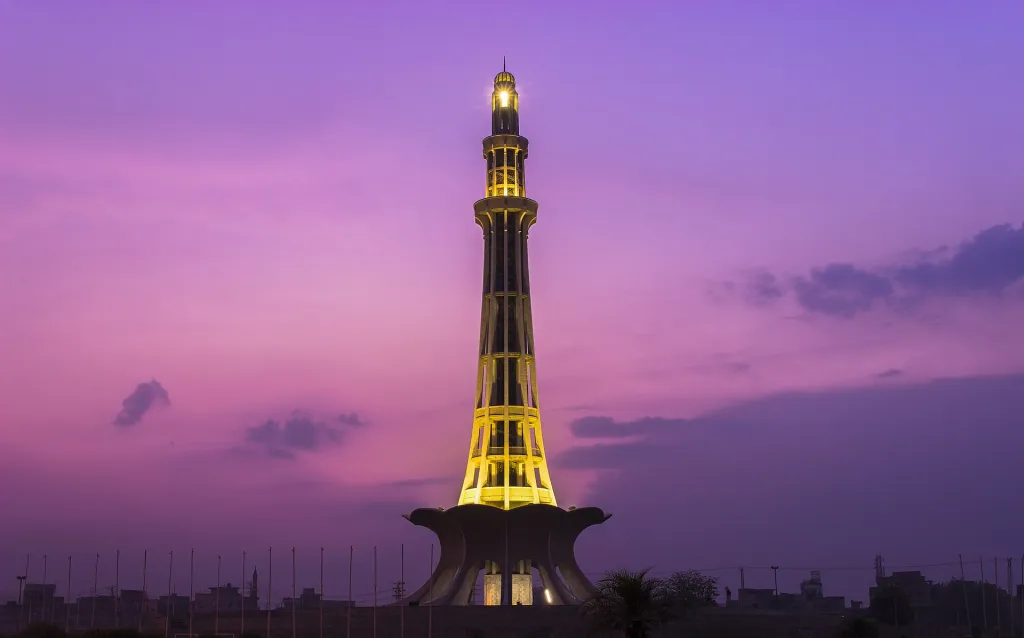
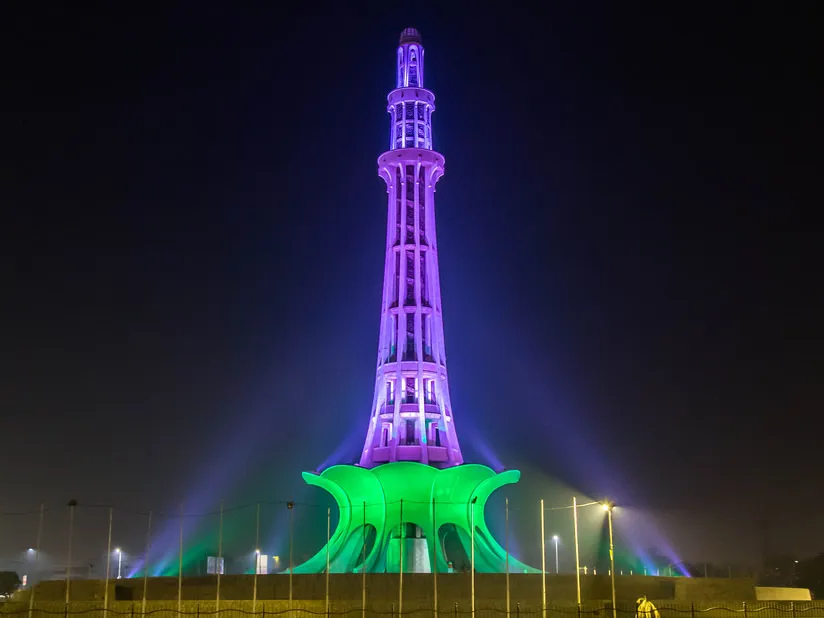
In Pakistan, 23 March is Pakistan Day, a public holiday that also marks the coming into force of the first constitution in 1956. The Minar-e-Pakistan, a tower about 60 metres high, was built on the site of the 1940 session; and the surrounding Greater Iqbal Park is one of Lahore's best-known public spaces.
How We Know
The resolution's text, the proceedings of the session and Jinnah's address were published by the League and in the press at the time, and are collected in documentary volumes edited by Latif Ahmed Sherwani and examined in studies including Muhammad Aslam Malik's The Making of the Pakistan Resolution (Oxford University Press, 2001) and the National Archives of Pakistan's study of the League's 1940 Working Committee.
Debates
- 'States' or 'state'? The text spoke of 'Independent States' in the plural. Some Pakistani and Bangladeshi writers later argued this envisaged separate eastern and western states; others read it as loose drafting, since the League went on to pursue a single Pakistan.
- Goal or bargaining counter? Historian Ayesha Jalal, in The Sole Spokesman (1985), argued that Jinnah used the demand partly to secure parity for Muslims within a looser Indian union; many Pakistani historians see the resolution as a firm commitment to sovereignty from the start.
- Muslim opponents: Not all Muslims supported it, scholars such as Ali Usman Qasmi and Megan Eaton Robb have documented Muslim critics of the League's idea of Pakistan.
Frequently Asked Questions
What did the Lahore Resolution demand?
That the Muslim-majority areas in the north-western and eastern zones of India be grouped into 'Independent States' with autonomous and sovereign constituent units, with safeguards for minorities.
Who moved the Lahore Resolution?
A. K. Fazlul Huq, Chief Minister of Bengal. It was seconded by leaders from different provinces, including Chaudhry Khaliquzzaman, Zafar Ali Khan, Sardar Aurangzeb Khan and Sir Abdullah Haroon.
Did the resolution use the word 'Pakistan'?
No. The press soon called it the Pakistan Resolution, and that name became standard.
Why is 23 March Pakistan Day?
It marks the adoption of the Lahore Resolution in 1940 and the coming into force of Pakistan's first constitution on 23 March 1956, when Pakistan became an Islamic Republic.
Where was the resolution passed?
At Minto Park in Lahore, later renamed Iqbal Park. The Minar-e-Pakistan now stands on the site.
Keep Exploring
Related places and stories on DailyLife.pk
 Lahore Fort and Badshahi MosqueLahore Fort and Badshahi Mosque guide: Sheesh Mahal, Picture Wall, Alamgiri Gate
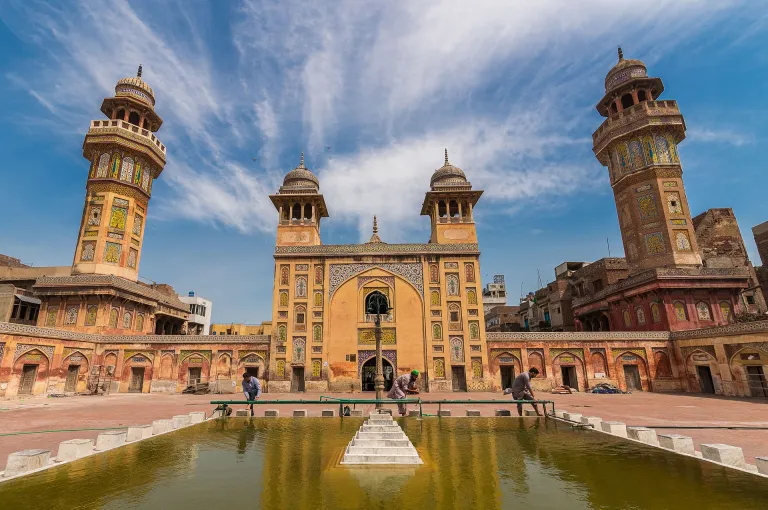 Walled City of LahoreExplore the Walled City of Lahore: Delhi Gate, the Royal Trail, Wazir Khan Mosque, Shahi Hammam
 LahoreLahore travel guide: Badshahi Mosque, Lahore Fort, Shalimar Gardens, the Walled City, food streets, neighbourhoods, metro
 The Pakistan MovementThe Pakistan Movement explained: Sir Syed and Aligarh, the Muslim League (1906), Iqbal's 1930 address
 The Making of Pakistan: A Timeline, 1857–1947Year-by-year timeline of Pakistan's creation, 1857–1947: Aligarh, the Muslim League, Iqbal's 1930 address, the Lahore Resolution
 Muhammad Ali JinnahQuaid-e-Azam Muhammad Ali Jinnah: life, law career, Muslim League, Lahore Resolution, 1947, death in 1948
How we know this
- Type Historical record
- Sources 6 (3 official/academic)
- Reviewed October 2026
- Disputed points Yes, see the debates
6 sources
- Lahore Resolution, Encyclopaedia Britannica
- Lahore Resolution (cross-reference; cites Sherwani, Malik, Jalal, Wolpert), Wikipedia
- Muslim League, Banglapedia (Asiatic Society of Bangladesh)
- Muslim League, Encyclopaedia Britannica
- 1946 Indian provincial elections (cross-reference; cites 'The Indian Elections – 1946', The World Today, and Stern 2001), Wikipedia
- Parliamentary History, National Assembly of Pakistan
Photo credits (4)
- The Minar-e-Pakistan.jpg, Ammar Ejaz, CC BY-SA 3.0, via Wikimedia Commons
- Minar e Pakistan night image.jpg, Holosoft, CC BY-SA 4.0, via Wikimedia Commons
- Jinnah1945a.jpg, Photographer not known, Public domain, via Wikimedia Commons
- Mazar-e-Quaid Karachi.jpg, Furqanlw, CC BY-SA 4.0, via Wikimedia Commons
