
Mountains
Five Giants: Pakistan's Eight-Thousanders
Five of the world's fourteen peaks above 8,000 m stand in Gilgit-Baltistan: K2, Nanga Parbat, Gasherbrum I, Broad Peak and Gasherbrum II. Heights, first ascents and where sources differ.
- Gilgit-Baltistan
- 5 of the world's 14 eight-thousanders
- Karakoram and western Himalaya
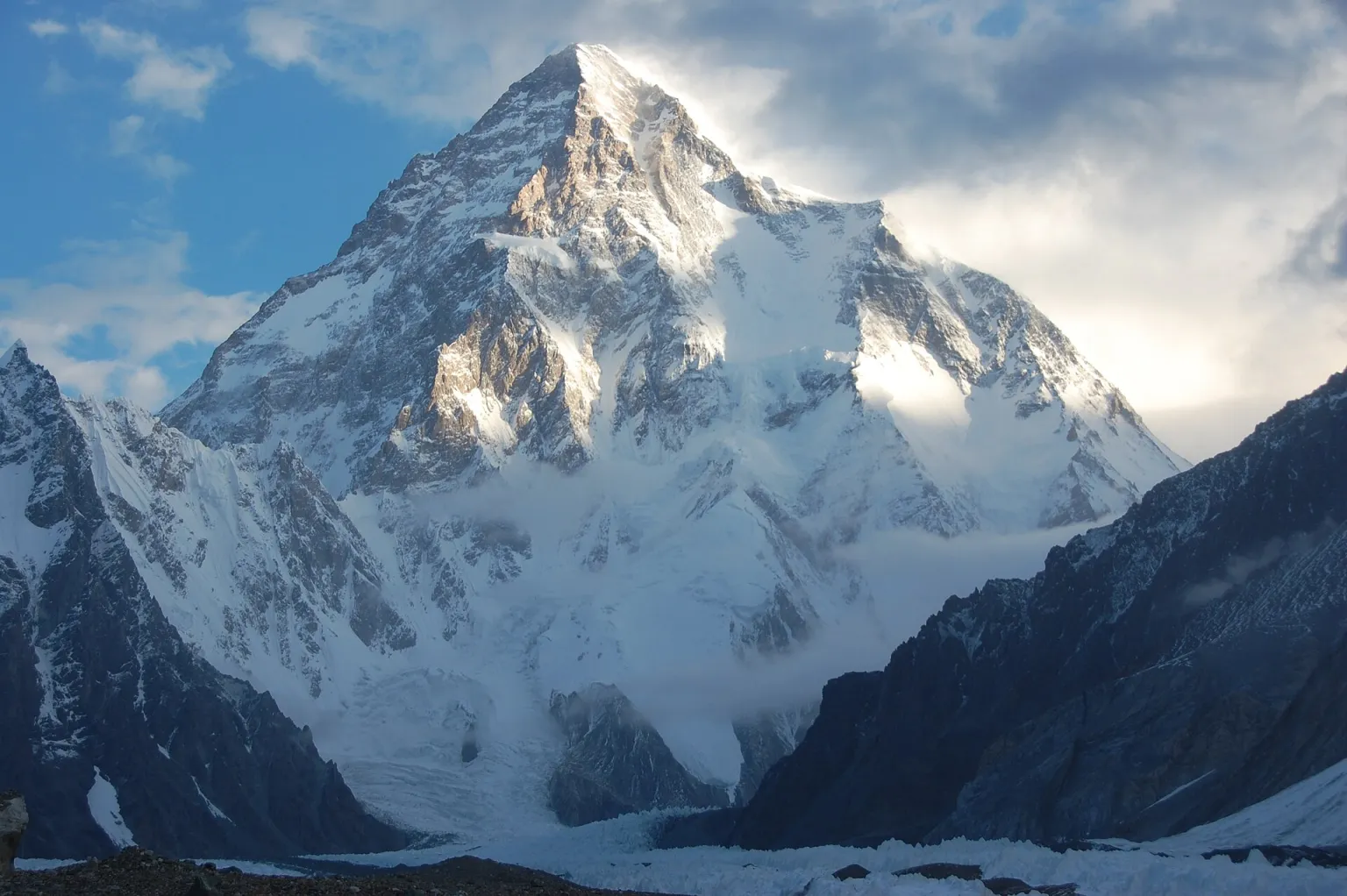
K2 seen from the Baltoro Glacier, Gilgit-Baltistan
Why Pakistan has so many
An eight-thousander is a mountain whose summit rises above 8,000 m. There are fourteen on Earth, and all of them lie in the Himalaya and Karakoram. Nepal, China, India and Pakistan share them. Pakistan holds five: K2, Nanga Parbat, Gasherbrum I, Broad Peak and Gasherbrum II. Four of the five (K2, Gasherbrum I, Broad Peak and Gasherbrum II) stand on the Karakoram watershed on the boundary with China's Xinjiang region. Nanga Parbat, in the western Himalaya, is the only one that lies entirely on the Pakistani side.
Four of the five crowd the head of the Baltoro Glacier in Baltistan, which is why one trek from Askole can pass beneath four of them. The odd one out, Nanga Parbat, rises alone above the Indus in Diamer and Astore districts. All five lie in Gilgit-Baltistan, a territory administered by Pakistan and part of the wider, disputed Kashmir region.
This page gives the heights and first ascents for each peak, and flags places where published sources disagree. Mountain heights are measured, re-measured and rounded in different ways, so a difference of a few metres between two respectable sources is normal and not an error on either side.
The five at a glance
| Peak | Height (main figure) | Other figures in print | Rank among the 14 | First ascent | First winter ascent |
|---|---|---|---|---|---|
| K2 (Chogori) | 8,611 m | 8,609.02 m from a 2014 satellite-based measurement, reported by Wikipedia | 2nd | 31 July 1954, Achille Compagnoni and Lino Lacedelli, Italian expedition | 16 January 2021, ten Nepali climbers |
| Nanga Parbat | 8,126 m (Britannica, Ministry of Tourism) | 8,125 m (Guinness World Records, Wikipedia list) | 9th | 3 July 1953, Hermann Buhl, German-Austrian expedition | 26 February 2016, Simone Moro, Alex Txikon and Muhammad Ali Sadpara |
| Gasherbrum I (Hidden Peak, K5) | 8,080 m | none found in the sources opened | 11th | 5 July 1958, Pete Schoening and Andy Kauffman, American expedition | 9 March 2012, Adam Bielecki and Janusz Gołąb |
| Broad Peak | 8,051 m (Wikipedia) | 8,047 m (Ministry of Tourism) | 12th | 9 June 1957, Fritz Wintersteller, Marcus Schmuck, Kurt Diemberger and Hermann Buhl, Austrian expedition | 5 March 2013, Polish team |
| Gasherbrum II (K4) | 8,035 m (Ministry of Tourism, Wikipedia) | 8,034 m (Wikipedia list) | 13th | 7 July 1956, Fritz Moravec, Josef Larch and Hans Willenpart, Austrian expedition | 2 February 2011, Simone Moro, Denis Urubko and Cory Richards |
Sources: Wikipedia list of eight-thousanders and individual peak articles; Encyclopaedia Britannica; Ministry of Tourism, Government of Pakistan. Dates checked 24 October 2026. Where two figures are shown, they come from different published sources.
The five peaks
 K2A near-perfect pyramid on the boundary with China, reached by the long Baltoro approach. Famous for storms and a high ratio of deaths to summits.
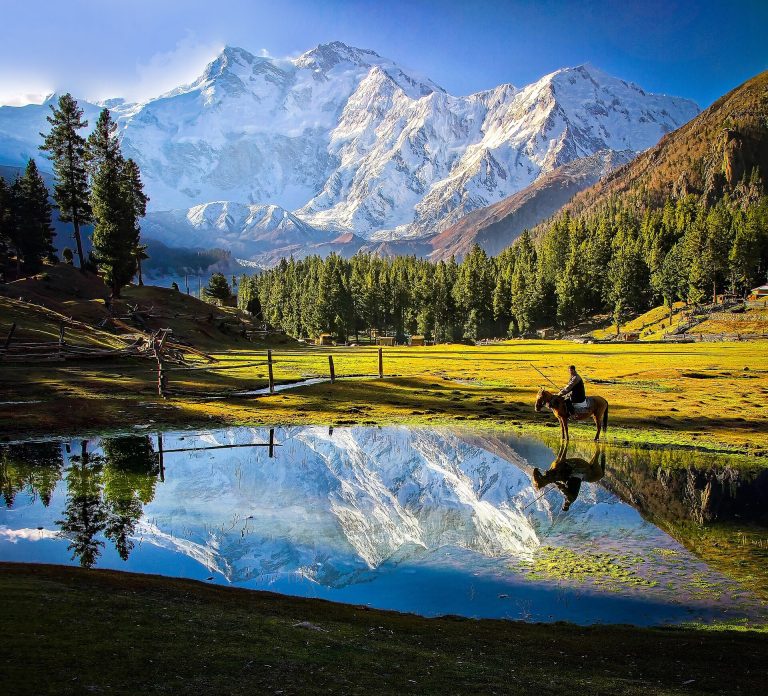 Nanga ParbatThe 'naked mountain', standing apart above the Indus, with a south face that rises roughly 4,600 m above its base.
 Gasherbrum I and IITwo neighbouring giants of the Gasherbrum massif. Gasherbrum I is also called Hidden Peak; Gasherbrum II is the more frequently climbed of the pair.
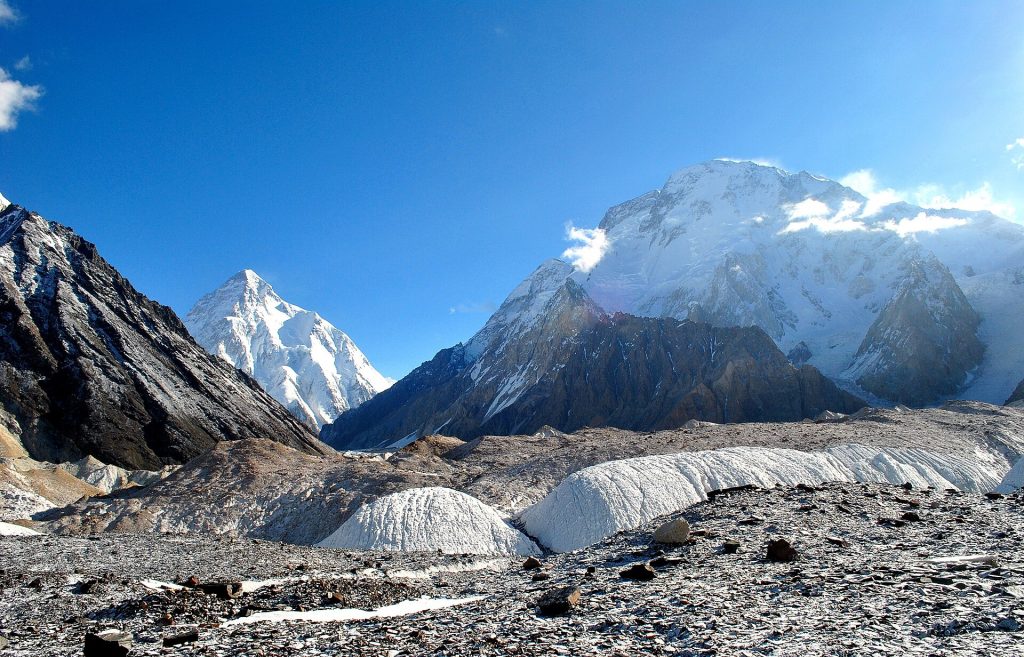
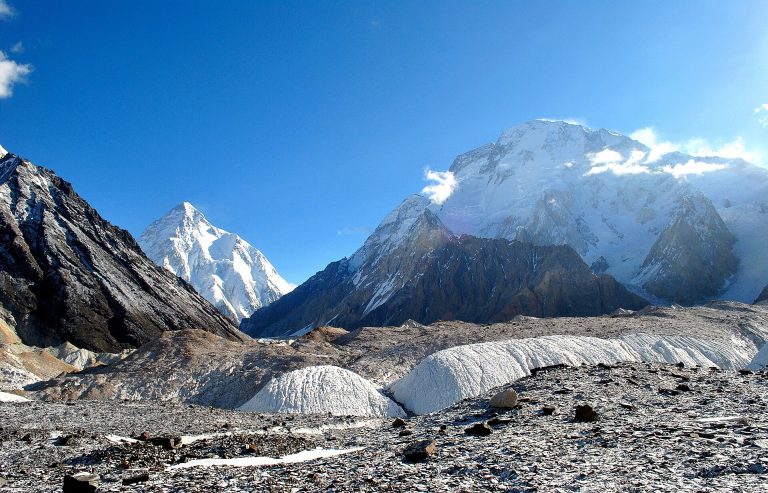 Broad PeakA wide-shouldered mountain about 8 km from K2, climbed first by an Austrian team in 1957 without porters or oxygen.
 Seeing them on footConcordia, where the Baltoro Glacier meets the Godwin-Austen Glacier, is the classic viewpoint for K2 and its neighbours. The trek guide explains what it takes to get there.
Why heights differ
A summit height is not a single natural constant. It depends on which survey or satellite measurement is used, how the snow cap is treated, which geoid model sets sea level and how the figure is rounded. K2 is the clearest case: most references give 8,611 m, while a 2014 measurement taken with satellite navigation on a Pakistani-led expedition produced 8,609.02 m, according to the Wikipedia article on K2. Neither figure changes K2's rank as the second-highest mountain.
Broad Peak shows the same pattern at smaller scale: 8,051 m in Wikipedia and 8,047 m in the Ministry of Tourism's list. Wikipedia also gives separate heights for Broad Peak's Rocky Summit (8,028 m) and Central Summit (8,011 m), which are real sub-summits and are sometimes confused with the main top. Nanga Parbat is 8,126 m in Britannica and the Ministry of Tourism but 8,125 m in Guinness World Records and the Wikipedia list; Gasherbrum II is 8,035 m in some places and 8,034 m in others.
On DailyLife.pk we use the figure most often given by Britannica and the Ministry of Tourism and show alternatives where we found them. If you are writing a formal document, cite the source that fits your purpose and mention the date.
First winter ascents
2 February 2011
Gasherbrum II
Simone Moro, Denis Urubko and Cory Richards, without supplemental oxygen or porters, according to Wikipedia.
9 March 2012
Gasherbrum I
Adam Bielecki and Janusz Gołąb of Poland, without supplemental oxygen.
5 March 2013
Broad Peak
Four Polish climbers reached the summit. Two of them, Maciej Berbeka and Tomasz Kowalski, were lost on the descent and declared dead on 8 March 2013.
26 February 2016
Nanga Parbat
Simone Moro, Alex Txikon and Muhammad Ali Sadpara. Wikipedia notes that the article text gives 26 February and the infobox gives 16 February; the later date is the one in the narrative.
16 January 2021
K2
Ten Nepali climbers led by Nirmal Purja and Mingma Gyalje Sherpa. The season also saw deaths, covered in the K2 page.
Risk and responsibility
These are among the most dangerous mountains on Earth. Wikipedia, citing climbing records, estimates that by August 2023 about 800 people had summited K2, with 96 deaths during attempts. Avalanches, serac fall, storms and altitude illness have killed experienced climbers, and in July 2026 an avalanche on Broad Peak killed all ten members of an international expedition. Nothing on this page is route or safety advice: see our pages on mountain safety and acclimatisation, and on seasons, permits and ethics, and plan any serious mountain journey with a licensed operator and current local guidance.
Keep reading
Mountaineering history of PakistanWho climbed what, and when, from the 1892 Conway expedition to the first Pakistani to complete all fourteen.Seasons, permits and ethicsThe Alpine Club of Pakistan, royalty fees as reported, porter welfare and rescue.Mountain safety and acclimatisationAltitude illness, ascent rates and when to turn back. Karakoram, Himalaya and Hindu KushHow the three great ranges meet in Pakistan.
Frequently Asked Questions
Which eight-thousanders are in Pakistan?
Five: K2, Nanga Parbat, Gasherbrum I, Broad Peak and Gasherbrum II. All lie in Gilgit-Baltistan. K2, Gasherbrum I, Broad Peak and Gasherbrum II sit on the boundary with China; Nanga Parbat is wholly within Pakistan's administered territory.
Is K2 higher than Nanga Parbat?
Yes. K2 is about 8,611 m and ranks second in the world. Nanga Parbat is about 8,126 m and ranks ninth.
Why do sources give slightly different heights?
Different surveys, satellite measurements and rounding. For example K2 is usually given as 8,611 m, but a 2014 satellite-based measurement gave 8,609.02 m. See the 'Why heights differ' section.
Can an ordinary visitor see these mountains without climbing?
Some can be seen from trekking routes. Nanga Parbat is visible from Fairy Meadows, and K2 and Broad Peak can be seen from Concordia on the Baltoro trek, which needs permits, a licensed operator and good acclimatisation. See the linked trek pages.
Have all five been climbed in winter?
Yes, between 2011 and 2021, ending with K2 on 16 January 2021.
Keep Exploring
Related places and stories on DailyLife.pk
K2K2 (Chogori): height, location, first ascent in 1954, winter ascent in 2021, history and fatalitiesNanga ParbatNanga Parbat (8,126 m): the Rupal Face, Diamir and Raikot sides, first ascent in 1953Gasherbrum I and IIGasherbrum I (8,080 m) and II (8,035 m): names, first ascents in 1956 and 1958Broad PeakBroad Peak (8,051 m): where it is, first ascent in 1957 by an Austrian teamK2 Base Camp and ConcordiaK2 Base Camp and Concordia trek guide: the Baltoro route from Askole, permits and licensed operatorsBaltoro Glacier, Gasherbrum and Broad PeakBaltoro Glacier guide: stages from Askole to Concordia, Gasherbrum I and Broad Peak, season, permitsHow we know this
- Type Explainer
- Sources 11 (3 official/academic)
- Reviewed October 2026
- Disputed points None
11 sources
- Eight-thousander, Wikipedia (used to locate primary sources)
- K2, Encyclopaedia Britannica
- Nanga Parbat, Encyclopaedia Britannica
- About Pakistan: highest peaks, Ministry of Tourism / Pakistan Tourism, Government of Pakistan
- K2, Wikipedia (used to locate primary sources)
- Nanga Parbat, Wikipedia (used to locate primary sources)
- Broad Peak, Wikipedia (used to locate primary sources)
- Gasherbrum I, Wikipedia (used to locate primary sources)
- Gasherbrum II, Wikipedia (used to locate primary sources)
- Tallest mountain face, Guinness World Records
- All 10 climbers swept away in avalanche in Pakistan are confirmed dead (1 August 2026), Associated Press via Local 10
Photo credits (6)
- K2, Mount Godwin Austen, Chogori, Savage Mountain.jpg, Wikimedia Commons contributor, CC BY 2.0, via Wikimedia Commons
- K2 and Broad peaks.JPG, Aapkamajid, CC BY-SA 3.0, via Wikimedia Commons
- Nanga Parbat The Killer Mountain.jpg, Tahsin Anwar Ali, CC BY-SA 3.0, via Wikimedia Commons
- Baltoro Glacier, Pakistan.jpg, Thsulemani, CC BY-SA 3.0, via Wikimedia Commons
- K2 from Concordia.JPG, Aapkamajid, CC BY-SA 3.0, via Wikimedia Commons
- The Mighty K2 PAkistan.jpg, Maqsood aktar, CC BY-SA 4.0, via Wikimedia Commons
