

History · Event
The Badshahi MosqueLahore: Completed 1673
Commissioned by Aurangzeb and finished in 1673, Lahore's red sandstone 'Imperial Mosque' was the grand finale of Mughal mosque building, and has survived wars, neglect and restoration.
- Completed 1673
- Walled City, Lahore
- UNESCO Tentative List (1993)
Badshahi Mosque, Lahore
- When
- 1671–1673 (gateway inscription: AH 1084, 1673–74)
- Certainty
- Well established
What Happened
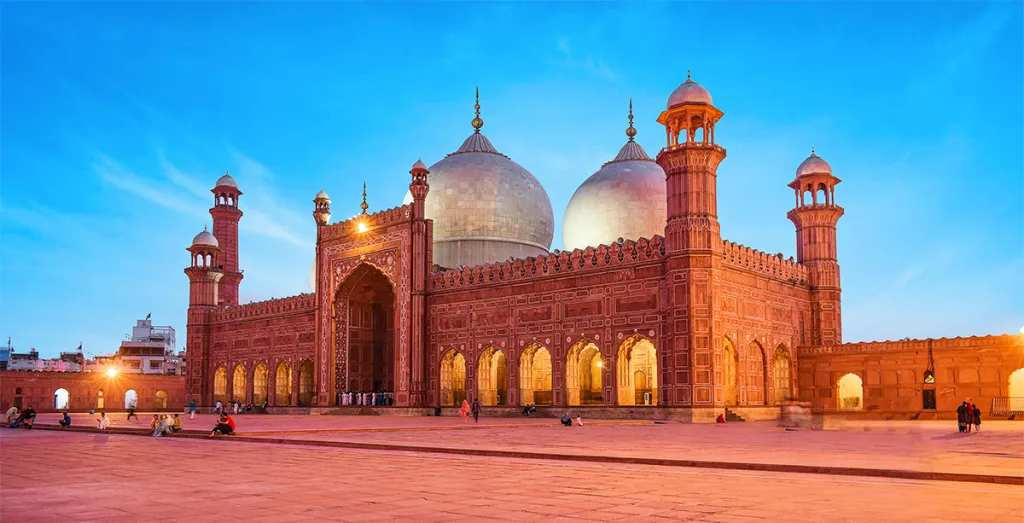
In 1671 the Mughal emperor Aurangzeb ordered a great congregational mosque for Lahore, one of the empire's chief cities. The work was supervised by Muzaffar Husain, known as Fidai Khan Koka, who was then governor of Lahore. Built of red sandstone with white marble domes, on a raised platform facing the Alamgiri Gate of the Lahore Fort, the mosque was completed in 1673; the inscription over its gateway gives the Hijri year 1084 (1673–74).
Its courtyard, reached by a flight of 22 steps, is vast; reference works estimate it can hold around 100,000 worshippers, with about 10,000 more in the prayer hall. Four octagonal minarets, about 60 metres tall, stand at its corners. It is often described as the last of the great imperial mosques of the Mughal era.
Background
Mughal forces took Lahore in 1524, and the city was often a royal residence; Britannica describes the following era as the city's golden age. The Lahore Fort, begun under Akbar, was extended by the next three emperors, and Shah Jahan greatly expanded the city. Britannica notes that Lahore declined in importance under Aurangzeb, yet Aurangzeb, who came to power in 1658, gave the city a congregational mosque on an imperial scale, placed directly opposite the fort's Alamgiri Gate across the Hazuri Bagh. Some accounts say it was built to mark his military campaigns. Its plan, a vast open courtyard, a prayer hall under three bulbous marble domes and tall corner minarets, follows the classic Mughal congregational mosque.
Timeline
1671
Construction begins
Work starts under Fidai Khan Koka, governor of Lahore, on Aurangzeb's orders.
1673
Completion
The mosque is finished; the gateway inscription is dated AH 1084 (1673–74).
1799
Under Sikh rule
After Ranjit Singh's forces take Lahore, the courtyard is used as a stable and the cells as soldiers' quarters and stores.
1850s
British garrison and return
The British use the mosque as a garrison; a Badshahi Mosque Authority is set up in 1852 and the building is returned to Muslims in 1856. Cells around the courtyard are later demolished.
1939–1960
Major restoration
Repairs begin under Sir Sikandar Hayat Khan, Premier of Punjab, and are completed in 1960.
22 February 1974
Islamic Summit prayers
Heads of state attending the Second Islamic Summit in Lahore offer Friday prayers at the mosque.
14 December 1993
UNESCO Tentative List
Pakistan submits the Badshahi Mosque to UNESCO's Tentative List of World Heritage Sites.
Legacy
- It completed the monumental ensemble of the Lahore Fort, Hazuri Bagh and mosque that still defines the north-west corner of the Walled City.
- It became one of the city's main venues for Eid and Friday congregations and a national symbol of Lahore.
- Its periods of military use under Sikh and British rule, and its restoration in the 20th century, mirror the changing fortunes of Lahore.
- Iqbal's tomb, built beside it, makes the precinct a place of national as well as religious significance.
How We Know
The building dates itself: the Persian inscription over the main gateway records the Hijri year 1084 (1673–74 CE), as noted in Pakistan's UNESCO Tentative List submission. Mughal-period histories and later colonial records document its builders and its later uses, and the Punjab government's restoration records cover the 20th-century works. Some secondary sources give slightly different construction spans (1671–73 or 1672–74).
Before and After
Where this moment sits in Pakistan’s story.
Before
- 1658–1707
Aurangzeb
The empire reaches its greatest extent. In Lahore he builds the Badshahi Mosque (1671–73) and the Alamgiri Gate of the fort.
- 1671–1707
Aurangzeb
Aurangzeb builds the Badshahi Mosque (1671–73). After his death in 1707 Mughal power fragments.
After
- 18th century
Rekhta and the Delhi poets
Poets in Delhi turn from Persian to the vernacular, then called Rekhta ('mixed'). Mir Taqi Mir becomes one of its great masters. The name Urdu, from a word meaning 'camp' (as in the Turkic ordu), comes into use for the language of the royal camp…
- 14th–18th century
Makli and Thatta
Samma, Arghun, Tarkhan and Mughal rulers and nobles build stone and brick tombs on Makli Hill, a UNESCO World Heritage Site since 1981.
Frequently Asked Questions
When was the Badshahi Mosque built?
Between 1671 and 1673. The gateway inscription gives AH 1084, corresponding to 1673–74.
Who built the Badshahi Mosque?
It was commissioned by the Mughal emperor Aurangzeb and built under the supervision of Lahore's governor Fidai Khan Koka.
How many people can the Badshahi Mosque hold?
Reference sources estimate about 100,000 in the courtyard and about 10,000 in the prayer hall.
Is the Badshahi Mosque a World Heritage Site?
Not yet. It has been on UNESCO's Tentative List since 1993.
Can visitors enter the mosque?
Yes. See our guide to the Lahore Fort and Badshahi Mosque for visiting tips and dress etiquette.
Keep Exploring
Related places and stories on DailyLife.pk
 Lahore Fort and Badshahi MosqueLahore Fort and Badshahi Mosque guide: Sheesh Mahal, Picture Wall, Alamgiri Gate
 Walled City of LahoreExplore the Walled City of Lahore: Delhi Gate, the Royal Trail, Wazir Khan Mosque, Shahi Hammam
 LahoreLahore travel guide: Badshahi Mosque, Lahore Fort, Shalimar Gardens, the Walled City, food streets, neighbourhoods, metro
 The Mughal EraThe Mughal Empire in Pakistan: Babur to Aurangzeb, Lahore Fort, Shalamar GardensArchitecture of PakistanPakistan's architecture: Indus cities, Gandhara monasteries, Multan tombs, Mughal Lahore, Makli, mountain forts
 Allama Muhammad IqbalAllama Muhammad Iqbal: life, Urdu and Persian poetry, the 1930 Allahabad address, legacy
How we know this
- Type Historical record
- Sources 5 (2 official/academic)
- Reviewed October 2026
- Disputed points None
5 sources
- Badshahi Mosque, Lahore (Tentative List), UNESCO World Heritage Centre
- Badshahi Mosque, Lahore, Asian Historical Architecture
- Badshahi Mosque (history and restoration, used to locate sources), Wikipedia
- Badshahi Mosque, Atlas Obscura
- Lahore, Encyclopaedia Britannica
Photo credits (3)
- Badshahi Mosque front picture.jpg, Romero Maia, CC BY-SA 4.0, via Wikimedia Commons
- Shahi Masjid Lahore.jpg, Rehan5811, CC BY-SA 4.0, via Wikimedia Commons
- The Badshahi in all its glory during the Eid Prayers.JPG, Bilalhassan88, CC BY-SA 3.0, via Wikimedia Commons
