

History · Biography
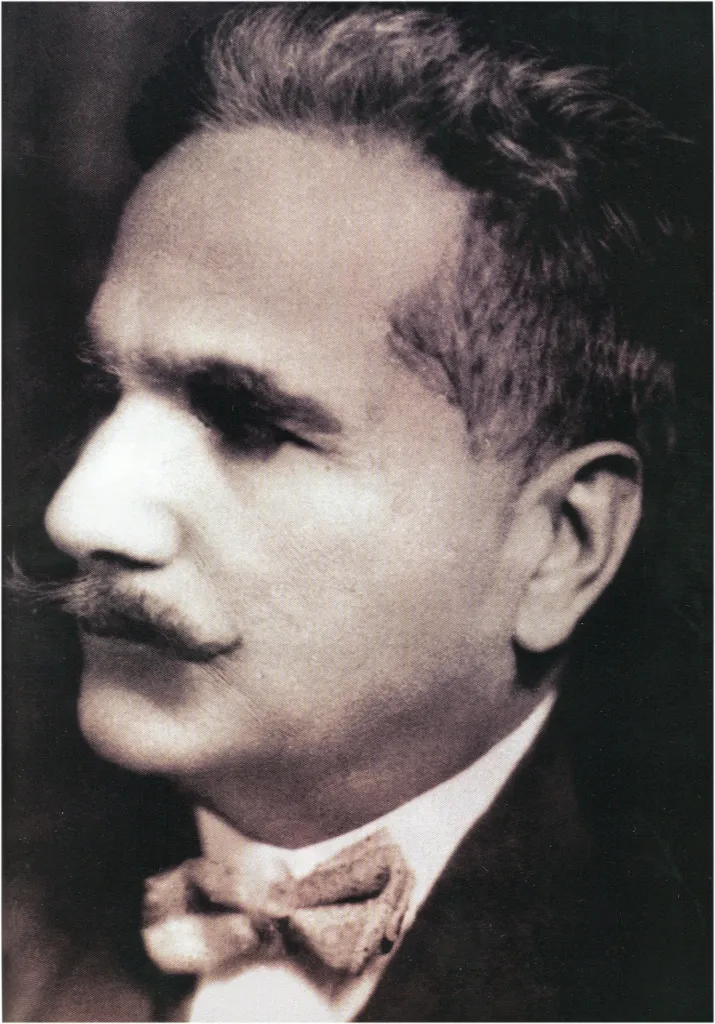
Allama Muhammad Iqbal: Poet of the East
Born in Sialkot in 1877, Iqbal wrote in Urdu and Persian, studied in Cambridge and Munich, and in 1930 sketched the idea of a Muslim state in the north-west that inspired Pakistan.
- 1877–1938
- Sialkot and Lahore
- Urdu and Persian poetry
- Philosopher of khudi (selfhood)
Tomb of Allama Iqbal, Lahore
About Allama Iqbal
Muhammad Iqbal, honoured with the title Allama, ‘the learned one’, is Pakistan's national poet and one of the most influential Muslim thinkers of the 20th century. Britannica calls him the greatest Urdu poet of that century, yet much of his most ambitious work was written in Persian, which let him address readers across Iran, Afghanistan and Central Asia as well as South Asia.
Born into a pious family of small merchants in Sialkot, he studied in Lahore, Cambridge and Munich and worked as a lawyer. His poetry urged Muslims to rediscover khudi, selfhood, self-respect and creative will, rather than wait passively for history to change.
Iqbal's influence on politics was as great as on literature. In his presidential address to the All-India Muslim League at Allahabad in 1930 he proposed a single Muslim state in the north-west of the subcontinent. He died in Lahore in 1938, nine years before Pakistan was created, but he is remembered alongside Muhammad Ali Jinnah as one of the country's founding figures, and his birthday, 9 November, is marked as Iqbal Day.
Life at a Glance
9 November 1877
Birth in Sialkot
Born in the family house now known as Iqbal Manzil, in the old city of Sialkot.
1890s–1905
Lahore
Studies at Government College, Lahore, and begins to make his name as a poet; early Urdu poems such as Naya Shawala express a hopeful Indian nationalism.
1905–1908
Europe
Takes a philosophy degree at Cambridge, qualifies as a barrister in London and earns a doctorate in Munich with a thesis on The Development of Metaphysics in Persia.
1915
Asrar-e-Khudi
Publishes The Secrets of the Self in Persian, the first statement of his philosophy of selfhood. Rumuz-e-Bekhudi follows in 1918.
1922
Knighthood
Knighted by the British Crown, hence ‘Sir Muhammad Iqbal’ in documents of the period.
1924
Bang-e-Dara
His first Urdu collection, including the celebrated paired poems Shikwa and Jawab-e-Shikwa.
1930
The Allahabad address
On 29 December, presiding over the 25th session of the All-India Muslim League, he calls for the Muslim-majority provinces of the north-west to be united in a single state.
1932–1937
Late masterpieces
Javid Nama (1932), Bal-e-Jibril (1935) and Zarb-e-Kalim (1936). The Iqbal Academy’s introduction to the collected works dates Zarb-e-Kalim to 1936.
21 April 1938
Death in Lahore
Dies in Lahore aged 60 and is buried beside the steps of the Badshahi Mosque. Armaghan-e-Hijaz is published after his death.
Major Works
Iqbal's principal books of poetry, with the language of each.
| Title | English title | Year | Language |
|---|---|---|---|
| Asrar-e-Khudi | The Secrets of the Self | 1915 | Persian |
| Rumuz-e-Bekhudi | The Mysteries of Selflessness | 1918 | Persian |
| Payam-e-Mashriq | Message of the East | 1923 | Persian |
| Bang-e-Dara | The Call of the Bell | 1924 | Urdu |
| Zabur-e-Ajam | Persian Psalms | 1927 | Persian |
| Javid Nama | The Song of Eternity | 1932 | Persian |
| Bal-e-Jibril | Gabriel's Wing | 1935 | Urdu |
| Zarb-e-Kalim | The Blow of Moses | 1936 | Urdu |
| Armaghan-e-Hijaz | Gift of the Hejaz | 1938 (posthumous) | Urdu and Persian |
Titles, translations and dates follow Encyclopaedia Britannica. Britannica regards Javid Nama as his masterpiece.
Poetry and Philosophy
Iqbal's central idea is khudi, usually translated as ‘the self’ or ‘selfhood’. Against what he saw as a fatalistic, world-denying strand in later Muslim thought, he argued that each person must develop an active, creative self through faith, love and striving. In Rumuz-e-Bekhudi he balanced this with the life of the community: a strong self flourishes within a strong, purposeful society.
His years in Europe gave him a deep knowledge of Western philosophy, which he set in dialogue with the Persian mystical tradition, above all the poetry of Jalaluddin Rumi. In Javid Nama Iqbal imagines himself travelling through the heavens with Rumi, meeting poets, saints and statesmen of many ages.
His Urdu poems are the ones most Pakistanis know by heart. Shikwa (‘Complaint’) dares to question God about the decline of the Muslim world; Jawab-e-Shikwa (‘Answer to the Complaint’) replies in God's voice. Iqbal also gave a series of lectures in English, published as The Reconstruction of Religious Thought in Islam, which argued for fresh interpretation (ijtihad) in Muslim law and thought. In 1910, at Aligarh, he spoke on ‘Islam as a Social and Political Ideal’, an early sign of his turn to political questions. For his place in the wider literary tradition, see Poetry and Literature.

The Allahabad Address, 1930
On 29 December 1930 Iqbal presided over the 25th session of the All-India Muslim League at Allahabad. While British India's constitutional future was being debated at the Round Table Conferences in London, he argued that Muslims of the subcontinent formed a distinct community with the right to develop according to their own culture and traditions.
“I would like to see the Punjab, North-West Frontier Province, Sind and Baluchistan amalgamated into a single State.”, Muhammad Iqbal, presidential address, Allahabad, 1930
He added that such a state might achieve self-government within the British Empire or outside it. The proposal did not yet include Bengal, and it attracted limited attention at the time. But it was the first time a leading figure had set out, from the League's presidential chair, a territorial vision close to the later Pakistan. In letters to Muhammad Ali Jinnah in the following years, Iqbal urged him to lead Muslims in this direction; the Pakistan Movement took up the idea after 1940.
Places to Visit
Follow Iqbal’s life through Sialkot and Lahore. On 9 November 2026, his 149th birth anniversary, check museum opening arrangements and local notices before travelling; a public holiday does not establish that every museum is open.
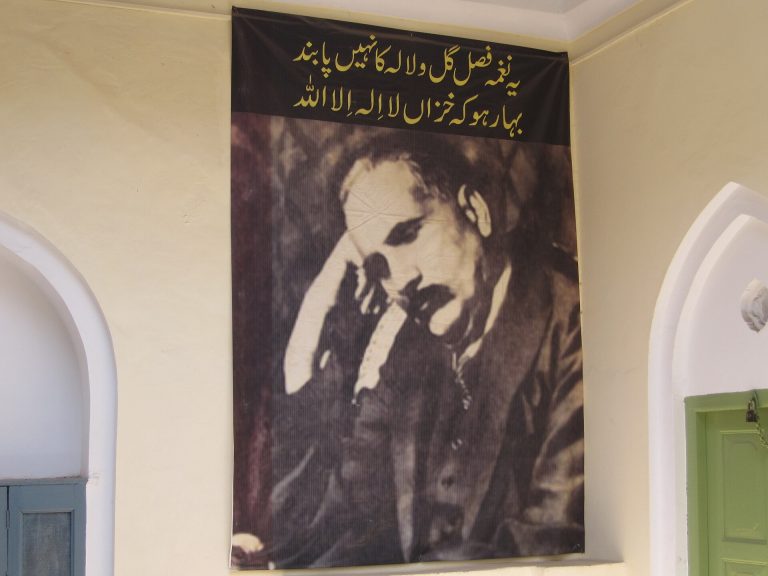
 Iqbal Manzil, SialkotThe family home where Iqbal was born, now a museum with rooms, furniture and personal items from his early life. Iqbal Day on 9 November brings gatherings and recitations.
 Tomb of Allama Iqbal, LahoreBeside the gateway of the Badshahi Mosque in the Hazuri Bagh. Designed by Nawab Zain Yar Jang, chief architect of Hyderabad Deccan, in red sandstone with a white marble cenotaph.
 Badshahi Mosque and Lahore FortIqbal's tomb stands between these two great Mughal monuments, so a visit easily combines all three.
Building Iqbal's Tomb
After Iqbal's death, a committee in Lahore chose a site just outside the Badshahi Mosque, facing Lahore Fort. According to a history in Dawn, the committee refused government money: the cost was raised from the people of Lahore, largely through door-to-door collections in the walled city. Red sandstone was ordered from Jaipur and marble from Makrana, and the design mixes Afghan and Moorish elements. Work stretched over years, slowed by Partition and by restrictions on exporting stone from India. The cenotaph's ornamental centrepiece (taweez) is of lapis lazuli, a gift from the government of Afghanistan.
Legacy
Iqbal's verses are recited in schools, quoted in parliament and sung by Pakistan's greatest vocalists. Universities, airports, parks, including Lahore's Greater Iqbal Park around Minar-e-Pakistan, and countless streets carry his name. In Iran, where he is known as Iqbal Lahori, his Persian poetry has its own devoted readership.
Frequently Asked Questions
When and where was Allama Iqbal born?
On 9 November 1877 in Sialkot, Punjab. His birthplace, Iqbal Manzil, is a museum.
In which languages did Iqbal write?
Urdu and Persian, plus prose and lectures in English. Several of his major works, including Asrar-e-Khudi and Javid Nama, are in Persian; Bang-e-Dara, Bal-e-Jibril and Zarb-e-Kalim are in Urdu.
What did Iqbal say in his Allahabad address?
Presiding over the Muslim League session at Allahabad on 29 December 1930, he said he would like to see Punjab, the North-West Frontier Province, Sindh and Balochistan amalgamated into a single state, with self-government within or outside the British Empire.
Where is Allama Iqbal buried?
In Lahore, in a red sandstone tomb beside the gateway of the Badshahi Mosque, in the Hazuri Bagh facing Lahore Fort.
What does ‘khudi’ mean in Iqbal's poetry?
Selfhood: the idea that each person should develop a strong, creative and morally active self through faith and effort, rather than accept passivity or fatalism.
Keep Exploring
Related places and stories on DailyLife.pk
 SialkotSialkot city guide: Iqbal Manzil, Holy Trinity Cathedral, Sialkot Fort, sports goods and football industry, history
 LahoreLahore travel guide: Badshahi Mosque, Lahore Fort, Shalimar Gardens, the Walled City, food streets, neighbourhoods, metro
 Poetry and Literature of PakistanPakistan's poetry and literature: Bhittai, Bulleh Shah, Rahman Baba, Khushal Khan Khattak, Ghalib's legacy, Iqbal, Faiz
 The Pakistan MovementThe Pakistan Movement explained: Sir Syed and Aligarh, the Muslim League (1906), Iqbal's 1930 address
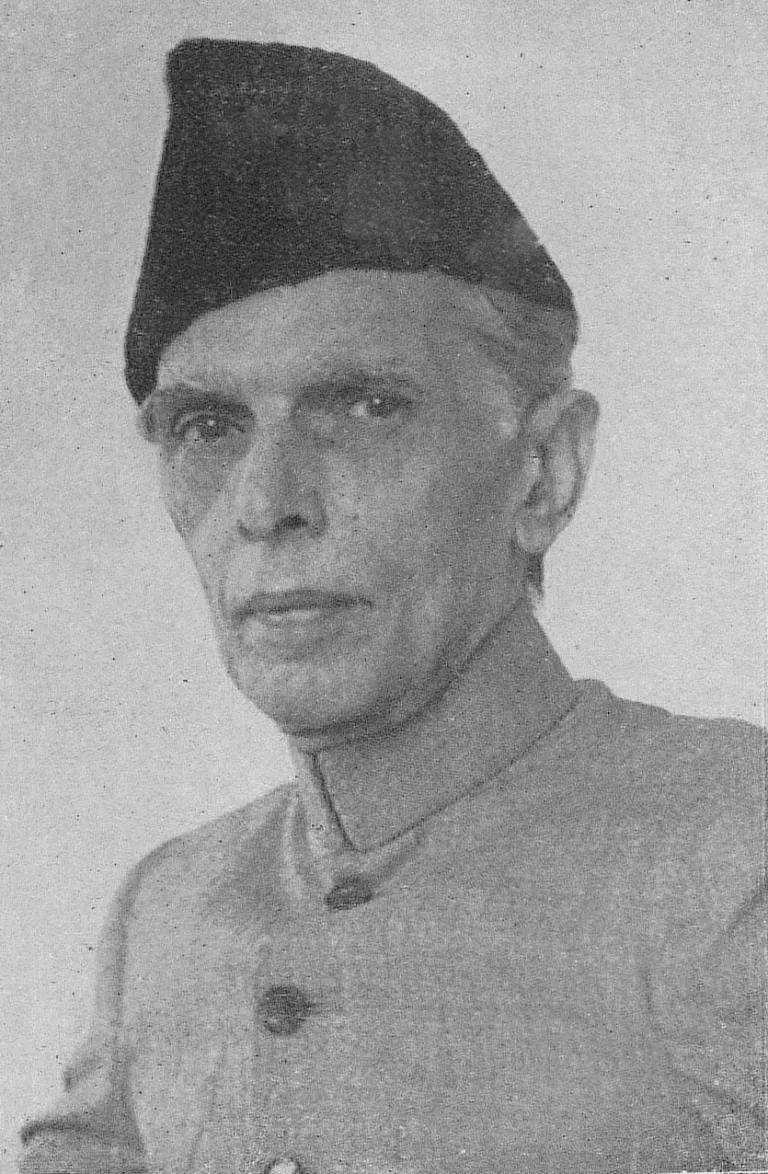
 Muhammad Ali JinnahQuaid-e-Azam Muhammad Ali Jinnah: life, law career, Muslim League, Lahore Resolution, 1947, death in 1948
How we know this
- Type Historical & cultural research
- Sources 6 (2 official/academic)
- Reviewed October 2026
- Disputed points None
6 sources
- Muhammad Iqbal, Encyclopaedia Britannica
- The Idea of Pakistan 1930 (text of the Allahabad address), India of the Past
- Allahabad Address, Iqbal Academy Pakistan
- Harking Back: Iqbal and mud from the graves of Rumi and Ataturk, Dawn
- Tomb of Allama Iqbal (used to locate sources), Wikipedia
- Mohammed Ali Jinnah, Encyclopaedia Britannica
Photo credits (7)
- Allama Iqbal Tomb side view, adjacent to the Badshahi Mosque's gateway.jpg, Rohaan Bhatti, CC BY-SA 3.0, via Wikimedia Commons
- Allama Iqbal.jpg, Iqbal Academy Pakistan, Public domain, via Wikimedia Commons
- Muhammad Iqbal in 1935.png, https://allamaiqbal.com/new/picture_gallery_iqbal.html, Public domain, via Wikimedia Commons
- Iqbal Manzil.jpg, ASAD ALI CHEEMA, CC BY-SA 4.0, via Wikimedia Commons
- Inside Iqbal Manzil.JPG, PakGuru99, CC BY-SA 3.0, via Wikimedia Commons
- Badshahi Mosque front picture.jpg, Romero Maia, CC BY-SA 4.0, via Wikimedia Commons
- Jinnah1945a.jpg, Photographer not known, Public domain, via Wikimedia Commons
