

Historical event
1857 in the Lands Now Pakistan
Mutinies in the cantonments, a rural rising on the Ravi and executions in Karachi: how the great uprising of 1857 played out in what is now Pakistan.
- May 1857 – 1858
- Punjab, Sindh, Frontier
- Mutinies and rural risings
- Called the War of Independence in Pakistan
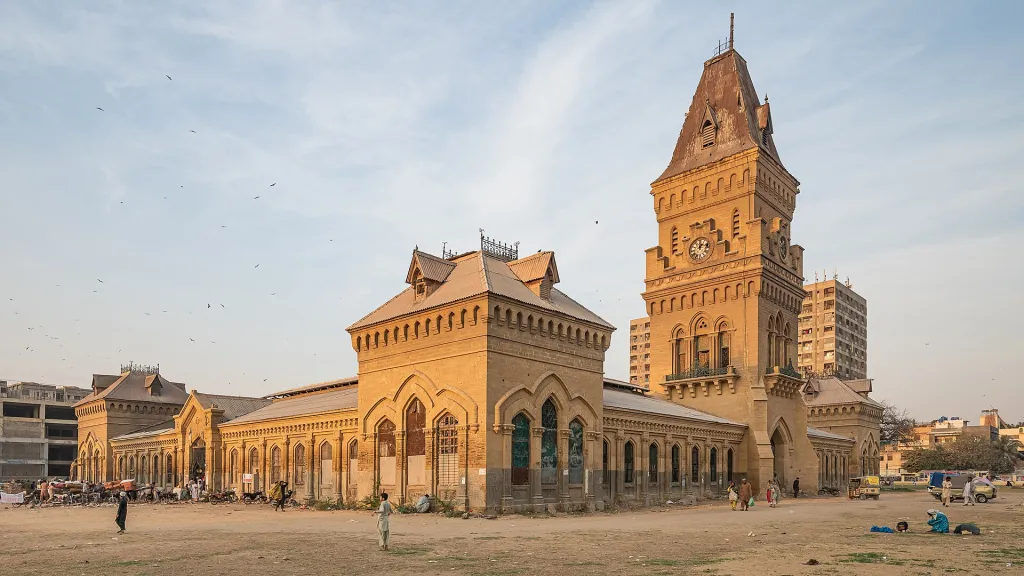
Empress Market, Karachi
- When
- May 1857 – 1858
- Certainty
- Well established
What Happened
The uprising that began among the East India Company's Indian soldiers (sepoys) at Meerut on 10 May 1857 spread across northern India within weeks. In Britain it was long called the Indian Mutiny; in Pakistan it is usually remembered as the War of Independence of 1857, and many historians prefer neutral terms such as the Revolt or Rebellion of 1857.
Most of the great sieges and battles took place far from the lands that are now Pakistan, in Delhi, Kanpur and Lucknow. But the Punjab, the Frontier and Sindh were not untouched. Company officers disarmed Bengal regiments at Peshawar, Mardan and other stations; sepoys mutinied at Jhelum and Sialkot; a plot was crushed in Karachi with public executions; and in the Ravi country around Gogera, near present-day Okara and Sahiwal, rural clans under Rai Ahmad Khan Kharal rose against the Company. Hill clans also attacked the station at Murree.
At the same time, the Punjab administration recruited large numbers of Punjabi and Pashtun irregulars, and columns from the province helped recapture Delhi in September 1857. That double role, local resistance alongside recruitment for the Company, is central to how the period is understood.
Background
The Company had annexed Sindh in 1843 and the Punjab in 1849, so in 1857 both were recent conquests. Many of the soldiers garrisoning them belonged to the Company's Bengal Army, recruited largely from the Gangetic plain, the same army whose regiments rose at Meerut. Grievances included the new rifle cartridges, rumoured to be greased with animal fat, as well as wider resentment of British power over political, economic and cultural life, which Britannica traces back to the expansion of British paramountcy from around 1820.
In the Punjab, officials moved quickly to disarm Bengal regiments they distrusted and to raise new units from local communities. According to accounts cited by historians such as Charles Allen and Christopher Hibbert, around 34,000 fresh levies were eventually pressed into service, and Sikh and Pashtun units played a significant part in the Delhi campaign.
Timeline
10 May 1857
Rising at Meerut
Sepoys of the Meerut garrison mutiny and march on Delhi, where the Mughal emperor Bahadur Shah Zafar becomes the symbolic head of the revolt.
18–19 May 1857
Unrest at Nowshera and Mardan
Officers report discontent in the 55th Bengal Native Infantry at Nowshera and Mardan; British troops are ordered to garrison Attock (Becher's report, 1858).
22 May 1857
Disarming at Peshawar
Two British infantry regiments with artillery disarm the four Bengal regiments considered most disaffected. Many local chiefs then side with the Company.
7 July 1857
Mutiny at Jhelum
Sepoys at Jhelum resist disarming; 35 soldiers of the British 24th Regiment of Foot are killed in the fighting.
9–12 July 1857
Sialkot and Trimmu Ghat
Most of the Sialkot brigade rises and heads for Delhi; three days later John Nicholson's column destroys roughly 1,100 of them at Trimmu Ghat on the Ravi.
2 September 1857
Attack on Murree
Around 300 men of the hill clans attack the Murree station; the rising is crushed and its leaders executed (Army Institute of Military History).
13–17 September 1857
Karachi plot crushed
A planned rising in the Karachi cantonment is reported to officers; after a curfew and arrests, sepoys are publicly executed on 17 September on the parade ground that is now Empress Market.
September 1857
Delhi retaken
Company forces, reinforced from the Punjab, recapture Delhi.
16–21 September 1857
Rising on the Ravi
Clans around Gogera rise under Rai Ahmad Khan Kharal, cutting communications between Lahore and Multan. Kharal is killed in battle on 21 September.
1858
Crown rule
The Company is dissolved and Britain governs India directly; an amnesty for rebels not involved in murder follows on 1 November 1858.
Where It Happened
Sites in today's Pakistan connected with 1857.
 KarachiSepoys accused of plotting a rising were executed in September 1857 on the parade ground where Empress Market now stands; a vigil is held there in their memory.
 PeshawarBengal regiments were disarmed on 22 May 1857, one of the Punjab administration's first moves to secure the Frontier.
 SialkotMost of the sepoy brigade rose on 9 July 1857 and set out for Delhi before being intercepted on the Ravi.
 JhelumFighting broke out when sepoys resisted disarming on 7 July 1857.
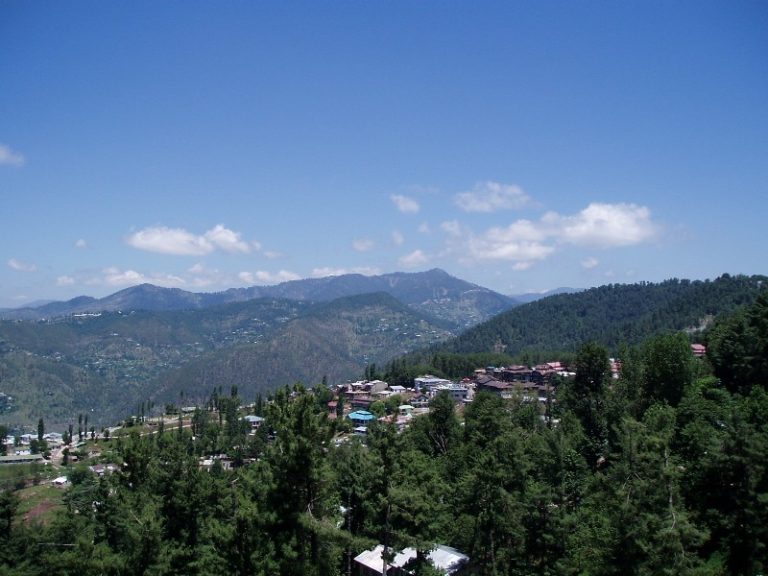 MurreeHill clans attacked the station in September 1857; the rising was put down and its leaders executed.
 Gogera and HarappaThe Ravi country rose under Ahmad Khan Kharal; according to the Army Institute of Military History, Kathia fighters held Harappa for a time before it was retaken.
Consequences
- The East India Company was dissolved and Britain began governing India directly in 1858; the last Mughal emperor was exiled to Burma.
- The army was reorganised, with British officials favouring recruitment from communities that had stayed loyal, a pattern that made the Punjab and the Frontier major recruiting grounds of the later British Indian Army.
- Muslims across northern India were widely suspected of disloyalty after 1857; the response of reformers such as Sir Syed Ahmad Khan helped shape the political journey that led to the Pakistan Movement.
- Local resisters such as Ahmad Khan Kharal were labelled rebels in colonial records and, as Pakistani writers note, were long left out of textbooks, surviving mainly in folklore until oral historians revived their story.
How We Know
Most of the detailed record comes from British official sources: the Punjab Mutiny reports and the diaries and letters of officers such as Herbert Edwardes and J. B. Becher, later used by historians including Charles Allen and Christopher Hibbert. These describe the disarmings and mutinies precisely but present local fighters as criminals or rebels.
The rural risings are also remembered through Punjabi oral tradition, ballads (dholas) about Ahmad Khan Kharal collected by oral historians such as A. D. Aijaz, whose book Kaal Bulaindi (1983) is discussed by Dawn, and through Pakistani research such as the Army Institute of Military History's account of the 'unsung heroes' of 1857. Dates and names occasionally differ between these traditions (for example, the exact day Berkeley was killed), and we note this where it matters.
Debates and Interpretations
- Naming: British writers called it a mutiny; Pakistani and Indian historiography generally calls it a war of independence; many academic historians use 'revolt' or 'rebellion'. Britannica notes that calling it a mere sepoy mutiny underestimates its deeper causes.
- The Punjab's role: Some accounts stress that Punjabi and Pashtun troops helped the Company retake Delhi; Pakistani writers such as Dr Turab-ul-Hassan Sargana emphasise that sepoys and civilians rose in many parts of the province and were suppressed harshly.
- Memory: Pakistani commentators argue that figures like Kharal were neglected both by colonial historians and by later official histories, and that their story survived mainly in Punjabi folk memory.
Before and After
Where this moment sits in Pakistan’s story.
Before
- 1850s
British garrison and return
The British use the mosque as a garrison; a Badshahi Mosque Authority is set up in 1852 and the building is returned to Muslims in 1856. Cells around the courtyard are later demolished.
- 1856
Survey names K2
Colonel T. G. Montgomerie of the Survey of India sights the peak from afar and labels it K2, the second Karakoram peak measured (Britannica).
- 1857
The uprising at Bijnor
Serving as a judicial officer at Bijnor, he shelters British officers and their families during the revolt and stays loyal to the government.
After
- 1857–1858
Uprising and Crown rule
After the great uprising, the last Mughal emperor is exiled and the British Crown takes over from the East India Company.
- 1857–1858
The War of 1857 and Crown rule
The great uprising against the East India Company, remembered in Pakistan as the War of Independence, is crushed. The last Mughal emperor is exiled and the British Crown takes over direct rule. Many Muslims emerge from the aftermath politically and economically weakened.
- 1857
End of the dynasty
After the uprising of 1857 the British exile the last Mughal emperor, formally ending the dynasty.
Frequently Asked Questions
Did the 1857 uprising reach what is now Pakistan?
Yes. There were disarmings and mutinies at Peshawar, Mardan, Jhelum and Sialkot, a crushed plot and executions in Karachi, an attack on Murree, and a rural rising around Gogera on the Ravi led by Rai Ahmad Khan Kharal.
Who was Rai Ahmad Khan Kharal?
A chief from Jhamra near Gogera (in today's Okara–Sahiwal area) who refused to help the East India Company in 1857 and led local clans against it. He was killed in battle on 21 September 1857 and is remembered in Punjabi ballads as a symbol of resistance.
Why is it called the War of Independence in Pakistan?
Pakistani (and Indian) historians see 1857 as a broad rising against foreign rule rather than only a soldiers' mutiny. British accounts long used 'Indian Mutiny'; many academic historians now use neutral terms such as 'Revolt of 1857'.
What happened in Karachi in 1857?
According to a Dawn report on the annual vigil, sepoys in the Karachi cantonment planned a rising in September 1857. After two soldiers reported the plan, the British imposed a curfew, hunted down suspects and publicly executed several on 17 September on the parade ground where Empress Market now stands.
What changed after 1857?
The East India Company was abolished and the British Crown ruled India directly from 1858. The army was reorganised, and the Punjab became its main recruiting ground.
Keep Exploring
Related places and stories on DailyLife.pk
 MurreeMurree travel guide: Mall Road, Holy Trinity Church, Patriata, Nathia Gali and Ayubia, with seasons, routesHarappaVisit Harappa near Sahiwal: the Bronze Age Indus city, its mounds, granary and museum
 KarachiKarachi travel guide: Mazar-e-Quaid, Mohatta Palace, Clifton, Burns Road, bazaars, neighbourhoods, Green Line BRT
 PeshawarPeshawar city guide: Qissa Khwani Bazaar, Mahabat Khan Mosque, Sethi House, Peshawar Museum, Pashtun food
 SialkotSialkot city guide: Iqbal Manzil, Holy Trinity Cathedral, Sialkot Fort, sports goods and football industry, historyJhelumJhelum city guide: Rohtas Fort, Tilla Jogian, Khewra and Mangla nearby, the river and cantonment
How we know this
- Type Historical record
- Sources 8 (2 official/academic)
- Reviewed October 2026
- Disputed points Yes, see the debates
8 sources
- Indian Mutiny, Encyclopaedia Britannica
- Indian Rebellion of 1857 (cross-reference; cites Allen, Hibbert, Kennedy), Wikipedia
- Unsung Heroes of the War of Independence 1857 (Dr Turab-ul-Hassan Sargana), Army Institute of Military History, Pakistan
- Tributes to A.D. Aijaz, the oral historian of Kharal's resistance (Shafiq Butt, 8 July 2019), Dawn
- Rai Ahmad Khan Kharal: symbol of resistance in the 1857 War of Independence (Gohar Ali Iftikhar, 22 September 2023), The Friday Times
- Vigil held at Empress Market, where blood of soldiers was spilt in 1857 (Shazia Hasan, 26 September 2016), Dawn
- Murree Insurrection (1857), Families in British India Society (FIBIS) Wiki
- 55th Regiment of Bengal Native Infantry (cites Becher's 1858 report in the Punjab Mutiny records), Wikipedia
Photo credits (6)
- PK Karachi asv2020-02 img36 Empress Market.jpg, A.Savin, FAL, via Wikimedia Commons
- Bala Hisar-Peshawar.JPG, Ammad Malik-101, CC BY-SA 3.0, via Wikimedia Commons
- SialkotFort.jpg, Torbenbrinker, CC BY-SA 4.0, via Wikimedia Commons
- Murree scene.jpg, Umair ua at English Wikipedia, Public domain, via Wikimedia Commons
- View of Granary and Great Hall on Mound F - Archaeological site of Harappa.jpg, Muhammad Bin Naveed, CC BY-SA 3.0, via Wikimedia Commons
- Tilla Jogian hills at sunset, River Jhelum in the foreground.jpg, Xishan01, CC BY-SA 3.0, via Wikimedia Commons
