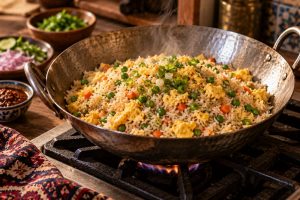
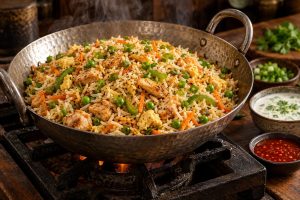
Chinese Fried Rice
چائنیز فرائیڈ رائس
Wok or broad skillet; quick stir-fry of safely chilled cooked rice
A Pakistani restaurant-style interpretation of Chinese-inspired fried rice, with a lighter egg-and-vegetable seasoning.
Start cooking ↓ Ingredients
One tablespoon = 15 ml; one teaspoon = 5 ml.
About Chinese Fried Rice
A Pakistani restaurant-style interpretation of Chinese-inspired fried rice, with a lighter egg-and-vegetable seasoning.
Make it work for your kitchen
Also known as Chinese-Style Fried Rice, Restaurant-Style Fried Rice.
Original quantities serve 4. Cooking times, pan size and frying-oil depth do not scale, cook in extra batches instead.
Before you start
Before you start
Cool rice rapidly after initial cooking and refrigerate no longer than 24 hours. Prepare the small-cut vegetables and clean equipment; beat the eggs separately.
Step-by-step cooking method
1 Prepare rice and ingredients
Loosen cooked, rapidly cooled and refrigerated basmati rice safely chilled cooked rice. Shred thinly shredded cabbage, dice finely diced carrot, chop finely chopped garlic and sliced spring onions, and beat large eggs eggs.
2 Cook eggs until set
In a wide pan over medium heat, heat a small share of neutral cooking oil oil, scramble eggs for about 2 minutes until fully set and transfer to a clean plate.
3 Stir-fry aromatics and vegetables
Add remaining oil and garlic for 20 seconds; add carrots and cabbage and stir-fry 3–4 minutes until crisp-tender.
4 Heat and season rice
Add chilled rice, frying in batches if necessary until steaming hot. Season with light soy sauce, white vinegar, white pepper and fine salt to taste.
5 Finish with egg and onions
Return cooked eggs, add sliced spring onions and toss for a minute; serve hot.
Chef’s tips
- Use cooked rice that was promptly cooled and refrigerated, not rice left at room temperature.
- At 8 servings, stir-fry in at least two batches to avoid steamy, clumped grains.
- Season after soy sauce; brands vary in sodium.
Common mistakes & quick fixes
- Clumpy, wet grains
- Use correctly chilled and loosened cooked rice; fry smaller batches.
- Burnt garlic
- Stir only briefly before adding vegetables.
- Vegetables become mushy
- Cut small, fry briefly and avoid crowding the pan.
Variations & serving ideas
Variation: Swap some carrot for capsicum or beans, adjusting pan time.
Variation: Use certified gluten-free tamari when required; do not assume standard soy sauce is gluten-free.
Perfect result check
| Check | Rice grains are separate and steaming hot |
|---|---|
| Check | Vegetables are cooked but slightly crisp |
| Check | Seasoning is balanced without a thick sauce |
Storage & reheating
| Fridge | Rice must be cooled rapidly after initial cooking, preferably within 1 hour, and refrigerated at 0–5°C. | |
|---|---|---|
| Storage | This recipe begins with chilled rice: serve the freshly stir-fried rice promptly and avoid storing then reheating it again. | |
| Reheating | Do not reheat cooked rice more than once. Discard rice left at room temperature for prolonged periods; never use overnight room-temperature rice. |
Nutrition information
Nutrition estimate in preparation, we only publish figures we can calculate transparently.
Nutrition estimate in preparation.
Know when to change the heat
| Stage | Heat | What to look for |
|---|---|---|
| Cooking heat | Use stage-specific heat in the recipe steps; never scale burner intensity mechanically. |
Helpful answers before you cook
Can I start with raw rice?
Cook it separately first and cool rapidly and safely; these timings only cover the final fried-rice stage.
Can I use hot freshly cooked rice?
It may be wetter and more likely to clump; a separate-grain freshly cooked version needs its own tested method.
Does a pressure cooker work for fried rice?
No validated pressure-frying method is offered; use a wok or wide pan.
How are nutrition values calculated?
Four baseline servings; divide full-batch totals by four once measured.
How does serving scaling work?
Multiply ingredient amounts for 2, 4 or 8; use more cooking batches, not mechanically longer wok time or increased heat.