Lemon Rice
لیموں چاول
Stovetop rice cooking and tempering
Tangy lemon rice with mustard seeds, curry leaves, turmeric and peanuts. Widely associated with South Indian cooking and also enjoyed across South Asia; do not mislabel it as uniquely Pakistani.

Excludes 5 min resting. One tablespoon = 15 ml; one teaspoon = 5 ml.
About Lemon Rice
Tangy lemon rice with mustard seeds, curry leaves, turmeric and peanuts. Widely associated with South Indian cooking and also enjoyed across South Asia; do not mislabel it as uniquely Pakistani.
Personally cooked and tested by Zohair Fakhar for DailyLife.pk. Cooking times can vary with your stove, cookware and batch size; follow the texture and doneness cues in the method.
Make it work for your kitchen
Also known as Nimbu Rice, Lemon Chawal, Elumichai Sadam.
Original quantities serve 4. Cooking times, pan size and frying-oil depth do not scale, cook in extra batches instead.
Before you start
Before you start
Rinse rice, cook until separate and spread briefly on a shallow tray to let excess steam escape. Use it promptly, or chill rapidly if cooking in advance; never leave cooked rice sitting at room temperature.
Set up the equipment
Have the following tools ready before starting: Heavy, tight-lidded pot with thick base; Measuring jug and kitchen scale; Sieve and broad fork; Small frying pan for separate garnish if applicable.
Clean workspaceMeasure the ingredients
Measure the ingredient quantities for your selected servings before applying heat. Keep separately listed groups, such as dough, filling, sauce or garnish, in separate containers; keep any optional additions separate.
Use the ingredient list aboveCheck allergens and substitutions
This recipe contains peanuts and mustard seeds. Check all packaged ingredients, optional additions and substitutions for other allergens and cross-contact.
Before cooking
Step-by-step cooking method
1 Rinse and cook the rice
Rinse dry basmati rice dry basmati and drain.
2 Rinse and cook the rice (continued)
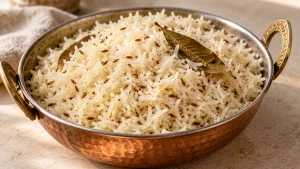
Combine with rice cooking water for absorption measured water in a covered pot, bring to a boil then cook gently about 11–13 minutes until tender and water absorbed; rest covered 5 minutes.
3 Separate the grains
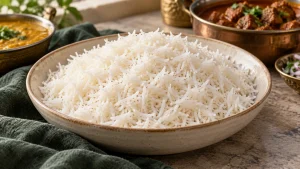
Fluff rice onto a wide clean tray for just a few minutes until less steamy and easier to toss; avoid prolonged room-temperature holding.
4 Toast the tempering
Heat neutral oil oil on medium-low, add black mustard seeds mustard seeds and let crackle carefully.
5 Toast the tempering (continued)
Add roasted unsalted peanuts peanuts, finely chopped ginger ginger and optional slit green chillies chilli; stir for 60–90 seconds, avoiding darkening.
6 Add curry leaves and turmeric
Add dry fresh curry leaves curry leaves carefully, they can splutter, then turmeric powder turmeric and stir 20–30 seconds, without burning spices.
7 Combine and season
Add rice gently to the pan, toss until evenly coated and warm throughout; mix in fine salt salt. Stop stirring as soon as the colour is even.
8 Finish with lemon
Switch off the heat. Fold in fresh lemon juice fresh lemon juice in two additions, taste and adjust sourness, and serve warm promptly.
Chef’s tips
- Dry the curry leaves carefully to reduce spluttering.
- Peanuts are an allergen and must be clearly declared.
- Lemon juice goes in after the cooking heat is off.
Common mistakes & quick fixes
- Rice breaks into clumps
- Use separate cooked grains and fold gently.
- Lemon tastes dull
- Add the juice at the very end, off heat.
- Tempering is bitter
- Do not scorch mustard or turmeric.
Variations & serving ideas
Variation: Omit peanuts only if a nut-free recipe is deliberately prepared with strict cross-contact control.
Perfect result check
| Check | Fluffy separate yellow rice grains |
|---|---|
| Check | Clear lemon aroma |
| Check | Crunchy peanuts and curry-leaf fragrance |
Storage & reheating
| Cooling | Serve promptly. To keep cooked rice, cool in shallow portions as quickly as possible, ideally within one hour, and refrigerate promptly at 0–5°C. | |
|---|---|---|
| Fridge | Within 24 hours | Follow conservative Food Standards Scotland guidance: use refrigerated cooked rice within 24 hours; reheat once until steaming hot throughout. |
| Freezer | Freeze promptly in small portions if storing longer; thaw in the fridge and reheat once. Never leave cooked rice at room temperature overnight. |
Know when to change the heat
| Stage | Heat | What to look for |
|---|---|---|
| Rinse and cook the rice | High then low heat | Rice is tender without a hard centre and the measured liquid is absorbed; rest covered before fluffing. |
| Separate the grains | No heat | Excess steam escapes briefly so grains are easier to fold. Use promptly or cool rapidly for refrigeration. |
| Toast the tempering | Medium-low heat | Mustard seeds crackle and ginger smells fragrant without darkening the roasted peanuts. |
| Add curry leaves and turmeric | Low heat | Dry curry leaves sizzle carefully; turmeric colours the oil without scorching. |
| Combine and season | Low heat | Rice is evenly coated and heated through, with grains still distinct. |
| Finish with lemon | No heat | Fold in lemon off heat until the sourness is balanced, then serve promptly. |
Helpful answers before you cook
Does this recipe require a rice soak?
This method uses rinsed, drained basmati without a separate soaking stage. Follow the rice-cooking step and check a grain for tenderness; rice variety and cookware can change the time and liquid needed.
When should I add the lemon juice?
Turn off the heat before adding the fresh lemon juice. Fold it in gradually, taste and stop at the sourness you prefer. Gentle folding keeps the grains intact and avoids crushing the rice.
How do I keep the grains separate?
Cook the rice until just tender, rest it covered, then fluff it gently. Spread it on a clean wide tray only briefly so excess steam escapes, and use it promptly. Fold it into the tempering rather than stirring hard; cool rapidly and refrigerate if preparing it ahead.
How does serving scaling work?
Ingredient quantities can scale 2/4/8, but rice water, pot size, oil retention and cooking times require practical verification rather than linear scaling.