
Explore Pakistan
National Symbols of Pakistan: FlagAnthem, Emblem and Nature
The green-and-white flag, the Qaumi Tarana, the state emblem and the markhor, chukar, jasmine and deodar: what Pakistan's national symbols are and where they come from.
- Flag adopted 11 August 1947
- Anthem adopted 1954
- National animal: markhor
- National flower: jasmine
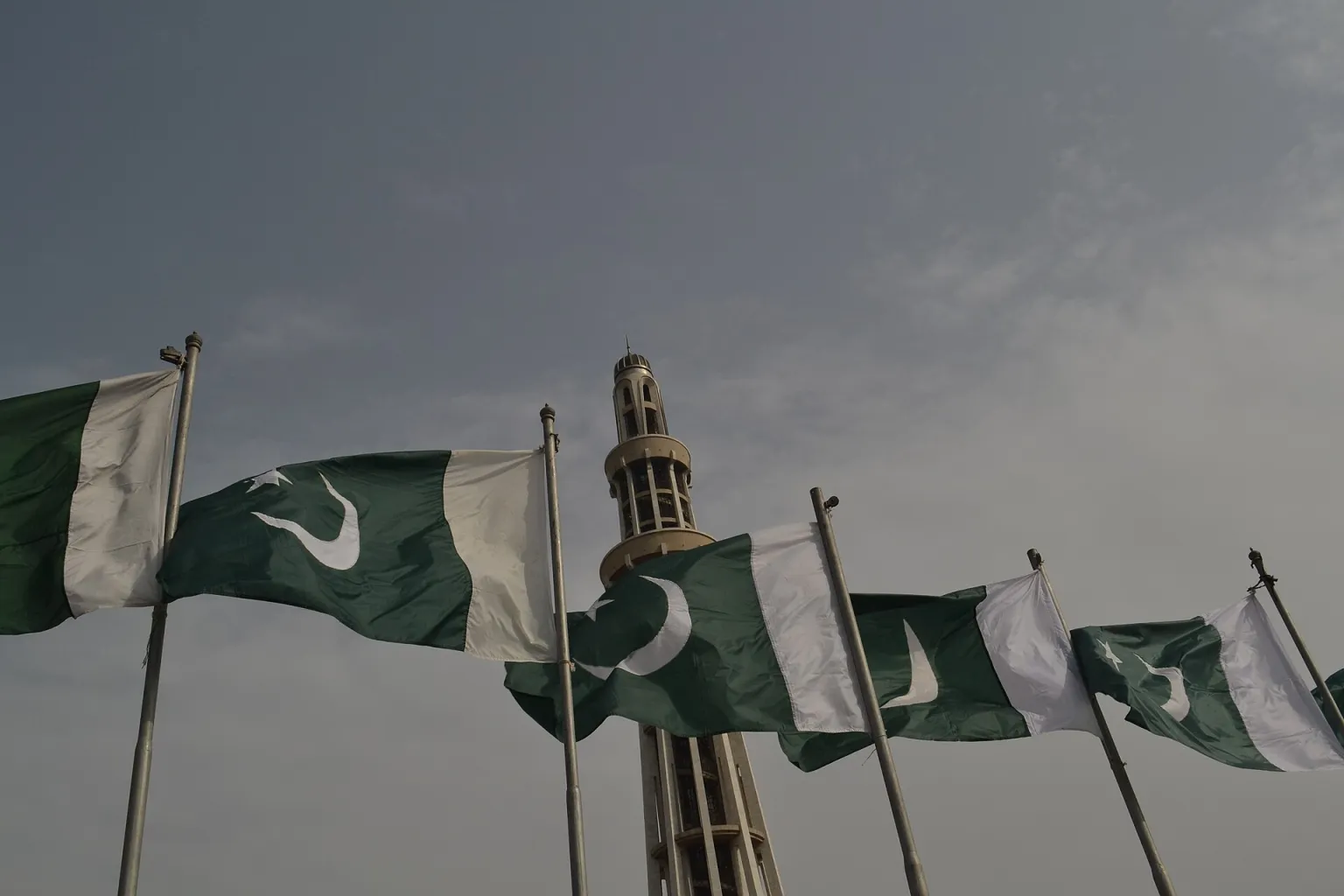
Minar-e-Pakistan, Lahore
Symbols of a Young State
Pakistan came into being on 14 August 1947, and within days it had a flag. Its other official symbols followed over the next decade: an anthem whose music was chosen before its words, a state emblem approved in 1954, and a set of plants and animals that tie national identity to the country's mountains, forests and gardens.
Together they tell a compact story. The flag and the crescent-and-star point to the Muslim League and the Pakistan Movement; the anthem, written in highly Persianised Urdu, celebrates the land and its ideals; the emblem shows the crops that fed the economy; and the markhor, chukar, jasmine and deodar root the nation in its landscape, from the crags of the Karakoram to courtyard gardens in Lahore and Karachi.
Not every symbol has the same legal footing. The flag and anthem are set by state decisions and protocol, while lists of national animals, birds and plants are published by government bodies such as the Ministry of Foreign Affairs and are widely taught in schools. Where sources differ or a status is informal, this page says so.
The National Flag
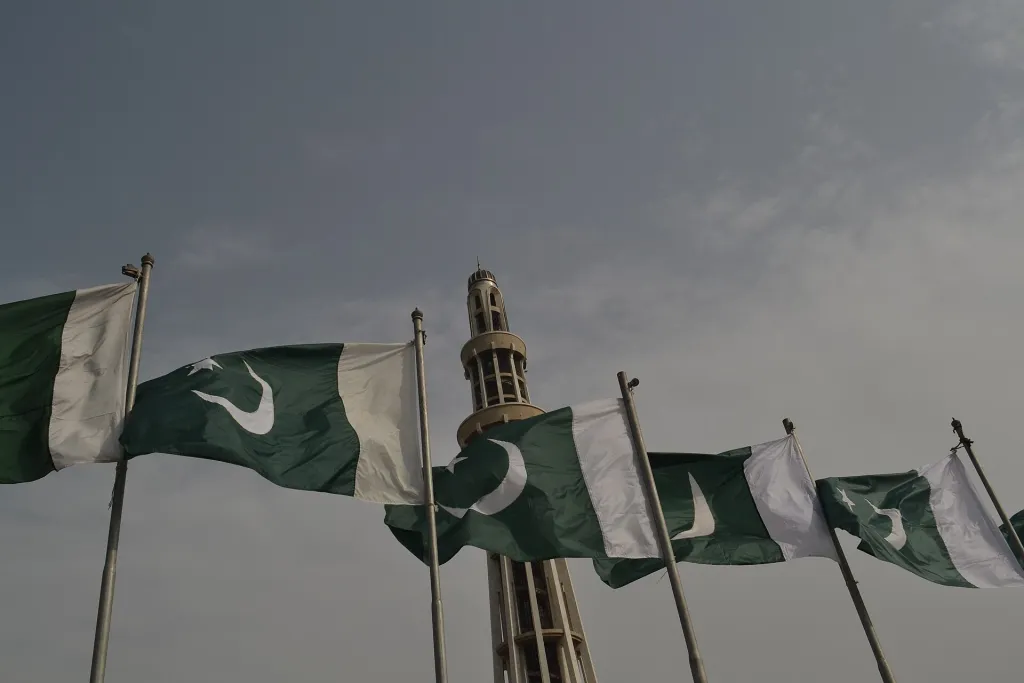
The flag is a dark green field with a white vertical band at the hoist (the edge nearest the pole), and a white crescent and five-pointed star in the centre of the green. Its proportions are 2 to 3. The Ministry of Foreign Affairs gives the official shade of green as hex #01411C, and records that the flag was adopted on 11 August 1947, three days before independence; it credits the design to Syed Amir-uddin Kedwaii.
The design grew directly out of the All-India Muslim League's green flag with a white crescent and star, which the League approved at its founding session in Dhaka in December 1906. The one change in 1947 was the white band at the hoist. Official descriptions explain it as representing Pakistan's religious minorities living alongside the Muslim majority, represented by the green. The crescent is read as a symbol of progress and the star as one of light and knowledge.
The flag survived every later constitutional change, including the move to a republic in 1956 and the separation of East Pakistan in 1971. It is hoisted on public buildings, flown from homes and cars in the weeks before Independence Day, and lowered to half-mast in times of national mourning.
The National Anthem: Qaumi Tarana
Pakistan's national anthem, the Qaumi Tarana, opens with the line Pak sarzamin shad bad (“Blessed be the sacred land”). Its words were written in Urdu by the poet Abul Asar Hafeez Jalandhari, and its music was composed by Ahmed Ghulamali Chagla. It was officially adopted in 1954.
Unusually, the tune came first. Chagla's composition existed before any lyrics were chosen, and poets were asked to write verses to fit it. Jalandhari's three stanzas were selected; their vocabulary draws heavily on Persian-derived words, giving the anthem a formal, elevated register. The Embassy of Pakistan's official description notes that the music uses 21 instruments and 38 different tones.
The anthem is played at state ceremonies, at many schools' morning assemblies and before international sporting fixtures. Citizens are expected to stand to attention while it plays.
The tune came first: the words of the Qaumi Tarana were written to fit music that already existed.
The State Emblem
The state emblem was approved by the central government in 1954. It has four elements:
- Crescent and star at the top, the traditional symbol also found on the flag.
- A shield divided into four parts showing cotton, wheat, tea and jute, the main crops of the young country's agriculture-based economy.
- A floral wreath around the shield, drawn from traditional Mughal decorative art and representing cultural heritage.
- A scroll carrying, in Urdu, the motto associated with Quaid-e-Azam Muhammad Ali Jinnah: Iman, Ittehad, Nazm, Faith, Unity, Discipline.
The emblem appears on government stationery, passports, official buildings and the seals of federal institutions. Because jute was above all a crop of East Pakistan, commentators have occasionally suggested updating the shield, but the 1954 design remains in use.
Living Symbols
The national animal, bird, flower and tree as listed by the Ministry of Foreign Affairs.
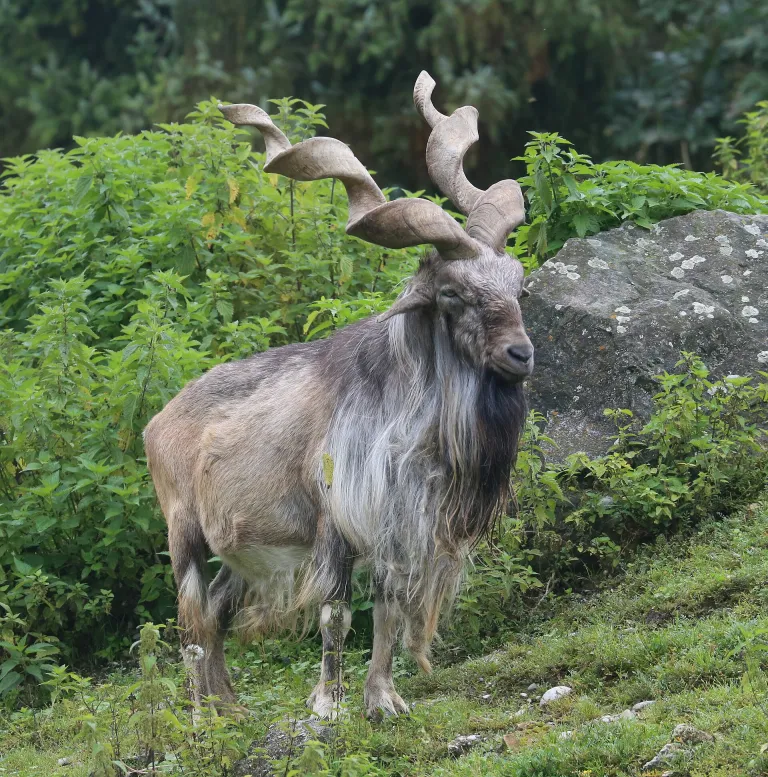 Markhor: national animalA wild mountain goat (Capra falconeri) famous for the long corkscrew horns of the males, found on steep, rocky slopes in the northern and western mountains. Community-run conservation and regulated trophy hunting have helped some populations recover.
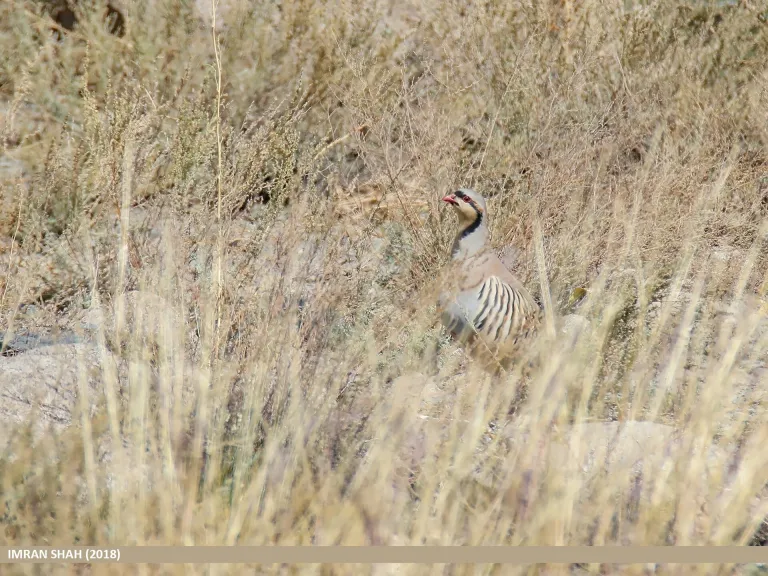 Chukar: national birdThe chukar partridge (Alectoris chukar), locally the chakor, is a hardy game bird of dry, rocky hillsides, recognised by its red bill, black eye-stripe and barred flanks. In Urdu and Punjabi poetry it is the bird that longs for the moon.
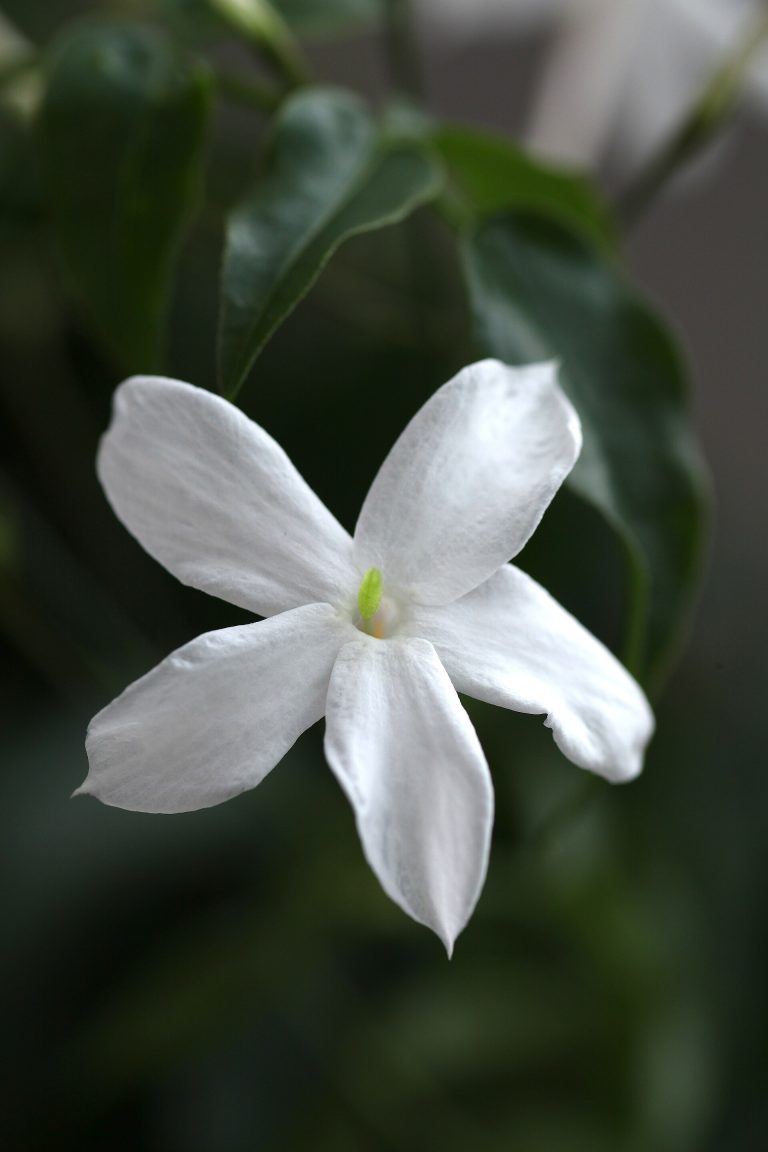 Jasmine: national flowerJasmine (Jasminum officinale), called chambeli, is grown in gardens and courtyards for its white, sweetly scented flowers. Strings of jasmine are worn in the hair and used to decorate weddings and celebrations.
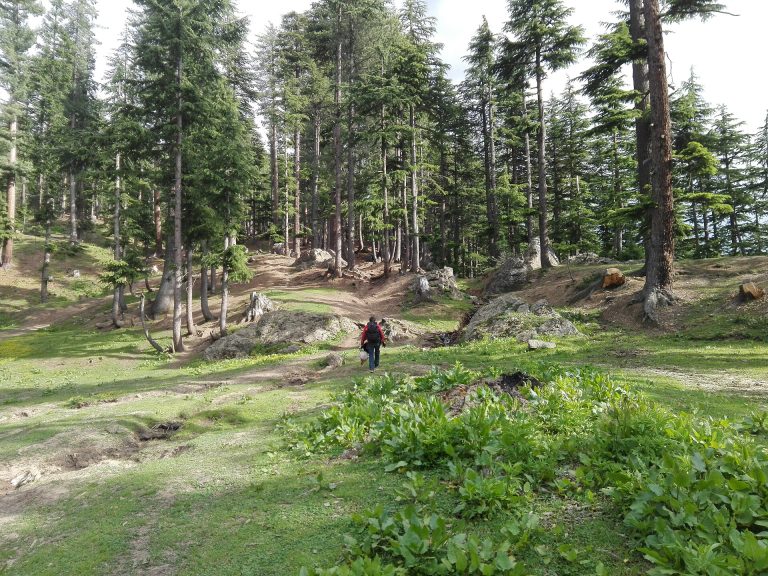 Deodar: national treeThe deodar cedar (Cedrus deodara) is a tall, slow-growing evergreen of the Himalayan and Hindu Kush foothills, forming forests in Swat, Chitral, Dir, Hazara, the Murree hills and Azad Kashmir. Its durable timber has long been prized for building.
National Figures and Landmarks
 Quaid-e-Azam Muhammad Ali JinnahLeader of the All-India Muslim League and Pakistan's first Governor-General, honoured as the Quaid-e-Azam (Great Leader) and founder of the nation. His portrait appears on Pakistan's banknotes, and his birthday, 25 December, is a public holiday.
 Allama Muhammad IqbalThe Sialkot-born philosopher-poet who wrote in Urdu and Persian is regarded as Pakistan's national poet. His 1930 Allahabad address is remembered as an early statement of the idea of a Muslim homeland in the north-west of the subcontinent.
 Minar-e-PakistanThe tower in Lahore's Greater Iqbal Park marks the spot where the All-India Muslim League passed the Lahore Resolution on 23 March 1940. It is the backdrop to many national celebrations.
Respecting the Symbols
Visitors should stand quietly while the national anthem is played, avoid placing the flag on the ground or using it as a costume or decoration in ways that could be seen as disrespectful, and follow the lead of local hosts at flag-raising ceremonies. Protocol rules for official use of the flag and emblem are issued by the federal government; check current guidance before using them on printed or commercial material.
Frequently Asked Questions
Who wrote Pakistan's national anthem?
The words of the Qaumi Tarana were written in Urdu by Abul Asar Hafeez Jalandhari, and the music was composed by Ahmed Ghulamali Chagla. It was officially adopted in 1954.
What does the white stripe on Pakistan's flag mean?
The white band at the hoist is officially described as representing Pakistan's religious minorities, while the green stands for the Muslim majority. The crescent symbolises progress and the star light and knowledge.
What is Pakistan's national animal?
The markhor (Capra falconeri), a wild mountain goat with spectacular spiralling horns found in the mountains of the north and west.
What is the national flower of Pakistan?
Jasmine (Jasminum officinale), known locally as chambeli, prized for its white, fragrant flowers.
Is hockey or cricket Pakistan's national sport?
Field hockey is listed as the national sport by the Ministry of Foreign Affairs. Cricket is the most popular sport in the country today.
What is the motto on the state emblem?
The scroll on the emblem carries the Quaid-e-Azam's motto in Urdu: Iman, Ittehad, Nazm, Faith, Unity, Discipline.
What are Pakistan's national fruit and national dress?
The mango is commonly described as the national fruit, a description used at official events such as the Ministry of Foreign Affairs' 2025 mango festival. The shalwar kameez is generally regarded as the national dress for both men and women. Neither appears on the Ministry of Foreign Affairs' short list of national symbols, which covers the flag, emblem, anthem, animal, bird, flower, tree and sport.
Keep Exploring
Related places and stories on DailyLife.pk
 LahoreLahore travel guide: Badshahi Mosque, Lahore Fort, Shalimar Gardens, the Walled City, food streets, neighbourhoods, metro
 KarachiKarachi travel guide: Mazar-e-Quaid, Mohatta Palace, Clifton, Burns Road, bazaars, neighbourhoods, Green Line BRT
 SialkotSialkot city guide: Iqbal Manzil, Holy Trinity Cathedral, Sialkot Fort, sports goods and football industry, history
 IslamabadIslamabad travel guide: Faisal Mosque, Pakistan Monument, Margalla Hills trails, Saidpur, markets, sectors, Metrobus
 The Pakistan MovementThe Pakistan Movement explained: Sir Syed and Aligarh, the Muslim League (1906), Iqbal's 1930 address
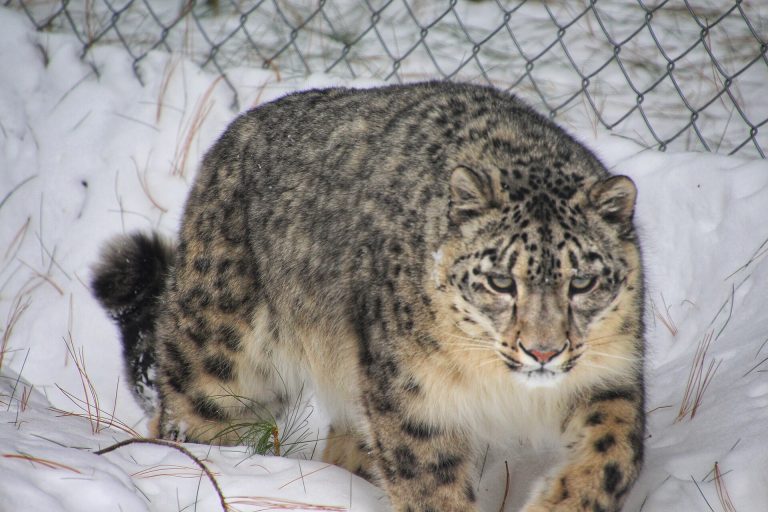 Wildlife of PakistanPakistan's wildlife: markhor (national animal), snow leopard, Indus river dolphin, Himalayan brown bear, ibex
How we know this
- Type Explainer
- Sources 14 (7 official/academic)
- Reviewed October 2026
- Disputed points None
14 sources
- National Symbols of Pakistan, Ministry of Foreign Affairs, Government of Pakistan
- Flag of Pakistan, Encyclopaedia Britannica
- Qaumi Tarana, Encyclopaedia Britannica
- State Emblem, Embassy of the Islamic Republic of Pakistan, Tashkent
- National Anthem, Embassy of the Islamic Republic of Pakistan, Tashkent
- National Flag, Embassy of the Islamic Republic of Pakistan, Tashkent
- Flora and fauna: Symbols of our national pride, Dawn
- The national emblem is in need of an essential update (letter, 29 September 2024), Dawn
- Markhor, Encyclopaedia Britannica
- Muhammad Iqbal, Encyclopaedia Britannica
- Mohammed Ali Jinnah, Encyclopaedia Britannica
- Constitution of the Islamic Republic of Pakistan, National Assembly of Pakistan
- MOFA hosts festival showcasing Pakistan's mango diplomacy (12 June 2025), Associated Press of Pakistan
- Shalwar kameez (used to locate primary sources, incl. Ozyegin, Gender and Sexuality in Muslim Cultures, Routledge 2016, p. 222), Wikipedia
Photo credits (12)
- Minar-e-Pakistan with waving national flags.JPG, Susmanhamza, CC BY-SA 3.0, via Wikimedia Commons
- Markhor Schraubenziege Capra falconeri Zoo Augsburg-02.jpg, Rufus46, CC BY-SA 3.0, via Wikimedia Commons
- Chukar Partridge (Alectoris chukar) (31634643457).jpg, Imran Shah from Islamabad, Pakistan, CC BY-SA 2.0, via Wikimedia Commons
- Jasminum officinale.JPG, B.traeger, CC BY 3.0, via Wikimedia Commons
- Deodar Cedar forest, Boyun Village, Kalam, Swat, Pakistan.jpg, Jawadqada, CC BY-SA 4.0, via Wikimedia Commons
- Mazar-e-Quaid Karachi.jpg, Furqanlw, CC BY-SA 4.0, via Wikimedia Commons
- Allama Iqbal Tomb side view, adjacent to the Badshahi Mosque's gateway.jpg, Rohaan Bhatti, CC BY-SA 3.0, via Wikimedia Commons
- Sindhi Cultural Day 2019 celebrations at Sindh museum Hyderabad, Sindh.jpg, JogiAsad, CC BY-SA 4.0, via Wikimedia Commons
- Mango trees in Khadro.JPG, Talha Zubair Khan, CC BY-SA 4.0, via Wikimedia Commons
- Pakistani Punjabis at a wedding.jpg, Alvi Haroon, CC0, via Wikimedia Commons
- HOCKEY ARGENTINA PAKISTAN.jpg, Michelangelo-36, Public domain, via Wikimedia Commons
- Indus River Skardu Pakistan.jpg, Akhtar Bashir Nigyaal, CC BY-SA 4.0, via Wikimedia Commons
