
Places to visit
Sethi House, Peshawar: a practical visitor guide
Visit Sethi House, Peshawar: what to see, historical context, getting there, a realistic plan, families and official access checks.
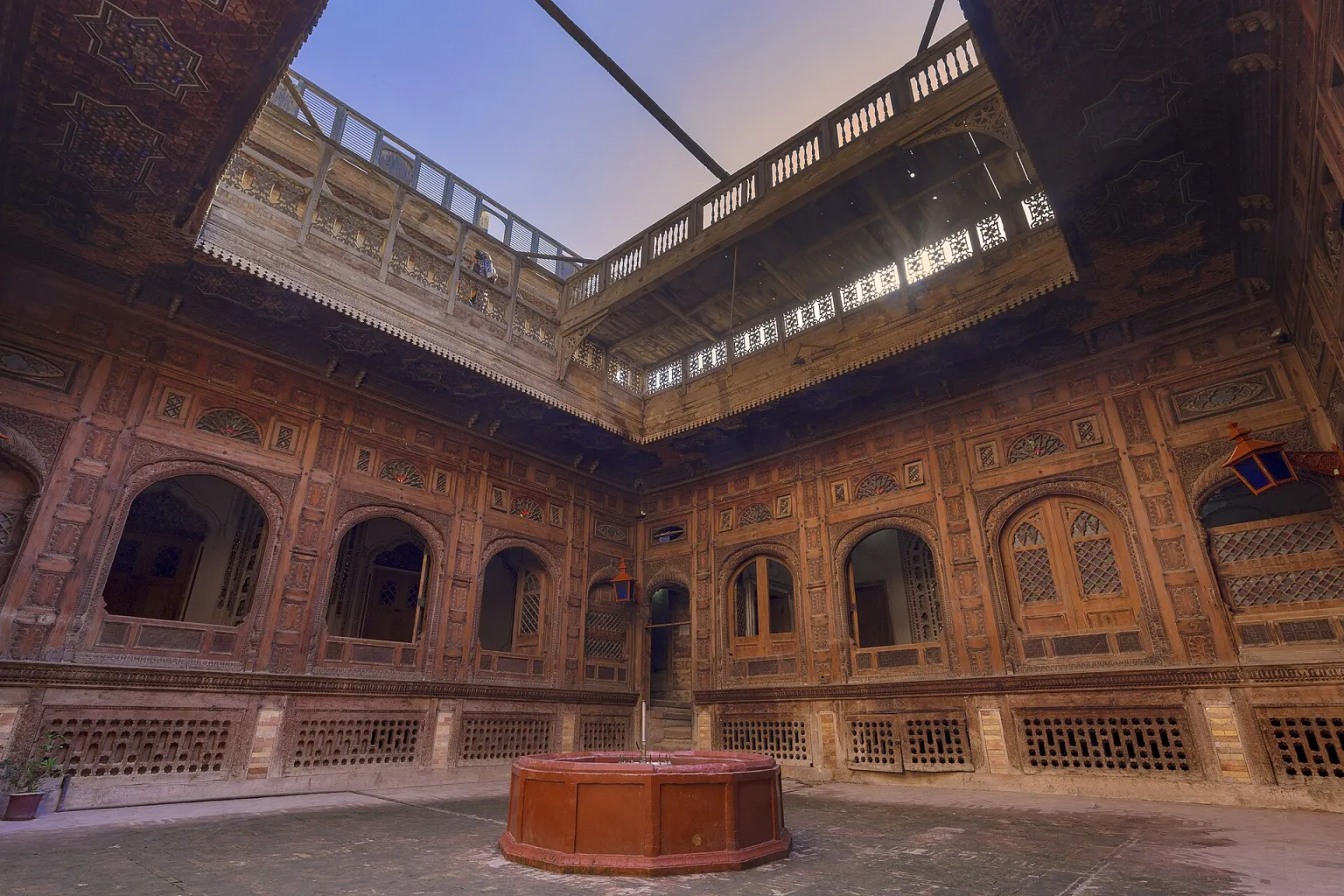
The carved wooden courtyard of Sethi House, Peshawar
Current travel advice — checked 31 October 2026
British travellers: FCDO advice updated 27 October 2026 advises against all travel to Peshawar, including the city. Check current FCDO advice before considering a journey. Domestic visitors should follow local authority instructions and current permissions; museum opening does not settle route access.
A merchant house rather than a royal palace
Sethi House introduces a different kind of historic wealth from the forts and royal gardens that dominate many Pakistan itineraries. Its attraction is the relationship between a trading family's home, skilled decorative work and the close urban fabric of old Peshawar. Plan roughly an hour to ninety minutes for the house itself, plus time for the pedestrian approach. This is an editorial allowance. Move slowly: a ceiling, screen or doorway rewards looking from more than one angle. The value of the visit lies in close attention, not in covering a large area or collecting a high number of rooms.
Dates and recognition require careful wording
The provincial directorate describes a nineteenth-century house with exceptional wood craftsmanship and Central Asian artistic connections. Official sources differ on the precise completion date, so a confident single-year claim is avoided here. UNESCO's website carries a 2026 Tentative List submission for Sethi House. Tentative List inclusion is not World Heritage inscription and must not be advertised as such. The useful history is the house's connection with Peshawar's merchant networks and the interplay between local domestic forms and wider decorative influences. A richly worked interior does not need an exaggerated status label to justify a visit.
Explore the places and guides mentioned
Photographs show the linked places or guide subjects. Open each page for its own visiting and planning information.


What to notice in the interior
Look for how light, privacy and decoration interact. A window or screen is not only a pattern: it controls visibility and the movement of air or light. A courtyard can organise circulation, while a decorated doorway marks a transition between spaces. The UNESCO submission describes carved wooden elements, coloured glass, painted surfaces and mirror work. Use those as prompts rather than an exhaustive checklist, since current access may cover only part of the house. Keep hands away from carved surfaces and glass. A close photograph, where permitted, is a better record than rubbing, leaning or opening a fragile fitting.
Trade, privacy and a domestic plan
The 2026 UNESCO Tentative List submission describes a merchant compound combining family space and business functions, with courtyards, screened circulation and ventilated lower spaces. That is a more useful interpretive thread than simply calling the house lavish. As you move through the permitted route, ask who could see whom, which transitions feel formal and how a room might connect to work as well as domestic life. Do not infer a precise gendered route or room function without interpretation, but notice the physical devices through which privacy could be organised.
The same submission names mirror-inlaid alcoves called cheenidaan and delicate woodwork called tarseem bandi. If those features are visible and identified, use the names as a route into looking rather than as vocabulary to collect. Compare a solid carved element with a screen that controls light and visibility. Both can be decorative, but they do different work. The house makes Peshawar's regional connections tangible at room scale: ideas associated with wider trade and artistic networks appear in a specific domestic setting. That does not mean every motif can be assigned a single foreign origin, and a visitor should avoid turning a complex craft tradition into a simple story of one culture borrowing from another.
The old-city approach is part of the logistics
The house is in Mohallah Sethian in the old city. Save the specific Sethi House destination and confirm it with the museum authority; the neighbourhood contains more than one historic Sethi property. A car may only be able to take you to a practical nearby stopping point. Arrange the final walking approach and return meeting place before getting out. Wear shoes suited to streets and interior thresholds, and bring a compact bag. Do not block an alley for a posed photograph or assume neighbouring doors are public because the museum is open to visitors.
An attentive route through a small building
Ask at the entrance which rooms are open and whether visitors must follow a guide or a fixed route. Start with the overall layout before concentrating on details. Pick one woodwork feature, one treatment of light and one circulation feature to compare. This gives structure to the visit without requiring specialist architectural terms. Leave time at the end to revisit the courtyard or permitted exterior view after understanding the interior. If a staircase or room is closed, accept the limit. Seeing one fragile historic house well is more valuable than trying to access every level or adjacent residence.
Practical checks before entering a historic home
Confirm current opening, admission, photography conditions and any guide arrangements with the provincial authority. The directorate's heritage description does not establish a current fee or a tour offered in a particular language. A visitor who cannot use stairs should ask exactly which parts can be seen without them, and whether thresholds or narrow passages interrupt that route. Ask about toilets rather than expecting them within a domestic building converted for visitors. International travellers need to check current official Peshawar travel advice separately. A museum's public status is not a general assurance about every journey or visitor circumstance.
Use the official attraction information as your starting point for the enquiries above.
Make the wider neighbourhood visit considerate
For children, invite a search for repeated geometric shapes from a permitted standing point, without touching or climbing. Explain that the alley outside is a place where people work and live. Photograph residents and shop interiors only with permission. The Peshawar city guide can help organise a broader day, while DailyLife's existing Mahabat Khan Mosque and Qissa Khwani guide provides separate old-city context. Do not assume all nearby religious or domestic spaces share the house's access arrangements. A short walk and a pause afterwards give the details time to settle, especially if you have already visited the much larger Peshawar Museum.
For related planning, read Mahabat Khan Mosque and Qissa Khwani.
Continue planning your trip
Frequently Asked Questions
Is Sethi House a UNESCO World Heritage Site?
The UNESCO page reviewed is a 2026 Tentative List submission. That is a different status from World Heritage inscription.
Can a car reach the door?
Do not assume it. The old-city location may require a final walk from a practical drop-off. Confirm the entrance and return meeting point locally.
Is the entire house accessible without stairs?
No such claim is verified here. Ask the operator which rooms can be reached without steps and whether narrow thresholds affect the route.
How much time is useful?
Allow around an hour to ninety minutes for the house plus the approach, as an editorial estimate. Guide arrangements and open rooms may change the visit.
How we know this
- Type Travel guide
- Sources 3 (1 official/academic)
- Reviewed October 2026
- Disputed points None
Rules and fees change, confirm with the official links below before you act.
3 sources
- Sethi House, Peshawar — official information, Government of Khyber Pakhtunkhwa
- Sethi House, Tentative List submission, UNESCO World Heritage Centre / Government of Pakistan submission
- Pakistan travel advice; updated 27 October 2026, UK Foreign, Commonwealth and Development Office
Photo credits (3)
- Sethi House Peshawar.jpg, Asmar Hussain110, CC BY-SA 4.0, via Wikimedia Commons
- Sethial street - Sethi House Complex, Peshawar.jpg, Teseum, CC BY-SA 4.0, via Wikimedia Commons
- Masjid Muhabat Khan.jpg, Hafeezburki, CC BY-SA 4.0, via Wikimedia Commons
