
Tres Leches Cake
Chilled three-milk soaked sponge
One 25 × 20 cm dish; twelve portions
Base elapsed estimate: 475 minutes, including the proofing, cooling or chilling explicitly stated in the method. Preparation and baking may overlap only where directed. A cold refrigerator is 4°C or below; a warm kitchen can require earlier refrigeration and longer chilling. One tablespoon = 15 ml; one teaspoon = 5 ml.
About Tres Leches Cake
A tres leches sponge with condensed milk, evaporated milk and cream, served chilled. It differs from the unsoaked hot-milk cake entry.
Preserve the egg foam, prick the cooled sponge evenly and add the milk soak gradually before a full refrigerated rest. This is an original editorial formulation. Pan dimensions, measured egg weight and the cooling or chilling stage are part of the recipe, not optional details. It has not been kitchen tested; oven performance and ingredient brands can change the final timing.
Personally cooked and tested by Zohair Fakhar for DailyLife.pk. Cooking times can vary with your stove, cookware and batch size; follow the texture and doneness cues in the method.
Make it work for your kitchen
Original quantities serve 12. Cooking times, pan size and frying-oil depth do not scale, cook in extra batches instead.
Before you start
Measure accurately
Weigh ingredients, including egg without shells where listed. Use the exact tin or dish dimensions specified. Prepare the vessel before mixing leavened batter so it can cook without delay.
PreparationClean handling
Do not taste raw flour, dough or egg batter. Use pasteurized dairy and clean utensils for uncooked cream fillings. Keep eggs and dairy refrigerated until needed.
Food safetySet up the equipment
Have the following tools ready before starting: Digital scales; 25 × 20 × 6 cm ovenproof dish; Electric mixer; Spatula; Skewer; Milk measuring jug; Chilled whipping bowl.
Clean workspaceMeasure the ingredients
Measure the ingredient quantities for your selected servings before applying heat. Keep separately listed groups, such as dough, filling, sauce or garnish, in separate containers; keep any optional additions separate.
Use the ingredient list above
Step-by-step cooking method
1 Bake a light sponge
Heat oven to 175°C. Grease and base-line a 25 × 20 × 6 cm dish with 5 g butter.
2 Bake a light sponge (continued)
Whisk eggs and sugar with an electric mixer 5–7 minutes until a ribbon sits on the surface for a few seconds.
3 Bake a light sponge (continued)
Fold in sifted flour, baking powder and salt. Mix batter milk, melted butter and vanilla into a little batter, then fold that back gently.
4 Set and cool the cake
Bake 25–32 minutes until springy and clean on a skewer. Cool in the dish for 30 minutes. Leave cake in its serving dish and prick all over with a skewer, about 2 cm apart, so the soak can distribute rather than pool in one place.
5 Add the three milks
Whisk condensed milk, evaporated milk and soak cream until uniform. Pour over cake in three additions, waiting 5 minutes between each.
6 Add the three milks (continued)
Refrigerate promptly after soaking and chill at least 6 hours. The cake must remain refrigerated because the milk is an uncooked perishable soak.
7 Top and portion
Whip topping cream with icing sugar to medium peaks.
8 Top and portion (continued)
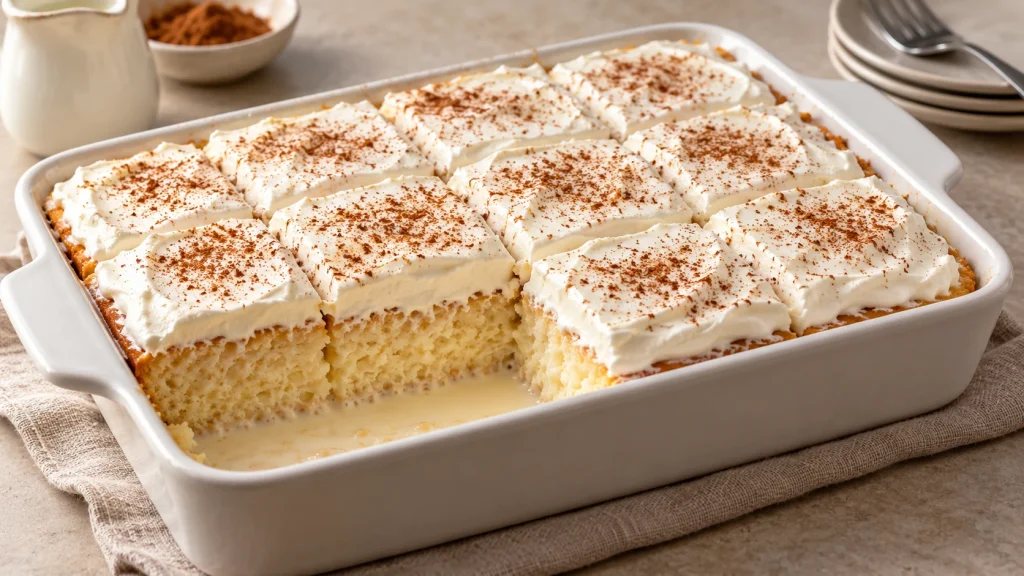
Spread over the cold soaked cake and cut twelve portions in the dish. Spoon any modest loose milk alongside; a large untouched pool suggests insufficient chilling or a dense overmixed sponge.
Chef’s tips
- Preserve the egg foam, prick the cooled sponge evenly and add the milk soak gradually before a full refrigerated rest.
- Begin checking at the early end of the stated range. Oven temperature, tin material and the depth of the mixture affect cooking more than the number of portions.
- Cool or chill for the specified period before cutting or decorating. A warm base melts dairy toppings, and a chilled dessert often needs time to finish setting.
Common mistakes & quick fixes
- The texture is heavy or uneven
- Measure by weight, use the stated mixing method and avoid changing vessel depth. Preserve the egg foam, prick the cooled sponge evenly and add the milk soak gradually before a full refrigerated rest.
- Outside is ready before the middle
- Check oven calibration and the stated tin size. Protect an already browned surface loosely with foil and continue gently until the actual doneness cue is met.
- Cream or filling softens during assembly
- Chill the base and dairy components first. Work in short stages and return perishable components to the refrigerator rather than leaving them beside a warm oven.
Variations & serving ideas
Serving size: Divide the same completed batch into smaller portions if desired. Do not increase batter depth or shorten a chilling stage merely because the portions are smaller.
Perfect result check
| Defining texture | Chilled three-milk soaked sponge. Preserve the egg foam, prick the cooled sponge evenly and add the milk soak gradually before a full refrigerated rest. |
|---|---|
| Safety and finish | No raw flour or egg batter is served. Egg custards and cheesecake reach at least 71°C centrally; cake and bread batters must be fully baked as specified, not intentionally left raw. |
Storage & reheating
| Refrigerator | Use within 48 hours | For cream, custard, cheesecake or fruit-filled desserts, cover and refrigerate at 4°C or colder promptly, within 2 hours or 1 hour above 32°C. Use shallow portions for cooling. This is a conservative editorial limit. |
|---|---|---|
| Serving | Keep chilled desserts cold until serving | Return unused portions promptly to the refrigerator. Plain baked goods without perishable toppings may be covered at cool room temperature for 24 hours; refrigerate in a hot kitchen. Texture is best on the day specified by the method. |
Know when to change the heat
| Stage | Heat | What to look for |
|---|---|---|
| Bake a light sponge | 175°C oven preheating; no heat mixing | Egg ribbon remains visible briefly; flour is folded without deflating. |
| Set and cool the cake | 175°C oven | Sponge is springy and skewer-clean before pricking. |
| Add the three milks | No heat; refrigerator | Each milk addition begins absorbing before the next; refrigerate promptly. |
| Top and portion | No heat | Cold soaked cake supports soft whipped-cream topping. |
Helpful answers before you cook
Why add three-milk soak in stages?
Three additions with five-minute pauses allow even absorption through the pricked sponge rather than flooding its edges.
Can it be stored on the counter?
No. The uncooked milk soak and whipped cream require refrigeration at 4°C or colder. Chill at least six hours and keep cold until serving.
Why is there milk left under the cake?
A little loose soak is normal, but a large untouched pool can mean a dense overmixed sponge or insufficient chilled rest. Preserve the egg foam and prick evenly.


