
Roasted Sweet Potato
Roast whole sweet potatoes, then dress the soft flesh
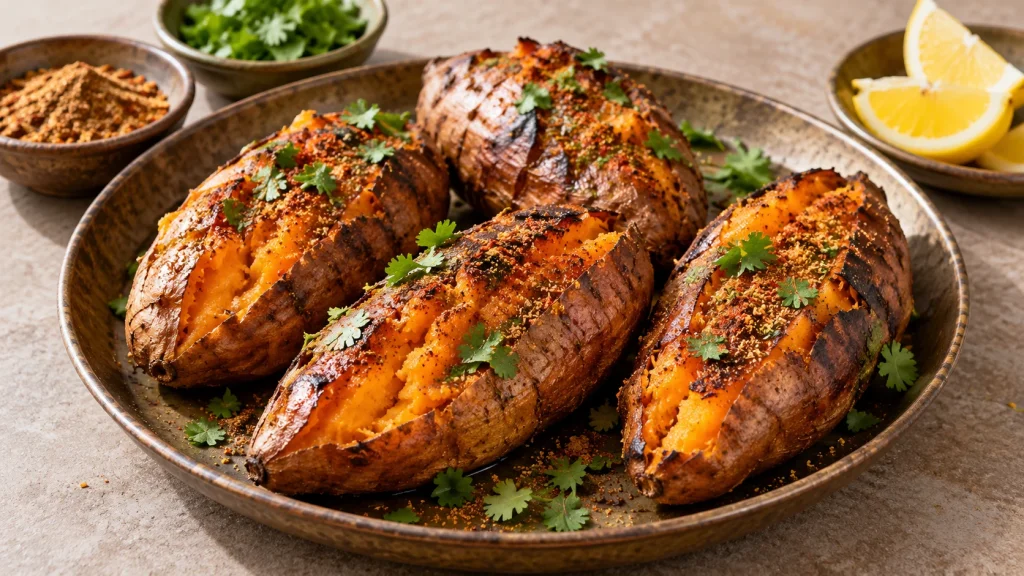
Four lemon-and-cumin street-style sweet potatoes
Planning allowances by stage: Wash and inspect (10 minutes); Roast uncovered (45–65 minutes); Rest before opening (5–10 minutes); Dress the flesh (3 minutes). Covered rests and cooling are included in the total where required; batch cooking and equipment recovery can extend elapsed time. Follow the individual sequence and doneness cues rather than adding every overlapping allowance. One tablespoon = 15 ml; one teaspoon = 5 ml.
About Roasted Sweet Potato
Roasted sweet potato is prepared whole until the centre is completely soft, then split and finished with lemon, cumin and a little chaat masala. This is a simple oven adaptation with a moist interior and lightly wrinkled skin.
Choose similarly sized potatoes so one is not burnt while another remains hard. Orange-fleshed and pale-fleshed varieties roast differently, so use a skewer or knife to assess the centre rather than a fixed timer alone. Do not seal them tightly in foil for this method; an open tray lets surface moisture escape.
Personally cooked and tested by Zohair Fakhar for DailyLife.pk. Cooking times can vary with your stove, cookware and batch size; follow the texture and doneness cues in the method.
Make it work for your kitchen
Original quantities serve 4. Cooking times, pan size and frying-oil depth do not scale, cook in extra batches instead.
Before you start
Set up the ingredients
Weigh each component before starting. Keep raw ingredients, cooked components and serving garnishes in separate bowls so the order in the steps is easy to follow. Wash produce under running water before cutting and use clean utensils for the finished dish.
PreparationPlan the finishing stage
Prepare a clean serving area before the final cooking or assembly. Finish only the amount you intend to eat immediately; moist garnishes and crisp components are best combined at the last moment. Keep chilled ingredients refrigerated until needed.
WorkflowSet up the equipment
Have the following tools ready before starting: Scales; Vegetable brush; Fork; Rimmed baking tray; Baking paper; Oven gloves; Thin knife; Small seasoning bowl.
Clean workspaceMeasure the ingredients
Measure the ingredient quantities for your selected servings before applying heat. Keep separately listed groups, such as dough, filling, sauce or garnish, in separate containers; keep any optional additions separate.
Use the ingredient list above
Step-by-step cooking method
1 Wash and inspect
Scrub sweet potatoes under running water and dry well.
2 Wash and inspect (continued)
Remove damaged areas and prick each skin several times with a fork. Keep potatoes whole if they are near the specified size; very large ones require a longer bake.
3 Roast uncovered
Preheat the oven to 210°C. Rub the measured oil thinly over the skins and put on a lined rimmed tray.
4 Roast uncovered (continued)
Roast 45–65 minutes, turning once, until the skin wrinkles and a thin knife slides easily through the thickest centre without resistance. Larger or pale dense varieties may need longer.
5 Rest before opening
Transfer the tray to a heatproof surface and rest 5–10 minutes.
6 Rest before opening (continued)
Split lengthwise with a knife, keeping your hands clear of steam. Fluff the flesh gently with a fork without mashing it into the skin.
7 Dress the flesh
Mix lemon juice, cumin, chaat masala and chilli. Divide across the four split potatoes and finish with coriander.
8 Dress the flesh (continued)
Taste before adding any separate salt; none is included because commercial chaat masala can be salty. Serve warm and eat the clean sound skin if desired.
Chef’s tips
- Measure the salt separately from any packaged seasoning; branded spice blends can already be salty.
- Keep cut sizes consistent so the components cook or soften at the same rate.
- Use a clean serving spoon rather than returning a tasting spoon to a component that will be stored.
Common mistakes & quick fixes
- The final mixture tastes flat.
- Taste a small complete serving, including every sauce or garnish. Adjust the measured salt or acid in a small portion first, then apply that correction to the remaining batch.
- The texture deteriorates before serving.
- Keep crisp and moist components separate until the final step, and prepare smaller serving batches. A long assembled hold cannot be corrected by adding more spice.
Variations & serving ideas
Milder serving: Use half the stated chilli in the base batch, keeping the other ingredient weights unchanged. Offer additional chilli separately at the table; heat-sensitive diners can then take an unmodified portion of the fully cooked dish.
Perfect result check
| Main component | The centre is cooked or softened as specified, with no raw patches. |
|---|---|
| Finished serving | The individual components remain identifiable, evenly seasoned and easy to portion. |
Storage & reheating
| Refrigerate cooked potatoes | Up to 48 hours | Cool promptly, split into shallow portions if large, and refrigerate within two hours. Reheat thoroughly once before adding fresh coriander and lemon. Do not leave cooked potatoes enclosed warm overnight. |
|---|---|---|
| Freeze cooked flesh | Up to 1 month for quality | Scoop and cool the flesh promptly, seal in small portions and freeze. Defrost in the refrigerator and reheat thoroughly; the skin texture will not be restored. |
Know when to change the heat
| Stage | Heat | What to look for |
|---|---|---|
| Roasting | 210°C oven | A thin knife meets no resistance at the thickest point; surface colour alone is insufficient. |
| Opening | No heat | Allow steam to settle before splitting and keep hands out of its path. |
Helpful answers before you cook
Why is the middle still firm?
The potato may be larger or denser than the specified size. Continue roasting and check with a thin knife; a dark skin is not proof of tenderness.
Should I wrap it in foil?
Not for this open-tray formulation. Foil traps steam and changes skin texture; it also makes it easier to overlook a hot wrapped leftover.
Can I make it sweeter?
The natural sweetness concentrates during roasting. This savoury formulation uses lemon and spice rather than added sugar; choose a sweeter orange-fleshed variety if preferred.


