Aloo Tikki
Dry potato and a small rice-flour binder
Golden shallow-fried potato patties with a small rice-flour binder. The original four-serving quantities make eight tikkis; plan two evenly sized patties per selected serving.
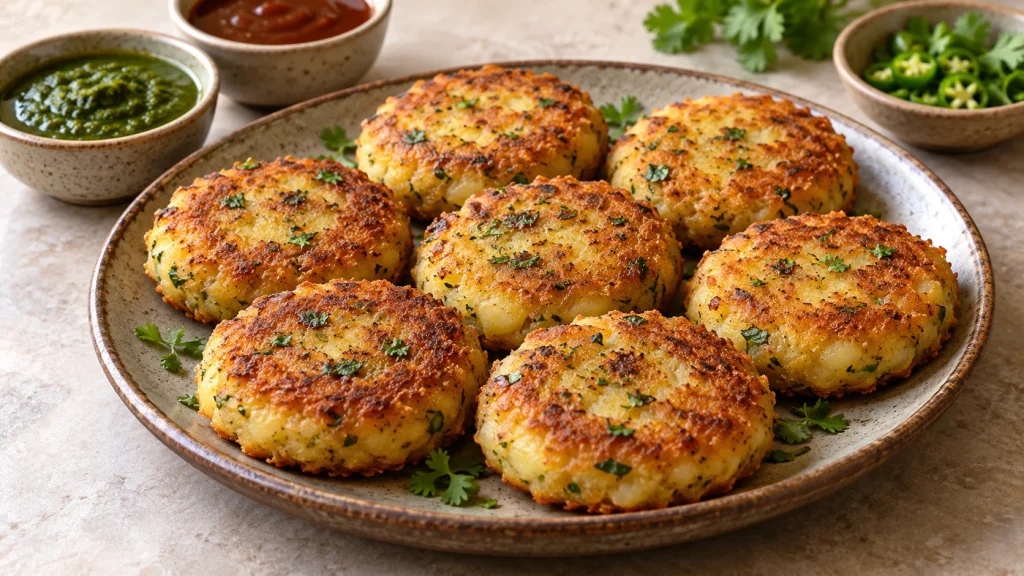
The original 25 minute preparation, 35 minute cooking and 90 minute total are planning estimates. Allow about 15–20 minutes simmering within the 20–25 minute potato-cooking stage, 1–2 minutes steam-drying, extra shallow cooling until handleable, shaping plus 15 minutes refrigeration and 6–8 minutes frying per small batch. Oil heating, cooling conditions and extra batches can extend the total. The 3–4 minute guide for each face does not replace checking the crust, hot centre and cooked binder. One tablespoon = 15 ml; one teaspoon = 5 ml.
About Aloo Tikki
Aloo tikki is a potato-led shallow-fried patty with a browned surface and a tender middle. A modest rice-flour binder helps it hold without turning the centre into a flour-heavy dough.
The potatoes are cooked in chunks, drained and steam-dried before mashing. Wet mashed potato makes fragile patties and encourages unmeasured additions of starch. This version keeps the flavour simple with cumin, coriander and amchur; it is suitable as a snack or a base for separately prepared chaat.
Personally cooked and tested by Zohair Fakhar for DailyLife.pk. Cooking times can vary with your stove, cookware and batch size; follow the texture and doneness cues in the method.
Make it work for your kitchen
Original quantities serve 4. Cooking times, pan size and frying-oil depth do not scale, cook in extra batches instead.
Before you start
Set up the ingredients
Weigh the peeled potatoes before cooking, then cut them into roughly 3 cm chunks. Measure the remaining quantities for the selected servings. Wash the fresh coriander and green chilli, dry them and use clean utensils. Keep boiling liquid separate from the seasoning and frying allowance; it will be drained and discarded.
PreparationPlan the finishing stage
Boil, drain and steam-dry the potatoes before mashing without milk or butter. Spread the mash shallowly and cool only until comfortable to handle before seasoning and shaping; do not leave a large warm heap standing for hours. Allow the stated 15 minute covered refrigeration to firm the patties, then shallow-fry near serving. Keep any separately prepared sauce or chaat toppings cold and add them at the table.
WorkflowSet up the equipment
Have scales, a saucepan large enough for the selected potatoes and boiling liquid without overflowing, colander, potato masher, clean shallow tray, wide frying pan and broad spatula ready. Choose a pan that leaves space between patties and cook in more batches if needed. A clean food probe is useful when reheating chilled components; clean it after use.
Clean workspaceMeasure the ingredients
Keep the boiling liquid separate and discard it after draining; do not add it back to wet mash. The peeled potato weight is measured before boiling, not after cooking. Use the stated rice-flour binder and keep ground coriander distinct from chopped fresh coriander. Divide the measured shallow-frying oil across all necessary batches rather than using the whole allowance in every panful.
Use the ingredient list above
Step-by-step cooking method
1 Boil the potatoes
Put the selected potato allowance, peeled and cut into roughly 3 cm chunks, in the saucepan with the separately measured boiling liquid. Bring to a simmer and cook for about 15–20 minutes until a fork enters the centre easily with no hard core. Use a pan large enough for the selected amount without overflowing; the time is a guide, not a substitute for tenderness.
2 Drain, steam-dry and mash
Drain thoroughly and discard the boiling liquid. Return the potatoes to the warm emptied pan off the heat for 1–2 minutes, shaking gently to let surface moisture evaporate. Mash while warm without milk or butter. Do not loosen the mash with the discarded liquid.
3 Cool and season
Spread the mash in a clean shallow tray to cool promptly, just until comfortable to handle. The 20 minute stage allowance is a guide; room temperature and tray depth affect cooling. Do not leave a large warm heap standing for hours. Use the same-session shaping and frying sequence below, or refrigerate cooked potato promptly within 1–2 hours if preparing ahead.
4 Cool and season (continued)
Mix the rice-flour binder, salt, ground cumin, ground coriander, amchur, chilli powder, chopped fresh coriander and minced green chilli into the cooled-enough potato. It should hold a soft ball without smearing wetly across your palm. Do not taste this uncooked binder mixture; the patties still need frying. Avoid repeated unmeasured flour additions to compensate for wet potato.
5 Shape evenly
Plan two tikkis per selected serving and divide the mixture into that many equal portions. Shape each about 7 cm across and 1.5 cm thick, smoothing cracked edges. Cover and refrigerate at 0–5°C for 15 minutes to firm, then cook near serving. Keep waiting batches refrigerated. Do not make thick patties that brown before the centre heats.
6 Shallow-fry
Heat part of the measured shallow-frying oil in a broad pan over medium heat. Add only as many patties as fit with space between them, up to four in a suitably wide pan, using fewer if needed. Reserve enough of the total oil for the remaining batches; do not add the entire allowance again for each panful.
7 Shallow-fry (continued)
Leave the patties undisturbed for about 3–4 minutes until a firm golden crust forms. Turn carefully with a broad spatula and cook the other face for another 3–4 minutes. Adjust the heat if the outside browns before the centre is hot and the binder is cooked. Continue cooking any cool, powdery or gummy centre; colour alone is not the doneness test. Repeat in uncrowded batches using the remaining measured oil and patties, keeping waiting portions refrigerated.
8 Drain and serve
Drain briefly on a clean rack or absorbent paper. The centre should be tender and hot throughout, with no powdery or gummy binder. Serve two tikkis per selected serving, with any separately prepared sauce on the side; add chaat toppings only at the moment of eating. If using cooked potato that was chilled for advance preparation, or previously frozen shaped patties, final frying is their one reheat: heat until steaming hot throughout, serve promptly and do not plan another hot reheating.
Chef’s tips
- Measure the salt separately from any packaged seasoning; branded spice blends can already be salty.
- Keep cut sizes consistent so the components cook or soften at the same rate.
- Use a clean serving spoon rather than returning a tasting spoon to a component that will be stored.
Common mistakes & quick fixes
- The final mixture tastes flat.
- Taste a small complete serving, including every sauce or garnish. Adjust the measured salt or acid in a small portion first, then apply that correction to the remaining batch.
- The texture deteriorates before serving.
- Keep crisp and moist components separate until the final step, and prepare smaller serving batches. A long assembled hold cannot be corrected by adding more spice.
Variations & serving ideas
Milder serving: Use half the stated chilli in the base batch, keeping the other ingredient weights unchanged. Offer additional chilli separately at the table; heat-sensitive diners can then take an unmodified portion of the fully cooked dish.
Perfect result check
| Potato mixture and cooked centre | The drained, steam-dried mash holds together with the stated binder. After frying, the centre is tender and hot throughout without hard potato, raw flour, a powdery pocket or a gummy paste. |
|---|---|
| Finished tikki | Both faces have a firm golden crust and the patty lifts and turns without breaking. Keep sauce and toppings separate until serving to protect the crust. |
Storage & reheating
| Refrigerate tikkis made and fried in one session | Up to 48 hours at 0–5°C | For tikkis made and fried in one session, cool leftovers promptly in shallow portions and refrigerate within 1–2 hours at 0–5°C. Eat within 48 hours or freeze in portions at -18°C or colder; up to one month is a quality suggestion, not a tested shelf-life claim. Defrost frozen cooked portions in the refrigerator and use within 24 hours of full defrosting. Reheat only the required portion once until steaming hot throughout; the crust may soften. Keep any separately served sauce or fresh topping covered and cold according to its own ingredients. If advance-chilled cooked potato or frozen shaped patties were already reheated by final frying, do not reheat those tikkis again; serve promptly. |
|---|---|---|
| Freeze shaped patties before frying | Up to 1 month suggested for quality | Cool the cooked potato promptly and shape with clean utensils. Freeze the shaped, unfried patties separated on a clean tray, then seal in portions at -18°C or colder. The one-month period is a quality suggestion, not a tested shelf-life claim. Defrost in the refrigerator and use within 24 hours of full defrosting. Fry in uncrowded batches until the rice-flour binder is cooked and the centre is steaming hot throughout. Frying is the reheating of the cooked potato in these advance-prepared patties; eat promptly and do not reheat them again after frying. Keep the measured frying oil separate until cooking. |
Know when to change the heat
| Stage | Heat | What to look for |
|---|---|---|
| Boil and dry the potatoes | Medium simmer; then residual pan warmth off heat | Check the centres are tender, drain and discard the liquid, then let surface moisture evaporate before mashing without dairy. |
| Shallow-fry the patties | Medium heat, uncrowded batches | Let a crust form before turning and adjust the heat if browning outruns centre heating. Use the total measured oil across batches, not a fresh full allowance each time. |
Helpful answers before you cook
Why do they fall apart?
Wet potato or turning before a crust forms are common causes. Drain, discard the boiling liquid and steam-dry before mashing without dairy. Let the first face set before turning and avoid repeated unmeasured flour additions; keep the stated binder and even patty thickness.
Can I use instant mash?
Not as a direct replacement. Its water content and texture vary. The listed potato amount is the peeled weight measured before boiling fresh potatoes, followed by draining and steam-drying; it is not a cooked-mash weight.
Can I freeze tikkis?
Yes: use the shaped, unfried route in Storage. Cool the cooked potato promptly, freeze patties separately and seal in portions for up to a month as a quality suggestion. Defrost in the refrigerator, use within 24 hours once fully defrosted and fry until the binder is cooked and the centre is steaming hot throughout. This is the cooked potato reheating step; eat promptly and do not plan another hot reheating.