
Lukhmi
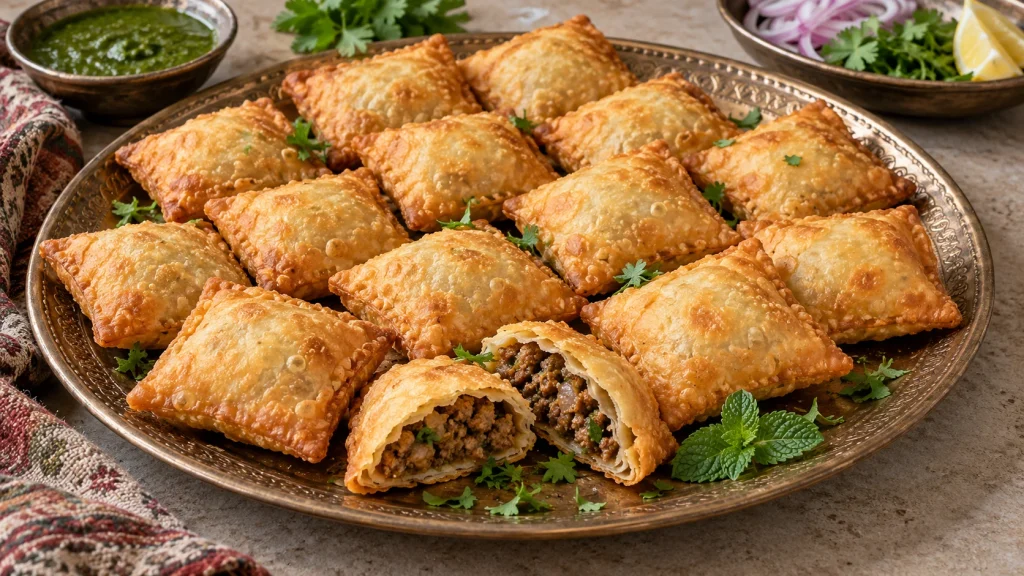
Small square lamb pastries with a restrained folded layer
Small square pastries with a dry spiced minced-lamb filling and a single folded ghee layer. The original eight-serving quantities make sixteen lukhmis; plan two finished pastries per selected serving.
The original 50 minute preparation, 40 minute cooking and 135 minute total are planning estimates, not measured test results. Allow about 20 minutes filling cooking plus extra shallow cooling, 10 minutes pastry mixing with a 30 minute covered rest that can overlap filling preparation, the separate 15 minute folded rest, rolling/cutting/sealing and 5–7 minutes frying per small batch. Four batches alone need about 20–28 minutes frying in addition to filling cooking; fewer pastries per batch, oil heating/recovery and extra cooling can extend the allowances. Follow the mince, seam and hot-centre checks rather than the clock. One tablespoon = 15 ml; one teaspoon = 5 ml.
About Lukhmi
Lukhmi is a flat Hyderabadi-style savoury pastry filled here with dry spiced minced lamb. Its small square shape and a simple folded ghee layer distinguish it from the conical samosas in this catalogue.
The lamb is fully cooked and cooled before assembly. One controlled fold gives a short layered shell without requiring puff-pastry handling. Keep the pastry thin and the filling modest; a huge centre makes a pillow that can brown before its seam cooks. The wording and proportions here are an original home formulation.
Personally cooked and tested by Zohair Fakhar for DailyLife.pk. Cooking times can vary with your stove, cookware and batch size; follow the texture and doneness cues in the method.
Make it work for your kitchen
Original quantities serve 8. Cooking times, pan size and frying-oil depth do not scale, cook in extra batches instead.
Before you start
Set up the ingredients
Measure the selected-serving quantities and keep the pastry and filling ingredients separate. Keep raw minced lamb covered and refrigerated at 0–5°C within its use-by date. Do not wash raw meat. Wash hands and clean surfaces and utensils after handling it; use clean utensils for cooked filling and washed, dried herbs.
PreparationPlan the finishing stage
Cook the lamb filling fully, dry away free liquid and spread it shallowly to cool promptly until comfortable to handle before sealing. Overlap the covered 30 minute pastry rest with filling preparation where practical, then allow the separate 15 minute rest after the single ghee fold. Prepare only as many filled squares as will be cooked promptly; keep waiting filling and assembled pastries covered and cold.
WorkflowSet up the equipment
Have scales, separate bowls, wide filling pan, clean shallow tray, rolling pin, ruler, knife, fork, oil thermometer, clean food probe, dry slotted spoon and rack ready. For the original frying allowance use a suitable deep pan of at least 4 litre capacity, checking oil occupies no more than one-third of it with ample headroom. The pan must allow the 8 cm pastries to move without crowding; fry fewer at a time if necessary.
Clean workspaceMeasure the ingredients
Keep the ghee rubbed into the pastry separate from the ghee for its single folded layer. Keep initial pastry liquid, pastry reserve and sealing liquid separate; the filling has no added liquid allowance. Use reserve only if needed and sealing liquid only to lightly dampen borders. The frying bath is separate from filling oil and is a working allowance, not oil absorbed by the pastries.
Use the ingredient list above
Step-by-step cooking method
1 Cook the lamb filling
Heat the filling oil in the wide pan over medium heat and soften the finely chopped onion for about 5–6 minutes. Add ginger and garlic for about 1 minute, then add the minced lamb, ground cumin, ground coriander, chilli powder and filling salt. Keep raw-meat utensils away from the cooked-food area.
2 Cook the lamb filling (continued)
Break the lamb into fine crumbs and cook for about 10–12 minutes until no free liquid remains. Check representative thick areas reach 75°C for 30 seconds with a clean probe; clean the probe after use and continue cooking if needed. Add lemon juice and reduce for about 1 minute more until the filling is dry again. Stir in chopped mint and fresh coriander, then spread in a clean shallow tray to cool promptly until comfortable to handle. Refrigerate within 1–2 hours if not proceeding promptly; do not seal hot, steaming or wet filling into pastry.
3 Make short pastry
Mix the pastry plain flour, fine semolina and pastry salt. Rub in the separately measured pastry ghee until sandy. Add the initial pastry liquid gradually to form a smooth firm dough with only brief kneading. Use the separate pastry reserve in 5 ml increments only if dry; it may not all be needed. Cover and rest for 30 minutes while the filling cools. Do not taste raw dough.
4 Fold once and relax
For the original eight-serving batch, roll the dough to about a 35 by 25 cm rectangle. For fewer servings use a smaller rectangle of similar thickness, or work larger batches in portions. Spread the separately measured folding fat thinly over the dough, sharing it among any portions; this is the ghee reserved for the folded layer, not another addition of the pastry ghee. Fold into thirds like a letter, cover and rest for 15 minutes. Roll again gently to about 2 mm thick, using only the dusting allowance as needed, without repeated forceful strokes that smear the layers.
5 Cut and seal
Plan two finished pastries per selected serving. Cut two approximately 8 cm pastry squares for each finished lukhmi, keeping the final rolled thickness about 2 mm. Gather offcuts only once if necessary. Keep waiting pastry covered so the borders do not dry out.
6 Cut and seal (continued)
Use half the squares as bases and divide the cooked filling, cooled enough to handle, evenly among them. Leave a clean border about 7 mm wide. Lightly dampen the borders using only as much of the separate sealing allowance as needed, cover each base with a remaining square and press firmly with a fork without puncturing the centre. Keep waiting filling and assembled pastries refrigerated and keep the outside of each pastry free of dripping liquid before frying.
7 Fry and inspect
Use a suitable deep heavy pan with about 5 cm of frying oil, checking the oil occupies no more than one-third of it and leaves ample headroom before food is added. For the original allowance, use at least 4 litre capacity and check actual fill and pastry clearance; do not pour the whole allowance into an unsuitable pan. Heat the oil to 165–170°C. Fry only as many pastries as fit without crowding, using fewer than four if needed, for about 5–7 minutes per small batch, turning until evenly golden. Attend the pan, use dry tools and allow oil temperature recovery between batches. If oil smokes, turn off the heat and leave it to cool; never add water to hot oil.
8 Fry and inspect (continued)
Lift a sample from the first batch with clean utensils, let it become safe to handle and open it: the seam must have no raw flour line and the filling must be steaming hot throughout. Continue cooking any underdone pastry and check later batches too; colour and time alone do not show that the seam is cooked. Drain fully cooked pastries on a clean rack and wait about 3 minutes before serving, checking the centre is comfortable to eat. Serve two lukhmis per selected serving and keep raw-meat tools away from finished food.
Chef’s tips
- Measure the salt separately from any packaged seasoning; branded spice blends can already be salty.
- Keep cut sizes consistent so the components cook or soften at the same rate.
- Use a clean serving spoon rather than returning a tasting spoon to a component that will be stored.
Common mistakes & quick fixes
- The final mixture tastes flat.
- Taste a small complete serving, including every sauce or garnish. Adjust the measured salt or acid in a small portion first, then apply that correction to the remaining batch.
- The texture deteriorates before serving.
- Keep crisp and moist components separate until the final step, and prepare smaller serving batches. A long assembled hold cannot be corrected by adding more spice.
Variations & serving ideas
Milder serving: Use half the stated chilli in the base batch, keeping the other ingredient weights unchanged. Offer additional chilli separately at the table; heat-sensitive diners can then take an unmodified portion of the fully cooked dish.
Perfect result check
| Cooked lamb filling and pastry seam | The lamb filling is fully cooked and dry before sealing, with no free liquid. After frying, the seam has no raw dough line and the filling is steaming hot throughout. |
|---|---|
| Finished pastry | The small square holds its cleanly sealed edges and a short, lightly layered shell. Let steam settle on a rack and check the centre is comfortable to eat before serving. |
Storage & reheating
| Refrigerate fully cooked lukhmi | Up to 48 hours at 0–5°C | For lukhmi made and fried in one session, cool fully cooked pastries promptly in shallow portions and refrigerate within 1–2 hours at 0–5°C. Eat within 48 hours or freeze. Reheat only the required portion once until steaming hot throughout; the shell may soften. Keep any separately served sauce or garnish covered and cold according to its own ingredients. These cooked-leftover limits do not extend raw-lamb use-by dates or apply to uncooked assembled pastry. |
|---|---|---|
| Freeze fully cooked lukhmi | Up to 1 month suggested for quality | Cool fully cooked pastries promptly, separate portions with suitable food-safe paper and seal at -18°C or colder. The one-month period is a quality suggestion, not a tested shelf-life claim. Defrost in the refrigerator and use within 24 hours of full defrosting. Reheat once until steaming hot throughout; texture may soften. Keep separately prepared fresh toppings or sauces out of the frozen pastries. |
Know when to change the heat
| Stage | Heat | What to look for |
|---|---|---|
| Cook and dry the lamb | Medium heat | Break the mince into fine crumbs, cook through and remove free liquid. Check 75°C for 30 seconds with a clean probe before shallow cooling; reduce the lemon juice again so filling stays dry. |
| Fry the sealed squares | 165–170°C oil; uncrowded small batches | Maintain safe oil headroom, allow recovery between batches and check the pastry seam and hot filling, not just surface colour. Use fewer pastries if the pan is crowded. |
Helpful answers before you cook
Is lukhmi just a square samosa?
This entry uses a flat square shape, semolina in the pastry and one folded ghee layer for the stated short pastry. Names and methods vary; follow this formulation rather than treating another stuffed-pastry method as an identical substitution.
Why is the filling wet?
Lamb and onion release liquid. Cook uncovered until it evaporates, and reduce the added lemon juice again before cooling. Seal only cooked filling that is dry and cool enough to handle; trapped liquid or steam makes a gummy inner layer.
Can I make larger squares?
Larger squares change the filling depth and seam cooking. Keep the approximately 8 cm squares and about 2 mm rolled pastry in this formulation. Scale by making two finished pastries per selected serving, with two pastry squares for each, rather than increasing each pastry’s size.


