
Ladoo Peethi
Chana-led fritters with tart chutney and crisp radish
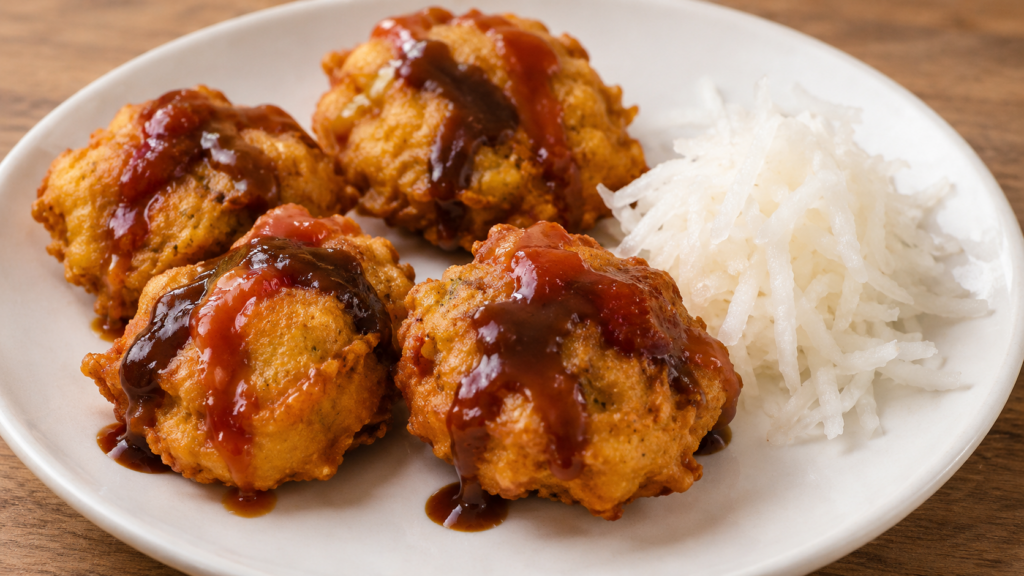
Small savoury chana-and-urad fritters served with plum sauce, ready-to-eat tamarind chutney and freshly grated radish. The original six-serving quantities make twenty-four small fritters; plan four per selected serving.
The original 40 minute preparation, 40 minute cooking and 570 minute total are planning estimates, not measured test results. Allow 8 hours refrigerated soaking, about 10 minutes grinding and aerating, 15–20 minutes sauce work that can overlap batter preparation, extra sauce cooling, about 30 minutes original-batch frying in 5–7 minute batches and about 5 minutes dressing. Oil heating/recovery, longer soaking or smaller frying batches can extend these allowances. Follow the fruit-softness and cooked-centre checks rather than the clock. One tablespoon = 15 ml; one teaspoon = 5 ml.
About Ladoo Peethi
Ladoo peethi is a savoury lentil-fritter chaat, despite the sweet-sounding name. This formulation pairs chana-led fritters with a tamarind sauce, a simple dried-plum sauce and freshly grated radish.
The fritters are not confectionery laddoos and are not covered in yogurt. Their contrast comes from a cooked pulse centre, sweet-sour sauces and raw crisp radish. Long lentil soaking is done under refrigeration and the ground batter is cooked the same day, without an improvised fermentation.
Personally cooked and tested by Zohair Fakhar for DailyLife.pk. Cooking times can vary with your stove, cookware and batch size; follow the texture and doneness cues in the method.
Make it work for your kitchen
Original quantities serve 6. Cooking times, pan size and frying-oil depth do not scale, cook in extra batches instead.
Before you start
Set up the ingredients
Measure the selected-serving quantities and keep dal batter, plum sauce, ready-to-eat tamarind chutney and radish separate. Rinse the two dals before their covered refrigerated soak. Wash radish under running water before peeling and grating, and use clean hands, surfaces and utensils for the finished dish. Check chutney and dried-fruit package storage and allergen labels.
PreparationPlan the finishing stage
Allow the separate 8 hour refrigerated soak first. Prepare the plum sauce while working on the batter, allowing extra cooling time before cold storage. Grind the soaked dal and cook the batter the same day; keep waiting batter covered and refrigerated at 0–5°C. Dress only the servings to be eaten promptly so crisp fritters are not left soaking in sauce.
WorkflowSet up the equipment
Have scales, covered refrigerator containers, colander, grinder, whisk, saucepan, suitable immersion blender, oil thermometer, dry slotted spoon, clean sample plate and knife, rack and grater ready. The original frying allowance needs a suitable deep pan of at least 3 litre capacity: check oil occupies no more than one-third before food is added, with ample headroom and room for a small uncrowded batch.
Clean workspaceMeasure the ingredients
Keep the soaking allowance, initial batter liquid, batter reserve and plum-sauce liquid separate. Drain and discard the soak; it is not used for grinding or sauce. Add batter reserve only in 5 ml increments if needed and do not add it all automatically. Keep batter salt separate from plum-sauce salt. The frying bath is a working allowance, not oil absorbed by the fritters.
Use the ingredient list above
Step-by-step cooking method
1 Soak in the refrigerator
Rinse the chana dal and split skinned urad dal, cover with the separately measured soaking allowance and refrigerate, covered, at 0–5°C for 8 hours or overnight until swollen. Drain and discard the soak, rinse once with clean water and drain thoroughly. Keep the soak refrigerated rather than on a warm counter, and grind and cook the soaked dal the same day.
2 Make a plum sauce
Combine the pitted dried plums, separately measured plum-sauce liquid, sugar, vinegar, plum-sauce salt and chilli flakes in the saucepan. Simmer gently for about 12–15 minutes until the fruit is soft, allowing longer if still firm. Turn off the heat and use a suitable immersion blender according to its instructions, keeping the blade submerged and avoiding splashes. Do not seal hot sauce in a closed countertop blender.
3 Finish and cool the plum sauce
If the blended sauce needs thickening, return it to a gentle simmer for about 1 minute, stirring, until spoonable. Transfer to clean shallow portions and cool promptly; refrigerate within 1–2 hours at 0–5°C if not serving promptly. This is a freshly cooked sauce, not a tested canning recipe, and the sugar and vinegar do not establish a shelf-stable preserve.
4 Grind and aerate
Grind the thoroughly drained dal with the separately measured initial batter liquid to a thick fine paste. Add the separate batter reserve in 5 ml increments only if needed to keep the grinder working, stopping the machine before scraping; it may not all be needed. Transfer to a clean bowl and beat for 4–5 minutes until lighter, then fold in the batter seasoning, roasted ground cumin and baking powder. The paste should hold a soft mound rather than pour. Do not taste raw batter; keep waiting batter covered and refrigerated.
5 Fry small portions
Use a suitable deep heavy pan with oil occupying no more than one-third of it before food is added and leaving ample headroom. The original frying allowance gives about 5 cm depth in a roughly straight-sided 16 cm internal-diameter pan of at least 3 litre capacity; check actual fill and room rather than pouring the whole allowance into an unsuitable pan. Heat the oil to 165–170°C. Plan four small fritters per selected serving, using similar heaped tablespoonfuls of batter. Lower each portion close to the surface using a dry spoon, without splashing. Fry a small uncrowded batch for about 5–7 minutes, turning until evenly golden; do not enlarge each fritter to use more batter.
6 Check the cooked centre
Lift a first-batch sample onto a clean plate with a dry slotted spoon, let it become safe to handle and open the thickest centre with a clean knife. The middle must be steaming hot and the dal fully cooked, with no raw gritty paste. Cook underdone fritters further and check again; colour and time alone do not establish that the centre is cooked. Check later batches too and keep raw-batter utensils separate from cooked food.
7 Adjust heat between batches
If the outside colours before the centre cooks, reduce the heat and extend frying, then inspect another cooked sample. Keep the pan uncrowded and allow the oil to recover to 165–170°C between batches. Use dry tools and keep loose liquid away from hot oil; never add water to the frying pan. Attend the pan throughout. If oil smokes, turn off the heat and leave it to cool.
8 Dress at serving
Drain fully cooked fritters on a clean rack. Wash the radish under running water before peeling and grating; squeeze out excess loose liquid and toss with the measured lemon juice. Put four fritters on each selected-serving plate, dividing the cooked plum sauce, ready-to-eat tamarind chutney and radish evenly among the selected servings. Add the sauces and radish only just before eating. Keep extra sauces and radish covered and refrigerated at 0–5°C; allow fritters to become comfortable to eat before serving.
Chef’s tips
- Measure the salt separately from any packaged seasoning; branded spice blends can already be salty.
- Keep cut sizes consistent so the components cook or soften at the same rate.
- Use a clean serving spoon rather than returning a tasting spoon to a component that will be stored.
Common mistakes & quick fixes
- The final mixture tastes flat.
- Taste a small complete serving, including every sauce or garnish. Adjust the measured salt or acid in a small portion first, then apply that correction to the remaining batch.
- The texture deteriorates before serving.
- Keep crisp and moist components separate until the final step, and prepare smaller serving batches. A long assembled hold cannot be corrected by adding more spice.
Variations & serving ideas
Milder serving: Use half the stated chilli in the base batch, keeping the other ingredient weights unchanged. Offer additional chilli separately at the table; heat-sensitive diners can then take an unmodified portion of the fully cooked dish.
Perfect result check
| Cooked dal fritter | The small fritter is golden outside, steaming hot inside and fully cooked through, with no raw gritty dal paste. Keep portions similar and inspect a safely handled sample from each batch. |
|---|---|
| Freshly dressed plate | Four fritters per selected serving keep their texture until dressed. The plum sauce is spoonable, the tamarind chutney remains separate until serving and the freshly grated radish is drained and crisp. |
Storage & reheating
| Refrigerate cooked fritters and sauce separately | Up to 48 hours at 0–5°C | Cool fully cooked fritters and homemade plum sauce promptly in shallow portions, then cover and refrigerate within 1–2 hours at 0–5°C. Eat within 48 hours or freeze suitable cooked portions. Reheat only the fritters needed once until steaming hot throughout; the shell may soften. Keep radish and ready-to-eat tamarind chutney covered and cold, follow any shorter package/use-by instructions, and dress at serving. These cooked-leftover limits do not apply to raw soaked dal or uncooked batter. |
|---|---|---|
| Freeze fully cooked undressed fritters | Up to 1 month suggested for quality | Cool fully cooked fritters promptly, separate portions and seal at -18°C or colder. The one-month window is a quality suggestion, not a tested shelf-life claim. Defrost fully in the refrigerator, use within 24 hours of full defrosting and reheat once until steaming hot throughout. Keep sauces and fresh radish separate from the frozen fritters; texture may soften. |
Know when to change the heat
| Stage | Heat | What to look for |
|---|---|---|
| Cook the plum sauce | Gentle simmer; turn off for blending | Soften the dried fruit, blend with a suitable submerged immersion blade and briefly simmer again only if needed for a spoonable texture. Cool shallow portions promptly. |
| Fry small fritters | 165–170°C oil; small uncrowded batches | Allow oil recovery and check the cooked centre, not just colour. Reduce heat if the shell browns too quickly. Keep oil no more than one-third full with ample headroom; smoking oil needs heat off and cooling. |
Helpful answers before you cook
Is ladoo peethi sweet?
The dal fritter itself is savoury. This version pairs it with a sweet-sour cooked plum sauce, ready-to-eat tamarind chutney and crisp radish. It is not a confectionery laddoo and no yogurt is specified in this formulation.
Why is the centre gritty?
Check the dal has swollen during the refrigerated soak and grind it to a thick fine paste. Keep the portions small and similar, and do not thin the paste into pouring batter. If the outside browns while the centre stays gritty, reduce heat, cook longer and open another safely handled sample; raw dal paste is not a finished centre.
Can I store the assembled plates?
Keep cooked fritters, plum sauce, ready-to-eat tamarind chutney and radish separate, and dress only at serving. Promptly cool cooked components and refrigerate within 1–2 hours at 0–5°C; eat within 48 hours or freeze suitable cooked portions. Reheat required fritters once until steaming hot throughout and follow shorter chutney package instructions. Do not store uncooked batter under the cooked-leftover rule.


