
Chicken Tikka Pizza
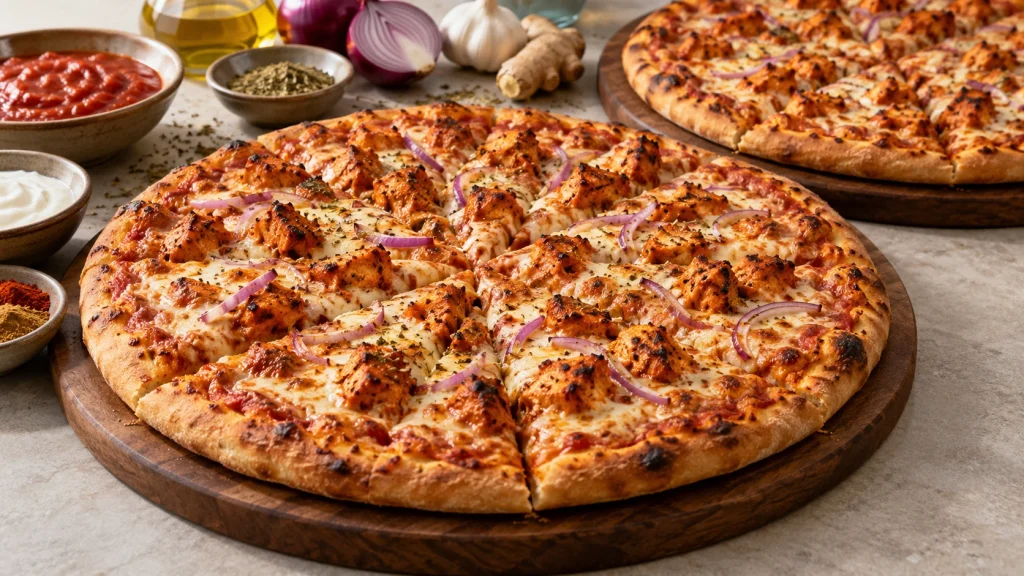
Yogurt-marinated tikka chicken with red onion
Two 30 cm pizzas; twelve slices, four main-course portions
Allow about 2 hours 35 minutes at a moderate room temperature, or up to 3 hours if the dough rises slowly. Preheating and topping preparation overlap the rise. Do not shorten proofing solely to match the clock. One tablespoon = 15 ml; one teaspoon = 5 ml.
About Chicken Tikka Pizza
A tikka-spiced topping is cooked separately so the short pizza bake does not have to make raw poultry safe.
The dough uses 65% water relative to flour and a modest amount of oil for a workable domestic-oven crust. Toppings are measured for two pizzas; controlling moisture matters more than adding a thick layer of cheese. Prepare the topping while the dough rises and bake one pizza at a time so the baking sheet can transfer enough heat to the base. This original editorial formula still needs kitchen testing.
Personally cooked and tested by Zohair Fakhar for DailyLife.pk. Cooking times can vary with your stove, cookware and batch size; follow the texture and doneness cues in the method.
Make it work for your kitchen
Original quantities serve 4. Cooking times, pan size and frying-oil depth do not scale, cook in extra batches instead.
Before you start
Check the oven and tray
Use a conventional oven at 250°C; fan ovens may need about 20°C less, subject to the manufacturer. Use trays or parchment rated for that temperature. Do not preheat a nonstick tray beyond its rating.
EquipmentControl topping water
A tikka-spiced topping is cooked separately so the short pizza bake does not have to make raw poultry safe.
ToppingSet up the equipment
Have the following tools ready before starting: Digital scales; Large mixing bowl; Two 30 cm pizza trays or oven-safe parchment; Heavy baking sheet; 26 cm skillet for cooked toppings; Small sauce pan; Wire rack; Food thermometer.
Clean workspaceMeasure the ingredients
Measure the ingredient quantities for your selected servings before applying heat. Keep separately listed groups, such as dough, filling, sauce or garnish, in separate containers; keep any optional additions separate.
Use the ingredient list above
Step-by-step cooking method
1 Mix and knead a measured dough
Mix bread flour, yeast, sugar and dough salt. Add the lukewarm water and 15 ml dough oil. Mix until no dry flour remains, rest 10 minutes, then knead 8–10 minutes on a lightly dusted surface until smooth and elastic. Use the bench flour allowance sparingly: the dough should feel tacky but should not leave a thick paste on your hands. Do not add unmeasured flour until it becomes stiff.
2 Proof and heat the oven
Lightly oil a bowl with the 5 ml oil. Place dough inside, cover and leave at a moderate room temperature for 60–90 minutes, until roughly doubled. Divide into two equal balls, about 345 g each, and rest covered 15 minutes. During this final rest, heat a conventional oven to 250°C with a heavy baking sheet on the middle shelf for at least 30 minutes; begin preheating earlier if necessary.
3 Prepare the individual topping
Mix yogurt, lemon, ginger, garlic, cumin, paprika, coriander and topping salt with chicken. Refrigerate 30 minutes during the dough rise. Sear in neutral oil in a 26 cm skillet for 7–10 minutes, stirring, until 74°C. Cook off loose marinade until the pieces are coated and dry, then cool on a plate. Spread cooked chicken and onion evenly over the tomato base.
4 Reduce the tomato base
Warm the sauce olive oil in a small pan, soften sauce garlic for 20 seconds, then add tomatoes, sauce oregano and sauce salt. Simmer uncovered 8–10 minutes, stirring, until about 150 g remains and a spoon drawn across the base leaves a brief trail. Cool before spreading. This reduction keeps a thin crust from turning soggy.
5 Shape and assemble
Work with one dough ball while the other stays covered. Press out the centre on a piece of baking parchment rated for the oven temperature, using the bench flour allowance as needed. Stretch to 30 cm, preserving a slightly thicker 1.5 cm rim.
6 Shape and assemble (continued)
If it springs back, cover and rest 5 minutes rather than tearing it. Divide all base sauce and toppings equally between the pizzas, following the topping sequence. Keep raw flour off the finished serving board.
7 Bake separately on a hot sheet
Transfer one pizza on its suitable parchment or a metal pizza tray to the hot sheet. Bake 10–14 minutes at 250°C until the underside has brown patches, the centre is set and the cheese bubbles. Rotate after 7 minutes if the back browns faster. If cheese colours before the base cooks, move down one shelf; if the base is firm but pale, allow another 1–2 minutes. Bake the second pizza after the sheet reheats for 3 minutes.
8 Finish and slice
Add any explicitly reserved fresh garnish or finishing oil now. Rest each pizza on a wire rack for 2 minutes before cutting into six slices. A rack releases trapped steam and helps the underside stay firm. Serve three slices per portion; the yield assumes these are a main course rather than a party snack.
Chef’s tips
- The measured sauce is a thin film, not a deep pool. Distribute toppings to the outer portion of the pizza rather than stacking the centre.
- Stretching is easier after the covered ball rest. If the edge tears, pinch it closed before adding sauce.
- Use the underside as a doneness check; a browned cheese top alone does not show whether the dough is baked.
Common mistakes & quick fixes
- Pale, damp underside
- Preheat the heavy sheet fully, reduce wet topping and bake lower in the oven. Lift the base carefully to inspect it before serving.
- Tough dough that shrinks back
- Give the ball another covered 5-minute rest. Excess bench flour and repeated forced stretching make shaping harder.
- Burned topping with a raw centre
- Make the centre evenly thin, use cooked meat and reduce the topping load. Continue baking lower down with a loose foil shield if necessary.
Variations & serving ideas
Smaller pizzas: Divide the same dough and topping into four 21 cm pizzas. Start checking at 8 minutes; the shorter bake must still set and brown the base.
Perfect result check
| Defining texture | Yogurt-marinated tikka chicken with red onion. Follow the size and consistency cues in the steps. |
|---|---|
| Relevant doneness | Chicken reaches 74°C in the thickest meat or filling; check away from bone where present. |
Storage & reheating
| Refrigerator | Use within 48 hours | Store cooked portions in shallow covered containers after prompt cooling; refrigerate at 4°C or colder within 2 hours, or within 1 hour above 32°C. Do not leave a whole warm pizza boxed on the counter. This is a conservative editorial limit. |
|---|---|---|
| Reheating | Reheat once | Reheat slices or a calzone in a 180°C oven until hot through and 74°C centrally. A rack or hot tray helps dry the base; timing depends on thickness. Cool and refrigerate promptly before storage. |
Know when to change the heat
| Stage | Heat | What to look for |
|---|---|---|
| Mix and knead a measured dough | No direct heat | 20 minutes; use the detailed doneness cues in this step. |
| Proof and heat the oven | 250°C conventional oven | 75–105 minutes; preheat overlaps; use the detailed doneness cues in this step. |
| Prepare the individual topping | Medium-high for any skillet work; otherwise no heat | 15–25 minutes during proof; use the detailed doneness cues in this step. |
| Reduce the tomato base | Low simmer | 10 minutes during proof; use the detailed doneness cues in this step. |
| Shape and assemble | No heat | 8–12 minutes; use the detailed doneness cues in this step. |
| Bake separately on a hot sheet | 250°C conventional oven | 23–31 minutes for two; use the detailed doneness cues in this step. |
| Finish and slice | No heat | 2 minutes per pizza; use the detailed doneness cues in this step. |
Helpful answers before you cook
What needs special preparation on this Chicken Tikka Pizza?
Cook the yogurt-marinated tikka chicken to 74°C and reduce its marinade to a clinging coat before cooling. Raw marinated chicken cannot rely on a short pizza bake.
Why is my pizza base pale beneath a browned top?
Preheat the heavy sheet for at least 30 minutes and bake one 30 cm pizza at a time. Keep the centre evenly thin; move down a shelf if cheese colours before the underside develops brown patches.
Can I use one large deep pan instead?
The dough is measured for two 30 cm pizzas. A single deep pan changes thickness, topping moisture and bake time; use the stated two-pizza geometry for this formulation.


