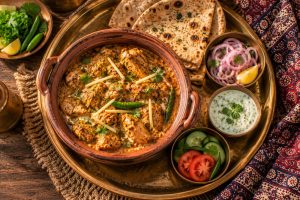
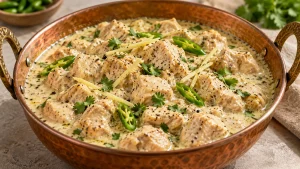
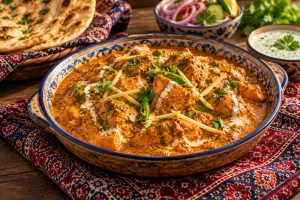
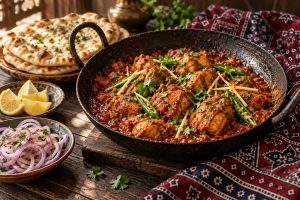
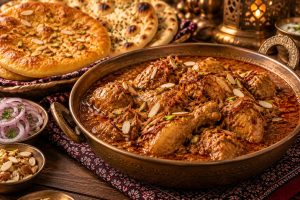
Chicken Mughlai
چکن مغلائی
Nut-enriched Mughlai chicken curry
A rich Mughlai-inspired Pakistani chicken curry with fried onion, yogurt, cashew-and-almond paste and a gentle cream finish. Households and restaurants use different nut and spice balances.

Allow about 80 minutes including a 30-minute refrigerated marinade that overlaps preparation, plus a 5-minute rest. Larger pieces may need longer to cook. One tablespoon = 15 ml; one teaspoon = 5 ml.
About Chicken Mughlai
A rich Mughlai-inspired Pakistani chicken curry with fried onion, yogurt, cashew-and-almond paste and a gentle cream finish. Households and restaurants use different nut and spice balances.
Personally cooked and tested by Zohair Fakhar for DailyLife.pk. Cooking times can vary with your stove, cookware and batch size; follow the texture and doneness cues in the method.
Make it work for your kitchen
Also known as Mughlai Chicken, Murgh Mughlai.
Original quantities serve 4. Cooking times, pan size and frying-oil depth do not scale, cook in extra batches instead.
Before you start
Before you start
Measure all ingredient groups, prepare fresh aromatics and keep raw chicken separate from ready-to-eat garnishes. Do not rinse raw poultry.
Set up the equipment
Have the following tools ready before starting: Heavy wide pan with tight-fitting lid; Chopping board and knife; separate poultry board; Blender or spice grinder as specified; Food thermometer; Measuring spoons and kitchen scale.
Clean workspaceMeasure the ingredients
Measure the ingredient quantities for your selected servings before applying heat. Keep separately listed groups, such as dough, filling, sauce or garnish, in separate containers; keep any optional additions separate.
Use the ingredient list aboveCheck allergens and substitutions
Check ingredient labels and any substitutions against these notes: Milk, tree nuts (cashew and almond).
Before cooking
Step-by-step cooking method
1 Marinate the chicken
Mix bone-in chicken portions, raw with plain yogurt, ginger-garlic paste, fresh lemon juice, red chilli powder, ground turmeric and fine salt; cover and refrigerate 30 minutes while slicing onion and measuring spices.
2 Brown onions and grind nuts
Heat neutral oil or ghee in a wide heavy pot; fry finely sliced onion over medium until uniformly golden, 10–12 minutes.
3 Brown onions and grind nuts (continued)
Remove most and cool. Blend cooled onion with unsalted cashew nuts, blanched almonds and 50 ml from the measured hot water into a paste.
4 Temper the whole spices
In the remaining fat warm cumin seeds, green cardamom pods and whole cloves for 30 seconds, then add the marinated chicken; stir 5–6 minutes until surfaces lose raw colour.
5 Cook nut-onion masala
Add the paste and ground coriander. Stir 5 minutes on medium-low, scraping the base; avoid scorching nuts.
6 Simmer chicken gently
Add the remaining 200 ml of measured hot water and garam masala powder. Cover and simmer gently 20–25 minutes; stir and verify thickest pieces reach 74°C, extending time if needed.
7 Finish gently and rest
Uncover to reduce briefly if watery.
8 Finish gently and rest (continued)
Turn heat low and add plain dairy cream and optional food-grade kewra water. Warm 2 minutes, then switch off, rest 5 minutes and garnish with fresh coriander.
Chef’s tips
- Blend cashews and almonds finely for a cohesive gravy.
- Keep chicken bone-in for flavour, but remove loose bone fragments before serving.
- Do not overuse kewra; it should be a faint background aroma.
Common mistakes & quick fixes
- Burnt nut paste
- Lower heat and stir continuously after adding ground nuts.
- Separated cream
- Finish below a simmer; do not rapidly boil.
- Undercooked bone-in chicken
- Probe the thickest meat without touching bone until 74°C.
Variations & serving ideas
Variation: Boneless chicken can be substituted with adjusted timing and edible-yield calculations.
Variation: A coconut-enriched variation exists in Pakistani restaurant recipes.
Variation: Cream can be reduced, changing the final gravy and nutrition.
Variation: Serve with naan, roti or rice; accompaniments excluded from nutrition.
Perfect result check
| Check | A thick, smooth nut-enriched gravy rather than a watery soup. |
|---|---|
| Check | Cooked chicken 74°C throughout; meat easily separates at the joint. |
Storage & reheating
| Fridge | 3–4 days | Cool promptly in shallow covered containers and refrigerate within 2 hours (1 hour above 32°C); refrigerate at 4°C or below. Most cooked chicken leftovers: use within 3–4 days. |
|---|---|---|
| Freeze and reheat | Freeze promptly | Reheat leftovers to 74°C/165°F; freeze promptly in airtight portions if needed. Dairy/nut sauces may change texture on thawing. |
Know when to change the heat
| Stage | Heat | What to look for |
|---|---|---|
| Brown the onions | Medium heat | Look for an even golden colour and steady sizzling. Stir and lift darker edges away from the hottest part of the pan before they blacken. |
| Cook the nut paste and simmer | Medium-low, then low | Stir the paste so it does not catch on the base. After adding water, keep small gentle bubbles around the chicken and check several thick pieces reach 74°C (165°F). |
| Add cream and rest | Low, then off | Reduce a watery sauce before adding cream. Once cream is stirred in, warm gently without vigorous bubbling, then switch off and rest for 5 minutes. |
Helpful answers before you cook
Why does my nut-onion sauce taste bitter?
Onions or nuts that turn dark brown or black can make the sauce bitter. Fry the onion to an even golden colour, then lower the heat when cooking the blended paste. Scrape the base as you stir. If a patch burns, avoid scraping it into the sauce; transfer the unburnt food to a clean pot.
How can I prevent the sauce splitting?
Keep the simmer gentle after adding the yogurt-coated chicken. Lower the heat before adding the cream at the end, stir it through, and warm briefly without a hard boil. If the sauce becomes too thick, loosen it with a little hot water.
How should I check bone-in chicken is cooked?
Insert a clean food thermometer into the thickest part of several pieces without touching bone. Each must reach at least 74°C (165°F). Extend the gentle simmer if needed; the stated time is a guide, and pieces of different sizes may finish at different times.