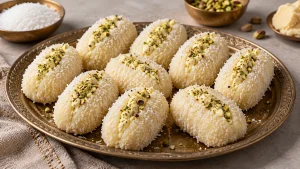
Balushahi
Fold the dough just enough to gather it; over-kneading removes the flaky crumb.
12 balushahi

Allow about 125 minutes including rests and cooling. Fry in small batches and let oil recover between them; syrup stages are judged by temperature and a cooled sample. One tablespoon = 15 ml; one teaspoon = 5 ml.
About Balushahi
Balushahi is a layered fried pastry with a crisp sugar coating and a tender, irregular crumb. It is not kneaded like bread or raised like a yeast doughnut. Rubbing ghee into flour and gently gathering the dough leaves small discontinuities that open into layers during slow frying. The centre indentation helps thick pieces cook evenly. Start in moderately warm oil, then maintain a gentle fry so the middle dries before the outside becomes dark.
Personally cooked and tested by Zohair Fakhar for DailyLife.pk. Cooking times can vary with your stove, cookware and batch size; follow the texture and doneness cues in the method.
Make it work for your kitchen
Original quantities serve 12. Cooking times, pan size and frying-oil depth do not scale, cook in extra batches instead.
Before you start
Prepare the work area
Set out a rack over a tray and keep syrup away from the frying pan. Use plain unsweetened yogurt. Use a 18 cm internal-diameter pot at least 10 cm tall: the listed oil gives approximately 3.1 cm depth. Check the actual level before heating and keep the pot under half full; fry only one or a few pieces so oil cannot overflow.
Before heatingSet up the equipment
Have the following tools ready before starting: Digital scale; Heatproof spatula; Fine sieve and clean muslin; Sugar or frying thermometer; Slotted spoon; 18 cm internal-diameter heavy pot, at least 10 cm tall; Frying thermometer; Wire draining rack.
Clean workspaceMeasure the ingredients
Measure the ingredient quantities for your selected servings before applying heat. Keep separately listed groups, such as dough, filling, sauce or garnish, in separate containers; keep any optional additions separate.
Use the ingredient list aboveCheck allergens and substitutions
Check ingredient labels and any substitutions against these notes: Milk; Wheat/gluten; Pistachios. Check labels for cross-contact.
Before cooking
Step-by-step cooking method
1 Make a rough dough
Mix flour, baking powder and salt. Rub in ghee until crumbs hold when squeezed.
2 Make a rough dough (continued)
Add yogurt and 35 ml water, folding to a rough dough; use up to 20 ml more only if dry flour remains. Do not knead smooth. Cover 20 minutes.
3 Shape
Divide into 12. Gently round each and press a deep central indentation without piercing fully through. Keep pieces about 5 cm wide and 2 cm thick. Fine surface cracks are desirable; wide splits are not.
4 Fry slowly
Heat oil to 140–145°C. Add only enough pastries to leave room for expansion.
5 Fry slowly (continued)
Fry 12–18 minutes, turning gently several times, keeping oil about 140–150°C.
6 Fry slowly (continued)
They should become even golden brown and feel light rather than dough-heavy. Split a test piece after cooling to check for a cooked flaky centre.
7 Coat
Dissolve sugar in 180 ml water, add lemon and simmer to about 110–112°C, a sticky coating syrup. Add cardamom. Dip warm drained pastries 2 minutes per side, then lift onto a rack.
8 Finish
Scatter pistachios while syrup is tacky. Let cool without stacking for 30 minutes so the surface coating firms.
Chef’s tips
- Fold the dough just enough to gather it; over-kneading removes the flaky crumb.
- Fine dough cracks are normal; do not smooth them by kneading for several minutes.
Common mistakes & quick fixes
- Raw dense middle
- The oil was too hot, the pastry too thick or the dough overworked. Use the stated size and test one piece.
- Syrup stays wet
- It may be too dilute or the pastries too cold. Use a thermometer and warm, well-drained pastries.
Variations & serving ideas
Ingredient boundary: Replacing ghee with liquid oil changes the dough layers; this formula is not tested for that swap.
Perfect result check
| Finished sweet | A golden flaky pastry has no wet dough at the centre and a thin sugar crust outside. |
|---|---|
| Serving | Twelve medium pastries should have open irregular flakes, not a bread-like elastic crumb. |
Storage & reheating
| Covered in shallow portions in the refrigerator | Use within 48 hours | Cool promptly rather than leaving a deep hot pan on the counter. Store at 4°C or colder; serve a clean portion and keep the remainder chilled. Freeze only if the texture change is acceptable. |
|---|
Know when to change the heat
| Stage | Heat | What to look for |
|---|---|---|
| Fry slowly | Low to medium-low heat | 12–18 minutes per batch |
| Coat | Medium then off heat | 10 minutes syrup plus 4 minutes dipping |
Helpful answers before you cook
Why low frying heat?
The thick pastry needs time to cook inside before the crust colours.
Should syrup soak the whole pastry?
It should coat and lightly penetrate the layers, not saturate it like gulab jamun.
Can the dough be perfectly smooth?
A rough gently folded dough is intentional; smooth elastic dough gives a denser result.