Badam Halwa
Stop before the almond paste becomes stiff enough to roll into balls.
6 small portions, approximately 500 g
Allow about 60 minutes overall. Pan width and ingredient moisture change evaporation, so the stated ranges and finishing cues govern the end of cooking. One tablespoon = 15 ml; one teaspoon = 5 ml.
About Badam Halwa
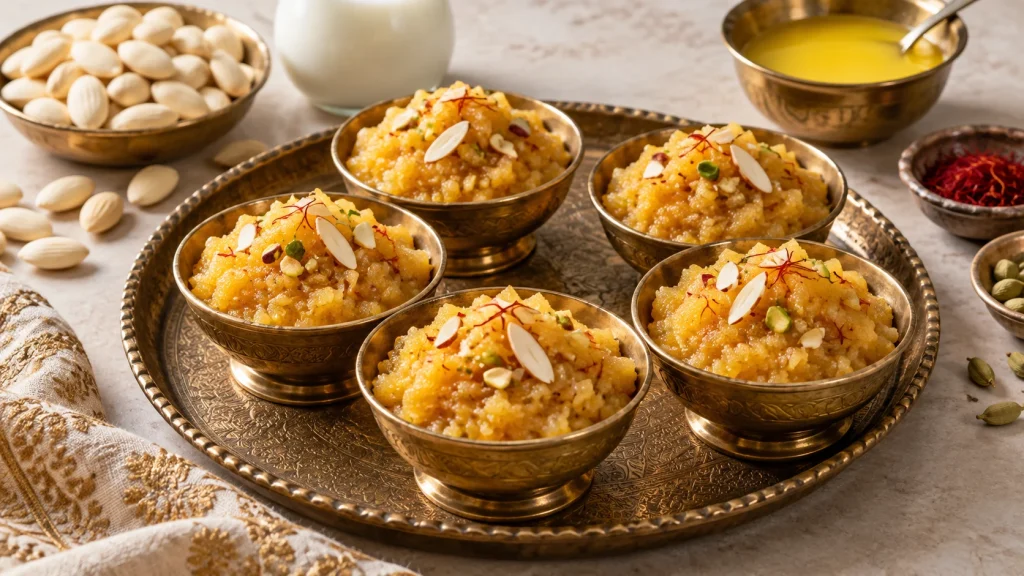
This badam halwa is a soft almond paste cooked with milk and gradual additions of ghee. Blanched almonds give a pale smooth body; almond meal with skins makes a darker, rougher dessert. The intended texture is glossy and spoonable rather than a firm marzipan block. It thickens as it rests, so stop cooking while the spatula can still fold it without force.
Personally cooked and tested by Zohair Fakhar for DailyLife.pk. Cooking times can vary with your stove, cookware and batch size; follow the texture and doneness cues in the method.
Make it work for your kitchen
Original quantities serve 6. Cooking times, pan size and frying-oil depth do not scale, cook in extra batches instead.
Before you start
Prepare the base
Use blanched almonds, not apricot kernels or bitter almonds. The saffron milk is taken from the measured total, not an extra ingredient.
Before heatingSet up the equipment
Have the following tools ready before starting: Digital scale; Heavy 24 cm wide saucepan or sauté pan; Heat-resistant flat spatula; Measuring jug; Small shallow serving or setting dish.
Clean workspaceMeasure the ingredients
Measure the ingredient quantities for your selected servings before applying heat. Keep separately listed groups, such as dough, filling, sauce or garnish, in separate containers; keep any optional additions separate.
Use the ingredient list aboveCheck allergens and substitutions
Check ingredient labels and any substitutions against these notes: Milk, including ghee and milk solids; Almond. Check packaged ingredient cross-contact.
Before cooking
Step-by-step cooking method
1 Make almond paste
Blend almonds with 150 ml milk to a fine paste.
2 Make almond paste (continued)
Use short bursts and scrape down until no coarse grit remains.
3 Make almond paste (continued)
Soak saffron in 20 ml of the remaining milk for 5 minutes.
4 Begin cooking
Melt 25 g ghee and add almond paste.
5 Begin cooking (continued)
Stir 5 minutes, then add remaining milk including saffron milk. Keep the paste moving across the base.
6 Concentrate
Stir 10–15 minutes until the paste thickens and begins to draw together. Add sugar and cardamom; it will briefly loosen.
7 Finish with ghee
Add remaining 50 g ghee in three portions over 8–12 minutes, stirring each in.
8 Finish with ghee (continued)
Stop when the halwa shines and a spatula leaves a short-lived clean track. Rest 10 minutes before serving.
Chef’s tips
- Stop before the almond paste becomes stiff enough to roll into balls.
- Use blanched almonds, not apricot kernels or bitter almonds. The saffron milk is taken from the measured total, not an extra ingredient.
Common mistakes & quick fixes
- Grainy halwa
- Grind the nuts finer and keep heat low; milk must hydrate the nut particles before heavy reduction.
- Scorched bottom
- Move the unburnt upper mixture to a clean heavy pan without scraping the stuck layer.
Variations & serving ideas
Nut-free serving: Where nuts are a garnish, omit them and use clean utensils to avoid cross-contact. Where ground nuts form the body, omission requires a different recipe rather than a direct swap.
Perfect result check
| Texture | A silky, pale golden mound with fine almond body and a slight ghee sheen. |
|---|---|
| Moisture | No free liquid runs into the space left by the spatula. |
Storage & reheating
| Covered in shallow portions in the refrigerator | Use within 48 hours | Cool promptly rather than leaving a deep hot pan on the counter. Store at 4°C or colder; serve a clean portion and keep the remainder chilled. Freeze only if the texture change is acceptable. |
|---|
Know when to change the heat
| Stage | Heat | What to look for |
|---|---|---|
| Begin cooking | Low heat | 5 minutes |
| Concentrate | Low heat | 10–15 minutes |
| Finish with ghee | Low heat | 8–12 minutes |
Helpful answers before you cook
Can I prepare it ahead?
Yes, cool promptly in shallow portions and refrigerate; warm only what you need or serve cool if preferred.
What determines the cooking time?
The moisture of the main ingredient and pan width matter more than a rigid timer. Use the described moisture and texture endpoint.
Can I replace the main ingredient?
Not directly. Vegetable water content and nut fat differ greatly; choose the separately formulated recipe for that ingredient.