
Ingredients & Spices · The complete guide
Green chillies (Hari mirch)
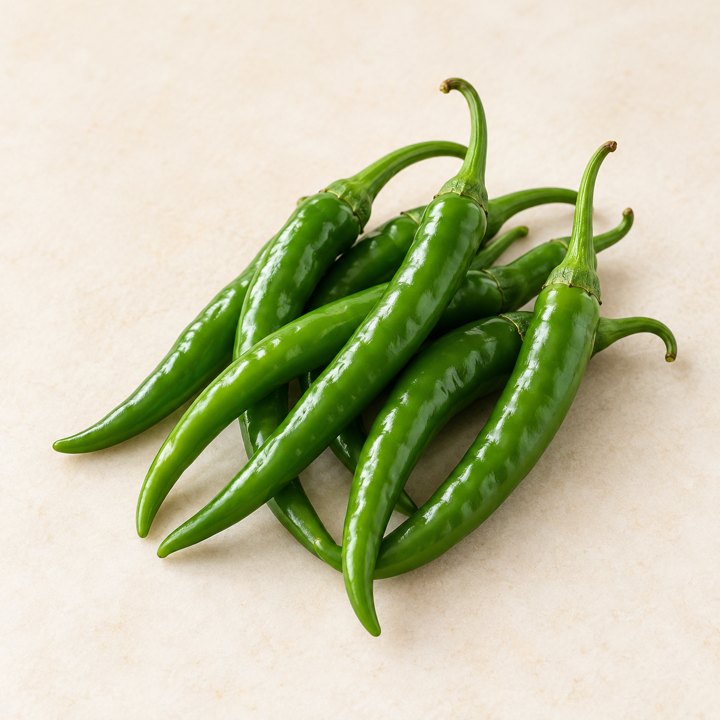
Green chillies, hari mirch, are usually unripe Capsicum fruits, although some cultivars are harvested at several colours. Length, shape and greenness are unreliable guides to heat.
What it is and names to know
Green chillies, hari mirch, are usually unripe Capsicum fruits, although some cultivars are harvested at several colours. Length, shape and greenness are unreliable guides to heat. They provide fresh grassy aroma as well as pungency.
Origins, producing regions and Pakistan context
The crop originated in the Americas and became established in South Asia after global maritime exchange. Pakistani chilli use reflects centuries of local adaptation rather than a native prehistoric origin.
Pakistan, India, China and many other countries grow fresh chillies. Local seasonal availability and cultivar are especially relevant to Pakistani households.
Background: Royal Botanic Gardens, Kew: plant identity and range.

Types and buying advice
Choose freshness and a known variety rather than relying on size for heat. Avoid soft slimy fruit and test unfamiliar batches cautiously.
How to cook with it
Slit and add to karahi, mince into kebab or chutney, or use rings as a finishing garnish. Keeping the chilli whole and intact gives a gentler infusion than crushing it throughout the dish.
For controlled heat, start with one chilli, cook, taste and add more. Remove some pale internal membrane for a milder result; the seeds themselves are not the main capsaicin-producing tissue.
A slit chilli in a simmering gravy can be removed, while a paste spreads its heat throughout the dish. Choose the form according to how much control you need. A paste also loses the clean visual effect of a fresh ring garnish. If serving people with different preferences, make the main food moderately seasoned and offer a fresh chilli accompaniment separately. Adding yoghurt may change the perception of heat but does not physically remove chilli from the dish.
Try the ingredient in Aloo Paratha, Chapli Kebab, Beef Pulao. Follow each recipes specified form and quantity, since whole pieces and fine powder season food differently.
For related pantry ingredients, see the Pakistani ingredients and spices guide.
For a mildly aromatic karahi, slit a chilli lengthwise while keeping it joined near the stalk, then let it cook in the sauce. For a chutney, chop or blend it so the heat disperses uniformly. These methods produce different concentrations in each bite. If the chilli is very hot, a small amount of paste may season an entire bowl, while a whole intact chilli gives a more localised infusion. Keep an unfamiliar variety separate until its strength is known.
Nutrition and realistic benefits
The fresh ingredient adds aroma and can contribute small amounts of nutrients, depending on the quantity eaten. A few slices or a spoonful shared across a family pan are not the same dietary exposure as a large vegetable serving. Use it as part of a varied meal rather than increasing the amount to seek a therapeutic effect. Research involving extracts, capsules or isolated active compounds does not establish what the normal cooking portion will do.
Disadvantages and precautions
Use gloves for large quantities and avoid rubbing eyes. Wash equipment before preparing a childs portion. Do not assume a familiar-looking batch has the same heat as the last one.
Clean handling matters even for a small garnish. FDA food-safety guidance explains practical handling. Buying from a traceable food supplier is more dependable than trying to judge safety from appearance alone.
Substitutions and storage
Fresh red chilli is an easy substitute with a riper flavour. Red powder supplies heat but changes colour and loses the fresh green note.
Buy firm sound produce and reject obvious rot or mould. Wash under running water before cutting so the knife does not carry dirt into the flesh; do not use household detergent. Store the fresh ingredient appropriately chilled when it needs refrigeration, and freeze small prepared portions if a surplus would otherwise spoil. A frozen aromatic is often useful in a cooked dish even when it no longer has the texture of a fresh garnish. Keep it separate from raw meat juices.
Working with other forms of this ingredient
Green chilli paste
Green chillies, hari mirch, are usually unripe Capsicum fruits, although some cultivars are harvested at several colours. Length, shape and greenness are unreliable guides to heat. They provide fresh grassy aroma as well as pungency.
Green chilli paste is crushed hari mirch, with a heat level set by the variety and amount of pale internal tissue included. It spreads heat throughout a marinade or chutney. Refrigerate promptly, or freeze small homemade portions; it is not a shelf-stable preserve.
Slit and add to karahi, mince into kebab or chutney, or use rings as a finishing garnish. Keeping the chilli whole and intact gives a gentler infusion than crushing it throughout the dish.
For controlled heat, start with one chilli, cook, taste and add more. Remove some pale internal membrane for a milder result; the seeds themselves are not the main capsaicin-producing tissue.
A slit chilli in a simmering gravy can be removed, while a paste spreads its heat throughout the dish. Choose the form according to how much control you need. A paste also loses the clean visual effect of a fresh ring garnish. If serving people with different preferences, make the main food moderately seasoned and offer a fresh chilli accompaniment separately. Adding yoghurt may change the perception of heat but does not physically remove chilli from the dish.
Try the ingredient in Chicken Makhani Handi. Follow each recipes specified form and quantity, since whole pieces and fine powder season food differently.
For related pantry ingredients, see the Pakistani ingredients and spices guide.
Names and forms used in our recipes
View the recipe names covered by this guide
- chopped green chilli
- chopped green chilli, optional
- crushed green chilli
- finely chopped green chilli
- finely crushed green chilli
- finely minced green chilli
- finely sliced green chilli
- fresh chillies
- fresh green chillies, slit
- green chilli
- green chilli paste
- green chilli, chopped
- green chilli, finely chopped
- green chilli, optional
- green chilli, sliced
- green chilli, slit
- green chilli, thinly sliced
- green chillies
- green chillies, chopped
- green chillies, minced
- green chillies, sliced
- green chillies, slit
- large mild green chillies
- long green peppers
- mild long green chillies
- sliced fresh green chillies
- sliced green chilli
- sliced green chilli, optional
- sliced green chillies
- slit fresh green chilli (optional)
- slit green chilli
- slit green chilli, optional
- slit green chillies
- whole green chillies
Frequently Asked Questions
Does chilli paste behave like a slit whole chilli?
A slit chilli in a simmering gravy can be removed, while a paste spreads its heat throughout the dish. Choose the form according to how much control you need.
What can I use instead of green chillies?
Fresh red chilli is an easy substitute with a riper flavour. Red powder supplies heat but changes colour and loses the fresh green note.
What is the main caution with green chillies?
Use gloves for large quantities and avoid rubbing eyes. Wash equipment before preparing a childs portion. Do not assume a familiar-looking batch has the same heat as the last one.
Keep Exploring
Related places and stories on DailyLife.pk

How we know this
- Type Explainer
- Sources 4 (2 official/academic)
- Reviewed November 2026
- Disputed points None
4 sources
Photo credits (1)
- I-11 Sabze Mande, Islamabad.jpg, Pakieditor, CC BY-SA 4.0, via Wikimedia Commons
