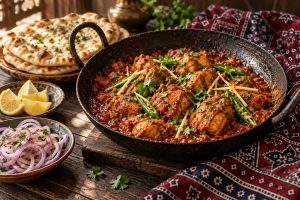
Chapli Kebab
چپلی کباب
Wide, flat and crackling at the edges: Peshawar's coriander-and-pomegranate kebab.
Large, thin beef patties flecked with crushed coriander seed, dried pomegranate, chilli and spring onion, shallow-fried until crisp and lacy at the edges and juicy within.

Allow about 25 minutes for preparation, 40 minutes for cooking in batches and at least 30 minutes for chilling. Longer chilling increases the elapsed time; judge each kebab by its centre temperature rather than the frying timer. One tablespoon = 15 ml; one teaspoon = 5 ml.
About Chapli Kebab
The chapli kebab is the signature kebab of Khyber Pakhtunkhwa, and Peshawar is the city most often named as its home. It is not shaped on a skewer. Instead, a generous handful of spiced mince is pressed out on a greased surface into a wide, thin round and slid into a pan of hot fat, where it puffs, crisps and browns at the edges. The name is commonly linked to a Pashto word meaning flat; others compare the shape to a chappal, the sandal.
What sets it apart from other kebabs is the seasoning. Coarsely crushed coriander seed and dried pomegranate seeds (anardana) give it a nutty, tangy crunch. Toasted maize flour helps bind it, and chopped tomato, onion, spring onion, green chilli and fresh coriander keep it juicy. A slice of tomato pressed into the top is a classic street-side touch.
Chapli kebabs are eaten across Pakistan, usually with naan, raita and sliced onion. Beef is most common; mutton is also used. Some cooks fry them in rendered beef fat for a deeper flavour, but a neutral oil works well at home.
Personally cooked and tested by Zohair Fakhar for DailyLife.pk. Cooking times can vary with your stove, cookware and batch size; follow the texture and doneness cues in the method.
Make it work for your kitchen
Also known as Chapli kabab, Chappli kabab, Peshawari chapli kebab, Chapal kabab, چپلی کباب.
Original quantities serve 4. Cooking times, pan size and frying-oil depth do not scale, cook in extra batches instead.
Before you start
Dry the vegetables
Chop the onion very finely, wrap it in a clean cloth and squeeze out the juice. Deseed and dice the tomato, then let it drain in a sieve. Wet vegetables are the main reason chapli kebabs fall apart.
Heat off · 10 minKeep the mince cold
Leave the mince in the fridge until you mix it. Cold fat binds better and gives juicier kebabs.
FridgeSet up a shaping station
Lightly oil a plate or a sheet of baking paper and keep a small bowl of water nearby for your hands.
2 minSet up the equipment
Have the following tools ready before starting: Heavy frying pan, cast-iron skillet or tawa; small dry pan; mortar and pestle or spice grinder; wide fish slice or spatula; instant-read thermometer.
Clean workspace
Step-by-step cooking method
1 Toast and crush the spices
Put 2 tbsp coriander seeds, 1 tsp cumin and the optional ½ tsp ajwain in a dry pan over medium-low heat. Shake often until fragrant and a shade darker, without letting the spices smoke. Tip onto a plate to cool, then pound or pulse with 1 tbsp anardana to a coarse, gritty mix.
2 Toast the maize flour
Add 25 g maize flour to the same dry pan over medium heat. Stir constantly until it smells nutty and turns a shade deeper. Move it to a bowl and let it cool before adding it to the mince.
3 Mix and knead
Use the onion, spring onion, green chilli and egg amounts listed for your selected servings; squeeze the finely chopped onion before mixing and beat the egg before measuring a partial egg. In a large bowl, combine 500 g cold beef mince with the cooled crushed spices, toasted flour, squeezed onion and chopped spring onions. Add 1 tbsp crushed ginger, 1 tbsp crushed garlic, 15 g chopped coriander, 1½ tsp chilli flakes, ½ tsp black pepper and 1¼ tsp salt. Mix in the selected green chillies and beaten egg. Knead firmly for 3–4 minutes until the mixture turns sticky and slightly stringy and holds together when squeezed.
4 Mix and knead (continued)
Fold in the drained diced tomato last. Cover and chill for at least 30 minutes.
5 Fry a test piece
Measure 150 ml oil as the frying allowance for the whole batch, including the test patty. Choose a pan in which a shallow layer covers the base; for fewer servings, use a smaller pan and cook in batches. Heat only enough of the measured oil to fry a small test patty, keeping the rest aside for later batches. Fry the test patty until its centre reaches 71°C (160°F), then let it cool enough to taste before adjusting salt or chilli in the remaining mixture. Do not taste the raw mixture.
6 Shape the kebabs
After cooking the small test patty, divide the remaining mixture into two equal patties per selected serving: 4 patties for 2 people, 8 for 4 people, 12 for 6 people or 16 for 8 people. With damp hands, press each portion on the lightly oiled plate or paper into a round about 12 cm across and 8 mm thick. Keep the edges slightly ragged. Make more patties for a larger batch rather than thicker patties. Press one optional thin tomato round into the centre of each.
7 Shallow-fry
Add the reserved frying fat in small amounts as needed to maintain a shallow layer across the pan base. Heat over medium-high until it shimmers and a crumb of mixture sizzles. Slide in one or two kebabs, tomato side up, without crowding. Fry until the underside is deep brown and the edges are crisp and lacy, spooning hot fat over the top. Flip carefully with a wide spatula and fry the second side the same way. Use a smaller pan rather than trying to fill a very wide pan; any extra frying fat used is additional to the listed allowance.
8 Check doneness and drain
Check that the centre reaches at least 71°C (160°F) with a clean food thermometer. Colour and juices are secondary cues, not a substitute for the temperature check. If the outside browns too quickly, lower the heat and continue cooking until the centre is ready. Drain on a rack or kitchen paper and repeat with the remaining kebabs.
Chef’s tips
- Mince with about 20% fat gives juicy, crisp kebabs. Very lean mince turns dry and crumbly.
- Squeeze the onion and drain the tomato thoroughly. Extra moisture breaks the patties in the pan.
- Use a heavy pan and fry only two at a time, so the oil stays hot enough to crisp the edges.
- If the mixture feels loose after kneading, add 1 tbsp more toasted maize flour and chill it again.
- Serve them straight from the pan. The crisp edges soften as they sit.
Common mistakes & quick fixes
- Kebabs break apart in the pan
- The mixture is too wet or under-kneaded. Squeeze the vegetables, knead until sticky, add 1 tbsp toasted flour and chill before shaping.
- Brown outside, pink inside
- The patty is too thick or the heat too high. Press them to about 8 mm and lower the heat slightly. Check for 71°C at the centre.
- Greasy, soft kebabs
- The oil wasn't hot enough or the pan was crowded. Wait for a shimmer and fry two at a time.
- Bitter, harsh spice flavour
- The seeds were over-toasted. Take them off as soon as they darken a shade and smell fragrant.
Variations & serving ideas
Mutton or lamb: Use mutton or lamb mince with some fat. Cook to the same 71°C internal temperature.
Chicken chapli: Use chicken thigh mince, add 1 tbsp extra toasted flour, and cook until the centre reaches 74°C (165°F).
Beef-fat frying: For a street-stall flavour, render beef fat (charbi) slowly and fry the kebabs in the clear fat instead of oil.
Egg-free: Leave out the egg and add 1 tbsp more toasted maize or gram flour. Knead well and chill for at least an hour.
Perfect result check
| Crust | Deep brown with crisp, lacy edges. |
|---|---|
| Centre | The centre reaches at least 71°C (160°F) on a clean food thermometer; do not rely on colour alone. |
| Texture | Holds together when lifted, with visible bits of coriander seed and herbs. |
Storage & reheating
| Raw mixture | Cook within 24 hours | Keep covered in the fridge at 4°C or below. Official guidance allows raw mince 1–2 days, but this mixture also contains egg and fresh vegetables. |
|---|---|---|
| Freezer (raw patties) | 3–4 months (best quality) | Shape without the tomato slice and freeze flat between sheets of baking paper. Thaw in the fridge overnight, then cook as above. |
| Fridge (cooked) | 3–4 days | Cool and refrigerate within 2 hours in an airtight container. |
| Reheating | Until steaming hot | Reheat in a hot, lightly oiled pan or oven until steaming throughout (74°C/165°F). Reheat only once. |
Know when to change the heat
| Stage | Heat | What to look for |
|---|---|---|
| Toasting seeds | Medium-low heat | Seeds darken a shade and smell fragrant, with no smoke |
| Toasting flour | Medium heat | Nutty smell, a shade deeper in colour |
| Frying | Medium-high heat | A shallow layer of frying fat shimmers and the patty sizzles steadily. Reduce the heat if the outside browns before the centre is cooked. |
| Doneness | Medium-high heat | Check the centre with a clean thermometer: at least 71°C (160°F). |
Helpful answers before you cook
Why toast the maize flour?
Toasting removes the raw taste and adds a nutty flavour. It also helps the flour soak up juices and bind the kebab. Gram flour works the same way if you can't find makai ka atta.
Can chapli kebabs be served pink?
No. Food-safety agencies advise cooking minced meat right through, because bacteria on the surface get mixed into the centre during mincing. US guidance is at least 71°C (160°F) for minced beef or lamb. UK guidance is to cook until steaming hot with no pink, or 70°C held for 2 minutes.
What does 'chapli' mean?
The name is usually linked to a Pashto word for flat, which suits these wide, thin patties. A popular alternative explanation compares the shape to a chappal, or sandal.
Can I bake or air-fry them?
You can, but you lose the crisp, lacy edges that shallow-frying gives. If you bake them, use a hot oven (220°C), turn them once, and check for 71°C in the centre.
Why press a tomato slice on top?
It is a classic street-style finish. It adds juiciness and a little sweetness, and it looks good. It's optional, so leave it off if you plan to freeze the patties.
How should I adjust the frying oil for different servings?
The displayed oil amount is an allowance for the whole batch, including the test patty. Pan width determines how much is needed to maintain a shallow layer. For fewer kebabs, use a smaller pan and fry without crowding; for more, cook extra batches and add reserved fat only as needed. Do not pour the whole allowance in at once. Any extra fat used is additional, and the amount poured into the pan is not the same as the amount absorbed by the kebabs.
How do I measure a partial egg for fewer or more servings?
For 2 people, the selected amount is half an egg. Beat one whole egg until uniform, then divide the beaten mixture into two equal portions and use one portion. For 6 people, use one whole beaten egg plus half of a second. Follow the selected amount rather than rounding up to a whole egg.