
Wildlife
Markhor: Pakistan's National Animal
The corkscrew-horned wild goat of Pakistan's mountains: where it lives, how it recovered in community-managed areas, and what still threatens it.
- Capra falconeri
- National animal of Pakistan
- IUCN: Near Threatened (assessed 2015)
- 600 to 3,600 m
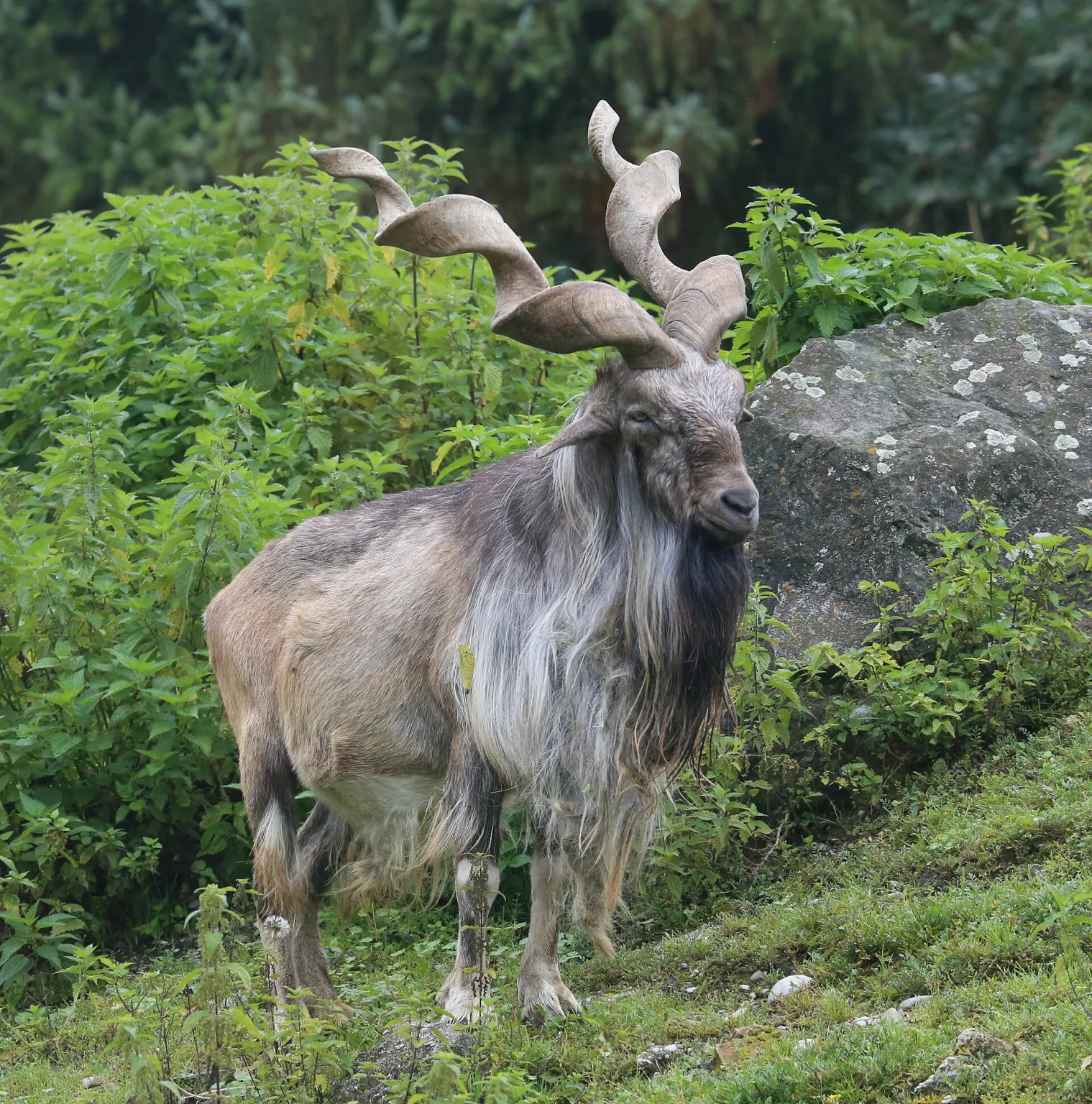
Markhor (male with corkscrew horns)
About the Markhor
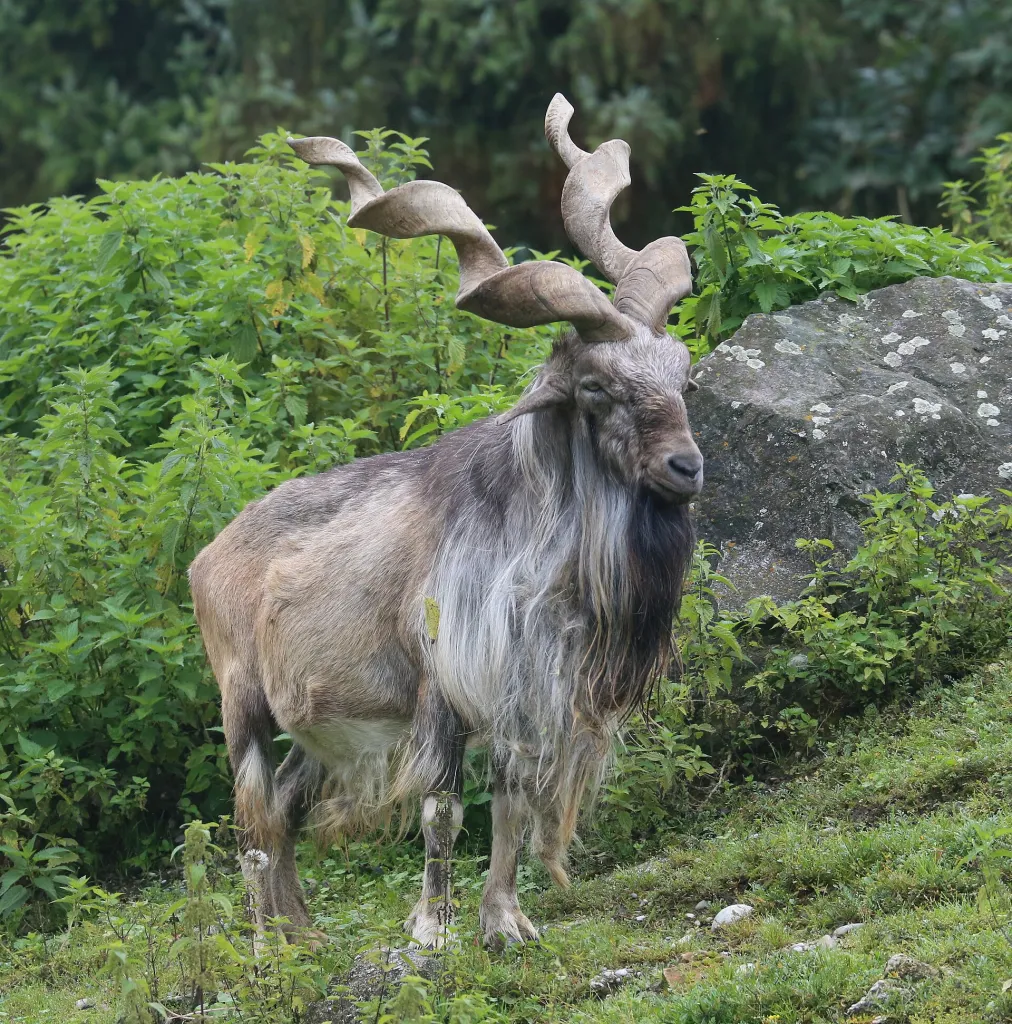
The markhor (Capra falconeri) is a large wild goat of dry, rocky mountains and the national animal of Pakistan. Males stand about 95 to 102 centimetres at the shoulder, according to Encyclopaedia Britannica, and carry spectacular corkscrew horns that can reach 160 centimetres. The coat is reddish brown in summer and long, grey and silky in winter, and males have a heavy fringe of hair on the throat and chest. Females are smaller and carry short, slim horns.
The common name is commonly explained as a Persian compound meaning snake-eater, linked to the spiralling horns, although the origin is debated. Markhor live on steep cliffs and shrubby slopes between roughly 600 and 3,600 metres, in woodland of oak, pine and juniper, and they browse and graze on grass, leaves and shrubs through the year.
The IUCN moved the markhor from Endangered to Near Threatened in its 2015 assessment, an improvement that is widely linked to conservation successes in Pakistan. The species is still threatened by poaching, competition with domestic goats and loss of habitat, and several local populations remain small.
Few animals symbolise a country's mountains as clearly as the markhor does Pakistan's.
Forms of Markhor in Pakistan
 Astore markhorThe Astore form (Capra falconeri falconeri) is listed by the park's information site among wildlife on the southern edge of Central Karakoram, where cliffs above rivers offer decent chances for patient visitors.
Where to See Markhor
Most visitors encounter markhor in a few well-known places. Chitral Gol National Park near Chitral town is the best-known: a Khyber Pakhtunkhwa wildlife official wrote in Dawn that it holds the world's largest population of Kashmir markhor, and described watching a female with kids come down to a stream to drink. The nearby Tooshi Conservancy in Chitral is described in the same feature as a markhor conservation area. In Gilgit-Baltistan, Central Karakoram National Park lists the markhor among its threatened species, and the park's information site says markhor appear on cliff slopes in the Astore valley.
Sightings depend on patience, binoculars and a local guide. The markhor's coat blends with rock so well that the Dawn writer notes even experienced observers struggle to spot it. Early morning and late afternoon are the best times, and keeping still beats walking towards animals.
Recovery and Community Conservation
Markhor were heavily hunted for meat and trophies through the twentieth century. Pakistan's modern conservation story depends on community-based management. In several mountain areas, villagers protect markhor year-round and a small number of regulated hunting licences for old males past breeding age are sold, with a share of the income going to local communities. The CKNP information site says such hunting occurs only within regulated community conservancies and never in the park's core zone. Supporters credit this model with allowing populations to rebound, and the IUCN's change to Near Threatened in 2015 is often cited in this context. Critics and supporters continue to debate the ethics and the long-term effects of trophy hunting, and the model is not applied everywhere.
The IUCN assessment cited on reference sites estimated the global population at about 5,800 in 2013 and described it as stable given ongoing conservation. Figures for Pakistan alone differ by survey, so local counts quoted in the media should be read as snapshots.
Threats
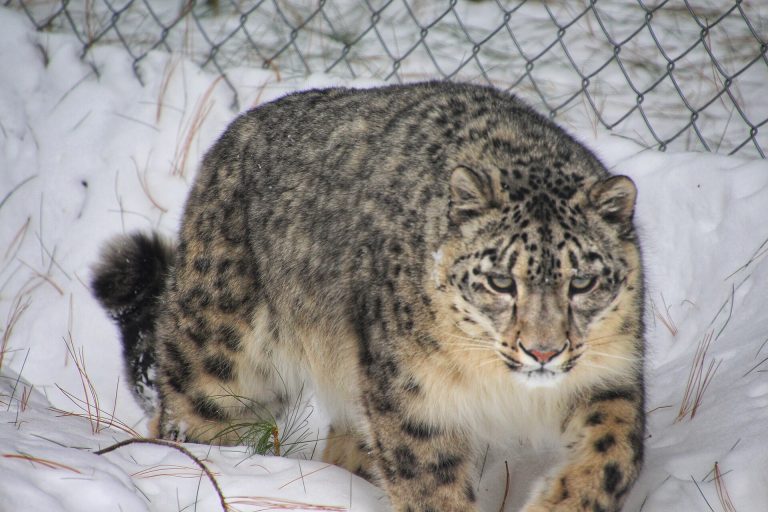
Poaching remains the most important threat, together with the disturbance and habitat loss that fragment populations into isolated groups. Competition with domestic goats for forage, and the risk of hybridisation between wild and domestic goats, are also concerns, according to the IUCN assessment as summarised on Wikipedia. Predators such as snow leopard, lynx, wolf and golden eagle (for kids) take markhor naturally and are part of a functioning mountain ecosystem. The IUCN assessment also notes cross-border hunting as a pressure in some parts of the range.
Watching Markhor Responsibly
- Hire a local guide or ranger; they know where animals feed and drink and how to avoid disturbing them.
- Use binoculars or a long lens; never approach, chase or corner animals, and keep dogs out of markhor habitat.
- Keep drones away from cliffs where markhor rest and rear kids.
- Never buy horns, skins or taxidermy, and report offers to the provincial wildlife department.
- Stay on tracks and take rubbish out so animals do not learn to scavenge.
- Support community-run conservancies and guesthouses that benefit from protection.
Frequently Asked Questions
Why is the markhor Pakistan's national animal?
It is a striking, native mountain species that has become a symbol of the country's northern ranges and of conservation. A 2017 Dawn feature on Chitral Gol also calls it Pakistan's national animal.
Is the markhor endangered?
The IUCN reclassified it as Near Threatened in 2015, down from Endangered, because of conservation gains. Some subspecies and local populations remain at risk.
Where can I see markhor?
Chitral Gol National Park near Chitral is the best-known site, and Central Karakoram National Park, including the Astore valley, is another. Sightings are never guaranteed.
How long are markhor horns?
Britannica gives up to about 160 cm for males.
Is trophy hunting legal?
In Pakistan a small number of regulated licences for old males are issued in some community-managed conservancies, and the system is debated. The CKNP information site says hunting does not occur in that park's core zone.
Keep Exploring
Related places and stories on DailyLife.pk
 Chitral Gol National ParkVisit Chitral Gol National Park near Chitral: markhor, snow leopard, deodar forest, spring flowersCentral Karakoram National ParkGuide to Central Karakoram National Park, Pakistan's largest protected area: K2, Baltoro, Biafo and Hispar glaciers
 ChitralPlan a Chitral trip: Chitral Fort, Shahi Mosque, Tirich Mir views, Chitral Gol, Garam Chashma
 Wildlife of PakistanPakistan's wildlife: markhor (national animal), snow leopard, Indus river dolphin, Himalayan brown bear, ibex
 National Parks of PakistanGuide to Pakistan's national parks: Central Karakoram, Deosai, Khunjerab, Hingol, Margalla Hills, Lal Suhanra and moreSnow Leopard in PakistanSnow leopards in Pakistan: range in the Karakoram, Hindu Kush and Himalaya, IUCN Vulnerable status (2017)
How we know this
- Type Explainer
- Sources 5 (2 official/academic)
- Reviewed October 2026
- Disputed points None
5 sources
- Markhor, Encyclopaedia Britannica
- Markhor (used to locate the IUCN 2015 assessment, Michel and Rosen Michel), Wikipedia
- Walking the trail majestic (Chitral Gol National Park), Dawn, 4 June 2017
- Central Karakoram National Park, Forest, Wildlife & Environment Department, Gilgit-Baltistan
- Karakoram wildlife guide, CKNP information site
Photo credits (5)
- Markhor Schraubenziege Capra falconeri Zoo Augsburg-02.jpg, Rufus46, CC BY-SA 3.0, via Wikimedia Commons
- Meadows of Chitral Gol National Park; Tahsin Shah 03.jpg, Tahsin A Shah, CC BY-SA 4.0, via Wikimedia Commons
- The Mighty K2 PAkistan.jpg, Maqsood aktar, CC BY-SA 4.0, via Wikimedia Commons
- Snow Leopard In Naltar Gilgit.jpg, Nazir Baig, CC BY-SA 4.0, via Wikimedia Commons
- Capra sibirica in Gilgit-Baltistan, Pakistan.jpg, Ali irfan, CC BY-SA 4.0, via Wikimedia Commons
