
History · Event
The 2022 Floods: A Third of Pakistan Under Water
The wettest August on record turned much of Sindh and Balochistan into inland seas, the costliest disaster in Pakistan's history and a global symbol of climate vulnerability.
- June–October 2022
- 33 million affected
- About one-third of the country submerged
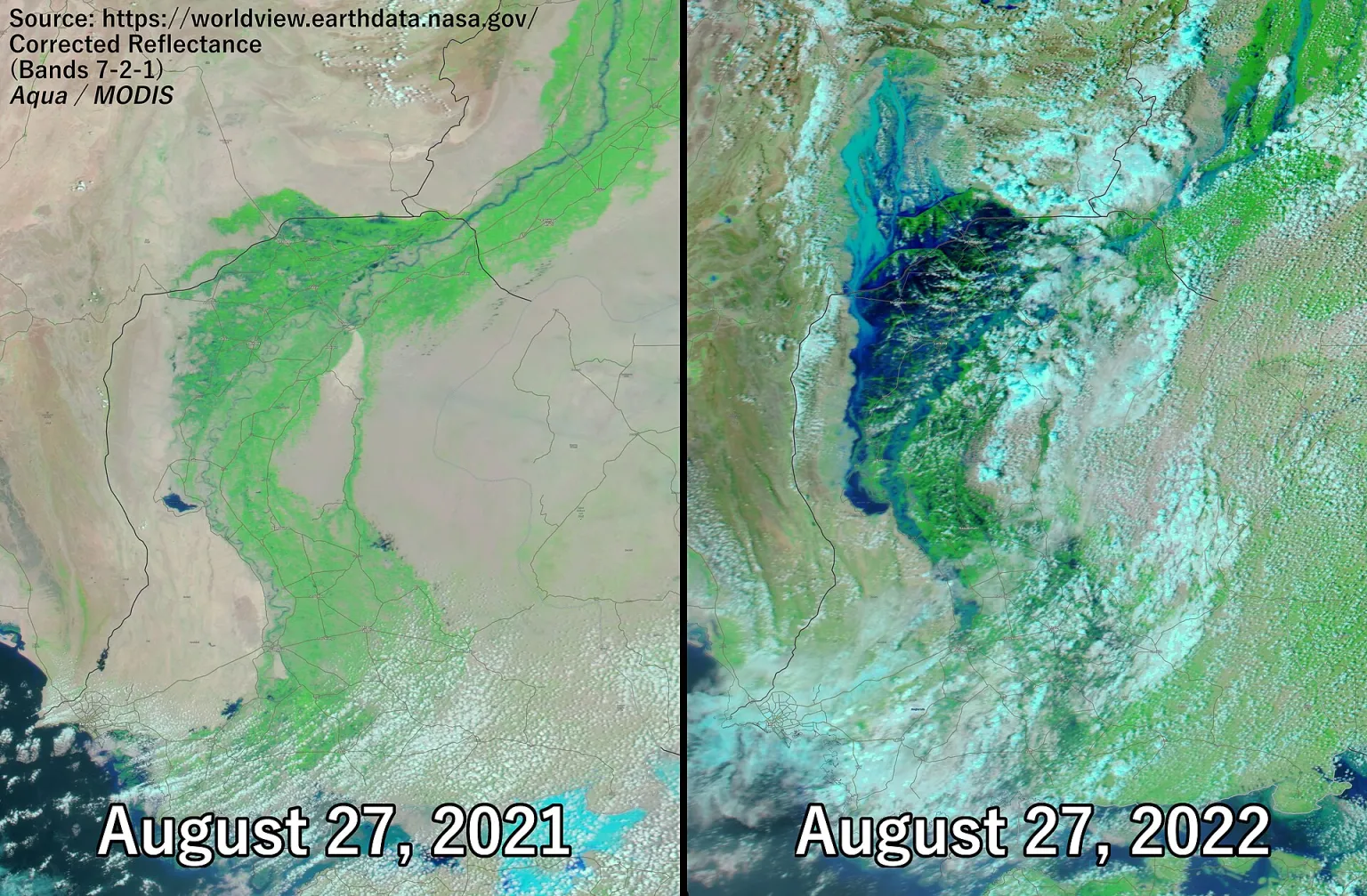
Sindh (satellite view)
- When
- Mid-June – October 2022
- Where
- Sindh, Balochistan, Khyber Pakhtunkhwa, Punjab, Swat Valley
- Certainty
- Well established
What Happened
Pakistan's 2022 monsoon began in mid-June and brought rain far above normal through July and August. August 2022 was the country's wettest since 1961, with more than three times its usual rainfall; Sindh and Balochistan each recorded their wettest August, at seven and eight times the normal amount. Flash floods tore through mountain valleys such as Swat, while in the plains of Sindh and eastern Balochistan rainwater and overflowing rivers created lakes stretching for kilometres that took months to drain.
At the height of the floods, roughly a third of Pakistan was under water. The government's Post-Disaster Needs Assessment (PDNA), released in October 2022, found that 33 million people had been affected, more than 8 million displaced and more than 1,730 killed. The National Disaster Management Authority recorded about 12,800 injured, more than 2.3 million houses damaged or destroyed, over 800,000 livestock lost and more than 1.7 million hectares of crops wiped out.
Sindh accounted for close to 70 per cent of the total damages and losses. The PDNA estimated damages of more than US$14.9 billion and economic losses of about US$15.2 billion, a total of over US$30 billion, with at least US$16.3 billion needed for recovery and reconstruction.
Background
Pakistan had already experienced major floods in 2010, and large populations live close to the flood plains of the Indus and its tributaries. A World Weather Attribution study published in September 2022 found that climate change had likely made the extreme rainfall heavier, while stressing large uncertainties, and highlighted vulnerability factors such as homes and farmland on flood plains, inadequate infrastructure, outdated river management and high poverty. See Climate of Pakistan.
Timeline
Mid-June 2022
Monsoon begins
Heavy pre-monsoon and monsoon rains start, earlier and stronger than usual.
July 2022
Floods spread
Repeated spells of heavy rain cause deadly floods in several provinces.
August 2022
Wettest August since 1961
Extreme rainfall over Sindh and Balochistan; flash floods hit Khyber Pakhtunkhwa, including Swat.
14 September 2022
Attribution study
World Weather Attribution publishes its analysis of climate change's role in the rainfall.
28 October 2022
PDNA released
The Post-Disaster Needs Assessment estimates over US$30 billion in damages and losses.
Consequences
- The PDNA estimated that the national poverty rate could rise by 3.7 to 4.0 percentage points, pushing 8.4 to 9.1 million more people into poverty.
- Direct losses were estimated at about 2.2 per cent of Pakistan's FY2022 GDP.
- Prime Minister Shehbaz Sharif and others described the floods as the worst natural disaster in Pakistan's history.
How We Know
Official figures come from the National Disaster Management Authority's situation reports and the Post-Disaster Needs Assessment led by the Ministry of Planning with the Asian Development Bank, European Union, UN agencies and World Bank. Rainfall statistics and climate attribution come from the Pakistan Meteorological Department and the World Weather Attribution group. Figures change with time and source: early NDMA counts were lower (World Weather Attribution cited nearly 1,500 deaths in mid-September); final totals exceed 1,700. Estimates of homes damaged or destroyed range from 1.7 million (World Weather Attribution, September 2022) to over 2.3 million (NDMA, via IFRC) depending on date and definition.
Climate Change and Responsibility
World Weather Attribution found that the five-day maximum rainfall over Sindh and Balochistan was about 75 per cent more intense in the observations than it would have been without 1.2°C of warming, and that climate models suggested increases of up to 50 per cent, but it cautioned that the human contribution could not be precisely quantified because the region's rainfall is highly variable and many models simulate it poorly. The same study stressed that vulnerability, homes and farmland close to flood plains, inadequate infrastructure, outdated river management, poverty and wider socio-economic factors, greatly increased the impact. The floods therefore raise questions both about global warming and about how risk is managed at home.
Before and After
Where this moment sits in Pakistan’s story.
Before
- 2022
Pasoori
Produced by Xulfi for season 14, Ali Sethi and Shae Gill's Pasoori became a global hit and the first Coke Studio song to pass one billion streams on YouTube Music.
- 2022
A record and a red carpet
The Legend of Maula Jatt opened in October and became Pakistan's highest-grossing film; Joyland premiered at Cannes in May and was shortlisted for the Oscars in December.
After
- June–September 2022
The worst floods on record
Pakistan received more than three times its usual August rainfall. The government's Post-Disaster Needs Assessment found 33 million people affected and more than 1,730 deaths, with damages over US$14.9 billion and losses of about US$15.2 billion.
Frequently Asked Questions
When did the 2022 floods happen?
Monsoon rains began in mid-June 2022 and were heaviest in July and August; flooding lasted into October, and some areas stayed waterlogged for months.
How many people were affected by the 2022 floods?
About 33 million people, according to the Post-Disaster Needs Assessment.
How many people died in the 2022 floods?
More than 1,700 people, according to the NDMA and the PDNA (which gives more than 1,730).
What was the cost of the 2022 floods?
The PDNA estimated damages of over US$14.9 billion and losses of about US$15.2 billion, with at least US$16.3 billion needed for rehabilitation and reconstruction.
Did climate change cause the 2022 floods?
World Weather Attribution found climate change likely made the extreme rainfall heavier, but could not precisely quantify its role; vulnerability and exposure also played a major part.
Keep Exploring
Related places and stories on DailyLife.pk
 Swat ValleyPlan a trip to Swat Valley: Kalam, Mahodand Lake, Malam Jabba
 Climate of PakistanPakistan's climate explained: seasons, monsoon, regional weather, record heat at Turbat
 Rivers and Lakes of PakistanPakistan's rivers and lakes: the Indus and its tributaries, the Indus Waters Treaty, Attabad, Saiful Muluk
 Agriculture in PakistanAgriculture in Pakistan: major crops, Indus canal irrigation, livestock and challenges
How we know this
- Type Historical record
- Sources 5 (2 official/academic)
- Reviewed October 2026
- Disputed points Yes, see the debates
5 sources
- Pakistan: flood damages and economic losses over USD 30 billion and reconstruction needs over USD 16 billion (28 October 2022), UNDP Pakistan
- Pakistan Floods 2022: Post-Disaster Needs Assessment: main report, UNDP Pakistan / Ministry of Planning
- Pakistan: Monsoon Floods: Final Report (MDRPK023), IFRC via ReliefWeb (UN OCHA)
- Climate change likely increased extreme monsoon rainfall, flooding highly vulnerable communities in Pakistan (14 September 2022), World Weather Attribution
- Pakistan floods of 2022, Encyclopaedia Britannica
Photo credits (1)
- 2022 Pakistan Floods - August 27, 2021 vs. August 27, 2022 in Sindh.jpg, NASA, Public domain, via Wikimedia Commons
