
History
The Medieval Era: From Muhammad bin Qasim to the Mughals
Between the Arab conquest of Sindh in 711–712 and Babur's arrival in 1526, Multan, Uch and Lahore grew into centres of Islamic rule, Persian learning and Sufi devotion.
- 711–1526 CE
- Sindh, Multan, Uch, Lahore, Thatta
- Arrival of Islam and Sufism
- Persian as the language of government
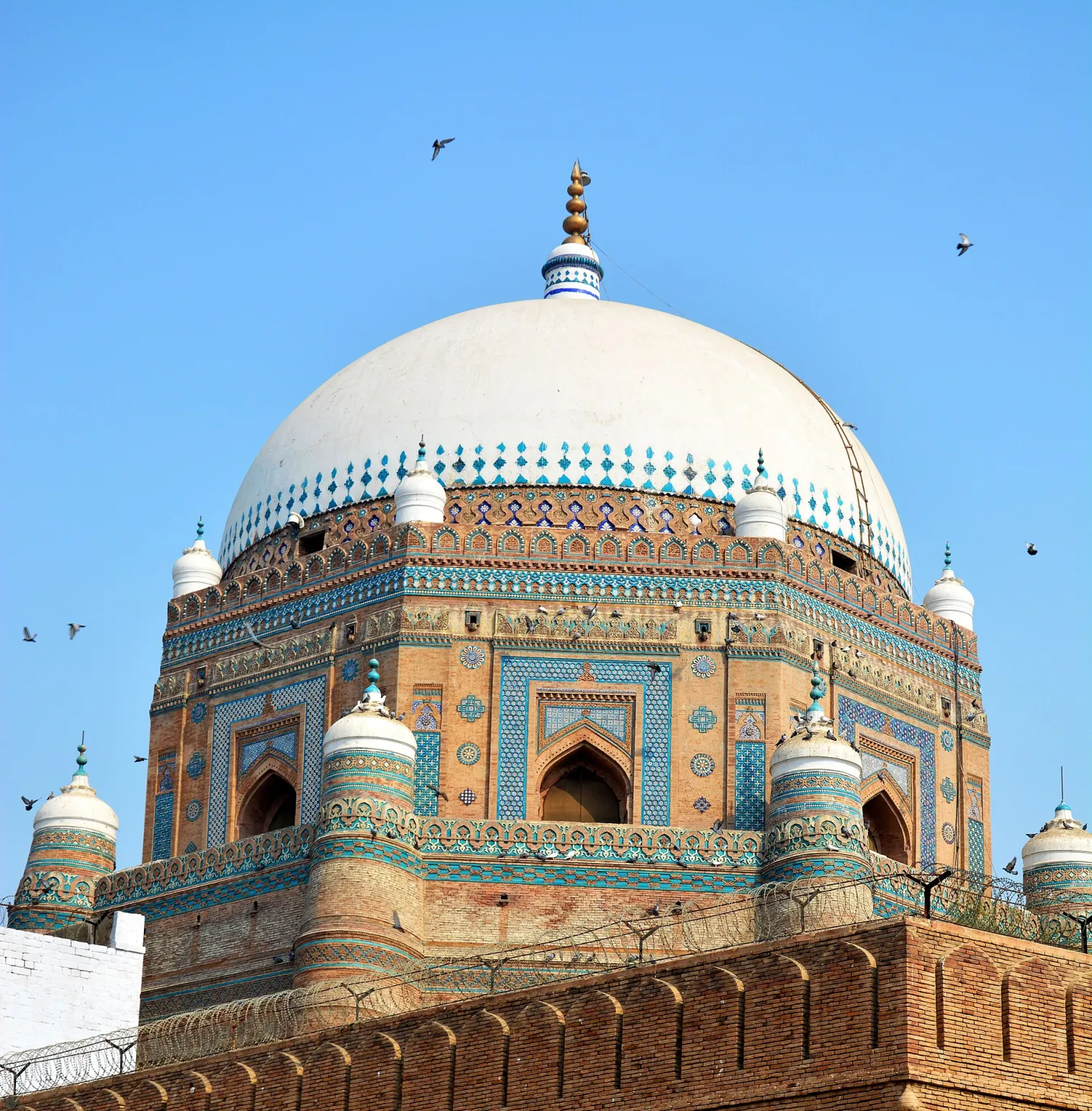
Tomb of Shah Rukn-e-Alam, Multan
About the Medieval Era
The eight centuries between the Arab conquest of Sindh and the founding of the Mughal Empire shaped the lands of today's Pakistan more deeply than almost any other period. In these centuries Islam became the faith of most people in the Indus basin, Persian became the language of courts and scholarship, and the shrines of Sufi saints became the places where ordinary people met the sacred.
Arab armies under Muhammad ibn al-Qasim, better known in Pakistan as Muhammad bin Qasim, conquered Sindh in 711 and brought Multan under Umayyad rule around 712, the first lasting Muslim foothold in South Asia. Three centuries later the Turkic rulers of Ghazni, in Afghanistan, turned Punjab into the eastern province of their empire, and Lahore became their capital. The Ghurids who replaced them opened the way to the Delhi Sultanate, whose five dynasties ruled much of northern South Asia until 1526.
Power was often far away in Ghazni or Delhi, yet the region was never a backwater. Multan and Uch guarded the routes from Central Asia and Iran and became famous for their Sufi masters; Lahore grew into a capital, sacked and rebuilt more than once; and in lower Sindh, local dynasties ruling from Thatta filled Makli Hill with stone tombs. The red-brick and blue-tiled shrines of Multan and Uch remain the period's most beautiful legacy.
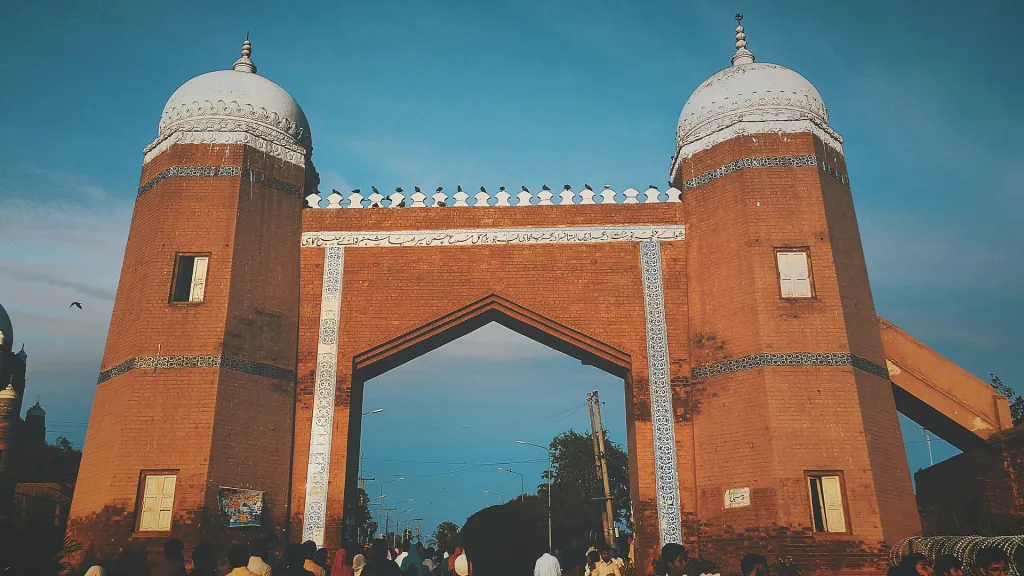
Timeline: 711 to 1526
711–712
The Arab conquest of Sindh
Muhammad bin Qasim defeats Raja Dahir, the last Hindu king of Sindh, and Sindh and Multan pass under the Umayyad caliphate, with Arabic as the language of administration.
10th century
Multan, outpost of Islam
For about three centuries Multan remains the main Muslim centre in the subcontinent, and in the 10th century it becomes a stronghold of the Qarmatians, an Ismaili-related movement.
1001–1027
Mahmud of Ghazni
Sultan Mahmud leads more than 20 raids into the subcontinent and makes Punjab the easternmost province of his empire. From his time onward Persian is the language of government in Muslim India.
11th century
Ali Hujwiri in Lahore
The Sufi scholar Ali Hujwiri, remembered as Data Ganj Bakhsh, comes to Lahore from Ghazni and writes the Persian classic Kashf al-Mahjub.
1163–1186
Lahore, Ghaznavid capital
Pushed out of Afghanistan by the Ghurids, the last Ghaznavids rule from Lahore.
1175–1186
The Ghurid advance
Muhammad of Ghor captures Multan and Uch in 1175 and annexes the Ghaznavid principality of Lahore in 1186.
1192–1206
Taraori and the road to Delhi
Defeated at Taraori in 1191, Muhammad returns to win there in 1192; by 1193 his forces hold Delhi. He is assassinated at Damyak on 15 March 1206.
1206–1210
Aibak, first sultan
Qutb al-Din Aibak proclaims himself king at Lahore in June 1206, founding the Delhi Sultanate. He dies at Lahore in 1210 after a polo accident and is buried there.
1241–1398
Mongols and Timur
A Mongol army sacks Lahore in 1241, raids recur through the 14th century, and in 1398 the city falls to Timur.
1524–1526
Babur arrives
Babur's troops take Lahore in 1524; his victory over Ibrahim Lodi at Panipat in 1526 ends the Delhi Sultanate and founds the Mughal dynasty.
Great Centres of the Age
Cities where the medieval period can still be seen and felt.
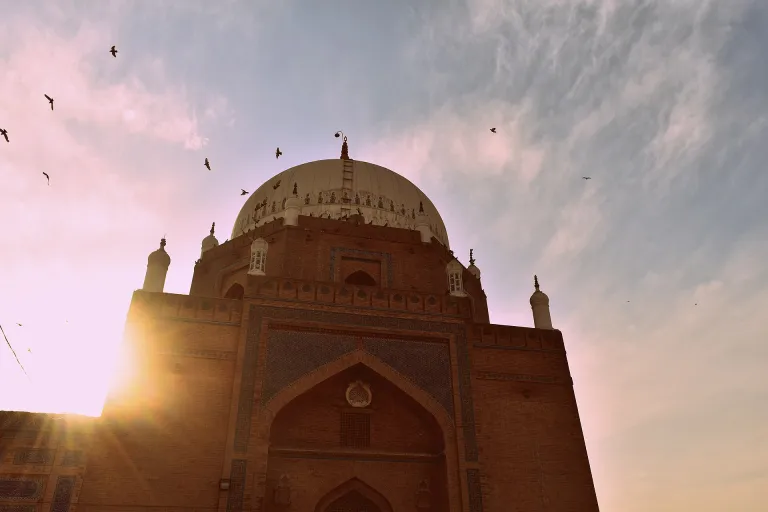 MultanThe old fort mound carries the tombs of the Suhrawardi saint Bahauddin Zakariya and his grandson Shah Rukn-e-Alam. Rukn-e-Alam's 35-metre octagonal tomb was built in 1320–24 by the Tughluq ruler Ghiyath al-Din.
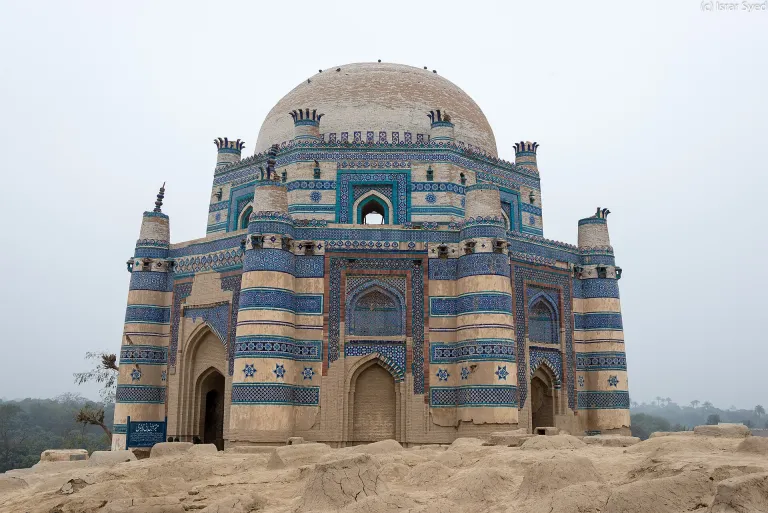 Uch SharifCaptured by the Ghurids in 1175, Uch drew Sufis from Central Asia. Its tile-faced tombs include the half-ruined tomb of Bibi Jawindi, built around 1494 for a great-granddaughter of the saint Jahaniyan Jahangasht (1307–1383).
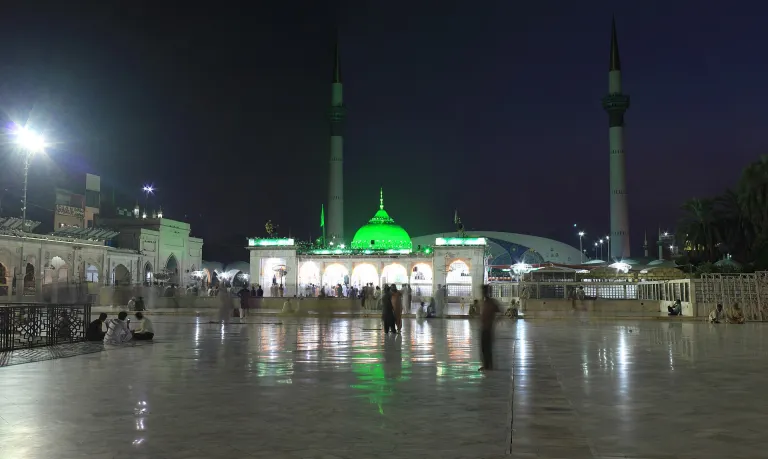 LahoreGhaznavid capital, seat of Aibak's coronation and burial, and site of the shrine of Ali Hujwiri, Data Darbar, still one of the busiest shrines in Pakistan.
 Thatta and MakliThe necropolis on Makli Hill records the civilisation of Sindh from the 14th to the 18th centuries. The carved stone tomb of Jam Nizamuddin II, who reigned 1461–1509, is its early masterpiece.
 SehwanThe town on the Indus taken during the Arab conquest of Sindh, later home to the shrine of the saint Lal Shahbaz Qalandar.
 Tomb of Qutb al-Din AibakThe first sultan of Delhi lies in Lahore's Anarkali area. His successor Iltutmish built the tomb; the present structure was rebuilt by Pakistan's Department of Archaeology in the 1970s.
Sufis, Shrines and the Spread of Islam
Conquest brought Muslim rulers to the Indus, but historians generally credit the slower work of traders, scholars and above all Sufis with making Islam the faith of most people in the region. Sufi masters taught a devotional, inward-looking Islam, lived among ordinary people and welcomed visitors of every background to their lodges (khanqahs).
In Lahore, Ali Hujwiri wrote Kashf al-Mahjub (‘The Unveiling of the Veiled’), one of the earliest Persian treatises on Sufism; his shrine, Data Darbar, has been a place of pilgrimage for nearly a thousand years. In the 13th century Bahauddin Zakariya made Multan the South Asian centre of the Suhrawardi order, and his grandson Shah Rukn-e-Alam continued the line. UNESCO notes that Rukn-e-Alam's tomb draws more than 100,000 pilgrims a year from across South Asia.
At Uch, saints of the Bukhari family, from Central Asia, founded a second great Suhrawardi centre. Jahaniyan Jahangasht, ‘the one who travelled the world’, built there the first domed tomb, for his teacher Baha' al-Halim.
A distinctive architecture
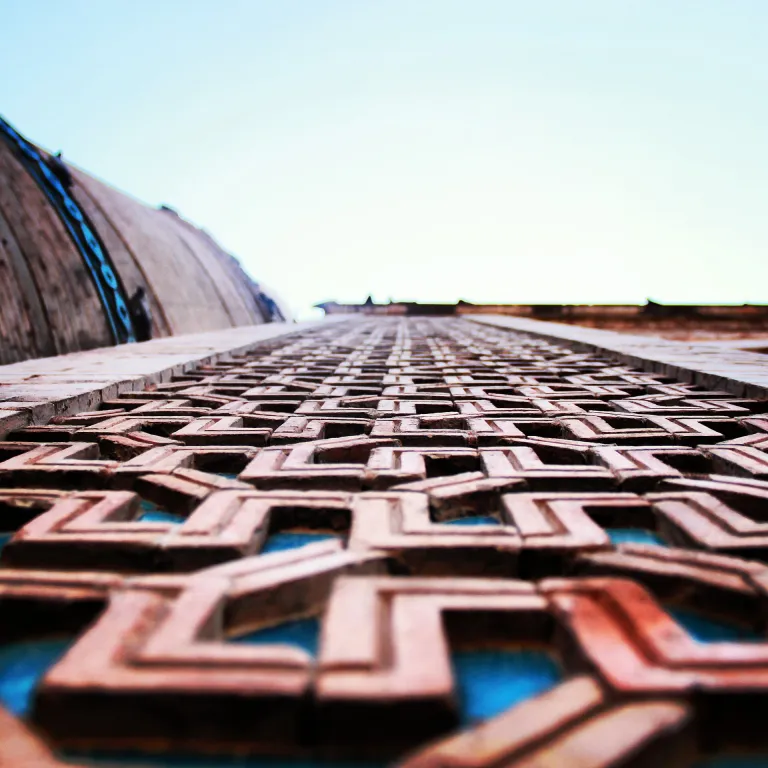
The shrines of Multan and Uch created a style found nowhere else: massive tapering walls of fired red brick, timber bracing, octagonal drums and domes, and bands of carved brick and glazed tile in deep blue, turquoise and white. The style travelled south to Sindh and was carried on by Multan's hereditary tile-makers into Mughal times. See our guide to Sufi shrines for visiting customs.

Language, Learning and Trade
The medieval centuries left a cultural layer that still shapes daily life in Pakistan. Under the Umayyads, Arabic was the language of administration in Sindh; from the Ghaznavids onward, Persian became the language of government, poetry, history-writing and Sufi literature across the Muslim-ruled north of the subcontinent, and remained so into the Mughal age and beyond.
Persian, Arabic and Turkic vocabulary mixed with the spoken languages of Punjab, Sindh and the Delhi region. Over the following centuries this mixing contributed to the growth of Urdu and enriched Punjabi, Sindhi and Saraiki, the languages in which later Sufi poets such as Bulleh Shah and Shah Abdul Latif would write.
The frontier cities lived from trade as well as faith. Multan and Uch sat on routes linking the Indus plains with Iran, Afghanistan and Central Asia; Lahore controlled the road from the Khyber to Delhi; and Sindh's ports connected the region to the Arabian Sea. Invasions from the north-west, Ghaznavid, Ghurid, Mongol and Timurid, followed the same roads, which is why so many of the period's turning points happened in today's Pakistan.
From Sultanate to Mughal Empire
When Babur defeated the last Lodi sultan at Panipat in 1526, he inherited a region that was already deeply Persianate and dotted with Sufi shrines. The Mughals built on that foundation, in Lahore above all. Continue the story in The Mughal Era.

Frequently Asked Questions
When did Islam arrive in the region that is now Pakistan?
Muslim traders were present on the coasts earlier, but the first lasting Muslim rule came with Muhammad bin Qasim's conquest of Sindh in 711 and of Multan around 712, under the Umayyad caliphate.
Who was Muhammad bin Qasim?
An Arab commander of the Umayyad caliphate who led the conquest of Sindh in 711–712, defeating Raja Dahir, the last Hindu king of Sindh. Sindh and Multan then became provinces of the caliphate.
Was the Delhi Sultanate ruled from Pakistan?
Its capital was Delhi, but its founder, Qutb al-Din Aibak, proclaimed himself king at Lahore in 1206 and died and was buried there in 1210. Multan, Uch and Lahore were important provincial centres throughout the Sultanate's history.
Why are Multan and Uch called cities of saints?
From the 13th century both became centres of the Suhrawardi Sufi order. Their tombs, of Bahauddin Zakariya and Shah Rukn-e-Alam in Multan, and of the Bukhari saints and Bibi Jawindi in Uch, remain major places of pilgrimage.
Where can I see medieval monuments in Pakistan?
The best are the Sufi tombs of Multan and Uch Sharif, Data Darbar and the Tomb of Qutb al-Din Aibak in Lahore, and the early tombs of the Makli necropolis near Thatta.
Keep Exploring
Related places and stories on DailyLife.pk
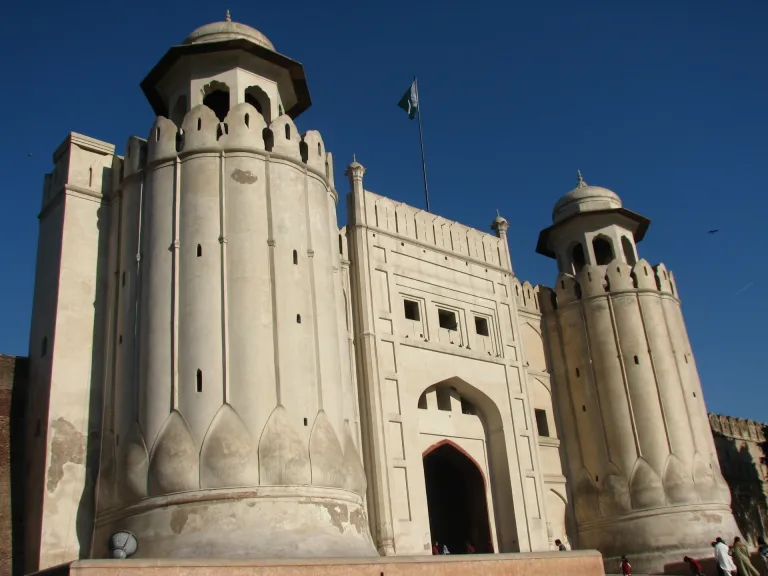
Uch SharifVisit Uch Sharif in Bahawalpur District: Bibi Jawindi's tomb, the Bukhari shrines, Sufi historyMakli NecropolisVisit Makli Necropolis near Thatta, Sindh: Jam Nizamuddin II MultanMultan city guide: Shah Rukn-e-Alam and other Sufi shrines, the walled city, blue pottery, sohan halwaLahoreLahore travel guide: Badshahi Mosque, Lahore Fort, Shalimar Gardens, the Walled City, food streets, neighbourhoods, metro
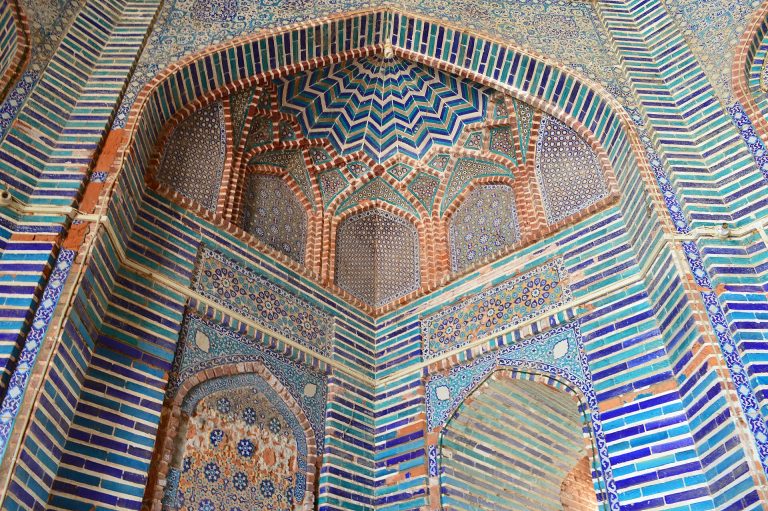 ThattaThatta city guide: Makli Necropolis, the Shah Jahan Mosque, Keenjhar Lake, history, 2023 Census populationSehwanSehwan Sharif guide: the shrine of Lal Shahbaz Qalandar, dhamaal and the urs, Kafir Qila
How we know this
- Type Historical & cultural research
- Sources 10 (8 official/academic)
- Reviewed October 2026
- Disputed points None
10 sources
- Pakistan: History, Encyclopaedia Britannica
- Lahore, Encyclopaedia Britannica
- Multan, Encyclopaedia Britannica
- Muʿizz al-Dīn Muḥammad ibn Sām, Encyclopaedia Britannica
- Ghūrid sultanate, Encyclopaedia Britannica
- Aybak, Qoṭb-al-Dīn, Encyclopaedia Iranica
- Tomb of Shah Rukn-e-Alam, Multan (Tentative List), UNESCO World Heritage Centre
- Tomb of Bibi Jawindi, Baha'al-Halim and Ustead and the Tomb and Mosque of Jalaluddin Bukhari (Tentative List), UNESCO World Heritage Centre
- Historical Monuments at Makli, Thatta, UNESCO World Heritage Centre
- Tomb of Qutb ud-Din Aibak (used to locate sources), Wikipedia
Photo credits (11)
- Tomb of Shah Rukn-e-Alam Multan.jpg, Junaidahmadj, CC BY-SA 3.0, via Wikimedia Commons
- Close up detail of the facade of the tomb of shah rukn e alam.jpg, Kkashaff, CC BY-SA 4.0, via Wikimedia Commons
- Bab-e-Qasim, Multan 20170630 181603.jpg, Effbt, CC BY-SA 4.0, via Wikimedia Commons
- Tomb of Bahauddin Zakariya, Multan 2016.jpg, Junaidshah11, CC BY-SA 4.0, via Wikimedia Commons
- Tomb of Bibi Jawindi Uch Sharif.jpg, Israr Syed, CC BY-SA 4.0, via Wikimedia Commons
- Data Darbar Complex Evening.JPG, Meemjee, CC BY-SA 3.0, via Wikimedia Commons
- Nizam al-Din Tomb, Makli Hill, Sindh..jpg, Asultan, CC BY-SA 3.0, via Wikimedia Commons
- Alamgiri Gate - Main entrance to Lahore Fort.jpg, S.hassanjawad, CC BY-SA 3.0, via Wikimedia Commons
- Shrine Lal Shahbaz Qalandar, Sehwan Shareef, Sindh, Pakistan.jpg, Fassifarooq, CC BY-SA 4.0, via Wikimedia Commons
- Night View of Badshahi Mosque (King’s Mosque).jpg, Muhammad Ashar, CC BY-SA 3.0, via Wikimedia Commons
- Takht-i-Bahi Buddhist Monastery.jpg, Muzamil Hassain Toori, CC BY-SA 4.0, via Wikimedia Commons
