
Places to visit
Hazuri Bagh and Baradari: a practical visitor guide
Visit Hazuri Bagh and Baradari: what to see, historical context, getting there, a realistic plan, families and official access checks.
Hazuri Bagh Baradari in Lahore
The space between the headline monuments
Hazuri Bagh and its marble baradari deserve attention even when Lahore Fort and Badshahi Mosque dominate the surrounding itinerary. The garden is a way to read the relationship between monumental buildings, public space and different periods of Lahore's history. Allow roughly thirty to sixty minutes for a focused visit as an editorial estimate, apart from any fort or mosque time. Do not assume access inside the pavilion or to underground spaces. A useful visit can be made through permitted views of the garden and marble structure, provided current precinct access has been confirmed.
A layered history rather than one Mughal scene
The federal heritage inventory associates the quadrangle with an earlier sarai and identifies the marble baradari with Ranjit Singh. The Walled City authority links the garden's creation in 1813 with the Koh-i-Noor episode involving Shah Shujah. Those connections make the place more historically layered than a generic Mughal-garden label suggests. The pavilion and the surrounding major monuments do not all belong to one patron or one moment. Treat the garden as a place where later rulers reshaped an existing monumental setting, and distinguish that documented sequence from stories about every piece of reused material.
Look at the pavilion's lightness and setting
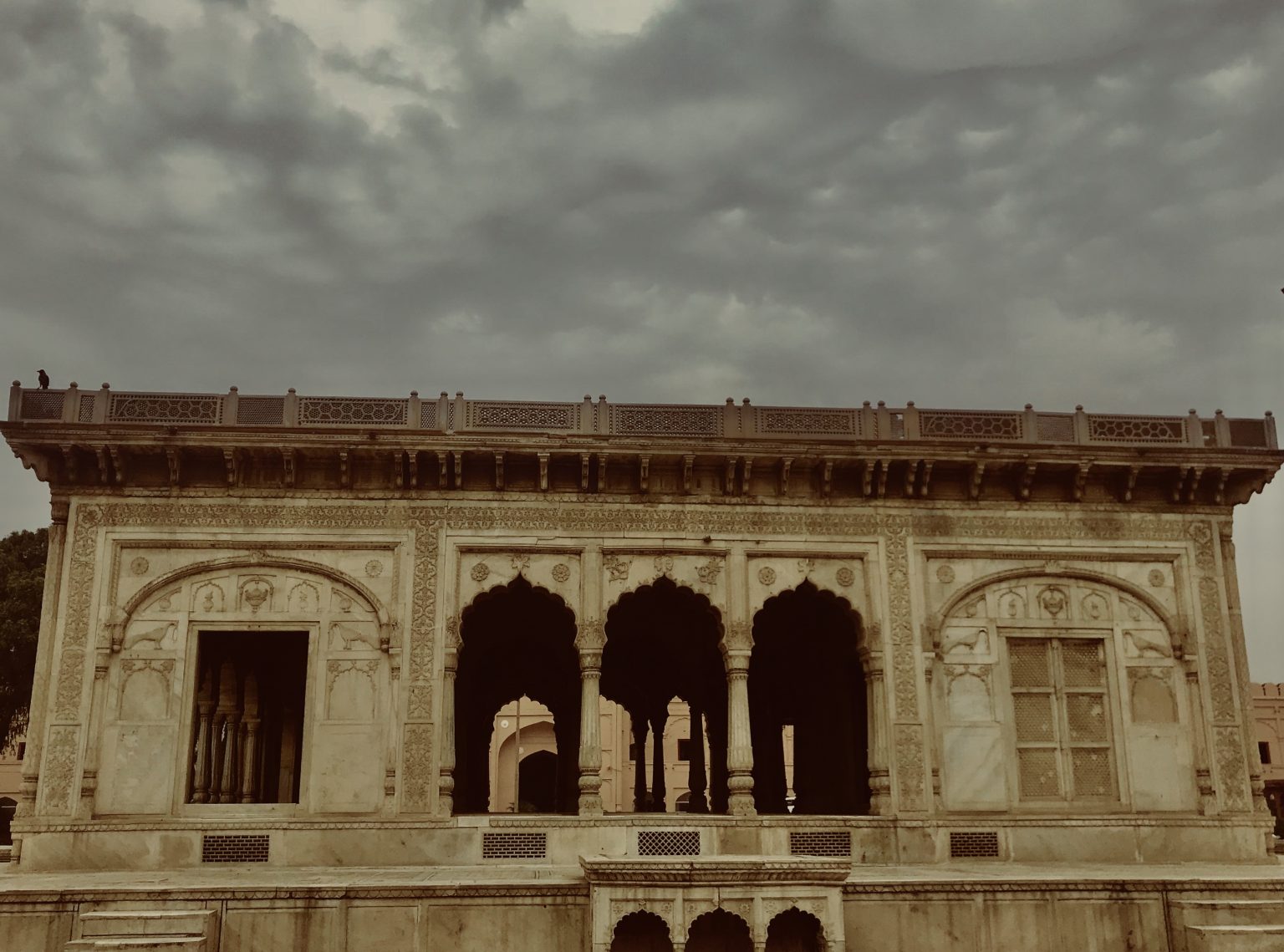
The word baradari is commonly used for an open-sided pavilion type, but the visitor task is to observe the particular structure before accepting a general label as a complete description. Notice how marble columns, openings and the roof organise views through it. Compare the pavilion's smaller scale with the mass of the fort and mosque around it. You do not need to enter a protected structure to understand those relationships. Stay behind barriers and avoid sitting or leaning on architectural features unless clearly permitted. Close contact with carved stonework is unnecessary for either observation or a photograph.
Explore the places and guides mentioned
Photographs show the linked places or guide subjects. Open each page for its own visiting and planning information.


A small pavilion can reorganise a large space
The baradari's position helps give the enclosure a centre, while openings allow views through and around it. This relationship is easy to miss if you approach only for a close photograph. Step back within the public route and notice how the pavilion changes the distance between observer and surrounding monuments. Its smaller scale can give a person a visual point of reference within an otherwise imposing precinct.
Compare the garden from two legal viewpoints rather than trying to enter a restricted room. One may emphasise the pavilion as an object, while the other shows it as part of a sequence of spaces. This is an architectural observation, not a claim to reconstruct every historical ceremonial route. It makes the garden's role legible and explains why the space deserves attention even for a visitor who has already seen many marble details elsewhere in Lahore.
The surrounding memorials have their own rules
Iqbal's tomb and other religious or commemorative sites lie within the wider historic setting, but proximity does not mean all doors share one public arrangement. Ask about access and etiquette at each place you intend to enter. Hazuri Bagh is also not a substitute entrance ticket for Lahore Fort or Badshahi Mosque. If travelling with a group, identify which places are priorities before arriving rather than adding every visible building to the plan. That makes it easier to give the garden a proper pause instead of treating it only as a corridor between queues.
Choose a precinct approach, not just a map pin
Use Hazuri Bagh together with the fort-and-mosque precinct when arranging transport, then confirm the current pedestrian approach. Road controls, drop-off points and operating gates can change the practical route. Agree where your driver will collect you; a large monumental area can make 'outside the mosque' too vague. Visitors with limited mobility should ask about the complete route from the drop-off, including surfaces, thresholds and any required stairs. A short straight-line distance on a map does not show every barrier or change of level in a historic precinct.
A thirty-to-sixty-minute observation plan
Start at a permitted viewpoint that lets you see the pavilion and at least one neighbouring monument together. Identify which structure you are looking at and its period before approaching closer. Spend the central portion on the baradari's visible materials and openings, then move to a second viewpoint if the public route allows. Finish with a quiet pause and a look back at the wider enclosure. Children can compare scale and material rather than memorise rulers. The plan works as a compact standalone stop or a restful interval, but do not use its short duration to justify rushing the adjacent major attractions.
Access and conservation uncertainty
The federal inventory describes features including underground chambers and an earlier form of the pavilion. That is architectural documentation, not a promise that those areas are publicly accessible or intact in the same way today. This guide verifies no pavilion interior tour, current ticket charge or guaranteed opening timetable. Check the responsible precinct authority before travelling, particularly for an event day or a visit dependent on close pavilion access. Where barriers or staff directions limit movement, accept them. Conservation conditions can reasonably require a view from farther away, and an older visitor image does not override a current restriction.
Use the official attraction information as your starting point for the enquiries above.
A useful way to connect Lahore periods
Read the Lahore city guide and DailyLife's existing Lahore Fort and Badshahi Mosque guide before building a larger circuit. Hazuri Bagh helps visitors compare Mughal, Sikh and later commemorative layers without pretending they form a seamless single-era landscape. For families, ask why a later ruler might place a smaller pavilion between already important buildings. Leave the answer open to discussion rather than turning a complex history into a moral slogan. A good visit ends with a clearer sense of spatial relationships and changing patronage, even if it involves only a few permitted viewpoints and no interior entry.
For related planning, read Lahore Fort and Badshahi Mosque.
Continue planning your trip
Frequently Asked Questions
Is the baradari Mughal?
The federal heritage inventory attributes the marble pavilion to Ranjit Singh. The surrounding precinct contains monuments and spaces from several periods.
Can I enter the pavilion or underground rooms?
No current public access to those spaces is verified. Plan around permitted views and follow the precinct’s barriers and staff directions.
Does this include Lahore Fort entry?
No. The fort and other neighbouring attractions have separate access arrangements that must be checked independently.
How much time should I allow?
Thirty to sixty minutes is an editorial allowance for the garden and pavilion views, excluding separate visits to the fort, mosque or memorials.
How we know this
- Type Travel guide
- Sources 2 (1 official/academic)
- Reviewed October 2026
- Disputed points None
Rules and fees change, confirm with the official links below before you act.
2 sources
- Hazuri Bagh and Baradari — official information, Government of Pakistan
- Roshnai Gate and Hazuri Bagh context, Walled City of Lahore Authority, Government of Punjab
Photo credits (3)
- Hazuri Bagh Darbari.jpg, Amna888, CC BY-SA 4.0, via Wikimedia Commons
- Night View of Badshahi Mosque (King’s Mosque).jpg, Muhammad Ashar, CC BY-SA 3.0, via Wikimedia Commons
- Wide angle view of Badshahi Mosque.jpg, Mishel Ijaz, CC BY-SA 4.0, via Wikimedia Commons
