Sarson ka Saag
with Makki ki Roti
سرسوں کا ساگ اور مکئی کی روٹی
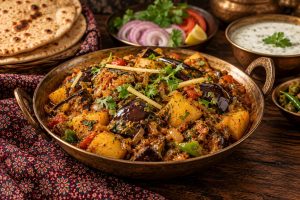
Slow-cooked mustard greens, golden maize-flour roti and a pat of white butter.
Punjab's winter classic: mustard greens and spinach simmered until silky, churned with maize flour and finished with a ghee and onion tarka, served with hand-patted makki ki roti.

The 135-minute total is a planning estimate for the original four-person batch, with dough and tarka made while the saag finishes. Cleaning very gritty greens can add time. Larger batches and cooking rotis one at a time on a single tawa take longer; serving-size changes do not shorten the greens’ simmer. Follow tenderness and cooked-centre cues rather than the clock alone. One tablespoon = 15 ml; one teaspoon = 5 ml.
About Sarson ka Saag with Makki ki Roti
When the mustard fields of Punjab turn yellow in winter, sarson ka saag and makki ki roti appear on tables from village homes to city food streets. The saag is made mostly from sarson (mustard greens), softened with spinach and often bathua (pigweed), cooked slowly until the leaves collapse into a thick, dark-green purée. It is then churned with a wooden ghotna and thickened with a little maize flour. Bright with ginger, garlic and green chilli and gently bitter from the mustard, it is finished with desi ghee, fried onion and a generous spoonful of white butter (makhan).
Its partner, makki ki roti (also called makai ki roti), is a thick, golden flatbread of maize flour. Because maize has no gluten, the dough is mixed with hot water and patted out by hand, not rolled, then cooked slowly on a tawa with ghee. A glass of lassi and a lump of gur are traditional on the side.
The dish is widely associated with rural Punjab and is eaten on both sides of the border. Within Pakistan, central Punjab is known for mustard-leaf saag, while in the Potohar region cooks use similar ingredients but often keep the method simpler. When mustard is out of season, saag is made with spinach alone, so many eateries serve it year-round.
Personally cooked and tested by Zohair Fakhar for DailyLife.pk. Cooking times can vary with your stove, cookware and batch size; follow the texture and doneness cues in the method.
Make it work for your kitchen
Also known as sarson da saag, saag makai, saag aur makki ki roti, makai ki roti, makki di roti, mustard greens curry with cornbread, ساگ, مکئی کی روٹی.
Original quantities serve 4. Cooking times, pan size and frying-oil depth do not scale, cook in extra batches instead.
Before you start
Trim the greens
Strip mustard leaves from thick stems. Peel the thicker stems and chop them finely, they add body but need the full cooking time, and discard yellowed or damaged leaves. Trim spinach and bathua.
Heat off · 15 minWash thoroughly
Wash the greens in a sink of water, lifting them out so grit stays behind. Repeat 3–4 times until no sand settles at the bottom, then chop roughly.
Heat off · 10 minPrep the aromatics
Roughly chop the ginger and green chillies for the saag; finely chop the onion, garlic and ginger for the tarka.
Heat off · 5 minSet up the equipment
Have the following tools ready before starting: Large heavy-based pot with lid (at least 5 litres), wooden ghotna or hand blender, small frying pan, tawa or heavy frying pan, two squares of baking paper or a plastic sheet, flat spatula.
Clean workspace
Step-by-step cooking method
1 Wilt the greens
Put the water, chopped mustard greens and stems, spinach, bathua, ginger, garlic, green chillies, salt and gur in the large pot, pressing the greens down. Cover and bring to a boil; within a few minutes the leaves collapse into the liquid. Stir well.
2 Simmer slowly
Lower the heat, cover and simmer, stirring every 15 minutes and adding a splash of water if the base looks dry. The greens are ready when they are dark olive-green and a piece of mustard stem crushes easily between your fingers.
3 Churn the saag
Turn off the heat. Churn with a wooden ghotna, or pulse briefly with a hand blender, to a coarse purée that still has some texture, not a smooth paste.
4 Thicken with maize flour
Use the maize flour quantity in the Saag ingredient group for the selected servings; keep the flour in Makki ki roti separate. Return the saag to low heat. Sprinkle in the saag flour a spoonful at a time, stirring firmly so no lumps form. Cook for 15–20 minutes, partly covered against splutters and stirring often, until the flour is incorporated and the saag is glossy and falls from the spoon in a soft dollop. Add a little of the hot water listed under Saag only as needed to loosen it.
5 Make the dough for the rotis
Use the flour, salt, coriander (if using) and hot-water range in the Makki ki roti ingredient group for the selected servings. Mix the dry ingredients in a bowl. Start with the lower end of that water range and stir with a spoon; reserve the rest. Cover and leave until cool enough to handle, then knead with the heel of your hand. Add the reserved water a spoonful at a time only until the dough is soft and holds together without cracking. Divide into equal balls: 3 for 2 people, 6 for 4, 9 for 6 or 12 for 8. Keep covered.
6 Fry the tarka
Heat the ghee in the small pan and fry the onion, stirring, until deep golden. Add the garlic, ginger and dried chillies and stir until the garlic is light golden and fragrant. Pour the tarka into the saag, stir, and keep it on the lowest heat, covered, while you cook the rotis.
7 Shape and cook the rotis
Knead each dough ball briefly, then pat it between two sheets of baking paper into a disc about 14–15 cm wide and 5 mm thick. Patch cracked edges with damp fingers. Peel away the paper and transfer carefully to a medium-hot tawa. Cook until the underside sets and develops golden spots, then flip carefully. Use the ghee allowance listed under Makki ki roti for the selected servings, keeping the Tarka ghee separate. Spread about 1 tsp per roti around the edges and over the surfaces from that allowance, adding the remainder only as needed. Turn until both sides have brown spots and the centre is cooked through. Keep the finished rotis wrapped in a clean cloth.
8 Serve
Taste the finished saag and adjust seasoning if needed. Measure 2–4 tbsp butter as the allowance for the whole batch, then divide it between the selected servings; it is not an amount for each bowl. Serve the saag hot with the freshly cooked rotis. Any extra butter served at the table is additional to the listed allowance.
Chef’s tips
- Use roughly three parts mustard to one part spinach: spinach mellows the bitterness, but too much makes the saag taste like plain palak.
- Fine, fresh makki ka atta gives the softest rotis. Coarse or old flour cracks more and needs hotter water.
- Knead each roti ball again just before shaping, maize dough dries out quickly, which causes cracked edges.
- Saag tastes even better the next day, so make the base ahead and add a fresh tarka when serving.
- If your greens are especially bitter, add the optional gur or a little more spinach rather than extra salt.
Common mistakes & quick fixes
- Saag is bitter and fibrous
- It needs more cooking. Simmer longer on low until the stems crush easily, then churn again; a teaspoon of gur also helps balance bitterness.
- Saag is watery
- Cook uncovered on low, stirring, and sprinkle in another tablespoon of maize flour, cooking it out for at least 10 minutes.
- Rotis crack at the edges
- The dough is too dry or too cool. Re-knead with a little hot water, keep the balls covered, and pinch cracks closed with a damp finger as you pat.
- Rotis are raw in the middle
- The tawa is too hot or the roti too thick. Cook on medium, press gently with the spatula and keep them about 5 mm thick.
Variations & serving ideas
Pressure-cooker saag: Cook the greens with the aromatics and less water under pressure for about 15 minutes, churn, then add the maize flour and finish on the stove.
Saag with radish or turnip greens: Swap some of the spinach for mooli or shalgam leaves for a sharper, more peppery saag.
Saag gosht: Brown mutton with onion, ginger and garlic, cook until tender, then simmer it in the finished saag for 15–20 minutes.
Makki ki roti with greens: Knead finely chopped fenugreek or spinach leaves, and a pinch of ajwain, into the maize dough.
Perfect result check
| Saag | Deep olive-green, coarse and spoonable, with the flour fully incorporated after cooking. Texture cues do not replace the cooking method or flour-packet directions. |
|---|---|
| Makki ki roti | Golden with brown spots on both sides, cooked through, crisp-edged and soft inside. |
| Tarka | Onion deep golden, garlic light golden, ghee fragrant, not burnt. |
Storage & reheating
| Fridge | Up to 3 days | Divide leftover saag into small, shallow containers and refrigerate promptly at 4 °C/40 °F or colder. Do not wait for a large pot to reach room temperature. Refrigerate within 2 hours, or within 1 hour above 32 °C/90 °F. Use within 3 days for this recipe; discard portions left out beyond those limits. |
|---|---|---|
| Freezer | Up to 3 months for best quality | Freeze the cooled saag in meal-sized portions at −18 °C/0 °F or colder, ideally before the tarka. The 3-month limit is for quality. Thaw in the fridge, reheat thoroughly and add a fresh tarka. Apply the same prompt-cooling limits before freezing. |
| Makki ki roti | Best eaten fresh | Rotis are best fresh and firm as they cool. Refrigerate leftovers promptly, within 2 hours or 1 hour above 32 °C/90 °F. Keep covered and use within a day for texture. |
| Reheating | Until steaming hot | Reheat only the saag portion needed with a splash of water, stirring to remove cold spots. Check several places with a food thermometer: reach at least 74 °C/165 °F throughout. Reheat refrigerated rotis on a tawa until hot through. Any extra ghee is additional to the recipe allowance. |
Know when to change the heat
| Stage | Heat | What to look for |
|---|---|---|
| Wilting the greens | High heat | Leaves collapse into the liquid |
| Slow simmer | Low heat | Gentle bubbling; stems crush between fingers |
| Cooking the maize flour | Low heat | Gentle bubbling while stirred; flour incorporated and saag glossy. Complete the cooking stage; do not use a raw taste test. |
| Tarka | Medium heat | Onion deep golden, garlic light golden |
| Makki ki roti | Medium heat | Golden spots on both sides and a cooked centre; check the inside of a roti if unsure. |
Helpful answers before you cook
What greens do I need for sarson ka saag?
Mustard greens are essential. Spinach is almost always added to soften the bitterness, and bathua (pigweed) is traditional where available. Some cooks add radish or turnip greens. If you cannot find bathua, simply use more spinach.
Why add maize flour to the saag?
The small flour allowance in the Saag group helps the churned greens hold together; keep it separate from the larger roti-flour allowance. Sprinkle it in gradually and stir over low heat for the full cooking stage in the method. Flour and raw dough should not be tasted before cooking. Glossiness and thickness help judge texture, but appearance or a lack of floury taste alone does not establish safe cooking. Follow any cooking directions on the flour packet.
Why does makki ki roti break, and how do I stop it?
Maize flour has no gluten, so the dough relies on hot water to hold together. Mix with water just off the boil, knead each ball again before shaping, keep the dough covered, and pat it out between sheets of paper rather than rolling it.
Can I use cornflour instead of makki ka atta?
No. Cornflour (cornstarch) is a pure starch and will not make a roti. Use fine yellow maize flour, sold in Pakistan as makki or makai ka atta; fine cornmeal is the closest substitute abroad.
When is sarson ka saag in season?
Mustard greens are a winter crop in Punjab, so saag is at its best through the cold months, when fresh sarson reaches the markets. Spinach-only saag can be made at other times of year.
Can I make it ahead?
Yes. Make the saag base ahead, cool it promptly in shallow containers and refrigerate for up to 3 days, or freeze for up to 3 months for quality. Reheat the portion needed to at least 74 °C/165 °F throughout and add a fresh tarka. Make rotis fresh where possible. Do not leave a large pot on the counter to cool completely; use the cooling limits in Storage & reheating.