Aloo Samosa
سموسہ
A crisp, blistered-free shell around spiced, lemony potato, fried low and slow.
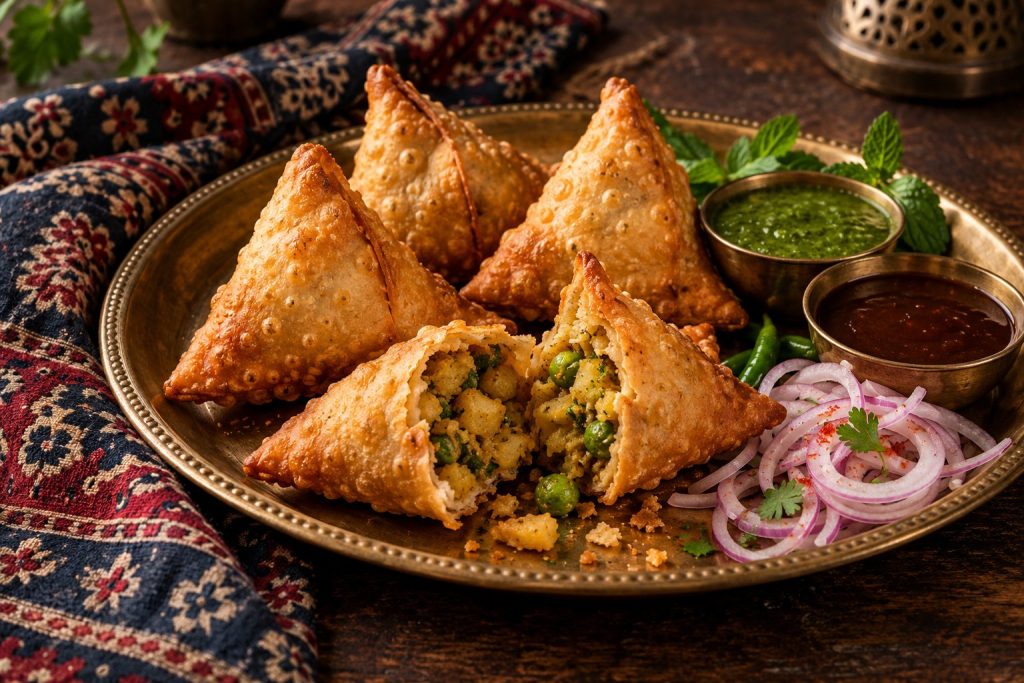
Hand-shaped cone samosas with a short, ajwain-scented pastry and a chunky potato filling sharpened with crushed coriander, green chilli, chaat masala and lemon.
Excludes the 30-minute dough rest, during which the filling cools. Frying is in three batches of four. One tablespoon = 15 ml; one teaspoon = 5 ml.
About Aloo Samosa
The samosa is a triangle of pastry around a savoury filling, deep-fried until crisp. It is one of the most familiar snacks in Pakistan: sold by the dozen from bakeries and roadside karahis, eaten with chai in the afternoon, and stacked high on almost every iftar table during Ramazan, when vendors in every city fry them by the hundred.
Two broad styles are common. The Punjabi-style samosa, made here, has a thick, short pastry rolled by hand, shaped into a cone and fried slowly until it is crisp and pale gold. The filling is chunky potato seasoned with whole cumin, crushed coriander and fennel, green chilli and something sour, usually lemon juice, chaat masala or anardana. Karachi and much of urban Sindh favour the smaller, flaky patti samosa, made with thin, ready-rolled pastry strips folded into neat triangles and filled with keema, chicken or a crunchy mix of fried lentils and onion.
The pastry is the part worth getting right. Rubbing plenty of ghee into the flour (the moyan) gives it a short, biscuity bite, and a firm dough holds its shape in the oil. Frying at a low, steady temperature, rather than in very hot oil, lets the shell cook through and crisp without the bubbles and soft patches of a rushed samosa. Serve them hot with imli chutney or green chutney, or crush one into a bowl of chana chaat.
Personally cooked and tested by Zohair Fakhar for DailyLife.pk. Cooking times can vary with your stove, cookware and batch size; follow the texture and doneness cues in the method.
Make it work for your kitchen
Also known as samosa, samosay, aloo ke samosay, aaloo samosa, potato samosa, Punjabi samosa, سموسے.
Original quantities serve 6. Cooking times, pan size and frying-oil depth do not scale, cook in extra batches instead.
Before you start
Make the dough
Mix the flour, crushed ajwain and salt. Add the melted ghee and rub it in with your fingertips until the mixture looks like breadcrumbs and holds together when you squeeze a handful. Add the water a little at a time and press into a firm, stiff dough, stiffer than chapati dough. Knead for 1–2 minutes until smooth, cover and rest for 30 minutes.
Heat off · 10 min + 30 min restBoil the potatoes
While the dough rests, put the whole potatoes in a pan of cold salted water and boil them (step 1). Boiling them in their skins keeps the flesh dry, which stops the filling going pasty.
Medium-high · 20–25 minSet up a shaping station
Have the rolling pin, knife, a small bowl of water, a tray lined with a clean cloth and a second cloth to cover the shaped samosas ready before you start rolling.
Heat off · 2 minSet up the equipment
Have the following tools ready before starting: Large bowl; rolling pin; sharp knife; heavy, deep pan or karahi; slotted spoon or spider; wire rack; deep-fry or instant-read thermometer (recommended).
Clean workspace
Step-by-step cooking method
1 Boil the potatoes
Cover the whole, unpeeled potatoes with cold water, add a pinch of salt and bring to the boil. Cook until a knife slides into the centre with no resistance but the potatoes are not splitting. Drain, leave until cool enough to handle, then peel and break them into rough 1 cm chunks with your fingers. Don't mash. If using frozen peas, add them to the potato water for the last 2 minutes and drain together.
2 Temper the spices
Heat the 2 tbsp oil in a frying pan. Add the cumin seeds; when they sizzle and darken a shade, add the onion and cook, stirring, until soft and translucent but not browned. Add the ginger and green chillies and stir for 1 minute until fragrant.
3 Season the filling
Lower the heat. Stir in the crushed coriander and fennel, turmeric, chilli flakes and salt and cook for 30 seconds without letting the spices catch. Add the potatoes and peas and fold gently until everything is coated and hot. Turn off the heat, then fold in the chaat masala, lemon juice and fresh coriander. Taste: it should be a little saltier and sharper than you'd like, as the pastry mutes it. Spread on a plate to cool completely.
4 Roll and cut
Knead the rested dough briefly and divide into 6 equal balls. Keep the others covered while you work. Roll one ball into an oval about 18 cm long and 2 mm thick, dusting only lightly. Cut it in half across the middle to make two half-moons.
5 Shape and fill
Moisten the straight edge of one half-moon with water. Fold it into a cone, overlapping the wet edge by about 1 cm, and press the seam firmly. Hold the cone open and fill it with about 3 tbsp of cool filling, leaving 1 cm clear at the top. Moisten the inside of the top edge, pinch a small pleat at the back so the samosa will stand, and press the opening firmly shut. Place on the cloth-lined tray, seam side down, and cover. Repeat to make 12.
6 Heat the oil
Pour the oil into a heavy, deep pan to a depth of 6–7 cm, keeping it no more than half full. Heat to about 160°C. Without a thermometer, drop in a pea-sized piece of dough: it should sink, then rise slowly with a gentle stream of small bubbles. If it shoots up and browns at once, the oil is too hot; take it off the heat to cool.
7 Fry low and slow
Lower 4 samosas gently into the oil with a slotted spoon. The temperature will drop; keep it between 150 and 160°C, adjusting the flame as needed. Fry, turning every few minutes, until the pastry is firm, evenly pale gold and crisp, and the vigorous bubbling around the samosas has calmed. If small blisters appear on the surface, the oil is too hot.
8 Drain and serve
Lift the samosas out and stand them on a wire rack for 5 minutes so excess oil drips off and the pastry firms up. Bring the oil back to 160°C before each new batch. Serve hot or warm with chutney.
Chef’s tips
- Measure the ghee carefully. Too little and the pastry is hard and chewy; too much and it may crack or break up in the oil.
- Cool the filling completely before shaping. Warm filling softens the pastry and makes the seams leak.
- Keep the dough and shaped samosas covered so the surface doesn't dry and crack.
- Fry only a few at a time. Overcrowding drops the oil temperature and gives greasy samosas.
- Leftover pastry scraps can be rolled, pricked and fried as crisp namak pare-style nibbles.
Common mistakes & quick fixes
- Pastry is covered in bubbles
- The oil was too hot or the dough too soft. Keep the oil at 150–160°C and use a firm, well-rested dough.
- Samosas are greasy and soft
- The oil was too cool or the pan crowded. Check the temperature before each batch and drain on a rack, not stacked on paper.
- Seams open in the oil
- Edges weren't moistened or pressed hard enough, or the filling was warm. Seal firmly and fill only to 1 cm below the rim.
- Filling is bland once fried
- Season the filling more boldly than seems necessary; finish with extra chaat masala and lemon before shaping.
Variations & serving ideas
Keema samosa: Replace the potato filling with 400 g beef or mutton mince cooked with 1 chopped onion, 1 tsp each ginger and garlic paste, 1 tsp ground coriander, ½ tsp each chilli powder and garam masala, and salt. Cook uncovered, stirring, until the mince is browned, cooked through and completely dry, then add chopped coriander, mint and green chillies and cool fully before filling.
Karachi patti samosa: Use ready-made samosa patti (thin pastry strips). Fold each strip into a triangle pocket, fill with keema, chicken or a crunchy mix of fried chana and moong daal, peanuts, onion, green chillies, chaat masala and lemon, seal with a flour-and-water paste and fry at about 170°C until golden.
Air-fryer or oven: Brush the shaped samosas lightly with oil and cook at 180°C, turning once, until golden and crisp. The pastry is drier and less blistered than fried, but still good.
Anardana instead of lemon: Swap the lemon juice for 1 tbsp coarsely crushed anardana (dried pomegranate seeds) for a fruitier, slightly chewy sourness.
Perfect result check
| Pastry | Smooth, firm and evenly pale gold; it sounds crisp when tapped and has no soft or doughy patches. |
|---|---|
| Seams | Sealed shut with no filling escaping into the oil. |
| Filling | Hot all the way through, chunky rather than mashed, with distinct cumin, chilli and lemon. |
| Oil | Samosas feel dry to the touch after draining, not greasy. |
Storage & reheating
| Fridge (cooked) | 3–4 days | Cool on a rack, then refrigerate in an airtight container within 2 hours of frying. |
|---|---|---|
| Freezer (raw or part-fried) | Best within 3–4 months | Freeze shaped samosas in a single layer on a tray, then pack into bags. Fry from frozen at 150–160°C, allowing a few extra minutes, until golden and hot in the centre. |
| Reheating | Until steaming hot | Reheat in an oven or air fryer at about 180°C until the pastry is crisp and the filling reaches 74°C (165°F) and is steaming hot. The microwave softens the pastry. |
Know when to change the heat
| Stage | Heat | What to look for |
|---|---|---|
| Boiling potatoes | Medium-high heat | Knife slides into the centre; skins not splitting |
| Tempering | Medium heat | Cumin sizzles and darkens; onion soft and translucent |
| Heating oil | Medium, to about 160°C | Test piece of dough sinks, then rises slowly with small bubbles |
| Frying | Low to medium-low, 150–160°C | Steady gentle bubbles; pastry turns firm and pale gold without blisters |
Helpful answers before you cook
Why do my samosas have bubbles on the pastry?
Bubbles form when the oil is too hot or the dough is too soft. Use a stiff dough with the ghee well rubbed in, rest it, and fry at 150–160°C so the pastry cooks gently.
Can I use oil instead of ghee in the pastry?
Yes. Use the same quantity of neutral oil (60 ml). Ghee gives a slightly richer flavour and a more biscuity texture, but oil works well and makes the samosas dairy-free.
Can I make samosas ahead for iftar?
Yes. Shape and freeze them raw, or half-fry them until the pastry is set but still pale, cool, then freeze. Fry from frozen in moderately hot oil until golden and heated through.
What is the difference between a Punjabi samosa and a patti samosa?
A Punjabi samosa uses a thick, hand-rolled short pastry shaped into a cone and usually has a potato filling. A patti samosa uses thin, ready-rolled pastry strips folded into small triangles, giving a flaky, layered shell; it is typical of Karachi and is often filled with keema or a lentil mix.
How do I know the oil is the right temperature without a thermometer?
Drop a pea-sized piece of dough into the oil. At the right temperature it sinks briefly, then rises slowly with gentle bubbles. If it floats and browns immediately, the oil is too hot; if it sits on the bottom with hardly any bubbles, it is too cool.