Prawn Tempura
Control coating thickness and oil recovery
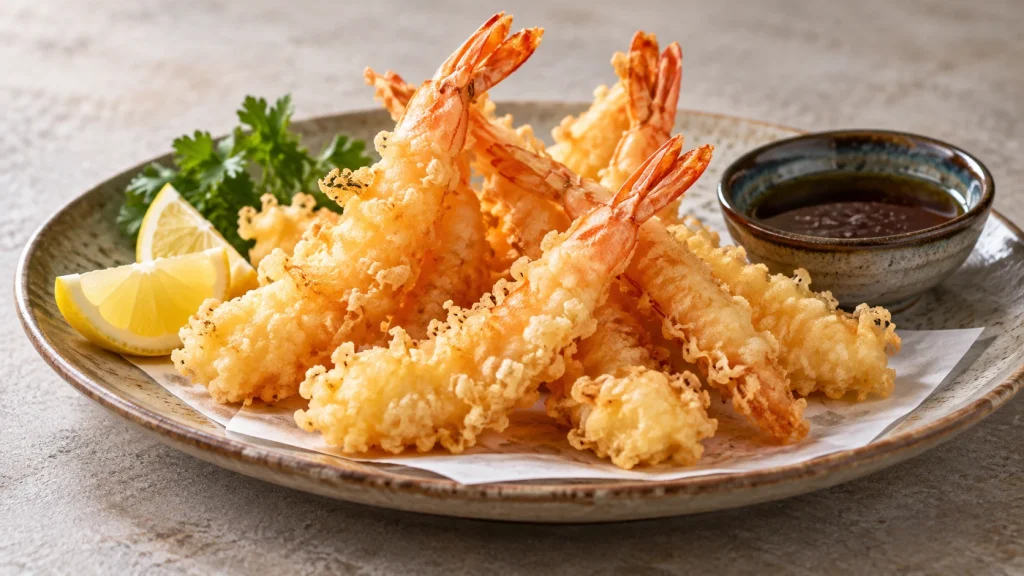
Large prawns are lightly dusted and dipped in a cold, briefly mixed tempura batter before frying in small batches. The coating stays pale gold, with rack draining and a separate lemon finish helping it remain crisp.
Allow 30 minutes preparation, approximately 25 minutes cooking and 2 minutes nonoverlapping waiting. Pat prawns dry and make 3 shallow cuts across the underside of each, no deeper than one third of the flesh. Gently straighten without tearing; check there are no retained shell fragments or water trapped under tails. Cooking ranges are guides: retain the stated doneness checks when your pan, meat age or portion thickness changes. One tablespoon = 15 ml; one teaspoon = 5 ml.
About Prawn Tempura
Prawn tempura is a light egg-and-flour batter mixed just before frying. Small lumps are intentional: overmixing develops a tough coating. The prawns are peeled and deveined, with shallow underside cuts to reduce curling without cutting through their bodies. This is a basic standalone tempura formulation with lemon, not an unmeasured dipping-sauce recipe.
Personally cooked and tested by Zohair Fakhar for DailyLife.pk. Cooking times can vary with your stove, cookware and batch size; follow the texture and doneness cues in the method.
Make it work for your kitchen
Original quantities serve 4. Cooking times, pan size and frying-oil depth do not scale, cook in extra batches instead.
Before you start
Prepare the batch
Pat prawns dry and make 3 shallow cuts across the underside of each, no deeper than one third of the flesh. Gently straighten without tearing; check there are no retained shell fragments or water trapped under tails.
Cut and portion before heatingKeep the work area ready
Keep raw seafood chilled until its cooking step; thaw frozen seafood in the refrigerator and pat it dry. Set aside a clean serving dish and clean utensils before handling raw protein. Do not return cooked food to the unwashed raw-food plate. Measure spices separately so they can enter the pan at the intended stage rather than burning while you find the next jar.
Food handlingSet up the equipment
Have the following tools ready before starting: Digital kitchen scale; Measuring jug and 5 ml / 15 ml spoons; Sharp knife and separate raw-protein board; Heavy pan sized for the stated batch; Instant-read food thermometer; Frying thermometer and draining rack where hot oil is specified.
Clean workspaceMeasure the ingredients
Measure the ingredient quantities for your selected servings before applying heat. Keep separately listed groups, such as dough, filling, sauce or garnish, in separate containers; keep any optional additions separate.
Use the ingredient list above
Step-by-step cooking method
1 Prepare the seafood
Pat prawns dry and make 3 shallow cuts across the underside of each, no deeper than one third of the flesh. Gently straighten without tearing; check there are no retained shell fragments or water trapped under tails.
2 Prepare the seafood (continued)
Pat dry carefully before applying flour or batter. Keep raw seafood chilled, and prepare a rack over a tray for draining. Use separate utensils and a clean final serving plate so a crisp cooked surface does not pick up raw juices.
3 Build the correct coating
Chill the 100 g batter flour and cornflour. Beat egg with ice-cold water, then add chilled flour, cornflour and salt with only a few strokes. Leave small lumps.
4 Build the correct coating (continued)
Dust dry prawns with the remaining 20 g flour just before dipping, allowing excess batter to drip away. Do not leave coated raw seafood at room temperature while the fryer heats. A consistent thin layer cooks more evenly than thick patches; shake off loose flour or allow excess batter to drip back into its bowl.
5 Set up the frying pot
Use a heavy 20 cm pot of at least 4 litre capacity with oil 5–6 cm deep and at least the same empty space above the oil; never fill beyond halfway. Heat with a frying thermometer to the temperature in the next step. Keep the pot stable, lower food away from you and never add water to hot fat. Use a lid only to smother an emergency fire, not during ordinary frying.
6 Fry in small batches
Heat oil to 170–175°C. Fry 4–5 prawns at a time for 2–4 minutes, turning gently as the coating sets. The batter should remain pale gold and the thick prawn flesh pearly and opaque, with no translucent centre.
7 Fry in small batches (continued)
Remove stray burnt coating between batches and let the oil recover before adding more food. Check seafood flesh is opaque and cooked through; for fish verify 63°C in the thickest centre. Oil colour or a browned crumb cannot prove that the inside is safe.
8 Drain and serve
Lift with a slotted utensil and drain in a single layer on the rack. Finish with measured lemon at the table so acid does not soak the crust before serving. Do not cover tightly or stack deeply: trapped steam softens crisp coatings. Discard raw leftover batter or crumbs that contacted seafood.
Chef’s tips
- Pat prawns dry and make 3 shallow cuts across the underside of each, no deeper than one third of the flesh. Gently straighten without tearing; check there are no retained shell fragments or water trapped under tails.
- For a smaller batch retain the same piece thickness and fry fewer pieces at once. The oil temperature and doneness endpoint stay unchanged.
- A 5 ml teaspoon and 15 ml tablespoon are used throughout. Weigh salt where possible because crystal sizes vary. Add any top-up water in the listed small increments and stop once the required texture is reached.
Common mistakes & quick fixes
- Coating falls away or becomes greasy
- Dry the seafood, shake off excess loose flour and let oil recover between small batches. A crowded pot lowers temperature and steams the coating instead of setting it quickly.
- Uneven finish between pieces
- Sort by thickness before cooking and check the largest piece separately. Move smaller finished pieces to a clean warm dish while thicker ones finish; do not assume colour alone proves that the centre is cooked.
Variations & serving ideas
A practical adjustment: For a smaller batch retain the same piece thickness and fry fewer pieces at once. The oil temperature and doneness endpoint stay unchanged.
Perfect result check
| Texture and structure | Dry the seafood, shake off excess loose flour and let oil recover between small batches. A crowded pot lowers temperature and steams the coating instead of setting it quickly. |
|---|---|
| Final seasoning | Taste only after the protein is fully cooked. The named principal ingredient should remain distinct, with no scorched spice bitterness or raw garlic edge. |
Storage & reheating
| Refrigerate | Within 2 hours; use within 48 hours | Divide into shallow portions promptly; refrigerate at 5°C or colder. Do not leave a deep cooking pot on the counter to cool. |
|---|---|---|
| Freeze | Up to 2 months for quality | Pack cooled portions airtight, label and freeze. Thaw in the refrigerator. Reheat one portion once to 74°C throughout; add a small measured splash of water only where a sauce needs loosening. |
Know when to change the heat
| Stage | Heat | What to look for |
|---|---|---|
| Prepare the fryer before dipping | 170–175°C, checked with a frying thermometer | Follow the existing pot-depth and half-fill limits. Keep prawns and batter cold while the oil heats, then dust and dip only the pieces ready to fry. |
| Fry in small batches and drain | Maintain 170–175°C | Let the thin coating set before turning. Check the thick prawn flesh using the stated cues rather than waiting for dark batter; remove loose coating and let the oil recover between batches. |
Helpful answers before you cook
Why is my tempura chewy?
Warm batter and prolonged whisking develop a heavier elastic coating. Keep ingredients cold, stir minimally and fry promptly in small batches.
Can frying oil depth be scaled down with the recipe?
No. Depth is determined by the pan and safe clearance, not by portion count. Use an appropriately smaller pot while retaining safe headroom.
Can I prepare these ahead?
These coatings are best freshly fried. Keep raw prepared seafood chilled and mix any light batter shortly before frying rather than holding finished seafood warm for a long period.