Mutton Sajji
Roast a salt-seasoned young-lamb leg indirectly
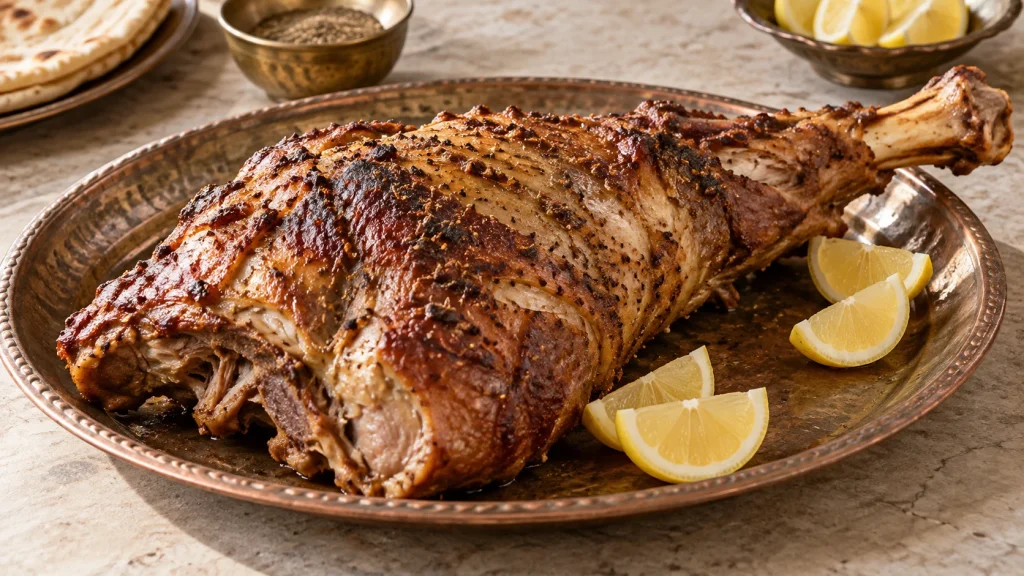
An unstuffed young-lamb leg adaptation for a covered household grill, dry-seasoned under refrigeration and roasted over indirect heat. A drip tray catches the fat below the meat; finish with lemon after resting and carve across each muscle’s grain.
Allow 45 minutes preparation, approximately 200 minutes cooking and 500 minutes nonoverlapping waiting. Plan a stable covered outdoor grill and a leg that fits with space around it. Dry seasoning is refrigerated overnight and the meat stays unstuffed. Cooking ranges are guides: retain the stated doneness checks when your pan, meat age or portion thickness changes. One tablespoon = 15 ml; one teaspoon = 5 ml.
About Mutton Sajji
Mutton sajji is presented as a salt-led young-lamb leg adaptation for a covered outdoor grill. It is clearly a household leg version, not a recreation of a whole animal suspended beside a traditional wood fire. The seasoning remains restrained and the leg roasts without a yogurt coating. Rice is not hidden inside the meat; any rice accompaniment should be prepared and handled separately.
Personally cooked and tested by Zohair Fakhar for DailyLife.pk. Cooking times can vary with your stove, cookware and batch size; follow the texture and doneness cues in the method.
Make it work for your kitchen
Original quantities serve 8. Cooking times, pan size and frying-oil depth do not scale, cook in extra batches instead.
Before you start
Prepare the batch
Plan a stable covered outdoor grill and a leg that fits with space around it. Dry seasoning is refrigerated overnight and the meat stays unstuffed.
Cut and portion before heatingKeep the work area ready
Measure the centre of the thickest piece, avoiding bone. Set aside a clean serving dish and clean utensils before handling raw protein. Do not return cooked food to the unwashed raw-food plate. Measure spices separately so they can enter the pan at the intended stage rather than burning while you find the next jar.
Food handlingSet up the equipment
Have the following tools ready before starting: Digital kitchen scale; Measuring jug and 5 ml / 15 ml spoons; Sharp knife and separate raw-protein board; Heavy pan sized for the stated batch; Instant-read food thermometer; Covered outdoor grill or oven as specified; clean wide tongs and rimmed tray; Covered outdoor grill with direct and indirect heat zones.
Clean workspaceMeasure the ingredients
Measure the ingredient quantities for your selected servings before applying heat. Keep separately listed groups, such as dough, filling, sauce or garnish, in separate containers; keep any optional additions separate.
Use the ingredient list above
Step-by-step cooking method
1 Choose a manageable leg
Use young lamb rather than mature goat for this dry-roasted format. Trim hard fat to a thin rim and remove thick exposed silver skin. Make 5–6 shallow cuts about 1 cm deep into thick muscles. Keep the leg intact and unstuffed; a stuffed whole carcass is outside this recipe.
2 Dry season under refrigeration
Rub salt evenly over the leg and into shallow cuts. Set on a rack in a covered tray and refrigerate 8–12 hours. Before roasting rub with the measured oil, pepper and cumin. Do not add an unmeasured wet marinade; the restrained surface seasoning is intentional.
3 Set up indirect roasting
Prepare a covered outdoor grill for indirect medium heat, approximately 165–175°C under the lid. Place a drip tray with 300 ml water below the meat, away from direct flames.
4 Set up indirect roasting (continued)
The water prevents drips scorching; it is not a meat braise and should not touch the leg. Use a rack or stable rotisserie rated for the weight.
5 Roast steadily
Cook the leg over indirect heat for about 2–3 hours, turning every 30–40 minutes unless using a rotisserie. Top the drip tray with the measured allowance if it dries.
6 Roast steadily (continued)
Check several thick muscles beside but not against the bone. The minimum is 63°C plus a 3-minute rest; this version aims around 75–80°C for fully cooked carveable meat, without claiming a pink centre.
7 Colour briefly if needed
If the leg is cooked but pale, move briefly near medium direct heat for 3–5 minutes per side, turning and moving away from flare-ups. Skip this stage if the surface is already well coloured. Do not let the salted crust blacken while chasing a whole-fire appearance that a household grill cannot exactly reproduce.
8 Rest and carve
Rest loosely covered for 20 minutes. Add lemon after resting, then carve across each muscle's grain, separating the natural seams if needed. Serve eight moderate portions. Any separately served rice must follow its own safe cooling rules; do not cool it in the meat's drip tray or stuff it into the cooked leg.
Chef’s tips
- Plan a stable covered outdoor grill and a leg that fits with space around it. Dry seasoning is refrigerated overnight and the meat stays unstuffed.
- An oven at 170°C conventional can provide the same controlled indirect roast principle; place the leg on a rack above its drip tray and verify the same internal endpoints.
- A 5 ml teaspoon and 15 ml tablespoon are used throughout. Weigh salt where possible because crystal sizes vary. Add any top-up water in the listed small increments and stop once the required texture is reached.
Common mistakes & quick fixes
- Salted surface darkens too fast
- Maintain indirect heat and move away from flames. A drip tray limits flare-ups; whole-leg cooking requires centre checks rather than judging by crust colour.
- Uneven finish between pieces
- Sort by thickness before cooking and check the largest piece separately. Move smaller finished pieces to a clean warm dish while thicker ones finish; do not assume colour alone proves that the centre is cooked.
Variations & serving ideas
A practical adjustment: An oven at 170°C conventional can provide the same controlled indirect roast principle; place the leg on a rack above its drip tray and verify the same internal endpoints.
Perfect result check
| Texture and structure | Maintain indirect heat and move away from flames. A drip tray limits flare-ups; whole-leg cooking requires centre checks rather than judging by crust colour. |
|---|---|
| Final seasoning | Taste only after the protein is fully cooked. The named principal ingredient should remain distinct, with no scorched spice bitterness or raw garlic edge. |
Storage & reheating
| Refrigerate | Within 2 hours; use within 48 hours | Divide into shallow portions promptly; refrigerate at 5°C or colder. Do not leave a deep cooking pot on the counter to cool. |
|---|---|---|
| Freeze | Up to 2 months for quality | Pack cooled portions airtight, label and freeze. Thaw in the refrigerator. Reheat one portion once to 74°C throughout; add a small measured splash of water only where a sauce needs loosening. |
Know when to change the heat
| Stage | Heat | What to look for |
|---|---|---|
| Roast the unstuffed leg steadily | Indirect 165–175°C under the lid | Keep the leg away from direct flames and the drip tray below it. Turn as described and check several thick muscles without touching bone. |
| Optional surface colour | Brief medium direct heat, only after cooking | Skip this stage if already coloured. Move away from flare-ups and complete the stated rest before carving; do not blacken the salted crust. |
Helpful answers before you cook
Is this a traditional whole-animal sajji?
No. It is an explicitly labelled young-lamb leg household adaptation. The catalogue name covers a wider dish family than this practical serving size.
Why no yogurt?
This formulation keeps a restrained salt-led roast character. Yogurt-spiced raan is covered separately and should not be treated as the same method.
Can I serve it with rice?
Yes, prepare rice separately using a measured rice recipe and safe handling. No rice stuffing is included or implied in this batch.