
Malaysian Nasi Goreng
Keep rice loose and add most crisp anchovies near the end.
4 fried-rice plates
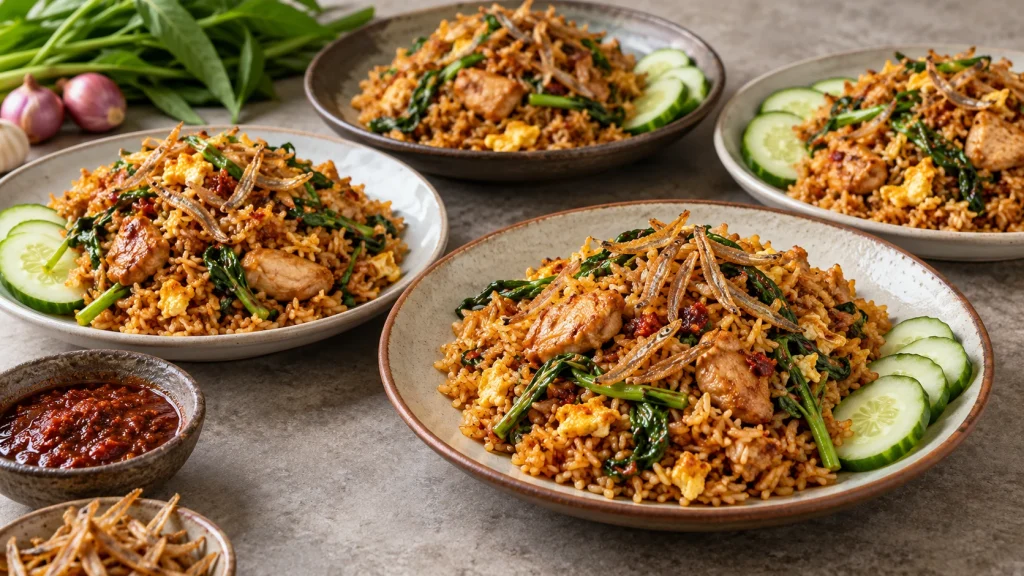
Allow about 40 minutes for one full batch in a 32 cm wok, or 55–60 minutes for two complete half-batches. All ingredients are divided equally if batching; each finished batch is served immediately, with no second reheating of the chilled rice. One tablespoon = 15 ml; one teaspoon = 5 ml.
About Malaysian Nasi Goreng
This Malaysian nasi goreng is a clearly defined kampung-inspired home version with chicken, kangkung, cooked sambal belacan and crisp anchovies. It is not presented as the only Malaysian fried-rice style. Commercial cooked sambal provides chilli and shrimp-paste flavour without asking the cook to ferment seafood. Most anchovies are folded in late so they retain crunch. The rice is already cooked and safely chilled; its age is counted from the first cooking, not from the stir-fry.
Personally cooked and tested by Zohair Fakhar for DailyLife.pk. Cooking times can vary with your stove, cookware and batch size; follow the texture and doneness cues in the method.
Make it work for your kitchen
Original quantities serve 4. Cooking times, pan size and frying-oil depth do not scale, cook in extra batches instead.
Before you start
Prepare the components
Use rice cooked within the previous 24 hours and promptly refrigerated. Ready-fried anchovies and cooked sambal are purchased prepared ingredients; follow their labels. Cookware: 32 cm heavy wok; use two full half-batches if food cannot be turned freely. Frying this chilled rice is its one reheating; serve immediately and do not plan to reheat leftovers again.
SetupSet up the equipment
Have the following tools ready before starting: Digital scale; Measuring jug; Chef knife; Separate raw-protein and ready-to-eat boards; Instant-read food thermometer; 32 cm heavy wok; use two full half-batches if food cannot be turned freely; Heatproof spatula; Small sauce bowl.
Clean workspaceMeasure the ingredients
Measure the ingredient quantities for your selected servings before applying heat. Keep separately listed groups, such as dough, filling, sauce or garnish, in separate containers; keep any optional additions separate.
Use the ingredient list aboveCheck allergens and substitutions
Check ingredient labels and any substitutions against these notes: Egg, fish, crustaceans from belacan, soy and often wheat; check sambal and anchovy labels.
Before cooking
Step-by-step cooking method
1 Prepare rice and seasoning
Break cold rice into loose grains. Mix sambal, soy, fish sauce and water. Separate kangkung stems and leaves and wash thoroughly.
2 Prepare rice and seasoning (continued)
Keep chicken cold until the pan is hot. Use a 32 cm wok.
3 Prepare rice and seasoning (continued)
If the food cannot be turned freely, divide all cooking ingredients into two equal sets—including oil, aromatics, protein, egg, rice, vegetables or fruit, sauces and garnish—and repeat the entire cooking sequence with one set at a time.
4 Prepare rice and seasoning (continued)
Do not put all protein or oil into the first half-batch.
5 Cook aromatics and chicken
Heat oil in a wide wok. Fry shallots 2 minutes and garlic 20 seconds. Add chicken and stir-fry 5–7 minutes, breaking up clusters, until the thickest pieces reach 74°C.
6 Cook egg and greens
Push chicken aside, pour beaten eggs into the cleared space and scramble until fully set. Add kangkung stems for 1 minute, then leaves for another minute until wilted and hot.
7 Fry rice
Add rice and seasoning. Turn and press for 4–6 minutes until separate and steaming throughout, checking 74°C in the mixed rice. Fold in 20 g anchovies for the last 30 seconds.
8 Serve
Divide among four plates, scatter remaining 10 g anchovies and place cucumber alongside. Use a clean board for cucumber after raw chicken preparation.
Chef’s tips
- Keep rice loose and add most crisp anchovies near the end.
- Keep measured sauces ready so the final hot stage can proceed without a pause for chopping.
Common mistakes & quick fixes
- Wet heavy rice
- Rice was not dried by proper chilling or the wok was crowded. Cook a half-batch if necessary.
- Soggy anchovies
- Do not simmer ready-fried anchovies in sauce; fold in late.
- Too salty
- Sambal, anchovies and sauces all contain salt. No extra salt is listed.
Variations & serving ideas
Seafood-free adaptation: To make a seafood-free adaptation, omit the 30 g ready-fried anchovies, replace the 30 g sambal belacan with 30 g labelled seafood-free cooked chilli sambal, and replace the 10 ml fish sauce with 10 ml water. Retain the listed 15 ml light soy sauce. Check the sambal and every sauce for fish, crustaceans and other seafood ingredients; the result loses the anchovy crunch and belacan flavour.
Perfect result check
| Finished dish | Hot separate grains carry cooked chicken, firm egg and wilted greens, with crisp anchovy contrast. |
|---|
Storage & reheating
| Serve immediately after frying; do not plan a second reheating | Use rice within 24 hours of its original cooking | The recipe starts with safely chilled cooked rice, so this stir-fry uses its one permitted reheating under the selected FSA guidance. Cook only what will be eaten now; do not cool these fried-rice leftovers for another reheating. The original rice-cooking time remains the start of the 24-hour clock. Discard uneaten served portions. |
|---|
Know when to change the heat
| Stage | Heat | What to look for |
|---|---|---|
| Cook aromatics and chicken | High to medium-high heat | 8 minutes |
| Cook egg and greens | Medium-high heat | 3 minutes |
| Fry rice | High heat | 5–6 minutes |
Helpful answers before you cook
Is this Indonesian nasi goreng?
This page is explicitly a Malaysian kampung-inspired variant with kangkung and anchovies, not a universal regional claim.
Can I make sambal from raw shrimp paste here?
No. The formula assumes a commercial cooked sambal; a scratch paste needs its own measured procedure.
Can I omit seafood?
To make a seafood-free adaptation, omit the 30 g ready-fried anchovies, replace the 30 g sambal belacan with 30 g labelled seafood-free cooked chilli sambal, and replace the 10 ml fish sauce with 10 ml water. Retain the listed 15 ml light soy sauce. Check the sambal and every sauce for fish, crustaceans and other seafood ingredients; the result loses the anchovy crunch and belacan flavour.


