
Japchae
Cook vegetables separately and drain noodles well before combining.
4 generous vegetable noodle portions
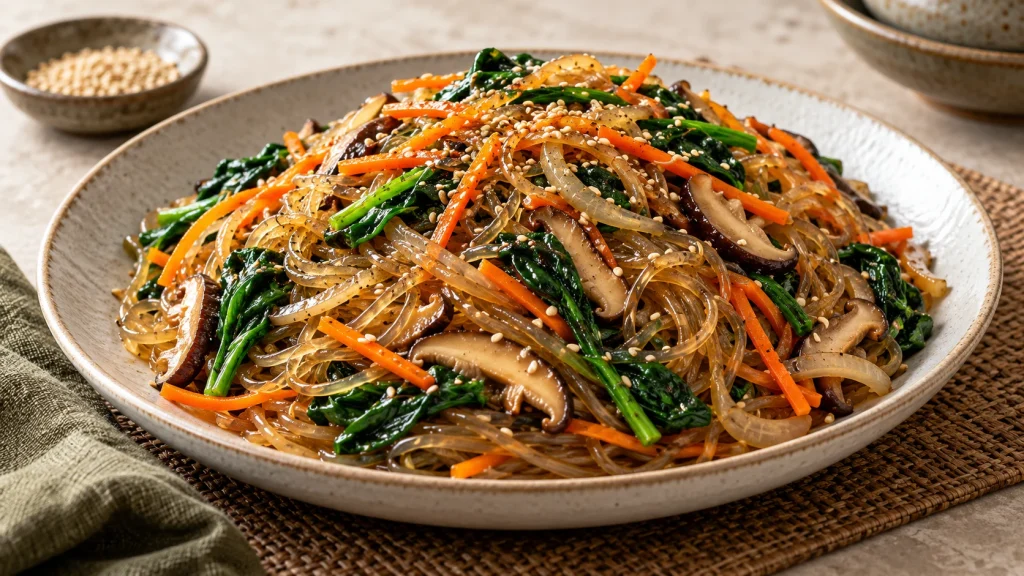
Allow about 45 minutes overall. Ingredient thickness, pan size and stove output affect cooking ranges; use the safety and texture checks. One tablespoon = 15 ml; one teaspoon = 5 ml.
About Japchae
This japchae is a vegetable-and-mushroom version with no meat or egg. Sweet-potato starch noodles give the translucent elastic texture; wheat vermicelli or ordinary pasta does not behave the same way. The vegetables are cooked in separate batches to retain their individual texture, then combined with seasoned noodles. A little sweetness is intentional, but the sauce should be absorbed and glossy rather than pooling at the bottom of a serving bowl.
Personally cooked and tested by Zohair Fakhar for DailyLife.pk. Cooking times can vary with your stove, cookware and batch size; follow the texture and doneness cues in the method.
Make it work for your kitchen
Original quantities serve 4. Cooking times, pan size and frying-oil depth do not scale, cook in extra batches instead.
Before you start
Set up before heating
Use Korean dangmyeon sweet-potato noodles and fresh sliced mushrooms. Set a large bowl nearby so the separate batches can be combined without crowding the pan. Cookware: 32 cm heavy wok for final noodle and vegetable toss.
PreparationSet up the equipment
Have the following tools ready before starting: Digital scale; Measuring jug; Chef knife; Separate raw-protein and ready-to-eat boards; Instant-read food thermometer; 32 cm heavy wok for final noodle and vegetable toss; Heatproof spatula; Small sauce bowl; 4 litre noodle-boiling pot; Colander or large fine sieve; Clean kitchen scissors.
Clean workspaceMeasure the ingredients
Measure the ingredient quantities for your selected servings before applying heat. Keep separately listed groups, such as dough, filling, sauce or garnish, in separate containers; keep any optional additions separate.
Use the ingredient list aboveCheck allergens and substitutions
Check ingredient labels and any substitutions against these notes: Soy; many soy sauces also contain wheat; Sesame. Check actual product labels and cross-contact.
Before cooking
Step-by-step cooking method
1 Cook noodles
Boil noodles in the measured water for their packet time, usually 6–8 minutes, until flexible with no hard centre.
2 Cook noodles (continued)
Drain, rinse briefly with cool potable water if the packet recommends it, drain well and cut long strands once or twice with clean scissors.
3 Mix seasoning
Whisk soy sauce, sugar, sesame oil, garlic and pepper until sugar is mostly dissolved.
4 Mix seasoning (continued)
Toss half through drained noodles.
5 Cook vegetables
Use neutral oil across separate batches: onion 3 minutes, carrots 3–4, mushrooms 5–6 and spinach 1–2.
6 Cook vegetables (continued)
Let mushroom liquid evaporate; drain excess spinach moisture. Transfer to a broad bowl.
7 Combine
Return noodles to the pan with remaining seasoning and toss 2–3 minutes until hot and glossy.
8 Combine (continued)
Add vegetables and toss another minute without crushing them. Scatter sesame and serve warm.
Chef’s tips
- Cook vegetables separately and drain noodles well before combining.
- Have sauce measured and vegetables cut before the high-heat stage; do not stop mid-fry to chop the remaining ingredients.
Common mistakes & quick fixes
- Watery noodles
- Mushrooms or spinach carried excess liquid; evaporate or drain before mixing.
- Noodles stick in one rope
- Separate while warm and coat with half the seasoning promptly.
- Mushy noodles
- Follow the actual noodle packet rather than an assumed universal time.
Variations & serving ideas
Ingredient boundary: It is best warm or freshly cooled; refrigerate promptly rather than holding at room temperature for a long buffet.
Perfect result check
| Main texture | Elastic translucent strands are lightly glossy, with distinct vegetables and no puddle of sauce. |
|---|---|
| Sauce | The sauce should season the named main ingredient without leaving an unintended watery puddle; use the specific reduction cue above. |
Storage & reheating
| Shallow covered portions in the refrigerator | Use within 48 hours | Cool promptly and keep at 4°C or colder. Reheat only once until steaming throughout; poultry or mixed leftovers should reach 74°C. Keep crisp coatings and fresh garnishes separate where possible. |
|---|
Know when to change the heat
| Stage | Heat | What to look for |
|---|---|---|
| Cook noodles | Boiling | 6–8 minutes |
| Cook vegetables | Medium-high heat | 15 minutes |
| Combine | Medium heat | 3–4 minutes |
Helpful answers before you cook
Is this vegan?
It contains no animal ingredients as written, but check soy sauce and noodle labels.
Can I use rice vermicelli?
That makes a different noodle dish; it lacks the defining elastic sweet-potato texture.
Can I serve it cold?
It is best warm or freshly cooled; refrigerate promptly rather than holding at room temperature for a long buffet.


