
Chicken Doner
Compress marinated thighs into a small roast and shave after cooking
Oven chicken döner with cabbage and garlic yogurt
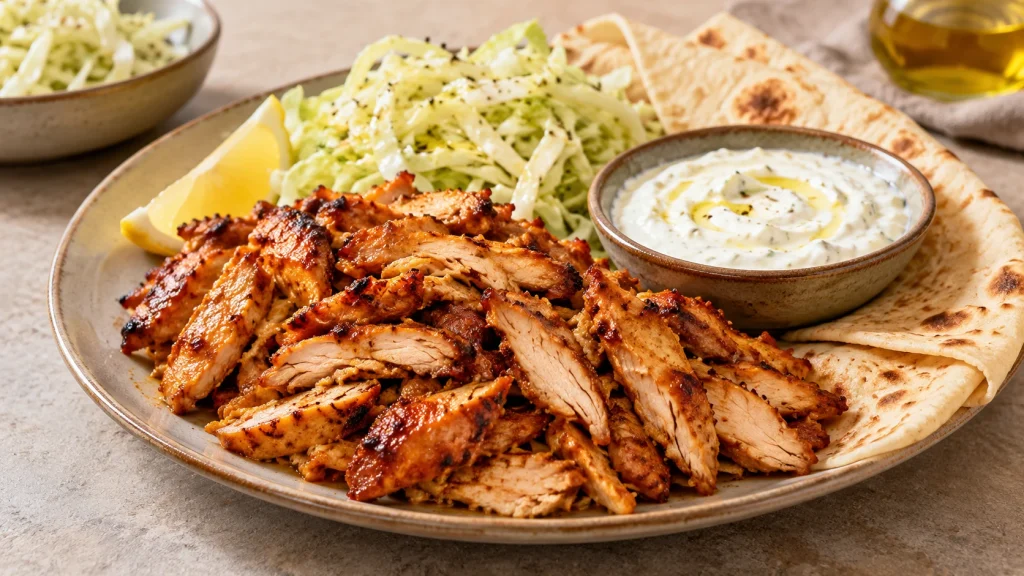
Includes 2 hours refrigerated marinating, 60–75 minutes oven cooking, 10 minutes resting and 5 minutes crisping. A deeper stack can take longer; use temperature, not the clock. One tablespoon = 15 ml; one teaspoon = 5 ml.
About Chicken Doner
Chicken döner normally cooks on a rotating vertical spit. This adaptation presses marinated boneless thighs into a small loaf tin, cooks the centre completely, then slices and browns the meat in a skillet. It produces layered chicken with crisp edges but is not represented as commercial spit-roasted döner. A thermometer is especially important because the inside of a compact stack heats much more slowly than individual chicken pieces.
Personally cooked and tested by Zohair Fakhar for DailyLife.pk. Cooking times can vary with your stove, cookware and batch size; follow the texture and doneness cues in the method.
Make it work for your kitchen
Original quantities serve 4. Cooking times, pan size and frying-oil depth do not scale, cook in extra batches instead.
Before you start
Match the tin
Use the specified narrow tin and keep the raw meat stack approximately 6–7 cm deep. A taller stack requires a longer cooking time and extra thermometer checks. Do not double the batch in the same tin.
EquipmentUnfold and trim
Open each thigh flat and remove loose pieces of fat. The layers should overlap without being rolled into tight tubes.
PreparationSet up the equipment
Have the following tools ready before starting: 20 × 10 cm loaf tin; Rimmed baking tray; Heavy skillet; Food thermometer; Foil; Sharp carving knife.
Clean workspaceMeasure the ingredients
Measure the ingredient quantities for your selected servings before applying heat. Keep separately listed groups, such as dough, filling, sauce or garnish, in separate containers; keep any optional additions separate.
Use the ingredient list above
Step-by-step cooking method
1 Marinate
Mix yogurt, olive oil, tomato paste, garlic, cumin, paprika, oregano, pepper and salt. Coat each thigh and refrigerate covered for 2–12 hours. Keep the sauce ingredients separate.
2 Build the roast
Heat oven to 200°C conventional. Rub 3 ml of finishing oil over the tin.
3 Build the roast (continued)
Layer thighs across its width, alternating thick and thin ends, and press down gently. Do not add a pool of leftover marinade. Set the tin on a rimmed tray and cover loosely with foil.
4 Cook through
Roast covered for 35 minutes, uncover and continue 25–40 minutes. Insert a clean thermometer into the centre from two angles and check several locations reach 74°C.
5 Cook through (continued)
If the top browns early, replace the foil. Drain excess liquid carefully only after the chicken is fully cooked.
6 Prepare the cold sides
Mix serving yogurt with garlic, 15 ml lemon and 1 g salt. Toss cabbage with the other 15 ml lemon, olive oil and remaining 1 g salt. Refrigerate both until serving. Warm the breads according to their packet instructions when the meat is nearly ready.
7 Rest, shave and brown
Rest the meat 10 minutes on a clean board. Hold the layered roast together with tongs and cut across it into strips about 5 mm thick; some layers will separate.
8 Rest, shave and brown (continued)
Heat the remaining 7 ml oil in a large skillet and crisp the slices in two batches for 1–2 minutes per batch. Serve immediately with cabbage, sauce and bread.
Chef’s tips
- A clean probe must reach the central layers, not merely a hot pocket of liquid beside the tin.
- Use a serrated knife with light strokes if the layers slide apart; the serving texture matters more than perfectly uniform slices.
Common mistakes & quick fixes
- Top is dark but centre is underdone
- Cover again and continue roasting. Surface browning cannot establish the safety of stacked poultry.
- Meat is steaming in the skillet
- Drain it well and work in smaller batches; use a short hot finish rather than boiling all the meat together.
Variations & serving ideas
Open plate: Serve the meat and cabbage without bread and spoon yogurt alongside; the cooking method stays the same.
More pepper: Replace 2 g sweet paprika with 2 g pul biber for a warmer Turkish-style seasoning.
Perfect result check
| Centre | Several central readings reach 74°C. |
|---|---|
| Slices | Layered tender chicken with a few crisp edges, not dry crumbs. |
Storage & reheating
| Refrigerate | Up to 48 hours | Separate leftover meat into shallow portions and chill within 1–2 hours; keep sauce and cabbage separate. |
|---|---|---|
| Reheat | Once | Heat meat until steaming throughout; add to freshly warmed bread. |
Know when to change the heat
| Stage | Heat | What to look for |
|---|---|---|
| Roast | 200°C conventional | Covered cooking heats the core; uncovered cooking colors the surface. |
| Crisp | Medium-high heat | Edges sizzle and brown in a short finish. |
Helpful answers before you cook
Can I use a vertical skewer in the oven?
That changes the geometry and stability of the roast. This method is developed around a supported narrow loaf tin, so its times should not be transferred to an improvised tower.
Can I use chicken breast?
Thighs tolerate the long central heating better. Breast is likely to dry at the outer layers before the middle is ready; use a separate single-layer breast preparation instead.
Can the cooked loaf be eaten without crisping?
Yes, provided every central part reached 74°C. The skillet step adds browned edges; it is not intended to complete the cooking of an unsafe centre.


