Buckwheat Bread
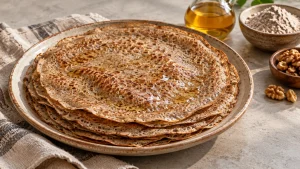
A supple buckwheat flatbread with a minority of wholewheat flour for easier handling
A supple buckwheat flatbread with a minority of wholewheat flour for easier handling. It is a modern home formulation under the broad catalogue name, not a certified gluten-free or uniquely regional bread.

Plan about 66 minutes including 20 minutes preparation, 26 minutes cooking and 20 minutes of separate resting or chilling. Cooking times are ranges: ingredient thickness, pan width and burner strength alter the endpoint. Preparation is counted separately rather than assuming every task overlaps. One tablespoon = 15 ml; one teaspoon = 5 ml.
About Buckwheat Bread
A supple buckwheat flatbread with a minority of wholewheat flour for easier handling. It is a modern home formulation under the broad catalogue name, not a certified gluten-free or uniquely regional bread.
If rolling causes edge cracks, give the dough another 5 minutes to hydrate and use parchment rather than adding handfuls of dry flour.
Personally cooked and tested by Zohair Fakhar for DailyLife.pk. Cooking times can vary with your stove, cookware and batch size; follow the texture and doneness cues in the method.
Make it work for your kitchen
Original quantities serve 6. Cooking times, pan size and frying-oil depth do not scale, cook in extra batches instead.
Before you start
Prepare the batch
Prepare the ingredient cuts listed below and complete the first method stage before moving on. Mix both flours and salt.
Mise en placeControl liquid and salt
Keep each separately labelled liquid quantity distinct: dough water, cooking liquid, soaking water and top-up allowances serve different purposes. Do not add an allowance automatically.
Batch controlSet up the equipment
Have the following tools ready before starting: Kitchen scale and measuring jug; Mixing bowl and rolling pin; Heavy griddle or lined oven tray as specified; Broad spatula and cooling rack.
Clean workspaceMeasure the ingredients
Measure the ingredient quantities for your selected servings before applying heat. Keep separately listed groups, such as dough, filling, sauce or garnish, in separate containers; keep any optional additions separate.
Use the ingredient list above
Step-by-step cooking method
1 Make dough
Mix both flours and salt.
2 Make dough (continued)
Add warm water and oil and stir thoroughly. Rest 20 minutes, then knead gently until cohesive; add allowance a teaspoon at a time if the dough cracks when flattened.
3 Shape
Divide into six pieces.
4 Shape (continued)
Roll between parchment sheets using a little of the rolling allowance to make 16 cm rounds about 3 mm thick.
5 Shape (continued)
Peel carefully; buckwheat dough is more fragile than wheat chapati dough.
6 Cook
Heat a heavy griddle to medium. Cook each bread 2 minutes until its top sets, turn and cook another 1.5–2 minutes.
7 Cook (continued)
Press thick areas lightly. A cooked bread has dry-looking surfaces and brown speckles, with no sticky centre.
8 Hold briefly
Stack under a clean cloth and serve warm. Rewarm briefly on a dry griddle if needed; prolonged uncovered heating makes buckwheat bread brittle.
Chef’s tips
- If rolling causes edge cracks, give the dough another 5 minutes to hydrate and use parchment rather than adding handfuls of dry flour.
Common mistakes & quick fixes
- Surface burns while centre is raw.
- Lower heat and keep the stated thickness. Break the first piece to assess the centre before cooking the remaining batch.
- Dough cracks during shaping.
- Keep unused portions covered and honour the hydration rest. Add only the specified allowance in small increments if needed.
Variations & serving ideas
Chosen version: A supple buckwheat flatbread with a minority of wholewheat flour for easier handling. It is a modern home formulation under the broad catalogue name, not a certified gluten-free or uniquely regional bread.
Seasoning adjustment: Keep the main ingredient and technique unchanged when adjusting chilli or finishing herbs. Substitute packaged sauces only after checking salt content and allergens.
Perfect result check
| Main ingredient | Heat a heavy griddle to medium. Cook each bread 2 minutes until its top sets, turn and cook another 1.5–2 minutes. Press thick areas lightly. A cooked bread has dry-looking surfaces and brown speckles, with no sticky centre. |
|---|---|
| Finished batch | Stack under a clean cloth and serve warm. Rewarm briefly on a dry griddle if needed; prolonged uncovered heating makes buckwheat bread brittle. |
Storage & reheating
| Covered and chilled | Refrigerate within 2 hours; use within 48 hours | Divide into shallow portions for rapid cooling and refrigerate within 2 hours. Reheat once until steaming hot throughout; stir soups to eliminate cool pockets. |
|---|---|---|
| Freeze if suitable | Best quality within one month | Freeze in labelled meal portions after prompt cooling. Defrost in the refrigerator and reheat thoroughly once. |
Know when to change the heat
| Stage | Heat | What to look for |
|---|---|---|
| Make dough | No heat | Mix both flours and salt. |
| Shape | No heat | Divide into six pieces. |
| Cook | Medium heat | Heat a heavy griddle to medium. |
| Hold briefly | No heat | Stack under a clean cloth and serve warm. |
Helpful answers before you cook
Is this gluten-free?
No. The formula deliberately includes wholewheat flour for handling, despite the buckwheat majority.
Why use parchment for rolling?
Buckwheat-rich dough is fragile; parchment supports it without excessive dry flour.
Why does bread become brittle?
Overcooking and uncovered cooling remove too much moisture. Serve warm and keep supple breads covered.