Shurukut
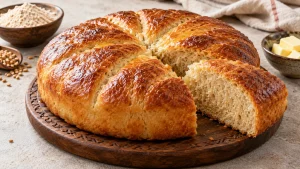
Walnut-filled yeast bread baked in a home oven
This home-oven recipe encloses finely chopped walnuts in a soft yeast dough made with plain flour, water and oil. The dough rises before shaping and proofs again on the baking trays; a thin coating of the reserved oil finishes the tops before baking.

Plan roughly 190 minutes for the original eight-person batch. This allowance combines about 35 minutes active preparation, up to 90 minutes for the first rise, about 30 minutes for the shaped-bread proof, 25 minutes baking and ten minutes cooling before cutting. The kneading and walnut-preparation stages are part of active preparation; do not add each complete stage total again. These are approximate planning allowances, not measured guarantees. Follow dough expansion and the cooked seam and centre checks; a cooler room, more shaping work or extra oven batches can lengthen the schedule. One tablespoon = 15 ml; one teaspoon = 5 ml.
About Shurukut
A clearly labelled domestic-oven interpretation of Shurukut ulak, identified as a Kalash walnut-stuffed bread. The catalogue shortens the name to Shurukut; the filling is plain chopped walnut, and no ceremonial history is asserted.
Seal carefully and keep walnuts away from the gathered edge. A walnut caught in the seam can create a leak while the dough expands.
Personally cooked and tested by Zohair Fakhar for DailyLife.pk. Cooking times can vary with your stove, cookware and batch size; follow the texture and doneness cues in the method.
Make it work for your kitchen
Also known as Shurukut ulak, Shurukut’ulak, Walnut Bread.
Original quantities serve 8. Cooking times, pan size and frying-oil depth do not scale, cook in extra batches instead.
Before you start
Prepare the batch
Measure the selected flour, instant yeast, salt and sugar before mixing. Inspect the walnuts for shell fragments, then chop them into small pieces without making an oily paste. Keep the walnuts separate from the dough ingredients until the filling stage.
Mise en placeControl liquid and salt
Keep the initial dough water and the separate extra-water allowance in different containers. Keep the amount listed for dough oil separate from the filling-and-surface quantity. Split the selected filling-and-surface quantity into two portions: two thirds for mixing with the chopped walnuts and one third reserved for brushing the tops. Both portions come from that single listed quantity; neither is extra.
Batch controlSet up the equipment
Have these tools ready: Kitchen scale and measuring jug; Mixing bowl with a clean cover; Separate containers for the dough liquids and reserved filling/surface portions; Knife and board for inspecting and chopping walnuts; Rolling pin and dough scraper; Lined baking trays sized to the selected batch; Pastry brush and fork or skewer for the tops; Domestic oven, oven gloves and cooling rack. Keep the bowl and shaped breads covered during their rises, and remove any cloth or other non-ovenproof cover before baking.
Clean workspaceMeasure the ingredients
Measure all ingredients for your selected servings. Keep the dough oil separate from the filling-and-surface quantity, divide the latter as described above, and keep the extra-water and rolling-flour allowances separate. The rolling-flour allowance is shared across the whole batch.
Use the ingredient list above
Step-by-step cooking method
1 Knead dough
Mix the main flour, instant yeast, salt and sugar measured for your selected servings. Add the selected initial dough water and the separately measured amount listed for dough oil, then knead for 8–10 minutes until smooth and elastic.
2 Knead dough (continued)
If the dough is stiff, add small amounts from the selected extra-water allowance, keeping the whole batch within that single allowance. Do not add it automatically or start a fresh allowance for each bread. Cover and let rise in a comfortably warm place for 60–90 minutes until expanded.
3 Prepare walnuts
Inspect the selected walnuts for shell fragments and chop finely enough not to puncture the dough. Just before shaping, mix them with the two-thirds portion set aside for the filling. Keep the remaining one-third portion for brushing the bread tops; do not grind the nuts into butter.
4 Fill breads
Make one bread for every two people selected: one for two people, two for four, three for six or four for eight. Divide the dough and the selected walnut filling into that same number of equal portions. Each finished bread gives two serving wedges.
5 Fill breads (continued)
Use the selected rolling-flour allowance sparingly across all the breads. Roll each dough ball to 16 cm, place one matching filling portion in the centre and gather the edges firmly, keeping walnut pieces away from the seam. Turn seam-down and flatten gently to about 18 cm and 1.5 cm thick. Do not use a fresh full rolling-flour allowance for each bread.
6 Proof and bake
Place on lined trays with space between. Cover and proof 25–35 minutes while oven heats to 200°C conventional or 180°C fan.
7 Proof and bake (continued)
Brush the tops using only the reserved one-third portion set aside for the surface, sharing it across all the breads, then prick lightly. Bake for 20–25 minutes until golden and the dough at a thick seam is set; check the first bread for raw flour pockets.
8 Cool briefly
Cool on a rack 10 minutes before cutting into wedges. A baked walnut filling remains textured; it should not be a wet sweet paste. Serve warm.
Chef’s tips
- Seal carefully and keep walnuts away from the gathered edge. A walnut caught in the seam can create a leak while the dough expands.
Common mistakes & quick fixes
- Is Shurukut the full local name?
- The identity reference uses Shurukut ulak or Shurukut’ulak. This draft preserves the shorter catalogue title and records the fuller name as an alias.
- Is this a verified traditional oven method?
- No. Walnut-stuffed bread identity is referenced, but this is an explicit independent domestic-oven formulation needing Kalash culinary review.
Variations & serving ideas
Chosen version: A clearly labelled domestic-oven interpretation of Shurukut ulak, identified as a Kalash walnut-stuffed bread. The catalogue shortens the name to Shurukut; the filling is plain chopped walnut, and no ceremonial history is asserted.
Seasoning adjustment: Keep the main ingredient and technique unchanged when adjusting chilli or finishing herbs. Substitute packaged sauces only after checking salt content and allergens.
Perfect result check
| Main ingredient | The shaped breads should have room to expand on their lined trays. Bake at the stated oven setting until golden and the dough at a thick seam is set. Cut the first bread after its brief cooling period to check for raw dough or flour pockets; surface colour alone does not confirm the centre is cooked. |
|---|---|
| Finished batch | Cool on a rack 10 minutes before cutting into wedges. A baked walnut filling remains textured; it should not be a wet sweet paste. Serve warm. |
Storage & reheating
| Cool in portions, then refrigerate | Refrigerate within 2 hours; use within 48 hours | For later use, cool the baked breads promptly in meal portions, then pack in a clean covered container and refrigerate within two hours at 0–5°C. Use within 48 hours or freeze promptly. Reheat only the portion needed, once, until steaming hot throughout, including the centre of the walnut-filled bread. |
|---|---|---|
| Freeze cooled walnut-filled bread portions | Use within 24 hours after fully defrosting | Cool promptly, then freeze in sealed, labelled meal portions. Defrost fully in the fridge and use within 24 hours. Reheat once until steaming hot throughout, checking the centre as well as the crust. Freezing and reheating can change the crumb and filling texture. |
Know when to change the heat
| Stage | Heat | What to look for |
|---|---|---|
| Knead dough | No heat | Mix main flour, yeast, salt and sugar. |
| Prepare walnuts | No heat | Inspect nuts for shell fragments and chop finely enough not to puncture dough. |
| Fill breads | No heat | Make one bread for every two people selected: one for two people, two for four, three for six or four for eight. Divide the dough and the selected walnut filling into that same number of equal portions. Each finished bread gives two serving wedges. |
| Proof and bake | 200°C conventional / 180°C fan | Leave space between the shaped breads on their lined trays and let them proof covered while the oven preheats separately. Remove the cover before baking. Use 200°C conventional or 180°C fan for baking; check the thick seam and centre as directed in the method. |
| Cool briefly | No heat | Cool on a rack 10 minutes before cutting into wedges. |
Helpful answers before you cook
Is Shurukut the full local name?
Pakistan Atlas uses the fuller name Shurukut ulak for a walnut-filled bread. This page keeps Shurukut as its short title and lists the fuller name among its aliases. The detailed dough and oven method here belong to this home version.
Is this a verified traditional oven method?
This page gives an independent recipe for a domestic oven using commercial instant yeast. Its measured dough, proofing schedule and oven settings belong to this home version; a cultural name or identity reference does not by itself establish those details as a traditional method.
Why finely chop rather than grind walnuts?
Inspect the walnuts for shell fragments, then chop into small pieces that spread evenly in the filling. Keep them away from the gathered seam so they do not tear the dough. Stop before the nuts become an oily paste; that changes the stated chopped-walnut filling.