
Keema Kaleji
Cook loose mince before its defining addition
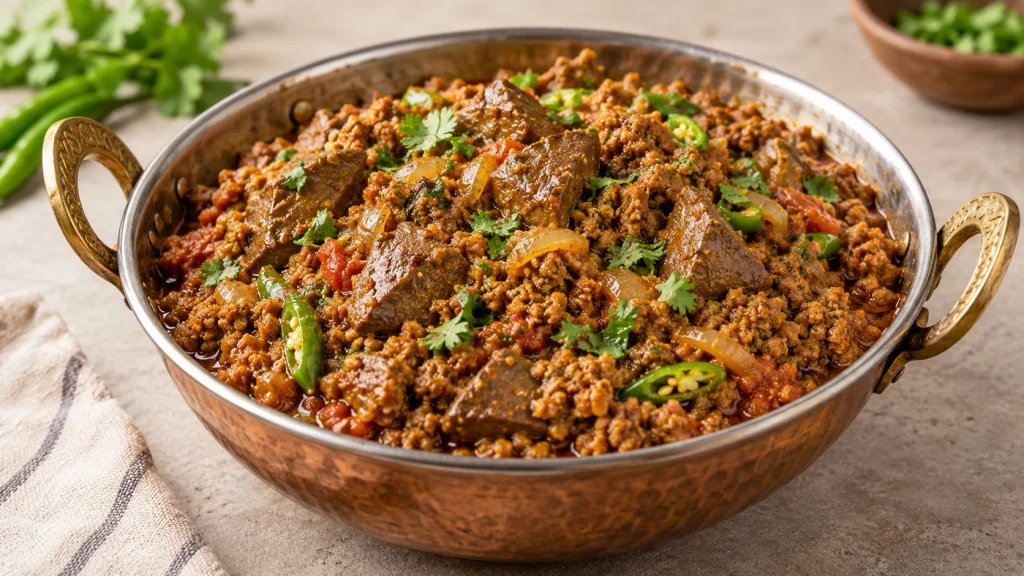
Beef mince and trimmed lamb-liver cubes cook in an onion-tomato masala, with the liver added after the mince base and fresh herbs added at the finish.
Allow 20 minutes preparation, approximately 40 minutes cooking and 3 minutes nonoverlapping waiting. Use thawed chilled mince and chop the onion finely so it integrates with the small meat granules. A 28 cm pan lets moisture escape without needing excessive oil. Cooking ranges are guides: retain the stated doneness checks when your pan, meat age or portion thickness changes. One tablespoon = 15 ml; one teaspoon = 5 ml.
About Keema Kaleji
Keema kaleji combines well-cooked beef mince with small lamb-liver cubes added near the end. The two meats need different handling: mince benefits from a developed tomato base, while liver quickly becomes tough if simmered for the same time. A thermometer endpoint, rather than a pink-centre preference, governs the organ meat in this home formulation.
Personally cooked and tested by Zohair Fakhar for DailyLife.pk. Cooking times can vary with your stove, cookware and batch size; follow the texture and doneness cues in the method.
Make it work for your kitchen
Original quantities serve 4. Cooking times, pan size and frying-oil depth do not scale, cook in extra batches instead.
Before you start
Prepare the batch
Use thawed chilled mince and chop the onion finely so it integrates with the small meat granules. A 28 cm pan lets moisture escape without needing excessive oil.
Cut and portion before heatingKeep the work area ready
Measure the centre of the thickest piece, avoiding bone. Set aside a clean serving dish and clean utensils before handling raw protein. Do not return cooked food to the unwashed raw-food plate. Measure spices separately so they can enter the pan at the intended stage rather than burning while you find the next jar.
Food handlingSet up the equipment
Have the following tools ready before starting: Digital kitchen scale; Measuring jug and 5 ml / 15 ml spoons; Sharp knife and separate raw-protein board; Heavy pan sized for the stated batch; Instant-read food thermometer.
Clean workspaceMeasure the ingredients
Measure the ingredient quantities for your selected servings before applying heat. Keep separately listed groups, such as dough, filling, sauce or garnish, in separate containers; keep any optional additions separate.
Use the ingredient list above
Step-by-step cooking method
1 Prepare a fine base
Heat oil in a wide heavy pan. Add cumin for 20 seconds, then onion and cook 8–10 minutes until golden at the edges. Add ginger and garlic and stir for 1 minute. Do not deeply darken the onion: the finely divided meat exposes more surface to the masala, so burnt flecks would be noticeable throughout.
2 Break up the mince
Add beef in two additions and press apart with a flat spatula for 5–7 minutes. Aim for small loose granules, not a smooth paste. Wait until the first addition loses its raw colour before adding the second. Keep the heat high enough that released moisture bubbles away rather than stewing a solid block.
3 Cook the tomatoes
Add tomatoes, coriander, turmeric, chilli and salt. Cook 6–8 minutes, scraping the bottom until tomato pieces collapse.
4 Cook the tomatoes (continued)
Add 100 ml water and bring to a gentle simmer. The beef must reach at least 71°C; colour alone is unreliable. Use a clean thermometer in a compact spoonful of mince, avoiding the pan surface.
5 Add the prepared liver late
After the beef base has simmered, spread the trimmed liver cubes over it and fold gently. Cover and cook 6–9 minutes at a steady simmer, turning once; use a 25 ml top-up if necessary.
6 Add the prepared liver late (continued)
Check a largest liver cube reaches at least 71°C. Remove from heat promptly at that endpoint rather than continuing until the liver becomes hard.
7 Finish deliberately
Add garam masala and green chillies during the final 2 minutes, then scatter fresh coriander off heat. Let stand for 3 minutes.
8 Finish deliberately (continued)
The finished texture should match the named addition and have no pool of watery tomato liquid, while the mince remains moist rather than crisp and desiccated. Serve from a clean dish with roti.
Chef’s tips
- Use thawed chilled mince and chop the onion finely so it integrates with the small meat granules. A 28 cm pan lets moisture escape without needing excessive oil.
- For a gentler chilli level use 1 g red chilli and deseed the measured green chillies; the main vegetable or organ addition should remain unchanged.
- A 5 ml teaspoon and 15 ml tablespoon are used throughout. Weigh salt where possible because crystal sizes vary. Add any top-up water in the listed small increments and stop once the required texture is reached.
Common mistakes & quick fixes
- Mince forms rubbery lumps
- Break clumps apart early with the edge of a flat spatula; once a dense lump sets, it is harder to separate without overworking the finished meat.
- Uneven finish between pieces
- Sort by thickness before cooking and check the largest piece separately. Move smaller finished pieces to a clean warm dish while thicker ones finish; do not assume colour alone proves that the centre is cooked.
Variations & serving ideas
A practical adjustment: For a gentler chilli level use 1 g red chilli and deseed the measured green chillies; the main vegetable or organ addition should remain unchanged.
Perfect result check
| Texture and structure | Break clumps apart early with the edge of a flat spatula; once a dense lump sets, it is harder to separate without overworking the finished meat. |
|---|---|
| Final seasoning | Taste only after the protein is fully cooked. The named principal ingredient should remain distinct, with no scorched spice bitterness or raw garlic edge. |
Storage & reheating
| Refrigerate | Within 2 hours; use within 48 hours | Divide into shallow portions promptly; refrigerate at 5°C or colder. Do not leave a deep cooking pot on the counter to cool. |
|---|---|---|
| Freeze | Up to 2 months for quality | Pack cooled portions airtight, label and freeze. Thaw in the refrigerator. Reheat one portion once to 74°C throughout; add a small measured splash of water only where a sauce needs loosening. |
Know when to change the heat
| Stage | Heat | What to look for |
|---|---|---|
| Cook the tomato-mince base | Medium to medium-high, then gentle simmer | Mince separates into granules and tomatoes collapse; check the mince with a food thermometer before the liver stage. |
| Add liver and finish | Medium-low simmer, then off heat | Turn liver cubes gently and check the centre of a largest cube with a thermometer; finish promptly once the stated endpoint is reached. |
Helpful answers before you cook
Should liver be soaked in milk?
It is unnecessary for this formulation and does not make liver safe. Buy fresh inspected liver, trim ducts and membrane, keep chilled and cook thoroughly.
Can lamb mince replace beef?
Yes, use the same weight and similar fat percentage. Skim excess rendered fat if necessary, but keep enough moisture that the small meat granules do not dry out.
Can this be doubled?
Brown mince in two pans or successive batches. Doubling the depth traps steam and changes the cooking rate; combine only after the meat and tomato base are cooked.


