
Heritage trail
Colonial Heritage: RailwaysBridges and Buildings of the Raj
A guide to the buildings and engineering of British rule that still shape Pakistan's cities: Karachi's Frere Hall and Empress Market, Lahore's station and museum, the Lansdowne Bridge at Sukkur and the colleges of Peshawar.
- Karachi, Lahore, Sukkur, Peshawar
- Mostly 1860s to 1910s
- Many buildings still in public use
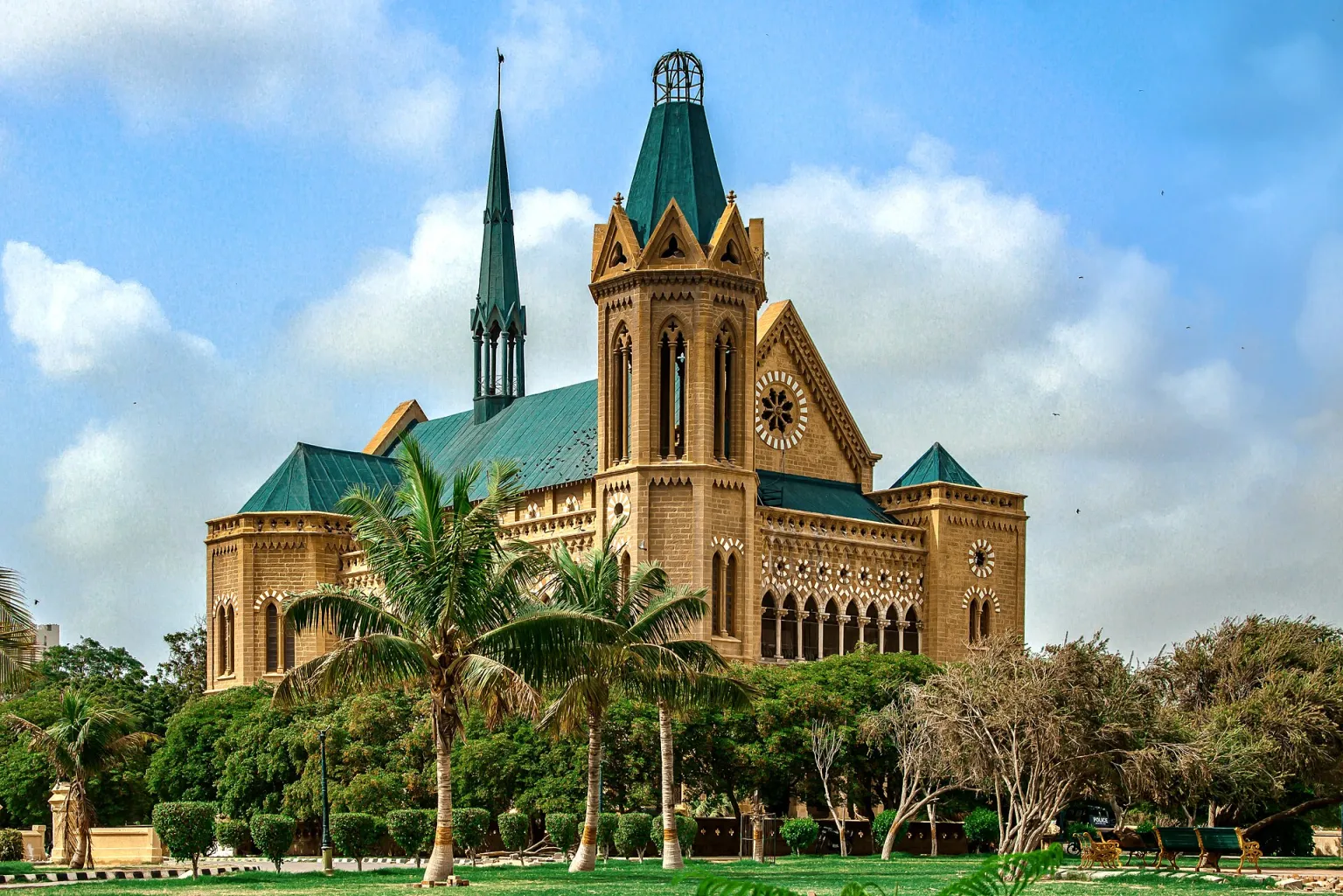
Frere Hall, Karachi
About colonial heritage
British rule left the territory that is now Pakistan with railways, canals, courts, colleges, museums and municipal halls, designed in styles ranging from Venetian Gothic to what architects call Indo-Saracenic, a mix of European planning and Mughal and local motifs. Many are still in daily use as courts, universities, libraries and markets, which is what makes them interesting to visit: they are working parts of the city rather than frozen monuments.
This page looks at the buildings and engineering. For the political and social history of the period, including the annexations of Sindh in 1843 and the Punjab in 1849, the canal colonies and the arguments about the legacy, read the British colonial era topic page. Historians continue to debate the period, and these structures were built mainly to serve imperial revenue and security.
Courts, cantonments, railway installations and government buildings may restrict entry and photography. Confirm opening and access locally.
Karachi
 Frere HallBuilt between August 1863 and 10 October 1865 in Venetian Gothic style, designed by Henry Saint Clair Wilkins. It later became a library, renamed the Liaquat National Library after independence, and is administered by the Karachi Municipal Corporation.
 Empress MarketConstructed from 1884 to 1889 to a design by James Strachan, in Indo-Gothic style, with a clock tower. It remains one of Karachi's busiest markets.
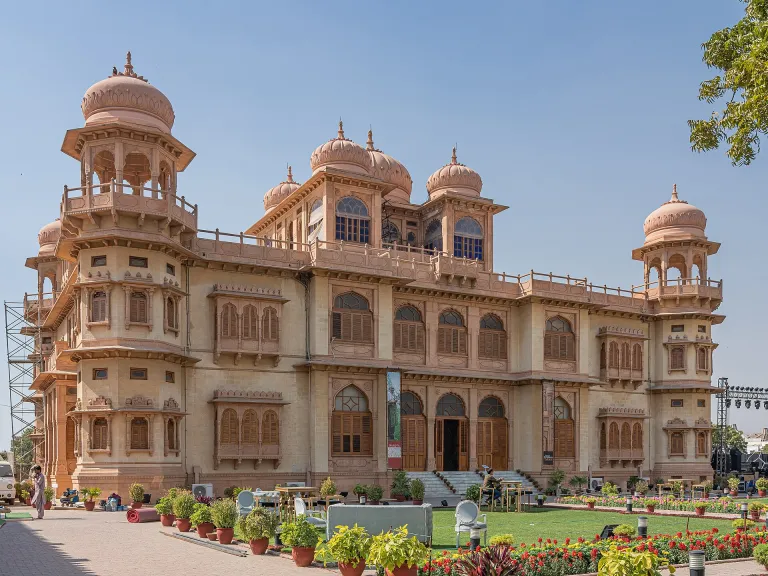 Mohatta PalaceA pink-stone palace in Clifton, now a museum; see the page for details.
Lahore
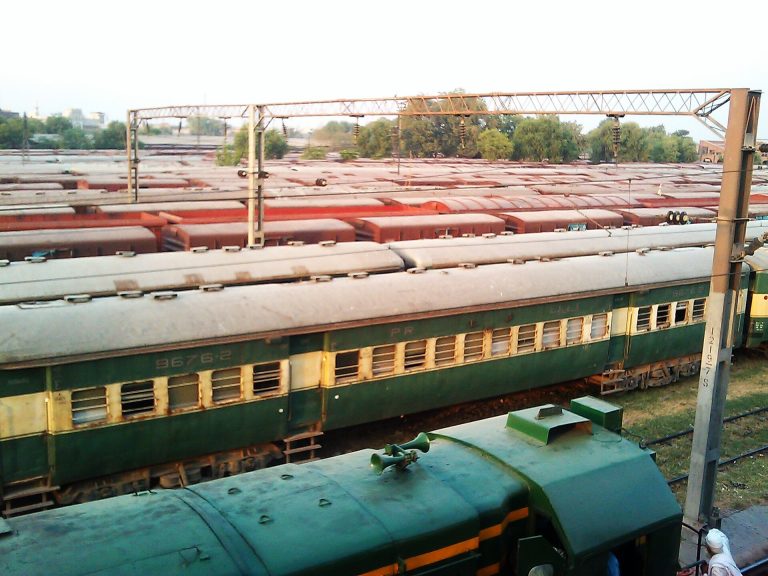 Lahore Junction stationBuilt around 1859 to 1860, in the style of a medieval fort with thick walls, turrets and loopholes, a reaction to the uprising of 1857, according to William Glover's history of colonial Lahore.
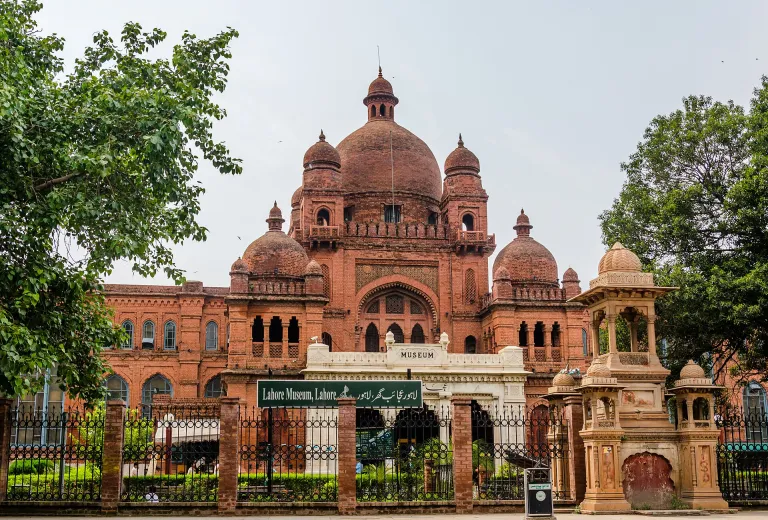 Lahore MuseumThe museum describes itself as opening to the public in 1894 in a red-brick Indo-Saracenic building. Its galleries range from Gandhara to Sikh and Pakistan Movement collections.
 Lahore High CourtA red-brick landmark on the Mall, often cited as an example of Lahore's hybrid Indo-Saracenic style. See the British colonial era page for context.
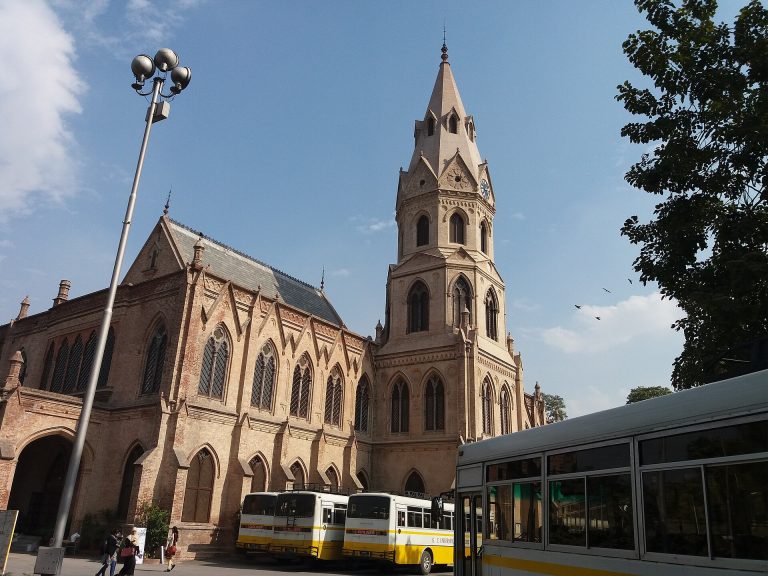 Government College UniversityA Gothic Revival campus with a tall clock tower, founded in 1864.
Peshawar and the frontier
 Peshawar MuseumThe main hall was built in 1906 to 1907 in memory of Queen Victoria, at a cost of Rs 60,000, and the museum opened in November 1907. The two-storey building blends British and Mughal styles.
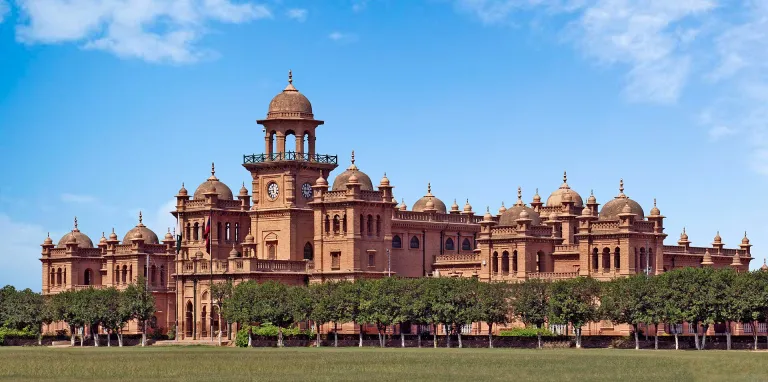 Islamia CollegeFounded in 1913 by Sahibzada Abdul Qayyum and Sir George Roos-Keppel, according to Wikipedia. The red-brick main building is a landmark on the university campus.
 Edwardes CollegeFounded as Church Mission College in 1900 by the Church Missionary Society; its first major building, the Old Hall of 1910, is in Mughal style, according to Wikipedia.
 Cunningham Clock TowerA brick clock tower, a landmark of colonial Peshawar.
Bridges, barrages and rails
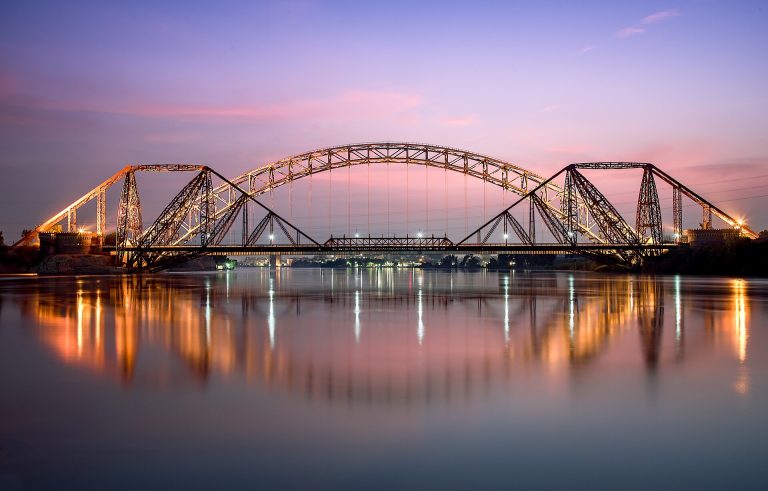 Lansdowne Bridge, SukkurDesigned by Sir Alexander Meadows Rendel as two 310 ft cantilevers carrying a 200 ft suspended span. It opened on 25 March 1889 and, on completion, was the longest rigid girder bridge span in the world. Rail traffic moved to the neighbouring Ayub Bridge in 1962.
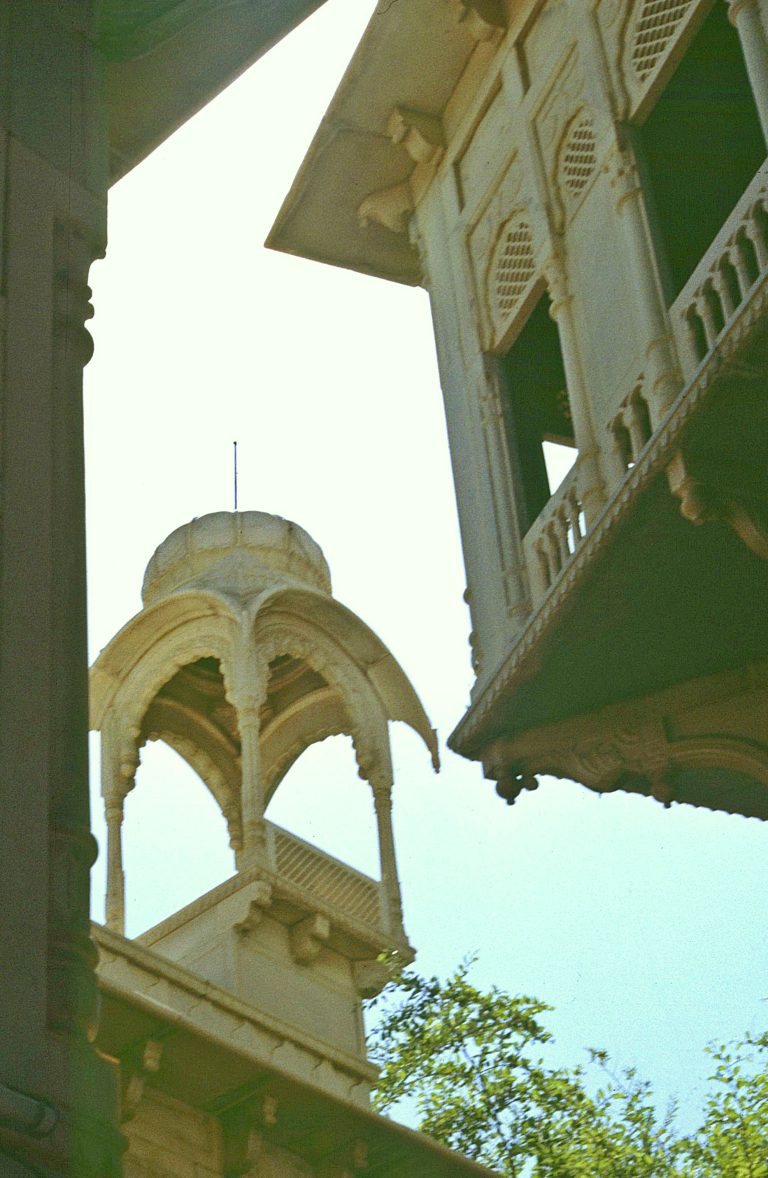 Sukkur BarrageA large irrigation barrage across the Indus, opened in 1932 as the Lloyd Barrage; see the page for its history.
 Quaid-e-Azam Residency, ZiaratA wooden colonial-era residence in the Balochistan hills where Muhammad Ali Jinnah stayed in 1948; see the Ziarat page.
Planning
Karachi
Saddar
Frere Hall and Empress Market are close together in Saddar. Go in the morning and check for event closures.
Lahore
The Mall
The High Court, Lahore Museum and Government College sit along or near the Mall; the railway station is a separate stop.
Museum hours
Confirm locally
Lahore Museum's website lists Saturday to Thursday opening, with different winter and summer hours, and closure on the first Monday of each month. The page is inconsistent, so check before you go.
Photography
Ask first
Courts, railway installations and cantonments can have strict photography rules.
A contested legacy
These buildings were commissioned by a colonial state. Local architects, engineers and craftspeople designed and built many of them, among them Bhai Ram Singh and Sir Ganga Ram in Lahore, and a visit is richer if you read the period critically. See the British colonial era page.

Frequently Asked Questions
What is Indo-Saracenic architecture?
A colonial-era style that combined European planning and engineering with domes, arches, chhatris and screens borrowed from Mughal and Indian architecture. Lahore Museum and the Lahore High Court are examples.
Can I go inside Frere Hall?
Frere Hall is used as an exhibition space, event venue and library, administered by the Karachi Municipal Corporation. Access depends on events and arrangements, so confirm locally.
Is the Lansdowne Bridge still used?
It no longer carries rail traffic, which moved to the Ayub Bridge in 1962. Check locally on current road use.
Why does Lahore station look like a fort?
William Glover's history describes it as built in a fortified style in 1859 to 1860, soon after the 1857 uprising, with turrets and loopholes for defence.
Keep Exploring
Related places and stories on DailyLife.pk
Mohatta PalaceMohatta Palace Museum, Karachi: the 1927 Rajasthani-style palace, its history from Mohatta family home to Qasr-e-FatimaSadhu Bela and Sukkur BarrageSadhu Bela and Sukkur Barrage guide: the Udasi temple island in the IndusZiaratZiarat travel guide: Quaid-e-Azam Residency, the UNESCO juniper forest biosphere reserve, Prospect Point, tangis, best season KarachiKarachi travel guide: Mazar-e-Quaid, Mohatta Palace, Clifton, Burns Road, bazaars, neighbourhoods, Green Line BRT
 LahoreLahore travel guide: Badshahi Mosque, Lahore Fort, Shalimar Gardens, the Walled City, food streets, neighbourhoods, metroPeshawarPeshawar city guide: Qissa Khwani Bazaar, Mahabat Khan Mosque, Sethi House, Peshawar Museum, Pashtun food
How we know this
- Type Historical & cultural research
- Sources 9 (2 official/academic)
- Reviewed October 2026
- Disputed points Yes, see the debates
9 sources
- Frere Hall, Wikipedia (used to locate primary sources)
- Empress Market, Wikipedia (used to locate primary sources)
- Lansdowne Bridge, Sukkur, 1885-1889, University of Cambridge special collections
- Lansdowne Bridge (Pakistan), Wikipedia (used to locate primary sources)
- Lahore Junction railway station, Wikipedia (used to locate primary sources)
- Lahore Museum, Government of Punjab
- Peshawar Museum, Directorate of Archaeology and Museums, Khyber Pakhtunkhwa
- Islamia College, Peshawar, Wikipedia (used to locate primary sources)
- Edwardes College, Wikipedia (used to locate primary sources)
Photo credits (15)
- Frere Hall Karachi. Pakistan.jpg, Asim Iftikhar Nagi, CC BY-SA 4.0, via Wikimedia Commons
- PK Karachi asv2020-02 img36 Empress Market.jpg, A.Savin, FAL, via Wikimedia Commons
- Lahore Junction railway station 1.jpg, Drmuhammadbilal.pk, CC BY-SA 3.0, via Wikimedia Commons
- Front View of Lahore Museum.jpg, Muhammad Ashar, CC BY-SA 3.0, via Wikimedia Commons
- Lahore High Court Building.jpg, MariyamAftab, CC BY-SA 4.0, via Wikimedia Commons
- Islamia College Peshawar (Public Sector University), Khyber Pakhtunkhwa, Pakistan cropped.jpg, Zafarmaini, CC BY-SA 4.0, via Wikimedia Commons
- Cunningham clock tower Peshawar KPK.jpg, Wisalahmad523, CC BY-SA 4.0, via Wikimedia Commons
- Lansdowne Rohri, Sukkur.jpg, Dejavufotography, CC BY-SA 4.0, via Wikimedia Commons
- Main Building, Government College University, Lahore.jpg, Xona14, CC BY-SA 4.0, via Wikimedia Commons
- Peshawar Museum.JPG, Khalid Mahmood, CC BY-SA 3.0, via Wikimedia Commons
- PK Karachi asv2020-02 img17 Mohatta Palace.jpg, A.Savin, FAL, via Wikimedia Commons
- Sethial street - Sethi House Complex, Peshawar.jpg, Teseum, CC BY-SA 4.0, via Wikimedia Commons
- SukkurSadhuBela.jpg, Ziegler175, CC BY-SA 3.0, via Wikimedia Commons
- Ziarat Valley Balochistan, Pakistan.jpg, Faiqah Abdul Jabbar, CC BY-SA 4.0, via Wikimedia Commons
- Wide angle view of Badshahi Mosque.jpg, Mishel Ijaz, CC BY-SA 4.0, via Wikimedia Commons
