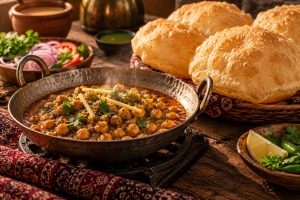
Siri Paye
سری پائے
Heavy lidded pot slow simmer; pressure timings deferred
Traditional Pakistani long-cooked goat head and trotters in a deeply spiced gelatinous gravy. This recipe uses commercially cleaned, inspected head pieces with brain excluded; family versions differ in whether brain is prepared separately.

One tablespoon = 15 ml; one teaspoon = 5 ml.
About Siri Paye
Traditional Pakistani long-cooked goat head and trotters in a deeply spiced gelatinous gravy. This recipe uses commercially cleaned, inspected head pieces with brain excluded; family versions differ in whether brain is prepared separately.
Personally cooked and tested by Zohair Fakhar for DailyLife.pk. Cooking times can vary with your stove, cookware and batch size; follow the texture and doneness cues in the method.
Make it work for your kitchen
Also known as Siri Paya, Siri Paaye, Goat Head and Trotters.
Original quantities serve 4. Cooking times, pan size and frying-oil depth do not scale, cook in extra batches instead.
Before you start
Before you start
Confirm butcher preparation Ask the butcher for inspected, fully de-haired and cleanly split 1200 g head and 900 g trotters; do not attempt home scorching or skull splitting. Keep chilled and inspect for bone fragments. No heat 10 min Organise the aromatics Slice 260 g onion, measure dry spices and whisk 150 g yogurt until smooth. No heat 15 min Prepare the serving garnishes Cut 45 g ginger and 1 lemon into wedges and wash 15 g coriander, if using. Refrigerate until needed. No heat 15 min
Set up the equipment
Have the following tools ready before starting: Large heavy pot (at least 6–7 L) with well-fitting lid; Separate wide frying pan; Ladle, fine sieve, skimmer and tongs; Thermometer and heatproof shallow storage containers.
Clean workspaceMeasure the ingredients
Measure the ingredient quantities for your selected servings before applying heat. Keep separately listed groups, such as dough, filling, sauce or garnish, in separate containers; keep any optional additions separate.
Use the ingredient list aboveCheck allergens and substitutions
Check ingredient labels and any substitutions against these notes: Dairy (yogurt); check spice blends
Before cooking
Step-by-step cooking method
1 Start the head-and-trotter broth
Place cleaned 1200 g head and 900 g trotters in the large pot with 2200 ml water, one bay leaf, half the ginger-garlic paste paste and half the sliced onions, thinly sliced. Bring to a boil over medium-high heat, skim foam and reduce to a steady gentle simmer.
2 Slow-cook until the bones loosen
Cover partially and gently simmer approximately 3–4 hours, checking regularly and adding a measured splash of hot water whenever exposed bones threaten to dry out. Meat and tendon should lift easily from bones; do not rely only on elapsed time.
3 Strain and inspect
With clean tongs transfer cooked meat to a tray. Strain the broth through a fine sieve and inspect carefully for small bone pieces. When cool enough to handle, separate edible meat and tender tendon from all bones; discard bones and hard fragments.
4 Make the aromatic masala
Heat 55 g oil in a separate pan over medium heat. Cook the remaining onion until golden, 8–10 minutes.
5 Make the aromatic masala (continued)
Add remaining ginger-garlic paste for 1 minute, then cloves, cardamom, remaining bay leaf, 12 g coriander, 6 g cumin, 3 g turmeric and 7 g chilli. Stir briefly without burning.
6 Add yogurt and reduce
Lower heat; gradually stir in 150 g whisked yogurt and cook 5–7 minutes until the raw tang softens and the mixture thickens. Add a ladle of hot broth if sticking.
7 Unite broth and meat
Add the strained broth and picked meat to the masala, plus 12 g salt. Simmer 15–20 minutes uncovered until rich and spoon-coating, adding hot water if overly thick. Taste before adding more salt.
8 Finish and serve safely
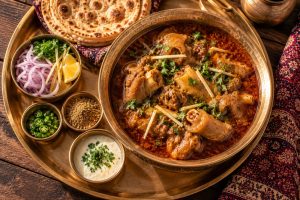
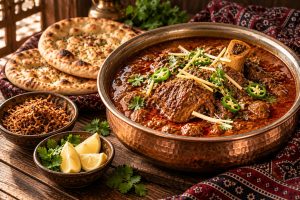
Stir in 5 g garam masala for 2 minutes. Portion four bowls with visible edible meat, tendon and broth. Garnish optionally with ginger, coriander and lemon. Serve piping hot, avoiding any remaining bones.
Chef’s tips
- Thorough bone removal matters as much as flavour.
- A long low simmer extracts gelatin without roughing up small bone pieces.
- Adjust final salt only after the broth has reduced.
Common mistakes & quick fixes
- Grit or tiny bones
- Strain broth and examine every served portion; do not rely on a coarse colander.
- Rubbery trotters
- Simmer until connective tissue is soft; tougher cuts take longer.
- Oily surface
- Skim surplus fat after cooking or when chilled; record discarded fat for nutrition.
Variations & serving ideas
Brain served separately: Some family versions add brain, but this recipe excludes it: separate handling and cooking require dedicated verification.
Milder gravy: Use 3–4 g red chilli powder; keep other aromatics unchanged.
Longer reduced broth: Reduce uncovered only after bone removal and watch salt concentration.
Perfect result check
| Check | Edible meat and tendon yield readily to a fork, and the strained broth has been inspected for hard bone fragments. |
|---|---|
| Check | Divide the finished stew into equal portions for the selected servings; the original quantities serve four. |
Storage & reheating
| Cooling | Rapid cooling Transfer leftover food promptly to shallow covered containers and refrigerate within 2 hours (1 hour above 32°C). | |
|---|---|---|
| Fridge | 3–4 days | Refrigeration Refrigerate at 4°C or below and use within 3–4 days; more stringent ingredient-specific advice takes precedence. |
| Freezer | Freeze promptly in suitable portions for longer storage. Label with the freezing date, thaw in the fridge and reheat thoroughly. | |
| Reheating | Reheat leftovers to 74°C/165°F throughout, stirring the stew to distribute heat. Add a little water if the broth has set thickly, and serve promptly. |
Know when to change the heat
| Stage | Heat | What to look for |
|---|---|---|
| Start the head-and-trotter broth | Medium-high, then low | Bring the meat and broth ingredients to a boil, skim and lower the heat. Maintain enough liquid for the long simmer. |
| Slow-cook until the bones loosen | Low heat | Keep a gentle simmer until meat and tendon lift readily from bone. Check liquid regularly and top up before pieces dry out; time varies with the pieces. |
| Strain and inspect | No heat | With clean tongs transfer cooked meat to a tray. Strain the broth through a fine sieve and inspect carefully for small bone pieces. When cool enough to handle, separate edible meat and tender tendon from all bones; discard bones and hard fragments. |
| Make the aromatic masala | Medium heat | Heat 55 g oil in a separate pan over medium heat. Cook the remaining onion until golden, 8–10 minutes. Add remaining ginger-garlic paste for 1 minute, then cloves, cardamom, remaining bay leaf, 12 g coriander, 6 g cumin, 3 g turmeric and 7 g chilli. Stir briefly without burning. |
| Add yogurt and reduce | Low heat | Lower heat; gradually stir in 150 g whisked yogurt and cook 5–7 minutes until the raw tang softens and the mixture thickens. Add a ladle of hot broth if sticking. |
| Unite broth and meat | Low heat | Add the strained broth and picked meat to the masala, plus 12 g salt. Simmer 15–20 minutes uncovered until rich and spoon-coating, adding hot water if overly thick. Taste before adding more salt. |
| Finish and serve safely | Low heat | Finish gently with garam masala, inspect again for bone fragments and portion with the optional fresh garnishes. |
Helpful answers before you cook
Can I use an uncleaned head?
No. Source cleaned and inspected head/trotters from a qualified butcher; detailed carcass dressing is outside this recipe.
Can I pressure cook it?
Only with a cooker-specific, independently tested recipe and the manufacturer’s minimum liquid, fill and release instructions; no universal timings are provided.
How do I tell if it is ready?
Edible meat and tendon should yield readily with a fork, with a gelatin-rich broth; ensure no small bone fragments remain.
How do I make the broth thicker without adding flour?
After combining the picked meat and broth with the masala, simmer uncovered to reduce gently until spoon-coating. Stir and check salt as the liquid concentrates; add a little hot water if it becomes too thick.