
Travel · Attractions
Keep the fort, the museum and the story separate
Read Umerkot’s fortifications and museum as different kinds of evidence, while handling the Akbar association, changing rulers and regional storytelling with care.
- Read the details
- Plan the approach
- Respect the fabric
Umerkot, Sindh
Start with three different kinds of evidence
Umerkot Fort is easier to understand when the masonry, museum displays and historical stories are allowed to do different jobs. A wall can show a construction method; a labelled object can identify a date or provenance; a narrative can explain why the place matters in regional memory. None automatically proves everything claimed by the others. Begin with that distinction before looking for a single defining story.
This is a historical interpretation visit, not a two-day driving itinerary. The aim is to ask useful questions inside one complex. First identify the principal entrance and the permitted route, then look at the fort’s broad arrangement before entering galleries if they are open. Keep separate notes for what you see, what a museum label says and what a guide recounts. The distinction makes the visit richer without demanding specialist equipment.
Read the changing rulers as a layered history
The Sindh antiquities department describes a sequence involving Soomro and Sodha rulers, Kalhoras, Jodhpur, Talpurs and British occupation. Such a sequence establishes that the fort’s history crosses several political periods. It does not establish that every surviving wall belongs to its earliest foundation. A long-lived fortified place may retain a plan while experiencing rebuilding, repair and changes of use.
The 2026 Tentative List submission contains inconsistent founding attributions within its own text, so a single precise founder should not be treated as settled here. Instead, ask whether site interpretation identifies particular phases and what evidence supports them. A useful label might distinguish the date of an event from the date of a visible structure. If it does not, leave that connection open rather than assigning the entire complex to one dynasty.
Handle the Akbar association precisely
The UNESCO Tentative List submission places Akbar’s 1542 birth at the fort and records refuge offered to Humayun by Rana Prasad. However, the federal inventory separately records the Memorial of Birth Place of Akbar, a pavilion built in 1898 by Syed Mehar Shah. Its recorded location is distinct from the fort. Keep the town’s historical association, the surviving fort and this later birthplace memorial separate; the nomination’s wording does not establish a surviving birth room.
Ask whether any marker you encounter identifies an event, an attributed location or a later commemoration. A nineteenth-century pavilion is evidence of commemoration, not surviving sixteenth-century birth architecture. Do not invent a scene involving conversations, attendants or room furnishings. If a guide supplies such details, ask for their source. A significant association remains interesting when the limits of the architectural evidence are stated plainly.
Examine the gateway and tapered walls
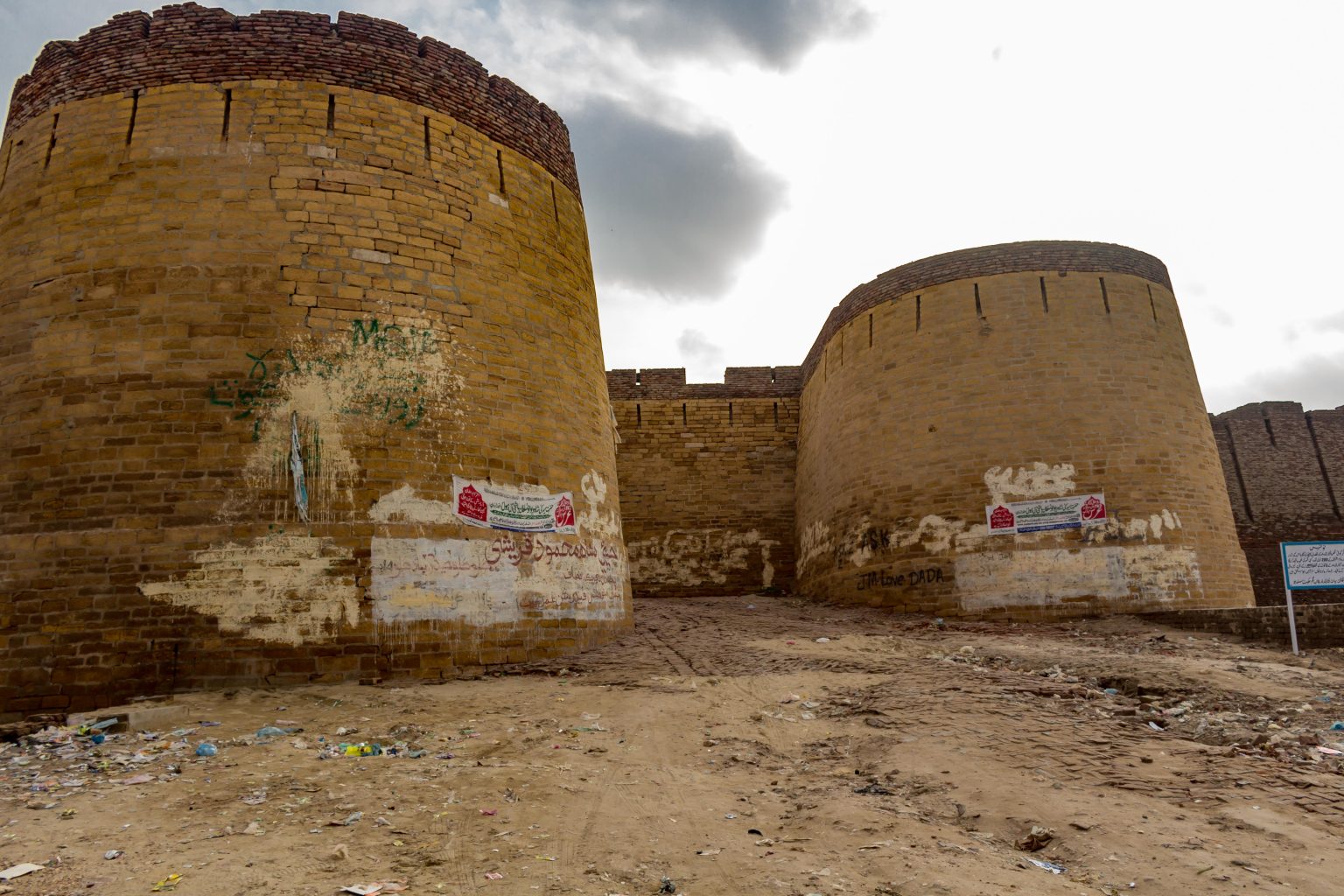
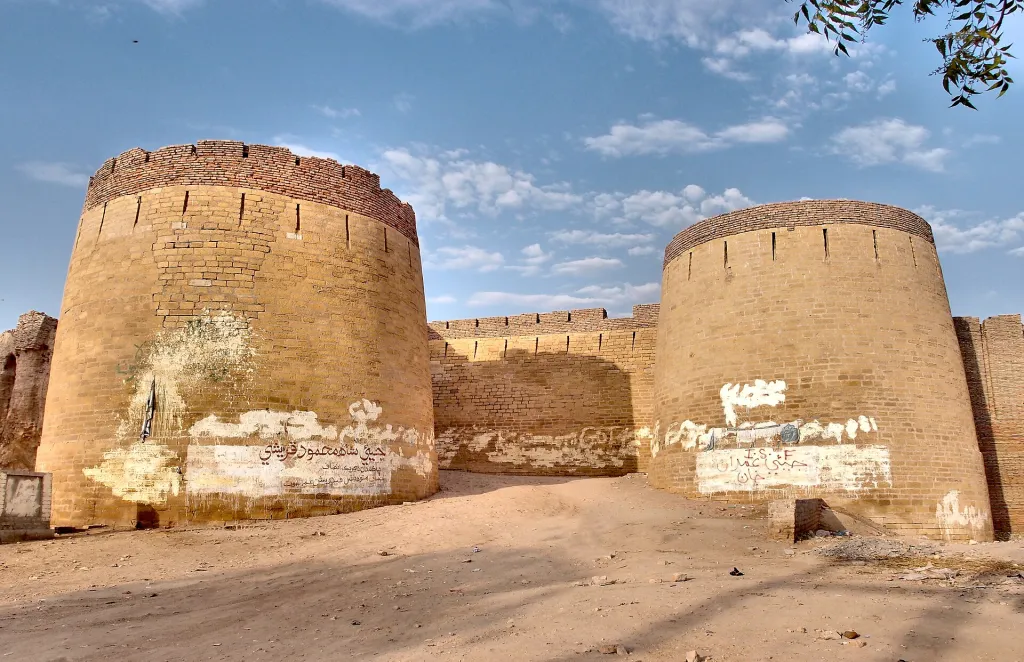
The provincial record describes a roughly rectangular fort, an eastern arched gateway flanked by semicircular bastions and walls with tapered profiles. These features offer a practical way to read the exterior. From a permitted viewpoint, compare the entrance opening with the solid masses on either side. Look at how the wall meets the ground and whether the changing profile is legible in side light.
A bastion projects from the line of a defensive wall, but its presence alone cannot reconstruct a specific battle or identify the weapons used there. Avoid turning every opening into a gun position without documentation. Nor should the dimensions in an official description be treated as proof of current condition. The basic geometry is enough to start: a boundary, a controlled opening and projections that change how the wall addresses its surroundings.
Understand brick facing and an earthen core
The antiquities department describes original burnt-brick tile facing laid with mud mortar around a mud-filled core. This is a useful correction to a quick glance that reads the fort as a homogeneous mass of solid brick. A facing and a core perform different roles within a wall, although a visitor should not probe joints or damaged edges to investigate them.
Look only where material is already visible from the authorised route. A break in surface finish is not permission to remove a piece or inspect a cavity. Differences in colour and texture can be recorded without deciding which construction phase they belong to. If an information panel explains a repair, note its date separately. A modern intervention may reveal the management history of the monument while the overall defensive arrangement preserves a much older idea.
Enter the museum with provenance questions
The provincial museum account records inauguration in 1968 and a move into an expanded building in 2006. It lists coins, weapons, manuscripts, paintings, documents and calligraphy, alongside photographs of Tharparkar life. That description indicates the range of the collection, not a guarantee that each category or particular object is on view during your visit. Confirm which galleries are currently available.
Choose one labelled object and ask three questions: when is it dated, where did it come from and why is it displayed here? A Mughal-period coin in a museum is not automatically something used by Akbar at this fort. A weapon’s appearance does not identify the owner. Provenance is the record connecting an object to its history. Where a label is incomplete, record the limitation rather than filling it with a plausible story.
Give Umar and Marvi its cultural place
The Tentative List account presents Umar and Marvi as a famous Sindhi romance associated with the fort. It is appropriate to discuss the story as cultural memory and literature, including Marvi’s attachment to home. Its importance does not require treating every named chamber or incident in a retelling as an excavated fact. Literary and oral traditions can matter deeply while remaining different from construction evidence.
If local interpretation connects the narrative to a particular space, identify it as that interpretation. Ask whether a panel discusses the story’s literary history or regional versions. Avoid using a modern illustration as proof of period clothing, furniture or the appearance of the fort. A respectful visit can make room for both the cultural meaning of the story and the separate questions raised by walls, documents and collection labels.
Observe conservation and route limitations
The fort and museum create different practical demands. Outdoor masonry may involve heat, steps and uneven ground, while galleries may have rules about bags, cameras or close approach to displays. Ask about the actual permitted route before entering either. A historical description of a central watchtower and staircase is not a current invitation to climb it, and a photograph taken from above does not establish public access.
Keep hands away from old surfaces and display cases, avoid leaning against walls, and respect temporary closures. Do not open cabinets or move objects for a better image. Anyone needing step-free access should ask separately about the fort entrance, gallery threshold and internal circulation. A museum being open does not by itself guarantee every part of the complex is reachable by the same route or suitable for the same visitors.

Check the town approach and current conditions
Umerkot is in eastern Sindh, but a regional name does not automatically place the town fort inside an international-border warning zone. Check the actual destination and road route on a current map. The UK travel advisory distinguishes a five-mile India-border zone and a separate warning for northern Sindh; other governments use different boundaries. Travellers should consult the advice relevant to them and confirm any local movement requirements before setting out.
Cooler months are generally more comfortable for outdoor observation; still check heat, rain and road conditions close to departure. Confirm current opening days, fees and photography rules directly, since older published schedules can change. Carry water for the journey and allow flexibility if the museum is closed. The essential result is a clear separation between visible architecture, labelled objects and historical association, even if the day’s access allows only part of the intended visit.
Frequently Asked Questions
Does Akbar’s association date every wall to 1542?
No. The event association does not date all surviving masonry. The federal inventory separately records a birthplace memorial pavilion built in 1898; neither it nor the nomination establishes a surviving birth room in the fort.
Is the museum the same age as the fort?
No. The provincial museum account records inauguration in 1968 and expansion into a new building in 2006.
Is Umerkot Fort on the World Heritage List?
It was submitted to Pakistan’s Tentative List on 18 March 2026. Tentative listing is not inscription.
Can I climb the central watchtower?
A historic staircase description does not confirm current visitor access. Follow management’s permitted route.
How we know this
- Type Practical guide
- Sources 6 (5 official/academic)
- Reviewed November 2026
- Disputed points None
Rules and fees change, confirm with the official links below before you act.
6 sources
- Umerkot Fort, Umerkot, Directorate General of Antiquities and Archaeology, Government of Sindh
- Thar Museum Umerkot, Directorate General of Antiquities and Archaeology, Government of Sindh
- Umerkot Fort, UNESCO World Heritage Centre
- Archaeological Museum Umerkot, Department of Archaeology and Museums, Pakistan
- Memorial of Birth Place of Akbar, Department of Archaeology and Museums, Pakistan
- Pakistan travel advice: Regional risks, UK Foreign, Commonwealth & Development Office
Photo credits (2)
- Entrance of Umerkot Fort.jpg, Harish Chander, CC BY-SA 4.0, via Wikimedia Commons
- Umarkot Fort view3.JPG, Saqib Qayyum, CC BY-SA 3.0, via Wikimedia Commons
