
Travel · Attractions
Follow the monastery through its spaces
Understand Takht-i-Bahi through the relationship between stupa courts, monastic rooms, stonework and the hillside, with current security checks before any journey.
- Read the built landscape
- Observe from permitted paths
- Check current access
Takht-i-Bahi, Mardan district, Khyber Pakhtunkhwa
A monastery with several kinds of space
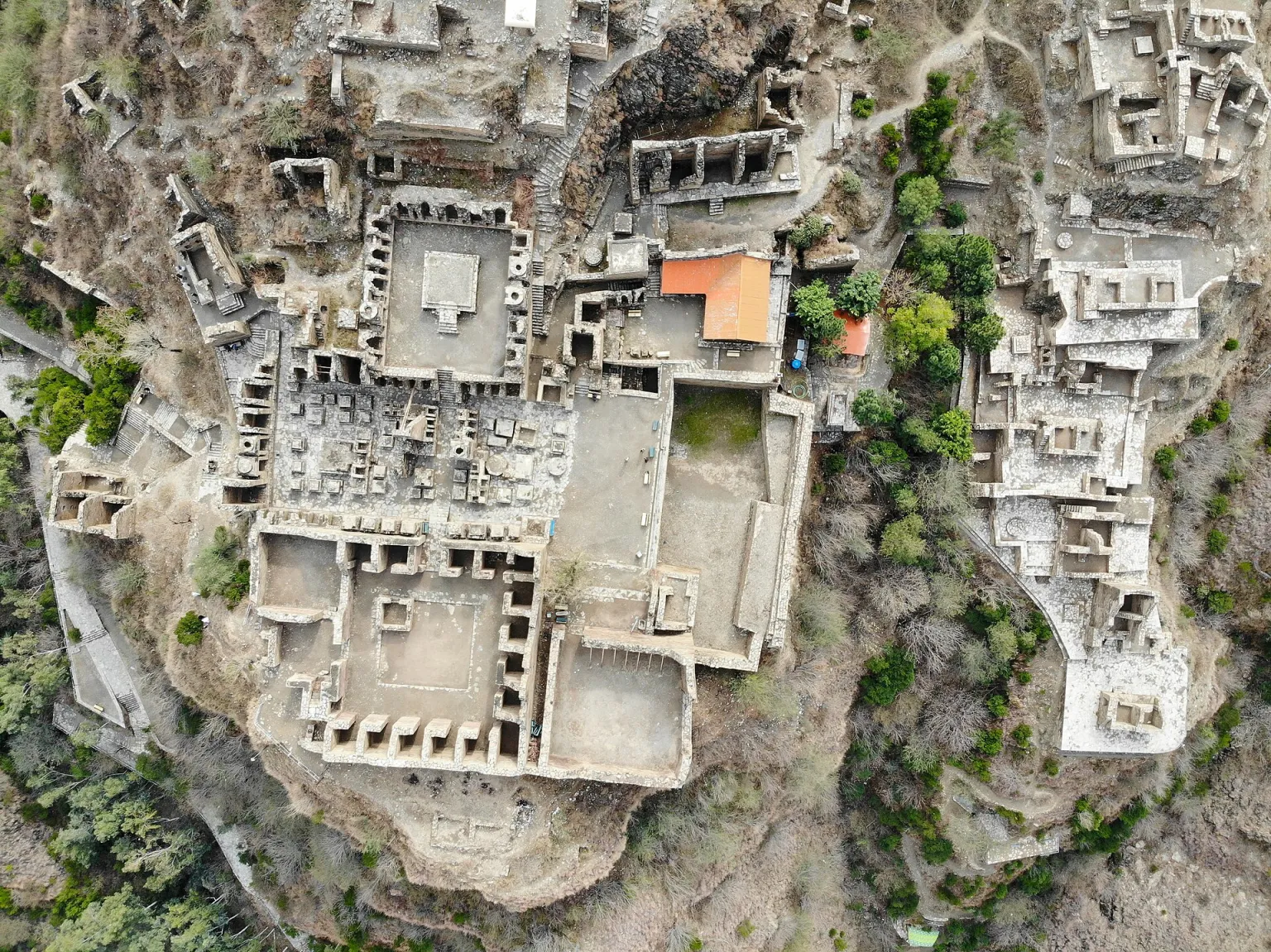
Takht-i-Bahi is a Buddhist monastic complex in the Gandhara region of present-day Khyber Pakhtunkhwa. Its attraction is the way substantial stone ruins still explain relationships between open courts, small rooms and changing levels. Begin with those relationships. A photograph of a single arch can be beautiful, but it says less about how the institution worked than a view showing where a passage leads and which court it serves.
UNESCO dates the foundation to the early first century CE and describes use continuing into the seventh century. The property inscribed in 1980 includes both Takht-i-Bahi and the separate city remains of Sahr-i-Bahlol. Those names should stay together when discussing the World Heritage inscription. This guide concentrates on the hillside monastery; it does not imply that the neighbouring urban component is an interchangeable visitor stop or freely accessible extension.
First understand the hillside
Before concentrating on individual walls, look at the ground. Where does the permitted approach climb? Which courts occupy broader shelves, and where do passages negotiate a difference in level? From a safe stopping place, compare the spread of the ruins with the surrounding slopes. This makes the setting part of the architectural story rather than a backdrop for a panoramic photograph.
UNESCO identifies the elevated location as an important reason for the complex’s survival. That does not mean every slope is stable or every visible ruin belongs to an open route. Avoid shortcuts across hillside masonry and do not use wall tops as viewing platforms. A lower photograph with clear foreground and background can communicate the arrangement better than an unsafe high position. If climbing is difficult for anyone in your group, ask about the actual approach, steps and available resting places before committing to the visit.
Separate the main stupa court from smaller monuments
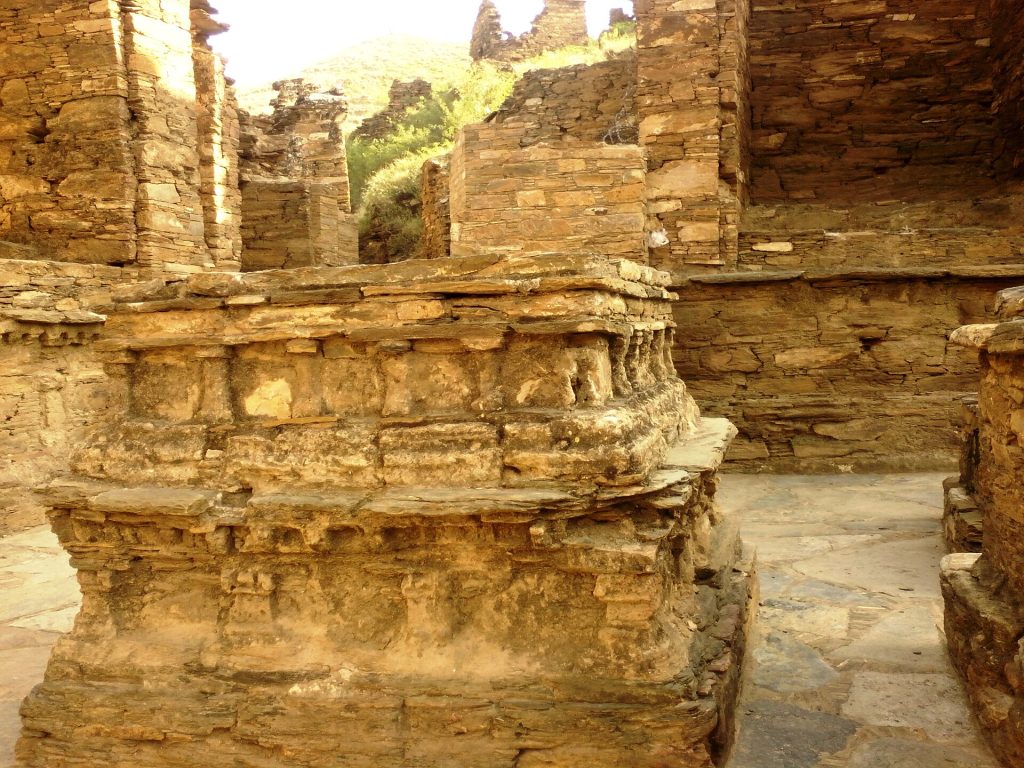
The main stupa court and the court containing votive stupas are useful anchors for reading the complex. A stupa is a Buddhist sacred monument; smaller examples should not be dismissed as rubble merely because their upper portions are missing. Use the site plan and interpretation to distinguish a monument’s base from adjoining walls and to identify which space you are looking into.
Stand where you can compare the central focus with the surrounding circulation space. Ask what can be seen from the court entrance and what becomes visible only after moving farther along the approved path. This is an exercise in observing spatial relationships, not a reconstruction of a particular ancient ceremony. Do not assign every low square a function from its shape alone. A guide should be able to relate a confident identification to a plan, excavation record or recognised interpretation, while leaving uncertain features as questions.
Read the quadrangle and its rooms together
In the monastic quadrangle, look at how repeated rooms address a shared open space. The repetition matters more than guessing the possessions of an individual occupant. Compare entrances, wall thickness and the relationship between a room and the court it faces, using only areas currently open to visitors. A doorway is a useful observation point even when the room beyond it is closed.
UNESCO’s description includes meditation cells, a conference hall and covered stepped passages among the surviving components. These labels help orient a visit, but they should not become a detailed imaginary daily timetable. A small room does not prove that one named practice happened there at one particular hour. Try describing what survives first: an enclosed compartment, an opening and a connection to a larger shared space. Then add the interpreted function from the site’s official explanation. This order makes the difference between evidence and inference easier to remember.
Notice stone patterns without testing the wall
The masonry rewards slow looking. UNESCO describes local dressed and partly dressed stone set in lime and mud mortar, with the characteristic Gandharan diaper pattern. From a permitted path, look for changes in block size and the arrangement of smaller stones around larger pieces. Take a photograph that includes enough wall to show the pattern, rather than isolating an attractive individual stone.
Keep your hands and equipment off the surface. Rubbing, scraping joints or inserting a ruler into a crack would turn observation into interference. Differences in colour or neatness may reflect exposure, repair or separate construction episodes; they cannot date a wall by themselves. If a section appears unusually regular, ask whether conservation work is documented there. A responsible description can say that two areas look different without announcing that one is original and the other modern. The most useful detail photograph has a location note so you can find its context again.
Make a small, meaningful observation exercise
Here is a hypothetical exercise for an authorised visit: choose one court, one connecting passage and one group of rooms. Sketch their relationship in an unmarked notebook without attempting a measured archaeological plan. Mark only what you can see safely, then add a question beside anything hidden or unclear. No tracing of walls, collection of fragments or entry into restricted spaces is needed.
For a family, give each person a different task: one notices routes, another repeated shapes, and another the relationship between stonework and slope. Compare the results at a permitted resting point. For someone interested in photography, use three views of the same feature: setting, whole feature and detail. These are suggested ways to structure attention, not a reported visit or a claim about what you will encounter. The reward is a clear account of one architectural relationship instead of a long camera roll of disconnected openings.

Plan around the current advisory, then confirm access
Security is a substantive planning issue here. Checked on 7 November 2026, FCDO advice is against all but essential travel to Mardan. Its separate all-travel warning includes the N45 north of the Mardan ring road to the edge of Chitral City. Assess the exact route as well as the destination; a familiar place name is not enough to establish which advisory area a road crosses.
Consult the current advice relevant to your nationality, local authorities and your insurer before making arrangements. Ask the responsible archaeology office about permissions, present opening, closures and photography rules. No fixed admission price or opening timetable is established here. If the journey is appropriate and authorised, plan for exposed outdoor walking, carry water and sun protection, and wear footwear suitable for uneven steps. Confirm toilets, drinking water and any assistance you need instead of assuming a World Heritage designation guarantees visitor facilities.
Leave with the monastery and city still distinct
Before leaving, return to the site plan and describe the route in a few sentences: where the main sacred focus stands, how the monastic rooms relate to shared space, and how the hillside shapes movement. If one relationship remains unclear, retain the question. An honest gap is more useful than a memorable story attached to the wrong court.
Sahr-i-Bahlol adds an urban dimension to the inscription, but UNESCO also records pressure from settlement growth there. Do not seek access through homes or assume residents’ property is part of a sightseeing circuit. Likewise, sculpture associated with the heritage belongs in a wider museum and excavation context; an empty architectural niche is not permission to invent the image once placed there. Take your notes and photographs away, leave all loose material undisturbed, and use a museum catalogue or archaeological publication to continue the questions that the surviving buildings have opened.
Frequently Asked Questions
Is Takht-i-Bahi a UNESCO World Heritage Site?
Yes. The 1980 inscription includes the Buddhist ruins of Takht-i-Bahi and the separate neighbouring city remains at Sahr-i-Bahlol.
Can I treat every room as a meditation cell?
No. Use the official plan and interpretation; repeated small rooms do not establish every detail of ancient use.
Is this a current recommendation to travel to Mardan?
No. The advisory checked on 7 November 2026 advises against all but essential travel to Mardan, with additional route-specific warnings.
Are opening hours and admission prices confirmed?
No fixed hours or price are established here. Confirm directly with the responsible authorities before any appropriate journey.
How we know this
- Type Practical guide
- Sources 4 (2 official/academic)
- Reviewed November 2026
- Disputed points None
Rules and fees change, confirm with the official links below before you act.
4 sources
- Buddhist Ruins of Takht-i-Bahi and Neighbouring City Remains at Sahr-i-Bahlol, UNESCO World Heritage Centre
- Takht-I-Bahi, Department of Archaeology and Museums, Pakistan
- Pakistan travel advice, checked 7 November 2026, UK Foreign, Commonwealth & Development Office
- Pakistan: regional risks, UK Foreign, Commonwealth & Development Office
Photo credits (2)
- Takht-i-Bahi Buddhist Monastery.jpg, Muzamil Hassain Toori, CC BY-SA 4.0, via Wikimedia Commons
- Takht-i-Bahi stupa.jpg, Shahabuddin648, CC BY-SA 3.0, via Wikimedia Commons
