
Travel · Attractions
Read a gateway as a working threshold
Explore Rohtas through its gate passages, masonry and inscriptions while planning a manageable walk that respects the village within the walls.
- Read the details
- Plan the approach
- Respect the fabric
Rohtas Fort, near Dina
Make the gateway your unit of exploration
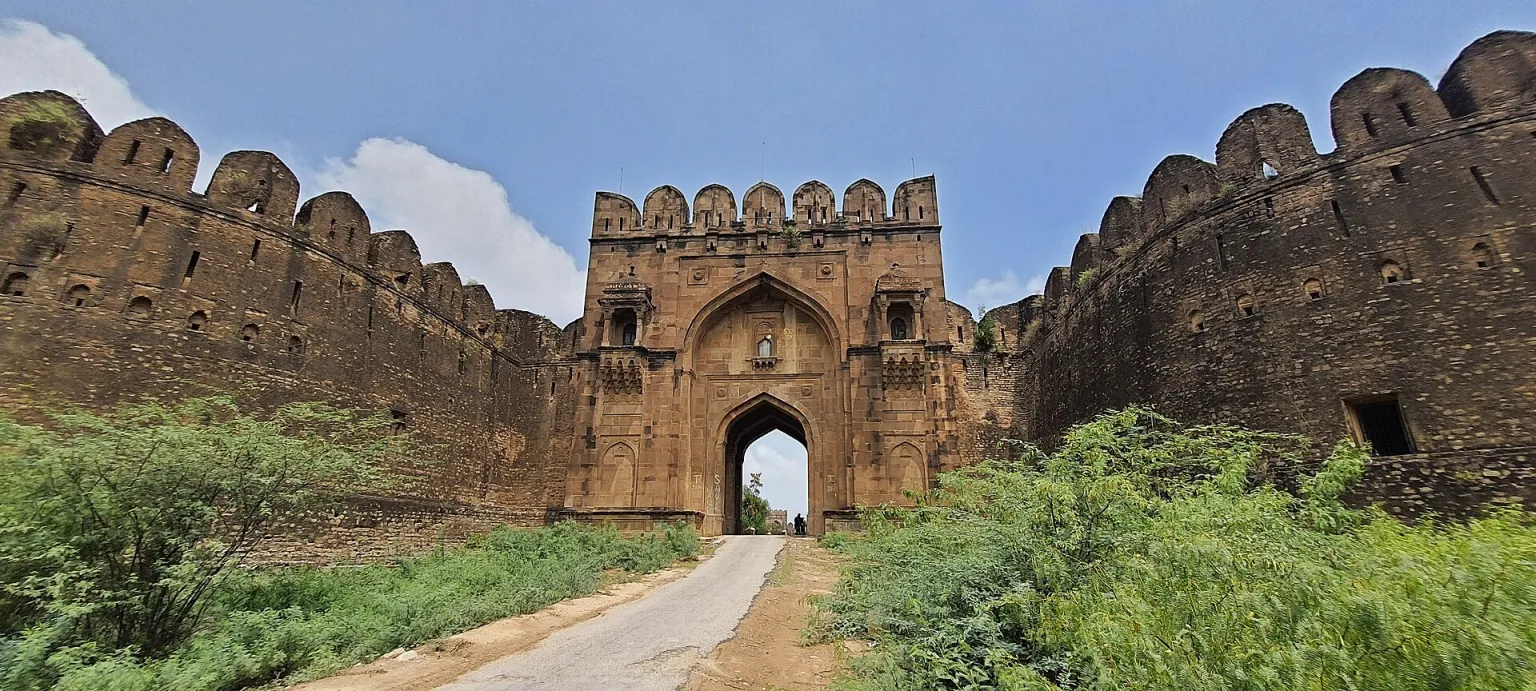
Rohtas is large enough to defeat a hurried checklist. A gateway offers a more manageable unit: approach it, look at the outer face, follow only the permitted passage and compare the inner side. A single threshold can reveal the relationship between defence, controlled movement and architectural display more clearly than a rushed attempt to reach every corner.
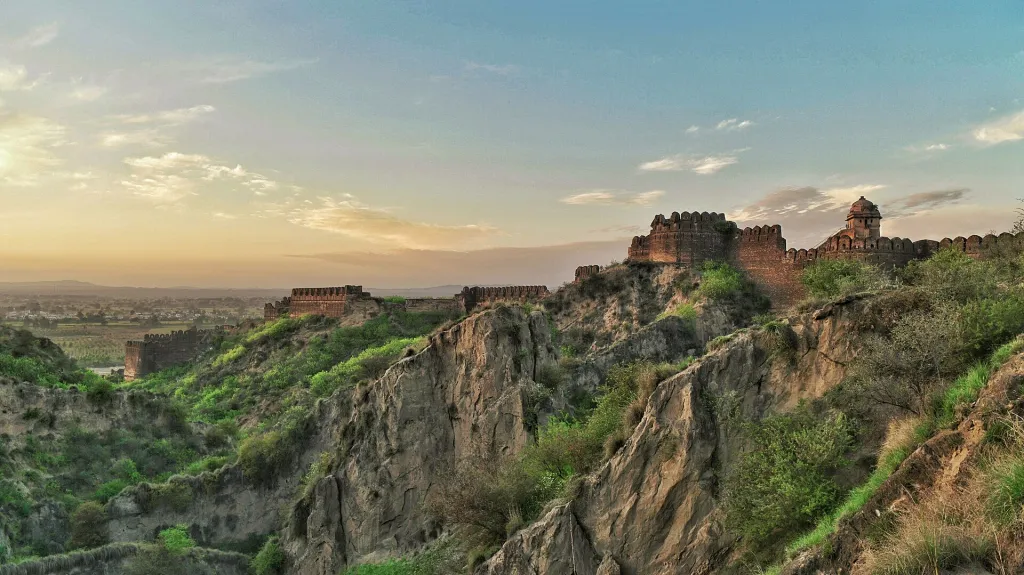
The federal archaeology record locates the fort near Dina and describes an irregular hilltop enclosure divided by an internal wall. Plan around that scale and terrain. Pick two or three authorised viewpoints with time to rest, rather than making a full circuit your default ambition. The purpose is to understand how the gateways belong to the walls and the land, not to collect twelve nearly identical photographs or claim completion of a route that conditions may interrupt.
Use a cautious construction timeline
UNESCO records construction beginning under Sher Shah Suri in 1541. Punjab’s general landmarks page uses 1542 in its short introduction. Such variation is a reason to distinguish a commencement date from a broad building campaign. Describe Rohtas as a sixteenth-century Suri foundation rather than making every surface the product of one year or one ruler.
Later occupation matters too. The federal account records Durrani and Sikh reuse after the earlier garrison period. A gate is therefore not simply a frozen battlefield prop. Ask which features an interpretation panel securely attributes and which survive without a precise phase label. Do not turn a repaired joint or a different stone colour into a personal reconstruction of a siege. Material observations are valuable when they remain separate from claims that require documentary or archaeological evidence.
Look at the approach before the arch
Stand at a safe distance and examine how the approach meets the gateway. Notice changes in direction, surrounding wall mass and the relationship between the opening and nearby bastions. These are prompts for reading a defensive threshold. They are not permission to assume that every bend was designed for the same weapon or that every opening served archers.
UNESCO identifies Rohtas as military architecture shaped by the age of gunpowder and cannon. That wider context can guide questions about protection and control without replacing site-specific interpretation. Compare the apparent narrowness of an opening with the mass of the structure around it. Then consider ordinary movement: people, supplies and animals also had to pass through a controlled entrance. Defence involved managing access as well as presenting an imposing face to someone approaching outside.
Compare stonework, carving and the passage
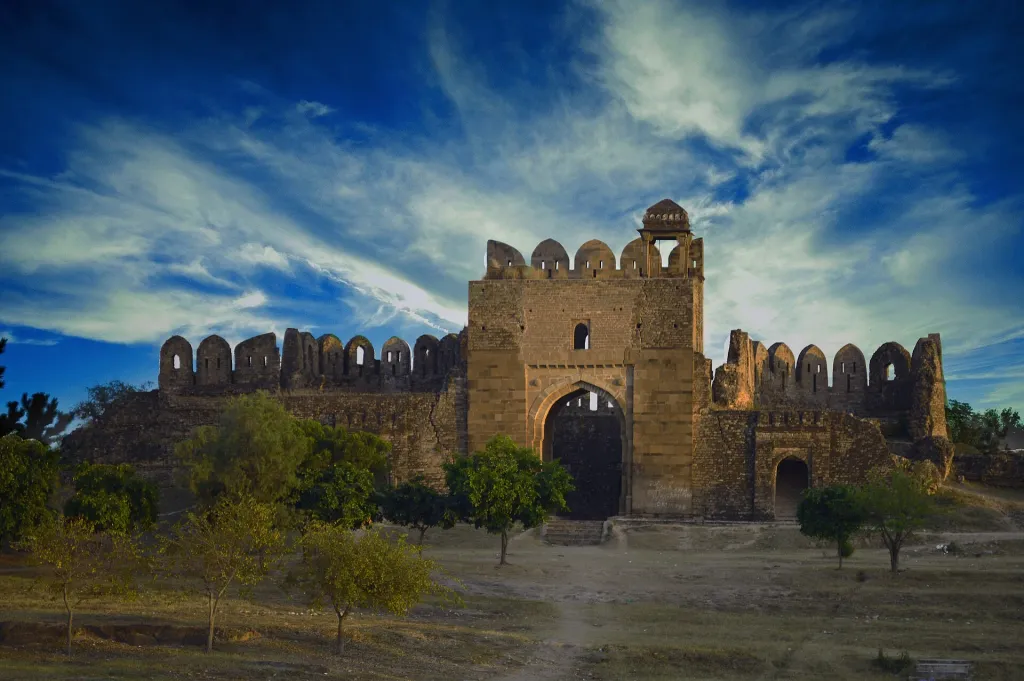
The Punjab government’s Rohtas page lists the twelve gates and describes ashlar stone construction. Its names include Sohail, Kabuli, Shishi, Langar Khani and Shah Chandwali. Use the spelling on local interpretation when identifying your photographs, since English transliterations vary. A named image is much more useful for later study than an unlabeled close-up of an arch.
Examine joints and the scale of stone blocks from the public route. Compare carved ornament with the broad structural surface, and notice how the depth of the passage changes light and sound. Do not touch carved edges to test their sharpness, and never climb masonry to look into an opening. Where a barrier prevents an interior comparison, record the limitation. A restricted passage can still be read from its two permitted approaches if a safe alternative route is available.
Read an inscription as evidence with limits
UNESCO highlights calligraphic inscriptions in marble and sandstone among the fort’s important decorative elements. An inscription can convey authority and commemorate work, but reading one accurately requires more than recognising a familiar word. Photograph only where permitted, keep the whole panel in one frame and note its location before taking a detail photograph.
If you cannot read the script, ask whether an official transcription or translation is available. Distinguish the text itself from a guide’s explanation of its significance. A panel on a gateway does not automatically date every adjacent wall. Avoid rubbing, chalking, wetting or cleaning a surface to make letters stand out. Changing light may improve legibility without intervention. For a family exercise, compare the inscription’s placement with the ornament around it and ask who was expected to notice that statement of power.
Remember the village inside the monument
Rohtas contains a living village, a fact recorded by both UNESCO and the federal archaeology department. This changes visitor behaviour. A lane that looks picturesque may also be a route to someone’s home, a shop or a daily task. Keep doorways clear, ask before photographing identifiable residents and avoid treating domestic activity as a performance arranged for tourists.
It also changes interpretation. The fort’s history did not stop when the original garrison ceased to use it. Present settlement and conservation responsibilities coexist within an inherited enclosure. Recognising that relationship does not require visitors to judge individual residents or repeat unsourced claims about encroachment. Follow public routes and site guidance. If visiting an active prayer space, ask about entry, dress and photography, and give worshippers priority over an architectural photograph or a group explanation.
Plan for a large, exposed and uneven site
Check admission, permitted entrances, guide arrangements and closures directly before departure. Confirm the final road approach and return pickup rather than expecting a driver to locate you at an arbitrary gate. The federal record describes approach from the Grand Trunk Road via Rohtas Fort Road; it does not establish the condition of that road on your travel date.
Carry water, sun protection and footwear suitable for uneven ground. Cooler weather can make a long walk more comfortable, but morning fog, rain or an unexpectedly warm day can change the plan. Do not assume shaded places or regular toilets along a chosen circuit. Ask about step-free access and actual walking distances if required. For children, establish a clear boundary away from wall edges, wells and broken masonry before anyone begins taking photographs.
Test two interpretations during a hypothetical walk
Imagine an intentionally short visit centred on two gateways. At the first, the group records three observations about movement: the width of the opening, any turn in the permitted route and the transition between outside and inside. At the second, it records three observations about display: a carved element, an inscription location and the contrast between ornament and plain masonry. This is a proposed exercise, not an account of a guided tour.
The comparison allows a gateway to be both protective and expressive. Someone can notice a strong wall without inventing a battle, or admire carving without forgetting the military purpose. Use a blank notebook and photographs from safe ground. At the end, put an evidence label beside each note: directly observed, stated on a panel, reported by a guide or still uncertain.

Choose a useful ending rather than an exhaustive circuit
Finish by returning to the first approach and looking again at its relationship to the wall. You may now notice how ornament draws attention to the threshold while masonry links it to a larger defensive system. A later visit can explore other features, including the stepped wells and buildings identified in the official records, when access and available time allow.
World Heritage status recognises significance; it does not guarantee every wall segment is sound or every route open. UNESCO’s account specifically discusses conservation and drainage vulnerabilities. Respect barriers even when another visitor crosses them. A successful visit can be small in distance and rich in observation: two gateways understood carefully, a precisely labelled inscription photograph and consideration for the people who live within the fort are substantial outcomes.
Frequently Asked Questions
How many gateways does Rohtas have?
Official descriptions record twelve monumental gateways. A list of twelve does not mean all are currently accessible.
Did construction begin in 1541 or 1542?
UNESCO and the federal archaeology record give commencement in 1541; a Punjab overview uses 1542. Use a sixteenth-century Suri building campaign when a precise phase is not established.
Is there a village inside the fort?
Yes. The official heritage descriptions record an existing village within the walls; visitors should respect domestic privacy and public routes.
Should I walk the entire wall circuit?
Only if site management confirms a suitable permitted route and it fits your group’s abilities. A short gateway-focused visit can be more rewarding.
How we know this
- Type Practical guide
- Sources 4 (4 official/academic)
- Reviewed November 2026
- Disputed points Yes, see the debates
Rules and fees change, confirm with the official links below before you act.
4 sources
- Rohtas Fort, UNESCO World Heritage Centre
- Rohtas Fort, Department of Archaeology and Museums, Pakistan
- Rohtas Fort: Gates, Government of Punjab
- Historical Landmarks, Government of Punjab
Photo credits (3)
- Sohail Gate, Rohtas Fort, Pakistan.jpg, MBNav412, CC BY-SA 4.0, via Wikimedia Commons
- Rohtas Fort (Jhelum, Pakistan) - World Heritage Site.jpeg, Hussain Khalid, CC BY-SA 4.0, via Wikimedia Commons
- Sohail Gate - Rohtas Fort by Hassan.jpg, Hassantahir6009, CC BY-SA 4.0, via Wikimedia Commons
