
Travel · Attractions
Read the symbol at three scales
Understand the Pakistan Monument’s overall form, examine relief imagery carefully and treat its museum as a separate historical interpretation.
- Look closely
- Read the evidence
- Respect conservation
Pakistan Monument · Shakarparian, Islamabad
Separate the silhouette, the surface and the galleries
The Pakistan Monument is easy to recognise in a photograph, but recognition is only the beginning of a visit. Its overall form communicates a national idea; its relief surfaces offer another level of detail; the nearby museum tells history through a different medium. Give each an independent question instead of treating the whole outing as a single viewpoint.
For the silhouette, ask how separate forms appear to gather together. For a relief, ask what is represented and how the figures or buildings are organised. For the museum, ask what sequence and evidence support the historical account. These are suggested reading strategies, not a prescribed route through open areas. Follow present access instructions. If you have time for only one component, choose it deliberately and avoid later describing a museum you did not enter as though you had examined its displays.
Use the official symbolism as a starting point
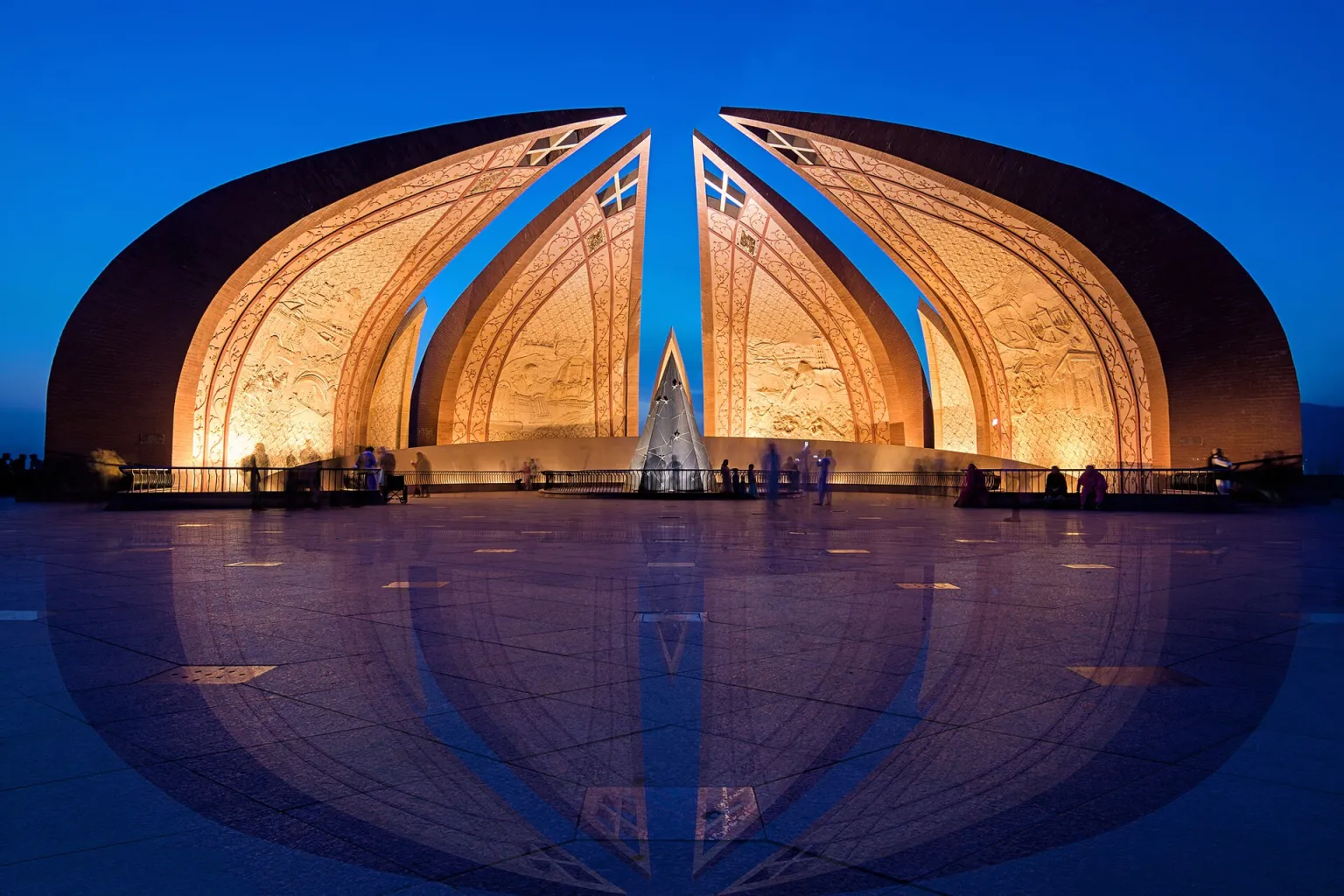
The Capital Development Authority describes the monument as representing unity among Pakistan’s provinces and territories and depicting the Pakistan Movement and national culture. Government news agency APP identifies architect Arif Masood and explains the composition through large and small petal forms. Its account links four larger petals with the four provinces and three smaller forms with territories as described in that historical design explanation.
Keep the distinction between a monument’s symbolic scheme and current administrative geography. APP’s explanation includes the erstwhile Federally Administered Tribal Areas; repeating that account does not make FATA a present province or separate current administrative unit. The design belongs to a particular historical context. Read any on-site interpretation alongside that context instead of forcing every symbolic element to match a map prepared today.
Let your position change what the form means
From an authorised distant viewpoint, look at the whole outline before concentrating on its interior. Then, where public access permits, observe how moving nearer changes the relationship between separate forms and enclosed space. A structure that looks compact in a photograph can feel quite different when its surfaces rise around a visitor. This is a visual and spatial response, not proof of a hidden mathematical rule.
CDA also notes the star-and-crescent association visible from an aerial view. Do not promise that an ordinary ground-level visitor will see the same image clearly. An aerial interpretation and a pedestrian experience operate at different viewpoints. There is no need to launch a drone or leave a permitted area to confirm a design description. A published view or official explanatory image can answer that question while you experience the accessible spaces at ground level.
Read a relief before identifying every figure
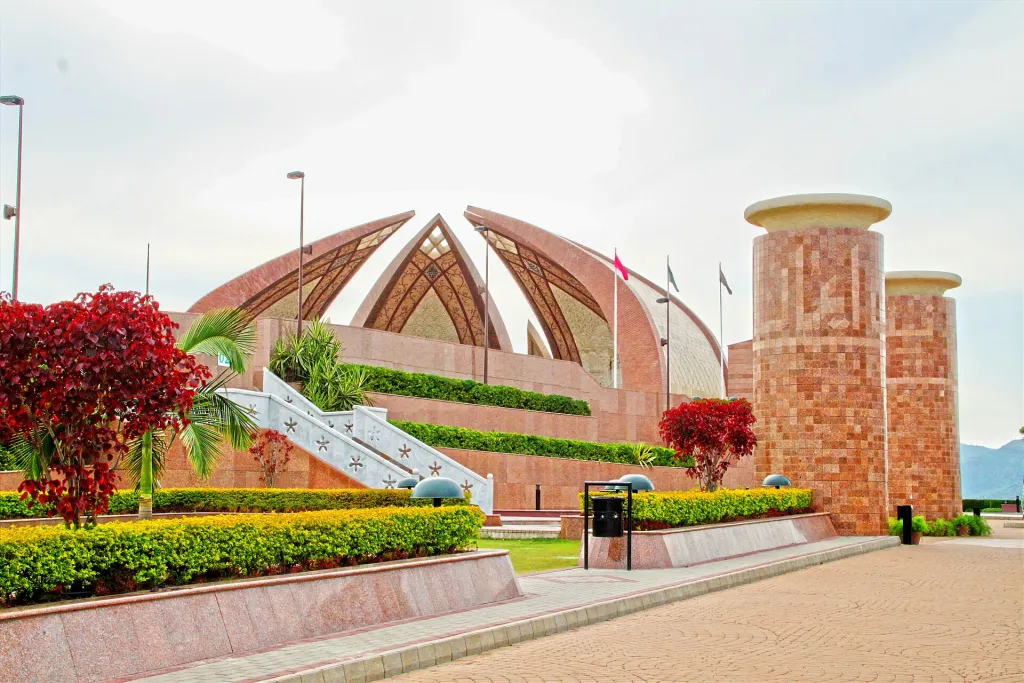
A relief projects from a background rather than standing entirely free like a statue. Begin with its arrangement: where your eye is led, which forms dominate, how depth produces shadow, and how architecture or human figures share the surface. You can observe these relationships even when you cannot securely identify every subject.
Use an on-site label or official explanation for names and historical references. A building in a compressed artistic scene may be simplified, and scale may serve the composition rather than reproduce measured reality. If you are unsure of an identification, keep it provisional. Do not turn a familiar-looking silhouette into a fact about which province a scene represents. A useful note might say “the panel places architectural imagery beside figures,” followed by the identification supplied on the sign. Separating the two preserves both your observation and the source of the historical claim.
Where a caption identifies a particular landmark, note the caption beside your sketch or photograph. That simple association prevents a later image collection from accumulating confident but unsupported names, especially when several historical buildings share arches, domes or towers.
Treat commemoration as a selected account
National monuments condense complicated histories into forms and images that people can encounter together. Selection is unavoidable: some episodes and symbols receive emphasis while other experiences remain outside the composition. Asking how a monument selects is a serious way to engage with it, not a reason to dismiss its commemorative purpose.
Look for the relationship between collective imagery and named individuals, where the interpretation provides names. Ask whether the emphasis is on sacrifice, cultural plurality, political leadership or a movement towards nationhood. These are possible themes to test against the work, not a claim that every panel contains all of them. Visitors may have different family histories and emotional responses. Make room for those differences without photographing strangers’ reactions as evidence or interrupting people who are using the place for quiet reflection.
Enter the museum with a different set of questions
Lok Virsa describes the Pakistan Monument Museum as presenting a journey from ancient civilisations through independence and subsequent national milestones. It identifies dedicated Quaid-i-Azam and Allama Iqbal corners and supporting archival and audiovisual resources. This institutional description explains the museum’s scope; it is not a guarantee that every resource is accessible to every walk-in visitor on a particular day.
Inside, distinguish an original object, a photograph, a reproduction and a staged historical scene when labels provide that information. A life-sized display can make an event vivid without becoming direct evidence of what the room or conversation actually looked like. Ask what document, object or explanation supports the interpretation. Keep the monument’s outdoor symbolism separate from the museum’s chronological narrative so a striking sculpture does not substitute for reading a historical panel carefully.
Make a group visit work without rushing the details
Choose a manageable task before arriving. A hypothetical family might have one person describe the overall form, another record a securely identified relief subject, and a third choose a museum question. This is an imagined planning example, not a report of a group whose experience has been observed. It gives different ages a reason to look without requiring everyone to complete the same extensive list.
Plan standing, walking and rest around the least mobile member of the party. Ask about the actual route, steps, surfaces, seating and accessible toilets rather than assuming the monument plaza and museum offer identical access. Check the forecast for exposed areas and allow the group to shorten the outdoor portion in uncomfortable conditions. Avoid planning a close-reading session at a time chosen solely for a dramatic photograph if the light, weather or crowd conditions make labels and surfaces difficult to examine.
Confirm each component before departure
Check current access to the monument grounds and the museum separately, including closures, entry arrangements and any restrictions affecting a group visit. Do not assume that seeing people outside means the galleries are open or that a museum ticket includes every nearby activity. Ask about permitted photography, bags and any research or audiovisual facilities you specifically hope to use.
Before leaving, take a moment to describe the three experiences in different words. The silhouette can express gathering or unity; the relief can select and compose historical imagery; the museum can explain a chronological account using displays. Those are interpretive possibilities grounded in different media. Record what you actually saw and what you learned from a named source. This makes the visit more useful than repeating a petal-count fact while missing the varied ways a public monument asks people to remember.
Frequently Asked Questions
Does the petal symbolism describe today’s administrative map exactly?
Read it as a historical design explanation. Accounts referring to the former FATA need that explicit historical qualification.
Can the aerial star-and-crescent effect be assumed at ground level?
No. CDA describes an aerial relationship; the ground-level experience has a different viewpoint.
Are monument access and museum admission the same?
Confirm them separately, including current opening arrangements and closures.
Is a museum reconstruction an original historical scene?
No. Read labels to distinguish original material, reproductions and interpretive reconstructions.
How we know this
- Type Practical guide
- Sources 4 (2 official/academic)
- Reviewed November 2026
- Disputed points None
Rules and fees change, confirm with the official links below before you act.
4 sources
- CDA-Destination, Capital Development Authority
- Pak Monument’s as architectural heritage symbolizes remarkable history of four provinces,GB, AJK, Associated Press of Pakistan
- Pakistan Monument Museum, Lok Virsa
- Seminar by Mr. Arif Masood, SZABIST University Islamabad
Photo credits (2)
- Blue Hour at Pakistan Monument.jpg, Muhammad Ashar, CC BY-SA 4.0, via Wikimedia Commons
- Pakistan Monument Islamabad PK.jpg, Usama Akram Photographer, CC BY-SA 4.0, via Wikimedia Commons
