
Travel · Attractions
Look beyond the sparkle at Sheesh Mahal
Read Lahore Fort’s Palace of Mirrors through its layered decoration, courtly setting and conservation work, with practical advice for an attentive visit.
- Read the details
- Plan the approach
- Respect the fabric
Sheesh Mahal, Lahore Fort
Let your eyes adjust before looking for the famous photograph
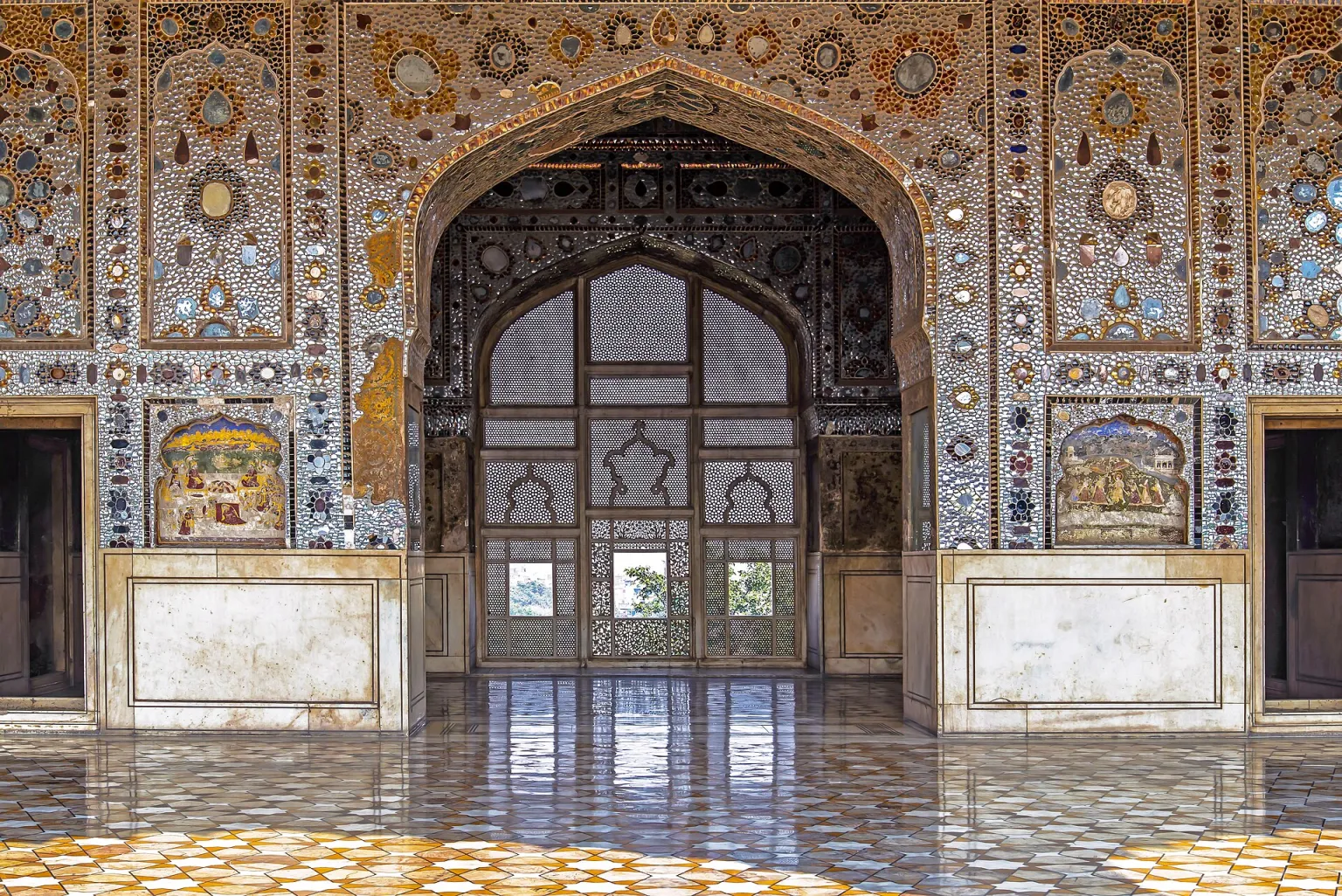
Sheesh Mahal rewards a pause. Instead of immediately framing the brightest patch, look at how small reflective elements sit within a larger pattern of ornament. Move only within the permitted viewing space and notice how the appearance changes with your angle. Reflection is an effect created between material, light and the viewer, not simply a glittering surface attached to an old building.
The Palace of Mirrors belongs within Lahore Fort’s courtly architecture. UNESCO identifies it among Shah Jahan’s additions and dates it to 1631–32. That establishes an important building phase; it does not mean every decorative layer visible today has remained unchanged since then. Begin with the securely documented setting and carry that distinction into the visit. A slower look can be richer than a photograph that makes every surface appear equally bright.
Place the hall within the Shah Burj setting
The Aga Khan Historic Cities Programme’s Archnet project account locates Sheesh Mahal in the Shah Burj Quadrangle and describes a principal hall with rooms behind it. The Walled City of Lahore Authority describes the courtyard basin and connecting water channels. Think of these as relationships between spaces: a hall opens towards a court, while water and adjacent structures participate in the composition.
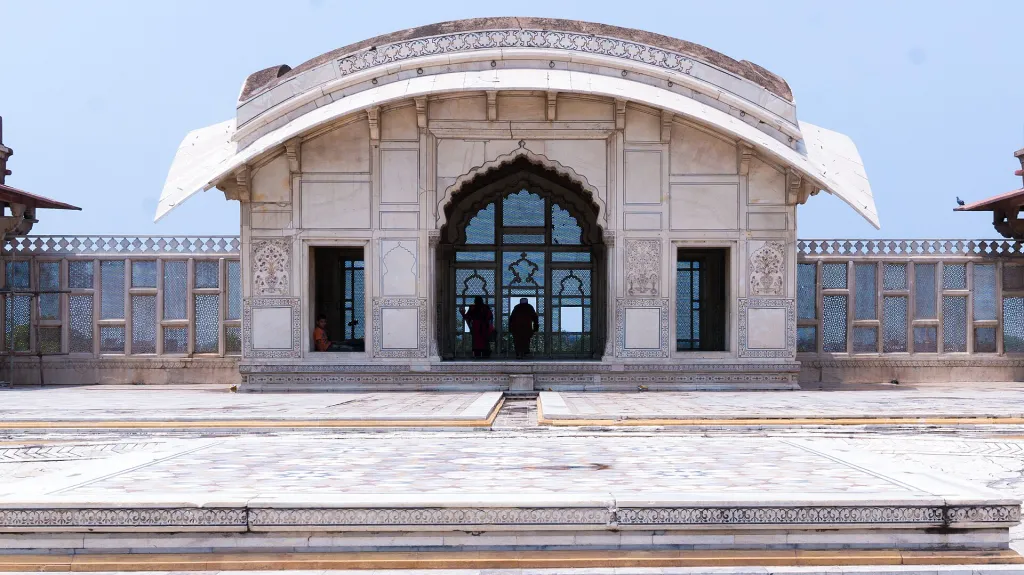
Do not treat Sheesh Mahal as a detached room that can be understood without its approach. As you move through the permitted fort route, notice transitions from monumental exterior architecture towards more closely worked surfaces. The Alamgiri Gate and Naulakha Pavilion are distinct structures, useful for comparison rather than interchangeable photographs of the mirror palace. A picture of another building should identify it honestly and explain why the comparison is relevant to the courtly complex.
Separate mirror mosaic from other decorative crafts
WCLA names mirror mosaic, stucco tracery, gilding, stone inlay and carved marble screens among the decorative features associated with Sheesh Mahal. Those are different materials and processes. Try to identify an example using an interpretation panel or a guide’s explanation rather than describing everything reflective or pale as mirror work. A perforated screen and a reflective mosaic affect light in different ways.
Choose one small area and follow the relationship between its shapes. Notice borders, repeated motifs and the contrast between reflective pieces and the material surrounding them. Do not touch to determine whether something is glass, plaster or stone. If the feature is too distant or obscured to identify, leave the note uncertain. Good observation includes recognising what the permitted viewpoint cannot resolve and asking a specific question instead of assigning a confident label to every surface.

Understand why the surface has a layered history
The Archnet conservation account warns against a simple assumption about the origin of all decoration. It discusses earlier fresco and gilding, later mirror interventions and the importance of Sikh-period changes. Sheesh Mahal remained significant under Ranjit Singh and afterwards. A Mughal construction date therefore does not erase the contribution of later occupants to the building as encountered today.
For visitors, the practical lesson is to ask which layer a description concerns. Is a guide discussing the structure, a decorative scheme, a roof intervention or a recent repair? These can have different dates. Avoid using later as a synonym for false or original as a synonym for better. Conservation has to assess inherited layers and their significance; an attentive visit can recognise several historical periods without trying to peel the building back to a single imagined moment.
Discuss court life without inventing a scene
WCLA associates Sheesh Mahal with the fort’s royal residential sphere. That helps explain the difference between a courtly interior and a large public military entrance. Screens, rich finishes and connected rooms invite questions about privacy, ceremony and controlled access. They do not supply a transcript of a particular evening or establish who occupied every chamber on a named day.
The authority’s public account also repeats a romantic story involving Mumtaz Mahal and stars. Treat that as a story, separate from the documented 1631–32 construction attribution. There is no need to invent candlelit conversations or claim that a visitor can experience exactly what an emperor saw. A careful interpretation can ask how reflection might alter a room’s atmosphere while keeping hypothetical experience distinct from historical evidence. Court life is a subject for inquiry, not a licence to fill gaps with cinematic certainty.
See conservation as support for the decoration
The decorative surface depends on what lies behind and above it. WCLA’s attic-chamber account records roof, timber, structural and water-management work completed in January 2021. The Aga Khan project account explains the subsequent challenge of stabilising mirror decoration and stucco. These are connected tasks: the appearance of a ceiling cannot be protected through polishing alone.
A visitor may notice barriers, limited viewing positions or a surface that does not look uniformly new. Do not conclude that conservation has failed because variations remain. The project account emphasises stabilising material and retaining surviving work, with replacements where elements were lost. Ask what an interpretation panel says about a repair rather than expecting the monument to resemble a newly furnished room. The distinction between maintaining historic fabric and manufacturing visual perfection is central to understanding why careful work can remain discreet.
Prepare for the fort journey as well as the hall
Confirm the current entrance, ticket arrangements, any separate Sheesh Mahal admission and the permitted viewing route before departure. Check whether conservation or another restriction affects the chamber you particularly want to see. A general fort opening time cannot establish access to every interior. Ask about guide services and photography rules directly, especially for equipment beyond a handheld camera.
Plan the walk from your actual drop-off point through the fort and back. Ask specifically about steps, surface changes, rest opportunities and toilets if these affect the party. Cooler conditions can make exposed courtyards more comfortable, but check the day’s heat, rain and visibility rather than promising one ideal season. Leave enough energy for the return. If combining the fort with a mosque visit, make the sacred-space etiquette and current prayer-related access arrangements a separate part of the plan.
Try an observation exercise with three categories
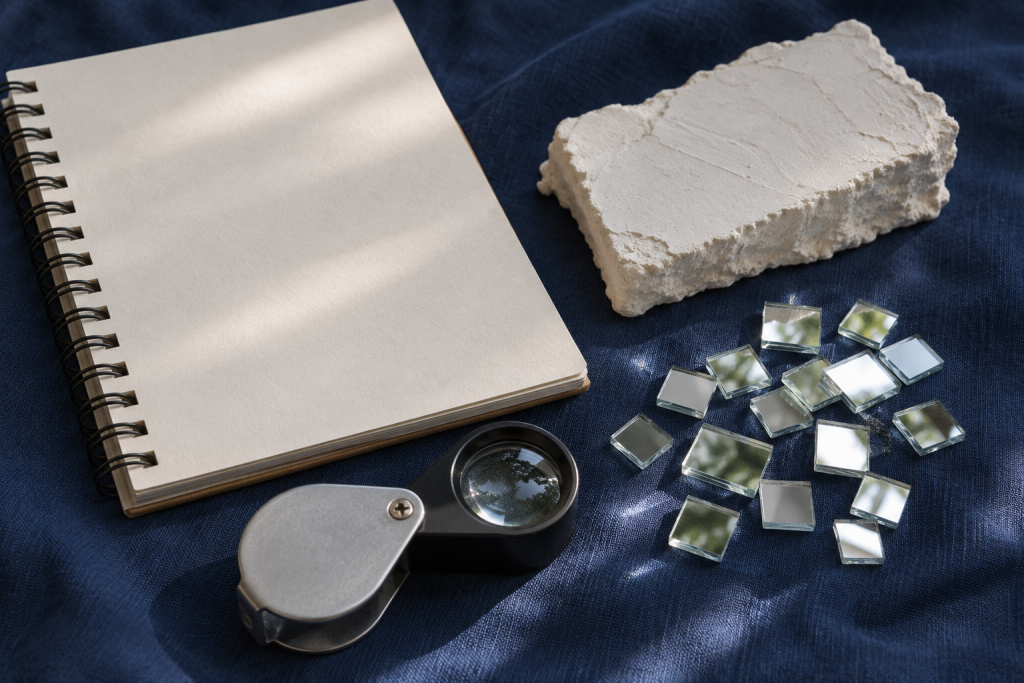
For a hypothetical short visit, divide a notebook page into material, light and evidence. Under material, record one feature that a reliable explanation identifies. Under light, note how a reflection changes when you shift within the permitted area. Under evidence, write whether the associated date refers to construction, a later decorative layer or conservation. This is a suggested exercise, not a report of an observed tour.
A family can simplify it: find one repeating pattern, identify one non-mirror material and ask one question about how the ceiling is protected. Keep the group from blocking other visitors while discussing the answers. Never use flash, extra lighting or tripods without permission, and do not lean equipment against a historic surface. The aim is to look carefully with the available light and respectful viewing distance, rather than trying to stage a spectacular effect.
Carry the distinction between building, decoration and care home
A useful account of Sheesh Mahal holds three histories together: Shah Jahan’s building campaign, later layers of use and decoration, and continuing work to keep the inherited structure stable. This is more accurate than presenting the room as a perfectly untouched survival or dismissing every later change. The attraction’s richness lies partly in that accumulated history.
Lahore Fort is part of the World Heritage property inscribed with Shalamar Gardens. Sheesh Mahal belongs within the fort rather than being a separate World Heritage inscription. When sharing a visit, label photographs of the actual hall distinctly from nearby pavilions and gates. Date any practical advice, identify restrictions you encountered and avoid turning one day’s arrangements into permanent promises. The strongest memory may be one carefully understood detail and a clearer sense of how craftsmanship, light and conservation depend on each other.
Frequently Asked Questions
When was Sheesh Mahal built?
UNESCO and the conservation project account date Shah Jahan’s building to 1631–32. Visible decorative layers and later repairs require separate dating.
Is all the mirror work Mughal?
The conservation account discusses later interventions and substantial Sikh-period presence. Do not assign every visible surface to the construction date.
Can visitors touch or illuminate the mirrors?
Follow site rules and barriers. Do not touch the decoration or introduce lighting equipment without permission.
Does fort admission guarantee access to the hall?
Confirm current arrangements and any separate ticket or conservation restriction with management before visiting.
How we know this
- Type Practical guide
- Sources 3 (1 official/academic)
- Reviewed November 2026
- Disputed points None
Rules and fees change, confirm with the official links below before you act.
3 sources
- Fort and Shalamar Gardens in Lahore, UNESCO World Heritage Centre
- Sheesh Mahal Restoration, Aga Khan Historic Cities Programme / Archnet
- Sheesh Mahal Attic Chamber, Walled City of Lahore Authority
Photo credits (3)
- Sheesh Mahal, Shahi Qila, Lahore (1).jpg, Faisalrazamalik, CC BY-SA 4.0, via Wikimedia Commons
- Alamgiri Gate - Main entrance to Lahore Fort.jpg, S.hassanjawad, CC BY-SA 3.0, via Wikimedia Commons
- Naulakha Pavilion in Lahore Fort.jpg, Jawad.hassan89, CC BY-SA 3.0, via Wikimedia Commons
