
Travel · Attractions
Look from the whole wall to a single panel
Read Lahore Fort’s exterior decoration through framed panels, ceramic surfaces and the documented stages of conservation.
- Read the details
- Plan the approach
- Respect the fabric
Picture Wall, Lahore Fort
Begin with the wall as an architectural composition
The Picture Wall is easy to treat as a long backdrop to Lahore Fort. Give it time as a designed surface instead. The authority dates its beginning to Jahangir’s reign in 1624–25 and completion to Shah Jahan in 1631–32. Two reigns are therefore part of the story before the first decorative detail is identified. Its relationship to the Shah Burj area connects a decorated boundary with the fort’s imperial spaces.
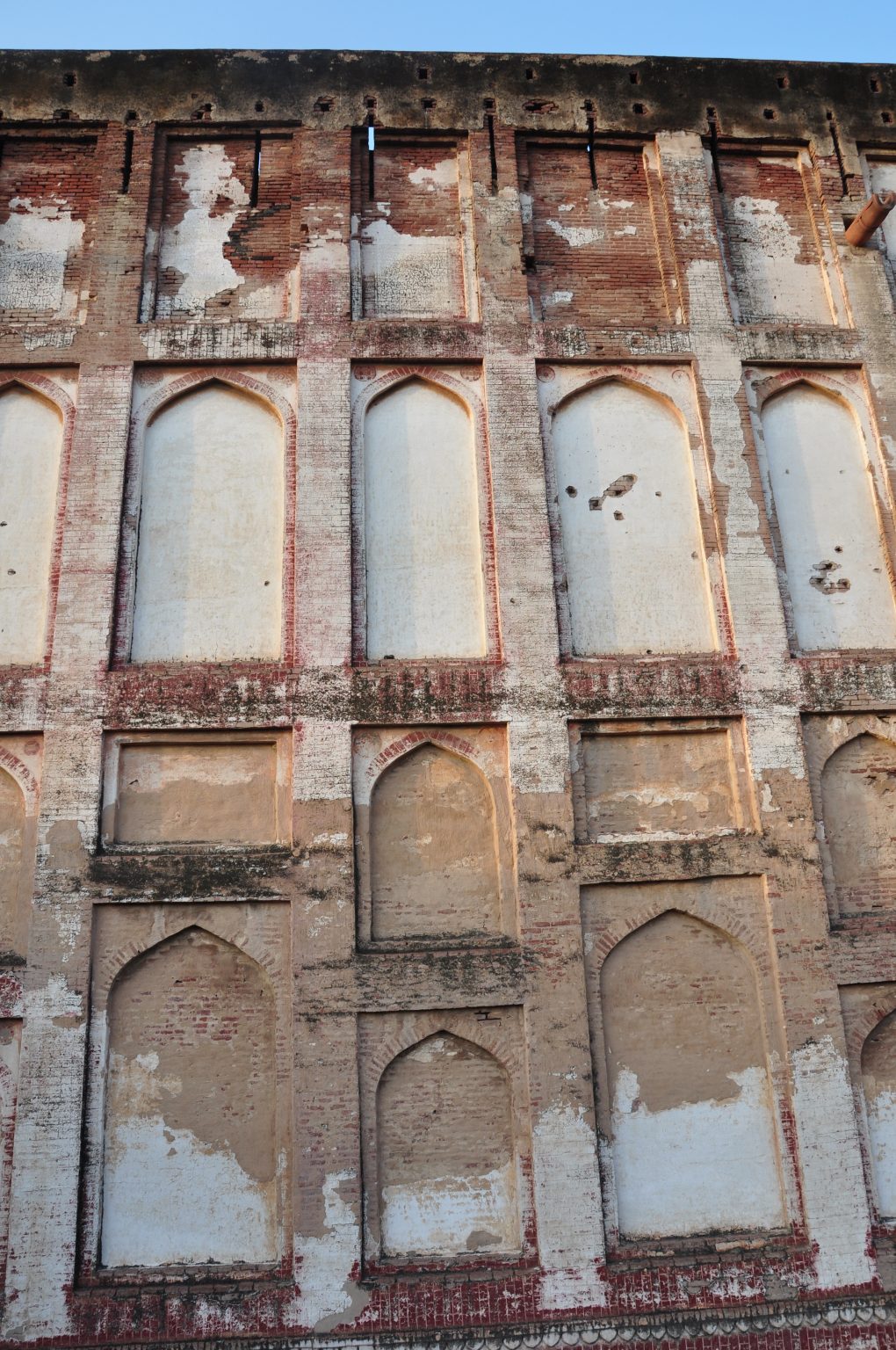
Start with a view that shows a substantial length of wall from a permitted standing area. Look for horizontal divisions, projecting features and recessed panels. These organise the imagery before individual colours or subjects become clear. Do not try to identify every scene at once. One broad view, one group of panels and one small detail provide a more useful sequence than a hurried series of close photographs without an architectural setting.
Treat dimensions as descriptions of particular sections
Published figures for this monument can refer to different extents. Archnet gives about 460 metres for the Picture Wall as a whole, while AKTC’s 2019 inauguration account describes conservation of a 240-foot western façade. These are not interchangeable measurements. A project announcement about one façade does not establish that work on the entire wall was completed on the same date.
The authority also describes decorated panels arranged over three levels. Use that as a prompt to notice organisation rather than a counting challenge. From the ground, some details will inevitably be too high or distant to resolve. A careful explanation should identify whether a number describes a wall, an intervention or a selected group of panels. This simple habit prevents impressive statistics from obscuring the more interesting fact that conservation was undertaken in documented stages with different scopes.
Read a panel’s frame before naming its subject
Choose one panel that can be seen clearly without approaching a barrier. First look at its outline and the border surrounding it. Then observe how shapes occupy the centre and how colour separates them from the ground. A figure, animal or plant may be apparent, but a confident identification of a particular narrative requires stronger evidence than a resemblance noticed from a distance.
Compare that panel with its neighbour. Ask whether the framing stays similar while the internal composition changes. This makes repetition and variation visible together. If using a camera, take an establishing photograph before zooming in, so the detail can later be located within the wall. Avoid labelling an uncertain form as a named ruler or a specific event. An honest description of a blue field, pale outline or branching motif is more useful than an attractive but unsupported story.
Keep tile, plaster and painted decoration distinct
AKTC’s project material identifies glazed tile mosaic alongside fresco and other decorative work. The wall is therefore more than a flat painted picture. Different techniques produce different edges, textures and relationships to the supporting masonry. On an accessible detail, notice whether colour appears divided into fitted pieces or carried across a continuous surface, while remembering that weathering and distance can make this hard to judge.
Kashikari is the term used in the conservation accounts for tile-mosaic work. Knowing the term helps visitors read project signs, but it does not replace close professional examination. Do not touch a surface to decide whether it is glazed, scrape a joint or wet a patch for a photograph. A dark area could have several explanations. Describe what is visible and leave technical diagnosis to the people responsible for investigating and conserving the material.
Understand what the 2019 conservation milestone covered
AKDN records the inauguration of the conserved western façade in May 2019. Its account says a prototype section preceded the main work and that an international workshop examined the approach. This matters because treatment was tested and discussed before extending across a larger surface. Conservation is a process of evidence and decisions, rather than simply making colours appear brighter.
A separate AKDN gallery describes minimal intervention and the involvement of artisans skilled in traditional construction alongside conservation training. Read that as the project’s stated approach, not a guarantee that every visible repair is original material. When comparing older and newer photographs, look for the documented location and date. Changes in lighting, camera angle and image processing can also alter apparent colour. Before-and-after imagery becomes more meaningful when it is tied to the precise part of the wall and the work recorded there.
Connect the wall with Shah Burj Gate
The Shah Burj Gate forms part of this decorated architectural setting. Archnet’s AKTC-sourced account dates the gateway to 1631–32 and records a separate restoration completed in March 2020. The project addressed tile mosaic and muqarnas, the layered vaulting inside the deep gateway. Its chronology demonstrates why a neighbouring element may have its own treatment history even when visitors experience the complex as one view.
Where the permitted route allows, compare a recessed wall panel with the depth of the gateway. Decoration has a different relationship to shadow on a flat enclosure and within a vaulted opening. Do not assume that a historic principal entrance is the entrance currently used for every visitor. Ask staff where the authorised observation route runs, particularly when conservation areas, excavations or event arrangements affect movement around the fort’s exterior.

Plan for distance, daylight and restricted viewpoints
This is an outdoor detail visit, so clear visibility and comfortable conditions matter. Check Lahore’s current air quality, weather and daylight before setting out. Bright overhead light may flatten relief, while a more oblique view can reveal recesses; neither observation justifies stepping off a permitted path. A compact binocular or camera zoom can make upper panels easier to study from a safe distance.
The fort’s official visitor information says the standard admission route may not be step-free and recommends arranging access needs in advance. Confirm the actual route to the wall with staff rather than extrapolating from a general accessibility statement. Ask about walking distance, level changes, rest opportunities and the return to transport. Keep drinking water and allow time to stop. The goal is to see a small amount clearly, not to cover the maximum frontage while tired or hurried.
Use an observation card rather than a reconstruction
Try this hypothetical exercise: draw three empty rectangles in a notebook, then use words or simple shapes to record one panel’s frame, dominant colours and visible surface divisions. Add a question mark wherever the subject is uncertain. Finally, make a separate note identifying which point came from an official source and which came from direct observation. No artistic skill is required.
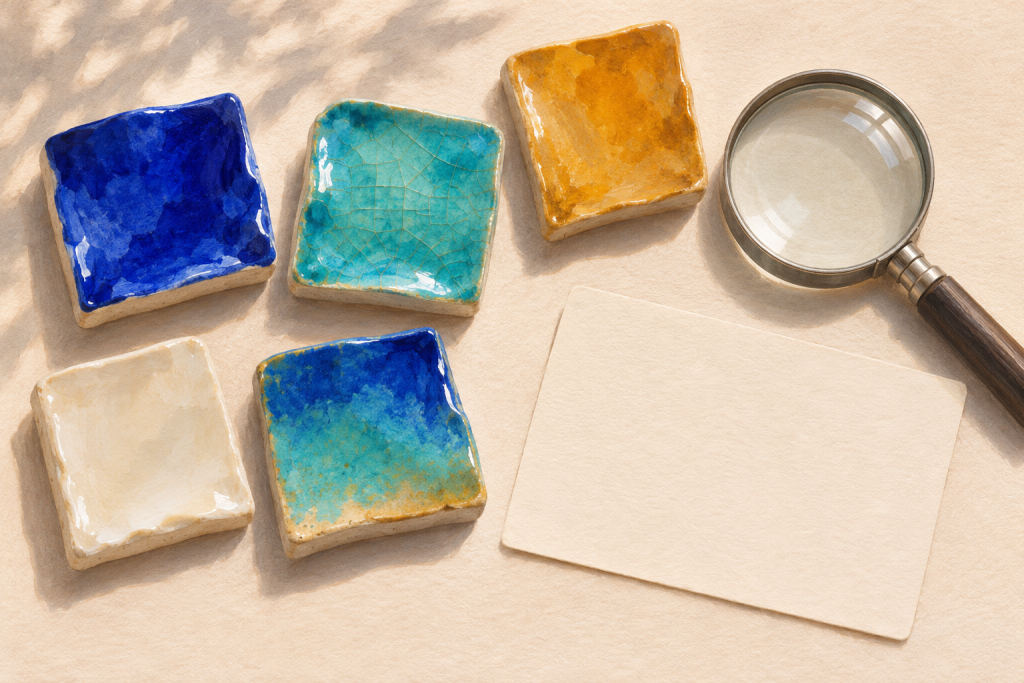
Loose modern glaze samples can illustrate the general idea of a ceramic surface in a classroom or at home. They cannot establish the historic wall’s recipes, pigments, firing methods or original colour balance. Do not bring props into contact with the monument or gather loose material from the ground. The accompanying illustration is a contemporary material arrangement, not a sample of the fort’s decoration. That distinction keeps an appealing educational image from becoming misleading evidence.
Leave the gaps in the record visible
The pleasure of the Picture Wall lies partly in the contrast between a vast composition and the small decisions embodied in its surfaces. A visitor can appreciate that relationship without claiming to decode every panel. Record one clearly observed feature, one documented conservation milestone and one question that remains unresolved. This creates a useful memory even if scaffolding or distance limits a particular view.
Lahore Fort belongs to the UNESCO-inscribed Fort and Shalamar Gardens property; the wall should be understood within that larger heritage context. Inscription does not certify that every section is accessible or that a conservation project has reached the same stage everywhere. When sharing an image, name the part shown if known and avoid presenting it as a condition survey of the entire monument. A modest, precise account does more justice to the wall’s complexity than an invented complete explanation.
Documentary photograph: Picture Wall (Lahore Fort) SQ185.jpg by Nadeem Abbas Mushtaq, CC BY-SA 3.0, via Wikimedia Commons. Display sizes may be scaled.
Frequently Asked Questions
Who commissioned the Picture Wall?
The authority dates its beginning to Jahangir’s reign in 1624–25 and completion under Shah Jahan in 1631–32.
Was the whole wall restored in 2019?
The 2019 inauguration account concerns the conserved western façade. Other sections and associated structures have separate project histories.
What is kashikari?
The conservation accounts use the term for tile-mosaic work. It is one of several decorative techniques discussed at the wall.
Can I get close enough to touch the tiles?
Use the authorised viewpoint and respect barriers. Touching is unnecessary and can harm sensitive material.
How we know this
- Type Practical guide
- Sources 6
- Reviewed November 2026
- Disputed points None
Rules and fees change, confirm with the official links below before you act.
6 sources
- Picture Wall, Punjab Walled Cities & Heritage Areas Authority
- Picture Wall Conservation, Archnet / Aga Khan Trust for Culture
- Inauguration of the historic Picture Wall of Lahore Fort, Aga Khan Development Network
- Restoration of the Walled City of Lahore, Punjab, Aga Khan Development Network
- Shah Burj Gate Restoration, Archnet / Aga Khan Trust for Culture
- Visit & Information, Lahore Fort / Walled City of Lahore Authority
Photo credits (2)
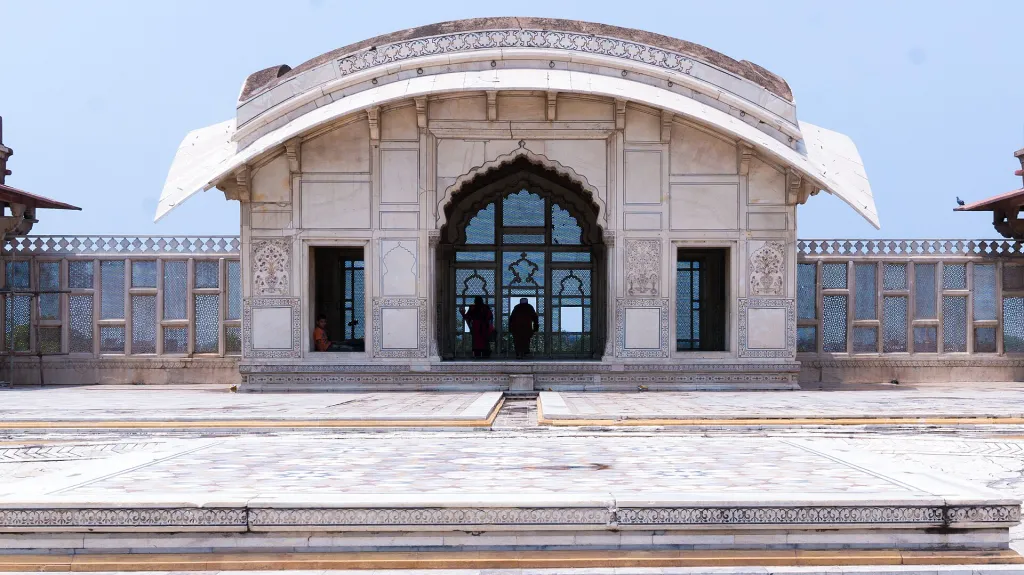
- Naulakha Pavilion in Lahore Fort.jpg, Jawad.hassan89, CC BY-SA 3.0, via Wikimedia Commons
- Alamgiri Gate - Main entrance to Lahore Fort.jpg, S.hassanjawad, CC BY-SA 3.0, via Wikimedia Commons

