
Travel · Attractions
Read a Samma tomb one band at a time
A close reading of Jam Nizamuddin’s stone tomb, its carved bands and mihrab, with the Samma setting and limits of stylistic interpretation kept in view.
- Read the details
- Plan the approach
- Respect the fabric
Makli, Thatta
Choose one building within Makli
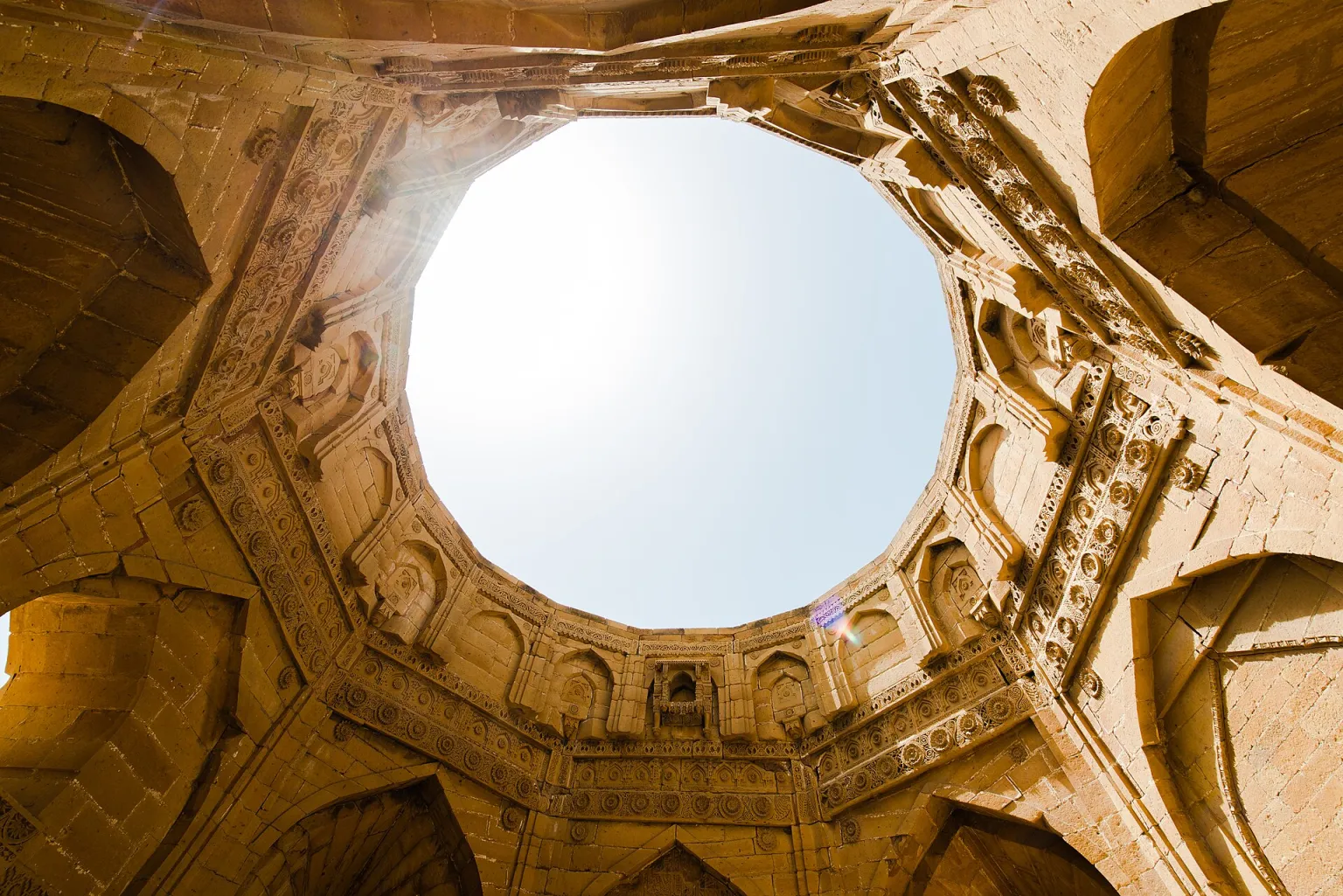
Jam Nizamuddin’s tomb rewards a visit measured in details rather than the number of monuments reached. Its stone walls carry bands, panels and small carved forms that are easily lost in a wide photograph. Begin where the whole chamber is visible, then choose one accessible elevation to examine from the visitor route. Let the square volume establish the building before individual motifs take over your attention.
This is a guide to that particular mausoleum, rather than a tour of the entire cemetery. Makli contains monuments from several periods, and a feature on one tomb cannot simply be transferred to its neighbour. Check the identifying sign or ask staff to confirm the building. The useful first question is straightforward: which parts belong to the chamber, which define its base, and where does decoration change scale?
Place the ruler in the Samma setting
The Sindh antiquities department identifies Jam Nizamuddin, also known as Jam Nindo, as a Samma ruler whose capital was Thatta. Its account gives his reign as 1461–1508. The federal archaeology entry dates the start of this tomb’s construction to 1509, a year after his death. Those records provide a manageable historical frame without requiring every carving to become a personal symbol of the ruler.
Makli’s UNESCO inscription concerns a much larger historic landscape. It does not mean all its tombs have identical dates, patrons or construction methods. Keep a short timeline in your notes: Samma patronage, the ruler’s lifetime, and the recorded beginning of the monument. That separation helps when a general cemetery guide moves rapidly between dynasties. A construction date also need not settle the date of every later repair.
Follow the horizontal carved bands
The provincial description draws attention to relief bands, lotus forms and arched panels with flower motifs. Use that vocabulary as an invitation to look, rather than a checklist that must be completed at any cost. Pick a band visible without leaning over graves. Follow how it continues around an angle or meets another panel, and notice whether its depth changes the shadow below it.
A useful observation compares a broad form with the finer cuts inside it. From farther away, a flower may read as a repeated circle; closer, the arrangement of petals becomes clearer. Stay within the permitted route and use optical zoom where necessary. Do not trace the carving with a finger or pencil. A rubbing would place pressure and material on a surface that visitors are there to preserve.
Look at the base and miniature forms
The official account also describes recessed panels at the base and miniature temple-spire forms at corners. These are especially useful details for understanding the building’s exchange of architectural ideas. Look for the relationship between the wall’s broad, comparatively flat areas and the more densely worked edges. A small carved form can give visual emphasis to a much larger mass without being a separate usable structure.
Avoid treating every recess as a blocked entrance. A door-like outline may be decorative, and its appearance alone cannot establish an earlier circulation route. Equally, a resemblance to a temple feature is an architectural comparison, not proof that this mausoleum was converted from a temple. Describing what is visible first keeps the distinction clear: shape, position and carving can be observed; a proposed previous building needs additional evidence.
Read the mihrab and inscriptions carefully
The provincial entry identifies a delicately carved mihrab and Arabic inscription bands inside. If entry is permitted, let staff indicate where visitors may stand. The mihrab is an orientation feature associated with the prayer direction; it is not a doorway into another room. Compare its concentrated carving with the bands seen outside, allowing your eyes to adjust before attempting a photograph.
An inscription deserves more than an improvised translation. Record a permitted photograph and seek a published reading if the wording matters to your interpretation. Do not assume every Arabic inscription is a foundation text naming a builder or date. Some are devotional. Where a surface is difficult to read, uncertainty is the accurate result. Flash, added lamps and close equipment placement also require permission, especially around fragile stone and other visitors.
Discuss shared craftsmanship without shortcuts
The department compares the tomb’s carving with work in Gujarat and uses religious labels for several motifs. Those comparisons are part of its interpretation. A careful visitor can acknowledge related forms while avoiding a claim that one motif identifies the religion of an individual mason. Workshops, patrons and visual traditions interacted in ways that a flower or bird alone cannot fully explain.
Try describing a panel twice. First use neutral visual terms such as interlaced lettering, curved stem or repeated petal. Then note the comparison offered by the official account. This two-stage description is a suggested exercise, not a historical reconstruction. It allows you to appreciate connections without turning resemblance into a documented journey by a particular craftsperson. The strength of the tomb is in the combination visible on the building itself.
Notice survival and repair without diagnosing
Makli is a conserved archaeological landscape, and looking closely should include the condition of its materials. From a permitted distance, notice whether edges are sharp or softened, whether joints interrupt a band, and whether some surfaces differ in colour. These are observations to record, not enough evidence to date a repair or identify its mortar. A recent-looking patch may have a longer history than it suggests.
The UNESCO property record discusses conservation needs across the wider cemetery. It should not be used as a live engineering report for this chamber. Respect temporary barriers even if an older photograph shows people inside them. Do not move loose stones to improve an image, remove vegetation, apply water to make relief stand out or collect fragments. Each apparently small intervention can alter evidence or worsen a vulnerable surface.
Plan for the ridge and the actual permitted route
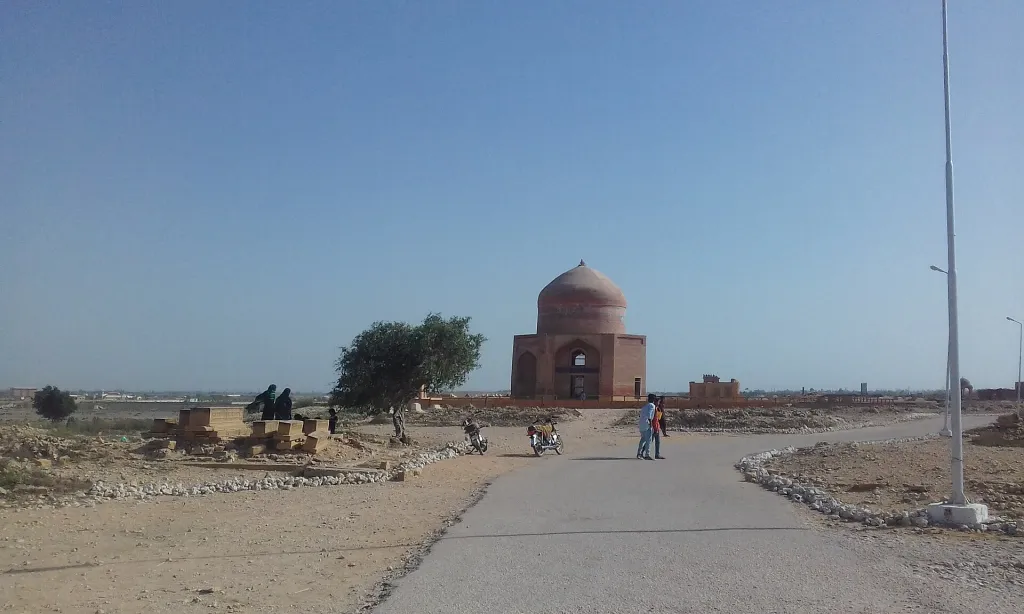
Makli is near Thatta in southern Sindh. A building-focused visit still involves an outdoor cemetery landscape, so arrange transport to the authorised visitor approach and ask how this particular tomb is reached. Confirm current hours, entry arrangements and any conservation closures directly with management. Published schedules do not guarantee access to the chamber or to every path on the day you arrive.
Cooler months generally make sustained outdoor observation easier than the hottest part of the year. Check the forecast, carry drinking water, use sun protection and wear footwear suitable for uneven ground. After rain, ask about the condition of the route rather than assuming a paved approach continues everywhere. Anyone who needs step-free access should describe their needs to staff in advance; a general statement that Makli is open does not establish an accessible route to this tomb.
Leave with a precise visual record
Keep the final record small enough to be accurate: one overall view, one base detail and one band or panel, where photography is allowed. Caption each with the building’s name and the feature actually shown. If a photograph includes a neighbouring monument, identify it separately. This avoids the common problem of attaching an attractive Makli detail to the wrong tomb when photographs are shared later.
Leave space in your notes for unresolved questions. You may have observed a change in stonework without knowing its cause, or recognised a flower without being able to name its type. That is a useful result. Treat the cemetery as a place of burial as well as an architectural site, keep noise low and give others room. The tomb’s Samma story becomes clearer through specific evidence, with uncertainty retained where the record does not resolve it.
Frequently Asked Questions
Is this the same as a general Makli tour?
No. This guide concentrates on Jam Nizamuddin’s square stone tomb and its carved surfaces within the larger Makli property.
When was the tomb begun?
The federal archaeology entry gives 1509, following the ruler’s death in 1508.
Do temple-like motifs prove an earlier temple stood here?
No. Stylistic resemblance by itself does not establish conversion or an earlier building on the same footprint.
Can I make a rubbing of the carvings?
Do not make rubbings or touch the relief. Use permitted photography and observation from the visitor route.
How we know this
- Type Practical guide
- Sources 3 (3 official/academic)
- Reviewed November 2026
- Disputed points None
Rules and fees change, confirm with the official links below before you act.
3 sources
- Jam Nizamuddin’s Tomb, Makli–Thatta, Directorate General of Antiquities and Archaeology, Government of Sindh
- Tomb of Jam Nizamuddin at Makli Hills, Department of Archaeology and Museums, Pakistan
- Historical Monuments at Makli, Thatta, UNESCO World Heritage Centre
Photo credits (2)
- Nizam al-Din Tomb, Makli Hill, Sindh..jpg, Asultan, CC BY-SA 3.0, via Wikimedia Commons
- Makli Necropolis near Thatta province of sindh pakistan.jpg, Nadirkhanbrahui, CC BY-SA 4.0, via Wikimedia Commons
